Northeast
Building Trump shooter used to fire shots at president was responsibility of local police: source

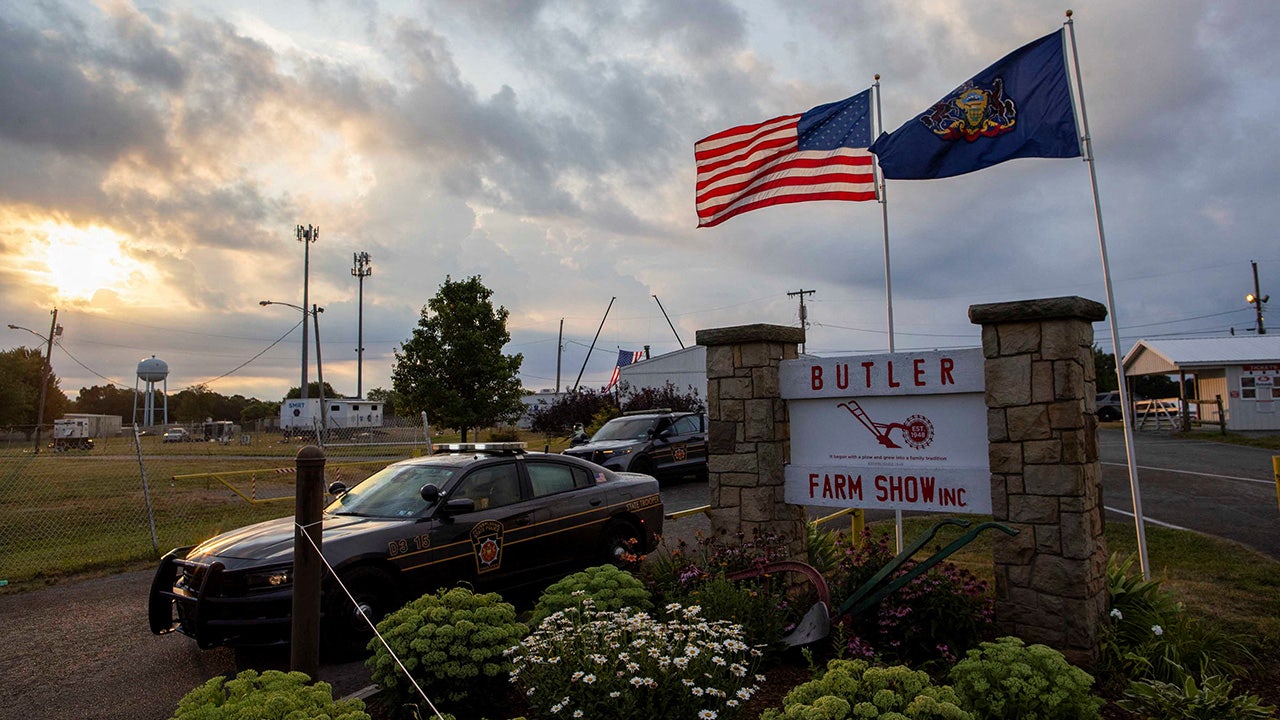
Local law enforcement had responsibility for the building where Thomas Matthew Crooks fired several shots at former President Trump on Saturday, Fox News has learned.
The building Crooks fired from was a “rally point” for one of the local counter sniper teams, according to a federal law enforcement official familiar with the security plans.
The source also said that a team was actually stationed in, or near, the building. There were four counter sniper teams at the Trump rally in Butler, Pennsylvania, on Saturday, including two from the Secret Service and two from local law enforcement.
The source also added that the Butler County Sheriff’s Department has confirmed that one officer climbed up onto the roof, saw Crooks armed with a rifle and retreated. Soon after that, Crooks began to fire, according to the source. Moments later, a Secret Service counter sniper fired on, and killed, Crooks.
LIVE UPDATES: TRUMP TO SOLDIER ON AT RNC AS SECRET SERVICE FACES GROWING SCRUTINY OVER ITS HISTORIC FAILURE
Former President Trump pumps his fist as Secret Service agents surround him after he was struck by a bullet at a campaign rally on Saturday in Butler, Pennsylvania. (AP Photo/Evan Vucci)
The Butler County Sheriff’s Department has declined to comment.
Trump had just begun speaking at a rally on Saturday evening when the gunman, later identified as Crooks, fired multiple shots toward the stage.
Authorities approach the suspected gunman, later identified as 20-year-old Thomas Matthew Crooks, from where he fell after the U.S. Secret Service returned fire after an apparent assassination attempt on former President Trump. (Obtained by Fox News Digital)
TRUMP BREAKS SILENCE ON ASSASSINATION ATTEMPT: ‘I’M NOT SUPPOSED TO BE HERE’
Trump was seen hitting the deck as Secret Service agents rushed the stage to surround the former president. Moments later, a bloodied Trump stood up and pumped his fist before the agents escorted him off the stage.
Police snipers return fire after shots were fired while Trump was speaking at a rally in Butler, Pennsylvania, on Saturday. (AP Photo/Gene J. Puskar)
CLICK TO GET THE FOX NEWS APP
At least one rally attendee was killed, and two spectators were critically injured, authorities said. The man killed was identified as 50-year-old Corey Comperatore, a former fire chief from the area.
Read the full article from Here

Pittsburg, PA
Overreactions to the Pittsburgh Steelers’ 2026 NFL Draft Class: Will Howard’s future, Omar Khan without Mike Tomlin, and more

The Pittsburgh Steelers had a 2026 NFL Draft that was, well, perplexing to put it nicely. There are a lot of ways to skin a cat when it comes to the draft process, and in three to four years, there’s a chance we look back on the class and the prevailing notion was dead wrong.
So today, we are going to name the three biggest overreactions to what the Steelers just did over the course of the weekend. Let’s jump in.
Overreaction No. 1: Max Iheanachor is another Broderick Jones
Look, if we want to reprimand what happened in the first round and the phone-gate debacle, that’s fine. But as Omar Khan said after the draft, the Steelers stuck true to their board and went with their highest rated player once Makai Lemon was poached by the Eagles.
Advertisement
And yes, Iheanachor is raw. Yes, he didn’t start playing football until very recently and was mostly a soccer player. But the truth is, there might not be a tackle with higher potential and a greater ceiling than Iheanachor.
The feet, the length, the traits, it’s all there. Sure, the Steelers will need to be patient, but this isn’t a player who is fundamentally flawed the way that Jones was. This is a player who you don’t have to fix; you have to build up. So it’s far too soon to write off Iheanachor.
Advertisement
Overreaction No.2: Mike McCarthy doesn’t like Will Howard
When the rhetoric coming out of Pittsburgh is always about how much the Steelers love Will Howard, and on day two, with their third pick in the draft, the Steelers take another quarterback that many view as a reach, it’s easy to see why some may believe that McCarthy doesn’t like Howard.
The truth is, McCarthy doesn’t know what he likes. He needs to see both Allar and Howard competing in a live environment before making any rash decisions. And when you don’t have an obvious quarterback of the future, taking as many shots as possible makes a lot of sense.
Advertisement
Overreaction No.3: Omar Khan was carried by Mike Tomlin
If you look at Omar Khan’s draft history since he took over for Kevin Colbert in 2023, you see draft classes littered with talent and starters. And honestly, just about every time it reached Sunday of draft weekend, the consensus view was that Khan and the Steelers nailed the draft.
Well, the only obvious difference in the decision-making process this year was no Mike Tomlin. And under Mike Tomlin, the Steelers were at every big-time Pro Day, the Senior Bowl, and well represented at the NFL Combine. A lot of that changed this year, but it doesn’t mean that Omar Khan wasn’t heavily involved, if not making picks, before.
We’ll see if the media and fans, or Khan and co., are right in 3-4 years.

On paper, Connecticut is economically thriving – jobs are at an all-time high with over 1.7 million positions in the state, as reported by the state Department of Labor (DOL). With over 5,000 jobs added for the month of January in various industries, as well as a projected surplus upwards of over $164.5 million for the Fiscal Year 2026, it’s a promising trajectory for our state and should demonstrate that Connecticut labor is as strong as it’s ever been.
But while it’s true that from an economic standpoint Connecticut is doing well, I look to our workers —our everyday people— to truly determine how successful we are at meeting our residents’ needs.
And right now, there are significant problems in our state that need to be addressed, from the well-known crisis in affordability to the seemingly intractable limits faced by many low-wage, hourly workers in scheduling and organizing that are so longstanding, they may seem invisible.
But there are also problems that thousands of Connecticut workers face that we can easily tackle in this session. At the top of that list is the issue faced by contracted workers, most of them building cleaners, who regularly lose good jobs without any fair reason or fair warning.
Throughout my life of advocating for safer, fair, and just workplaces, I am constantly met with the same recurring issue: new contractors who waltz in and completely usurp the status quo, terminating the jobs and upending the lives of workers who preceded them, no matter how long or how well they’d served the building’s occupants. Often, this happens once a building is sold or there is a transition in management, which results in the replacement of the building’s entire workforces.
The people whose lives are upended are often parents, spouses, and caretakers who have performed the job for decades, workers with unmatchable institutional knowledge. Such abrupt terminations can also result in a loss of health insurance and other benefits, a psychological shock that is worsened by the turbulence of war, tripling inflation, and Connecticut’s already high cost of living.
I’ve worked alongside several unions in Connecticut, as well as worked for a few myself prior to becoming state senator, and I have seen this shock issued by new contractors and building owners again and again. In 2024, I fought alongside 14 former custodians at ARKA group who were abruptly displaced when the company hired a nonunion contractor. It took over a year for many of these workers to get backpay for lost wages, and for some of them to return to their original postings.
I’m seeing this again in Norwalk with the most recent grievance being handled by building service worker union 32BJ, part of the Service Employees International Union. Elsa Guerrero and Corina Palacio, two part-time workers who were recently let go by a new cleaning contractor who took over at 40 Richards Avenue in Norwalk.
In the case of Elsa, in particular, the toll of losing her only source of income has been almost crippling. With her job, she was supporting a sister back home in Peru with a delicate health condition, and she is now left reeling, wondering how her sister will manage. For Corina, this was one of two part-time jobs she was working to make ends meet to support her and her child. However, with only one job now and daily expenses that keep adding up, the impact of her termination grows larger everyday.
These are the real costs of companies terminating employees abruptly when taking over a new worksite.
It is because of these situations that we’re urging the passage of effective, statewide worker’s retention laws in Connecticut, S.B. 358 and H.B. 5003. Both of these bills directly address this issue by protecting workers’ jobs for 90 days following a contractor change at their worksite, giving the worker time to find new work and the employer time to consider the value that worker brings to the worksite, without ending their right to ultimately hire whomever they choose.
As it currently stands in Connecticut, workers employed by building-service contractors have no legal right to keep their jobs if their owner decides to replace the workforce. With proper worker’s retention laws in place, workers are given some agency.
Connecticut would not be the first to establish such a framework; states like New Jersey, California, and Delaware share that honor. However, there has never been a more important time for a worker’s retention bill.
We have an obligation as lawmakers do all that’s possible to support workers like Elsa and Corina by giving them access to a resource whose value is often incalculable –- time.
State Sen. Julie Kushner of the 24th District is Deputy President Pro Tempore and represents Danbury and portions of New Fairfield and Ridgefield.
Maine
Maine budget includes $5 million for reproductive healthcare, UMaine PhD student explains shift from stalled bill – The Maine Campus
Maine legislators approved a budget on April 9 that is designed to protect family planning and reproductive healthcare, providing millions in annual funding for those services, according to a press release from Planned Parenthood. The budget is part of bill LD 335, sponsored by Rep. Amy Kuhn, which was left as unfinished business by the legislature. However, the bill has taken a new shape in the form of a budget amendment, which means that Maine is on track to become one of the first states to build an allowance for reproductive healthcare into the state budget.
If enacted, the budget amendment would provide $5 million annually for reproductive healthcare, regardless of federal spending decisions. This comes after the release of the Trump Administration’s budget plan for the 2027 fiscal year, which includes defunding access to birth control and abortions across the nation. According to News Center Maine, taxpayers would likely fill the gap to fund the budget if federal spending were to be reallocated.
Gianna DeJoy, a PhD candidate in anthropology and environmental policy at the University of Maine, provided written testimony for LD 335 before it became a budget amendment. She expanded on the purpose of the bill over email with the Maine Campus.
“My understanding is that LD 335 itself was reported out of committee but received no action from the full House or Senate, so it was left as unfinished business when the legislature adjourned last week. However, I believe an amendment based on that bill was included in the final supplemental budget,” wrote DeJoy.
She added that, despite the bill’s lack of final action, its core provisions were incorporated into the supplemental budget.
“So, the budget includes safety net funding for Title X providers, establishes a fund to maintain access to statewide family planning services and pledges $5 million to that fund, which is exactly what LD 335 had aimed to do,” wrote DeJoy.
She noted that adding the bill to the budget was the most logical route, considering the controversial nature of the bill. She explained that legislators are more likely to vote favorably on a budget plan than on a bill of this type.
“It makes sense for the spirit of that bill to sort of find new life as a budget amendment since it was directing spending, and because it can be easier for some legislators to vote on controversial issues when they’re folded into a bigger budget package,” wrote DeJoy.
She also mentioned that the bill was publicly supported by various groups and professionals.
“I just know there was an incredibly wide range of voices that came out in support of the bill when it came up before committee — including LGBTQ advocacy groups, the Maine Coalition to End Domestic Violence, professional associations for pediatricians, nurses, obstetricians and gynecologists, public health professionals,” wrote DeJoy.
She added that if passed, the budget amendment is likely to benefit those who cannot afford reliable reproductive healthcare services.
“[The bill] just highlights how the services offered by Maine Family Planning and Planned Parenthood are critical to the health and wellbeing of many different populations,” wrote DeJoy. She added that a women’s health clinic “might be a lifeline for the community,” and particularly for people in “medically underserved” areas.
DeJoy emphasized the need for Maine’s continued support for reproductive healthcare in light of a “hostile and unpredictable federal stance” toward funding such causes.
“This action reaffirms Maine’s position as a safe haven for reproductive rights,” wrote DeJoy.
-

 San Diego, CA2 minutes ago
Morning Report: Senator Wants Redo on County Reforms
-

 Milwaukee, WI8 minutes ago
Sam Stair arrest is part of a bigger landlord issue, Milwaukee officials say
-

 Atlanta, GA14 minutes ago
San Jose roll on, Atlanta correct course & more from Matchday 10 | MLSSoccer.com
-

 Minneapolis, MN19 minutes ago
Minneapolis Police Chief’s Public Statements on Domestic Violence Cases Under Scrutiny After City Auditor Report
-

 Indianapolis, IN26 minutes ago
Colts draft grades: Indianapolis gets mixed reviews, to say the least
-

 Pittsburg, PA32 minutes ago
Overreactions to the Pittsburgh Steelers’ 2026 NFL Draft Class: Will Howard’s future, Omar Khan without Mike Tomlin, and more
-

 Augusta, GA38 minutes ago
Augusta Braves: Semipro football and community involvement for Augusta
-

 Washington, D.C44 minutes ago
DC Weather: Sunny and seasonable Monday before midweek rain chances