Business
Commentary: A judge labels RFK Jr.’s attack on transgender care ‘unlawful’ and an act of ‘cruelty’

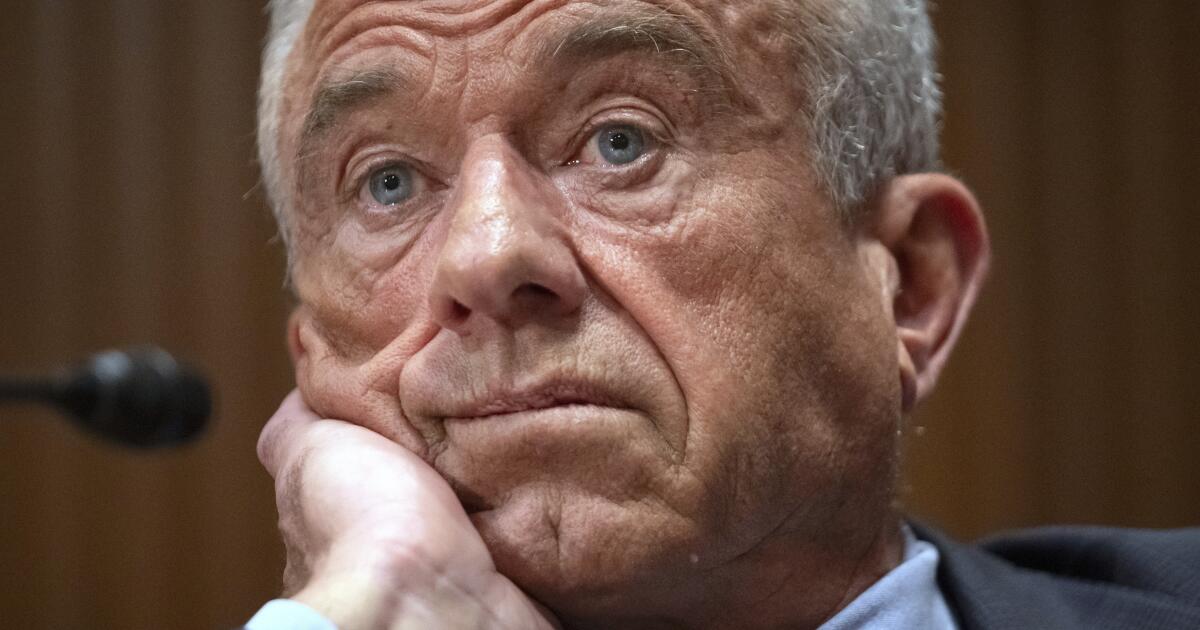
RFK Jr. threatened to block Medicaid payments to hospitals offering gender-affirming care to minors. This judge just invalidated Kennedy’s position.
The Trump administration’s attack on gender-affirming care for minors bears all the hallmarks of its approach to healthcare policy.
Although it purports to reflect rigorous science, it’s almost entirely fact-free — indeed, replete with misinformation and disinformation. It ignores the procedures required by law for issuing major policy directives, but relies on bluster and threats to force its targets to comply with its orders, trampling the rule of law. It claims to be concerned with protecting the health of patients, but it puts them at risk.
And it has experienced a sturdy pushback from judges.
You are between a rock and a hard place. The issue is how close is the rock and how close is the hard place.
— Superior Court Judge Matthew Braner, showing sympathy for hospitals in Trump’s anti-transgender crosshairs
The most recent example is a ruling Saturday from Federal Judge Mustafa T. Kasubhai of Eugene, Ore. Kasubhai summarily invalidated a Dec. 18 declaration issued by Health and Human Services Secretary Robert F. Kennedy Jr. purporting to find that gender-affirming care for minors falls below the standard of healthcare for hospitals and threatening to terminate Medicaid and Medicare funding for those that deliver it.
Kasubhai’s ruling came in a lawsuit brought by 19 states, including California, and the District of Columbia, challenging Kennedy’s declaration. His ruling ticked all the relevant boxes.
The case, he wrote, shows how “a leader’s wanton disregard for the rule of law causes very real harm to very real people… When a leader acts without authority and in the absence of the rule of law, he acts with cruelty.”
He rejected the government’s terminology for the therapies and treatments at issue — that these are “sex-rejecting procedures” — and stated he would use the term “gender-affirming care” instead, because “in this Court all people will be treated with dignity.”
He specified the harm confronting patients and their parents seeking such care after consulting with their physicians, noting that by Kennedy’s own estimate, more than 30 hospitals and hospital systems had ceased providing gender-affirming care to minors after Kennedy’s declaration was published.
Most of those institutions were reacting not to any change in healthcare law, but to Kennedy’s threat to exclude them from Medicaid and Medicare, a seldom-imposed penalty that could force some to shut down. Kennedy’s declaration confronted healthcare providers with “the Hobson’s Choice to either stop providing gender-affirming care for minors or risk the loss of critical funding necessary to operate at all.”
Although the law sets forth detailed procedures that must be followed before withdrawing Medicaid or Medicare funds, Kasubhai noted, Kennedy’s declaration aimed to circumvent all that: “Immediate compliance was demanded.”
And he took a swipe at the Trump administration’s “break it and see if they can get away with it” approach to the law, citing its “repeated flouting of court orders and the rule of law.”
As Kasubhai observed, despite its legal feebleness, Kennedy’s declaration and its explicit threat has had a concrete impact on the provision of gender-affirming services to American youths. Numerous hospitals terminated or limited their services out of fear of devastating financial consequences if the government followed through.
Some hospitals, however, reversed course under pressure from patients’ families or court orders. Among them were Children’s Hospital-San Diego and Children’s Hospital of Orange County, which are both affiliated with Rady Children’s Health. But Superior Court Judge Matthew Braner of San Diego ordered the programs to continue at least until a court hearing next month.
At an earlier hearing, a Rady lawyer told Braner that the system was at “catastrophic risk” of losing its funding if the government pursued its campaign. Braner said he recognized that due to the government’s threat to Rady “you are between a rock and a hard place,” but questioned whether the threat was imminent: “The issue is how close is the rock and how close is the hard place.”
Kennedy’s declaration has roiled gender-affirming programs nationwide. Children’s Hospital Colorado suspended those services in January; that decision was upheld by a state judge, but the Colorado Supreme Court is pondering whether to order the services to resume.
Some providers suspended or terminated their services even before Kennedy’s Dec. 18 declaration, but after President Trump issued an executive order on Jan. 28, 2025, charging that medical professionals are “maiming and sterilizing a growing number of impressionable children under the radical and false claim that adults can change a child’s sex through a series of irreversible medical interventions.”
Trump ordered government agencies to investigate such services provided by recipients of federal funds. He specifically ordered Health and Human Services to look into whether Medicaid and Medicare rules could be deployed against those providing the services.
Trump’s order seemed to be an outgrowth of what I called a “deranged and despicable” claim he uttered during his presidential campaign that schoolchildren were being abducted by school authorities and subjected to gender surgery. This was a product, I wrote, of “Trump’s fantasyland”: No such incidents are known to exist.
More than 20 hospitals and health systems rolled back or suspended their transgender services for minors after Trump’s order. Among them was Children’s Hospital of Los Angeles, which entirely terminated all its gender affirming services for minors in July and remains the only major California institution to have done so.
The government’s threats, Children’s Hospital executives wrote in a staff email announcing the closure of its gender-affirmation clinic in June, are “no longer theoretical”; they are “threatening our ability to serve the hundreds of thousands of patients who depend on CHLA for lifesaving care.”
Some institutions have tread a narrow path around the threats from Trump and Kennedy. The executive order and Kennedy declaration both define gender-affirming care as the use of puberty blockers, hormone treatment, and surgery. Kaiser Permanente and Stanford Medicine, among other providers, have said they would cease surgical interventions for minors but continue the other therapies, knowing that gender-affirming surgical operations on minors are almost never performed.
Kaiser told me through a spokesman that it continues to provide gender-affirming care “aligned with state law and the applicable standards of care, and tailored to meet the needs of each patient.”
According to a 2024 study by researchers at Brown and Harvard of some 23 million insured minors, the prevalence of surgery among those aged 15 to 17 was 2.1 per 100,000 patients, or about 2 thousandths of a percent, 0.1 per 100,000 among those aged 13 or 14, and zero among those 12 or younger.
The statistics indicate that “concerns around high rates of gender-affirming surgery use, specifically among [transgender] minors, may be unwarranted,” the researchers concluded, adding that the low rate “likely reflects adherence to stringent standards of gender-affirming care” in the medical profession.
The threat to drive providers of gender-affirming care for minors out of government healthcare programs isn’t the only weapon the Trump administration has deployed. The Department of Justice issued subpoenas last year to more than 20 doctors and clinics, seeking evidence of healthcare fraud and other legal offenses. The targets, according to then-Atty. Gen. Pam Bondi, were “medical professionals and organizations that mutilated children in the service of a warped ideology.”
At least four federal judges blocked some of those subpoenas as flagrantly illicit overreach. Two questioned the DOJ’s integrity, with one warning that a federal official’s inaccurate declaration could be interpreted as perjury. Another implied that a DOJ filing in his courtroom might have reflected “deliberate misuse … of court procedure.”
In January, the DOJ backed away from its demand for medical records that identify young patients who received gender-affirming care from CHLA; its action was part of a settlement with parents of transgender minors who feared that the subpoenas could be used to bring criminal charges against the parents of transgender children.
The campaign to undermine transgender treatments is sure to continue, in part because Republicans see transgender rights as a potent wedge issue to keep conservatives in their camp. They have a friend in the Supreme Court, which last year blessed a Tennessee law that banned puberty blockers and hormone treatments for minors experiencing gender dysphoria.
The 6-3 ruling drew a ringing dissent from Justice Sonia Sotomayor, who wrote that the court thereby “abandons transgender children and their parents to political whims.” With those words, she defined the Trump administration’s approach to healthcare in a nutshell.


A landmarked downtown Los Angeles apartment building designed by famed Los Angeles architect John Parkinson is on the market as its owners face foreclosure.
Residences in the Metropolitan, a 10-story tower built in 1913, are nearly filled with tenants but its ground floor retail spaces on Broadway and 5th Street are unoccupied, as are other street-level stores in downtown’s Historic Core.
The historic building was once considered one of the best in the city and is owned by the Fallas family, which operated a chain of value-priced clothing stores based in Gardena including one called Fallas Paredes in the Metropolitan.
Fallas-Paredes at 449 S. Broadway, Los Angeles, CA 90013.
(Google Maps)
Around 2011, Michael Fallas, who once worked in family’s downtown store as a stock boy, converted the upstairs floors from offices to apartments while continuing to operate Fallas Paredes. The store closed more than five years ago in the wake of a 2018 filing by its parent company for Chapter 11 bankruptcy protection.
Earlier this month in state Superior Court, a special servicer representing Fallas’ lender asked for a judicial foreclosure of the property, alleging that Fallas had stopped making payments on a $32 million loan dating to 2017. After leasing the property for years, Fallas bought the building in the 1990s.
Fallas didn’t respond to requests for comment.
The location of the Metropolitan where the buildings stands was hailed in a Times story in 1912, saying “it is regarded by many realty men as the most valuable piece of real estate in Los Angeles.”
The building today is recognized as a city historic-cultural monument because “Broadway became the commercial center of the Southland, a title it retained until well after World War II,” with its development, the city said. One of the architects who designed the Metropolitan in the Beaux-Arts style was John Parkinson, who is credited with designing such well-known local structures as City Hall, the Los Angeles Memorial Coliseum and Union Station.
Notable tenants in the Metropolitan have included the Los Angeles Public Library, Owl Drug Co., variety store J.J. Newberry and real estate company Janns Investment Co., which sold the land where UCLA is built and developed Westwood Village, among other Los Angeles neighborhoods.
In recent years, the buildings around the Metropolitan have struggled to keep retail tenants after a spurt of residential conversions of historic buildings starting in the early 2000s brought commerce to the neighborhood. Many downtown businesses have struggled since the pandemic reduced occupancy in offices downtown and reduced the flow of visitors.
“The lack of bodies on the street is generally hurting downtown, and that’s one of the reasons that has building has problems,” said downtown real estate broker Hal Bastian, who lives in the Historic Core.
There are close to 1,000 residential units in historic buildings at the intersection of Broadway and 5th Street, Bastian said, but all the ground floor stores are closed. Drug stores there suffered substantial losses from shoplifting he said, and now, “our challenge on Broadway is leasing.”
The 88 apartments in the Metropolitan are 91% rented, according to a listing for the property by the Zacuto Group, which also touts its roof deck with pool, fitness center and barbecue grills. No sale price is set.
Business
January 2025 wildfire victims seek tougher penalties against State Farm over claims handling

A fire survivors’ group announced Thursday it was seeking tougher penalties against State Farm over its handling of January 2025 wildfire claims.
The Every Fire Survivor’s Network said it was petitioning to join a state enforcement action announced this year against the company to make sure the case results in meaningful changes at California’s largest home insurer.
“We’re seeking a systematic review of all their claims and penalties calibrated to the actual scale of the harm — and we’re seeking the payouts that families are owed,” said Joy Chen, executive director of the group, at a Pacific Palisades news conference joined by victims of the fires.
The Department of Insurance in May filed an administrative action against State Farm General — the subsidiary of the giant Bloomington, Ill., insurer that handles California home insurance — after completing a “market conduct” exam.
The Jan. 7, 2025, fire damaged or destroyed more than 18,000 structures and killed 31 people.
State Farm has received more January 2025 claims than any other insurer — more than 13,700 auto and homeowners claims as of May 4, with payouts totaling $5.7 billion, according to the company.
The market conduct exam looked at 220 sample claims filed by the victims and found 398 violations of state law in about half of them.
Among other alleged violations, it found that the company failed in numerous cases to pursue a “thorough, fair and objective investigation” into claims, failed to come to “prompt, fair, and equitable settlements” and made settlement offers that were “unreasonably low.”
In announcing the action, Insurance Commissioner Ricardo Lara called the company’s claims handling “unacceptable” and said his department was taking “decisive action to hold them accountable.”
The state is seeking a “cease and desist” order to stop the insurer from engaging in unfair or deceptive practices.
It also has threatened to suspend State Farm’s license over the alleged violations, which each carry a penalty of up to $5,000 — or twice that figure if found to be willful. That could amount to a penalty of $2 million or more.
The threat to actually suspend State Farm’s license and its authority to write policies has been viewed skeptically by some, given its roughly 20% market share of the state’s home insurance market.
The company, which had an opportunity to include its responses in the exam report, denied fault in some cases and admitted fault in others. It often blamed problems on individual adjusters and denied systemic issues with its claims handling.
The petition filed by the wildfire survivor’s group criticizes the sample size of the market conduct exam as too small to capture all the alleged deficiencies in State Farm’s claims handling, which it claims are a “general business practice” of the company.
The group is seeking to conduct discovery, cross examine witnesses, present testimony from fire victims and bring more that 1,600 firsthand policyholder statements regarding State Farm’s practices into evidence, according to the petition.
It also wants State Farm to reopen cases in which claimants were paid too little, and it is seeking to participate in settlement discussions in order to increase any penalty State Farm would pay.
It calculated that a $2-million penalty would amount to a minute fraction of the assets of the State Farm Group.
“I submit to you that doesn’t defer bad conduct, it just allows you to continue to do it,” said Michelle Meyers, an attorney for Every Fire Survivor’s Network, at the news conference.
Consumer Watchdog, which has been a harsh critic of State Farm, also is providing legal support for victims’ effort.
Sevag Sarkissian, a spokesperson for State Farm, said the company was aware of the petition.
“We recognize that many wildfire survivors, including those that are State Farm General policyholders, continue to face difficult recovery challenges,” he said. “Our focus remains on helping customers recover.”
Michael Soller, a spokesperson for Lara, said the department is “acting with urgency to assist wildfire survivors in their ongoing recovery by investigating formal complaints filed by survivors and conducting the expedited market conduct exam that led to this enforcement action.”
He added that the department’s position is the state’s Administrative Procedure Act does not contemplate the commissioner or department staff authorizing intervention requests in the case.
He said that would be a hearing officer’s or administrative law judge’s decision when one is assigned to the case.
Meyers acknowledged the request was novel but said her reading of the law is that Lara can make the decision because no judge is yet assigned.
In response to the criticism, State Farm pledged earlier this year to improve its claims handling, including by providing single points of contact and improved communication so there are “fewer handoffs, fewer repeated explanations, and seamless support.”
It also named a new vice president of customer relations for State Farm General.

The state’s trial attorneys and Uber say they have reached a last-minute deal to scrap their dueling ballot measures and avert what was gearing up to be one of most expensive battles of the November election.
The deal, which comes a day after both measures qualified for the November ballot, has Uber agreeing to bulk up safety measures, while the trial attorneys will limit how much they can claim for lien-based medical treatment of victims who get in Uber or Lyft accidents, according to spokespeople for both sides of the campaign.
“Both sides agree: Californians deserve a system that’s safe, fair, and accountable,” read a joint statement from Uber and the Consumer Attorneys of California, a powerful attorney trade group. “This agreement protects patients from unnecessary treatment or getting overcharged, ensures access to medical care and legal representation, and strengthens safety measures.”
The agreement, finalized Thursday, means the ride-share giant will kill its ballot measure to cap how much attorneys can earn in vehicle collision cases and limit medical damages to rates based on insurance. Uber has argued that the costs for medical treatment done on a lien, which allows doctors to get paid from a cut of the plaintiff’s payout, far exceed what it would cost if the victim had used their own insurance.
In return, the Consumer Attorneys of California will cancel its competing ballot measure that sought to increase legal liability for ride-share companies if a passenger is sexually assaulted by a driver. The measure followed an investigation by the New York Times into sexual assault by drivers.
Both sides had poured tens of millions into the campaigns, plastering billboards across Los Angeles.
Lawyers claimed the fight had turned existential with the measure threatening to decimate the profit margin of many personal injury cases and leave drivers with small or thorny cases unable to find an attorney willing to take their case.
Spokespeople say the deal is predicated on their agreement being codified into a bill within the next week. Otherwise, they said, each side will move forward with its ballot measure.
-

 New York55 minutes ago
Video: Fans Show Up to the Parade in Their Best Knicks-Themed Attire
-

 Los Angeles, Ca1 hour ago
Victims sought after man allegedly points gun at passing cars in Santa Clarita Valley
-

 Detroit, MI1 hour ago
Best barbershop in Metro Detroit: Finalists for this year’s Vote 4 The Best
-

 San Francisco, CA2 hours ago
How to watch San Francisco Giants vs. Miami Marlins
-

 Dallas, TX2 hours ago
Drivers in North Texas struggle with Friday floods
-

 Miami, FL2 hours ago
Three wildfires burn more than 20,000 acres in Miami-Dade, force road closures
-

 Boston, MA2 hours ago
MBTA, state transportation chief apologizes for ‘insensitive’ employee hair-pulling incident
-

 Denver, CO2 hours ago
Man arrested on suspicion of murder in Denver shooting near South Park Hill, Hale

