Movie Reviews
Movie Review: ‘Mother Mary’ starring Anne Hathaway is full of itself, wastes talent with weak plot


Michaela Coel, left, and Anne Hathaway in the movie “Mother Mary.” Credit: Eric Zachanowich/A24 via TNS
The last time I heard Anne Hathaway sing was in 2012 when I saw her give the performance of a lifetime in “Les Misérables” as Fantine. I was eight years old.
Therefore, when I saw that Hathaway would be starring in a new musical drama — an A24 film, at that — with original music written by Jack Antonoff, Charli XCX and FKA Twigs, my 21-year-old self was intrigued.
In retrospect, I should have just re-watched “Les Mis.”
The film opens with mega-famous pop star Mother Mary, played by Hathaway, as she enters the stage of a packed stadium and performs to her adoring fans. Her wardrobe, sound, energy and overall aesthetic are reminiscent of Lady Gaga, and were, to me, obviously inspired by the well-known singer.
Viewers are then introduced to Sam Anselm — played by Michaela Coel — a clearly successful and respected British designer in her studio that also doubles as her home. Sam enters her bedroom from her studio and lies down. During the scene, viewers can hear Sam’s inner dialogue.
“I haven’t seen her in over 10 years, but I could tell she was coming from a thousand miles away,” Sam’s voice says as she falls in a fetal position on her bed.
Mother Mary, who is not referred to in any other way for the entirety of the film, then shows up to Sam’s studio as rain pours down in London, looking disgruntled, pale and generally unhappy — opposite of the Mother Mary we saw on stage a few scenes ago.
Mother Mary storms through Sam’s studio up to her bedroom as many of Sam’s assistants try to stop her, while also looking in shock as they realize they are in the presence of the iconic pop star.
After breaking through the assistants and storming into Sam’s room, the two have a conversation as Sam tries to get to the bottom of why Mother Mary is really there. In this scene, it is implied that Sam was once Mother Mary’s designer and the two shared a close bond, but that Mother Mary did something to destroy their relationship.
With tensions high in the room, Mother Mary reveals she needs a dress for a performance that is happening in three days. This isn’t just any performance, though — this is her first performance since “the incident.”
“The incident” is different from whatever occurred between Sam and Mother Mary. “The incident” happened after Sam and Mother Mary’s relationship ended, but Sam knows all about it, as it was all over social media. Whatever happened traumatized Mother Mary, and she has not performed since — until now.
After Mother Mary begs and pleads with Sam to make her a dress that “feels like her,” Sam begrudgingly agrees. Then the two get to work.
As Sam takes Mother Mary’s measurements, holds up different fabrics to the singer and tries to get a feel for what Mother Mary is looking for in a comeback dress, the layers start to peel back on what happened between the two of them, and what happened to Mother Mary in “the incident.” The film gives most of the context through flashbacks that appear in the design warehouse they are working in, in a very A24 fashion.
Through the two working together on the dress and also hashing out their issues from years past, it is finally revealed to viewers what happened between Sam and Mother Mary and also what happened to Mother Mary more recently in “the incident.”
The reasoning behind their relationship ending was anticlimactic, while the story of “the incident” was just ridiculous. When this information is revealed to viewers around three-quarters of the way through the film, it turns into a horror-style drama. As a fan of horror, this plot was just too silly to get on board with.
There was a lot of symbolism that felt on-the-nose, which was nice when you’re trying to catch on to deeper meanings, but the whole film felt very “fake deep” in that way. Similarly, Sam and Mother Mary pretty much only speak to each other in metaphors, which they even directly address at one point, but the dialog translates pretty cringe-worthy.
One thing to appreciate about the film was the tension between the two main characters. The feeling of betrayal from Sam left you wondering what happened between them — only to be unimpressed with the answer — and if their relationship went not only beyond designer and model, but also beyond friendship. It would have been interesting if the film explored their potentially romantic relationship in more depth.
The film also is very slow, creating boredom for the first part of the movie, and was still boring even when the plot picked up, because everything occurring was so confusing and unremarkable.
The film ends with an important breakthrough for Sam and Mother Mary, which honestly left me more perplexed than anything else. I wanted to be mind-blown by all of it, but it just came across as various creative swings and misses. The acting was so dramatic and exaggerated, which was impressive and enjoyable, but met with the lackluster plot, it made the film seem kind of full of itself.
On the note of acting, the acting was not an issue with the movie. Hathaway and Coel give great performances, and other notable actors including Hunter Schaefer and FKA Twigs give enjoyable performances as well. Paired with a better plot and better execution, this small cast would be unstoppable.
The original songs written for Mother Mary were also not half-bad, and fans of Antonoff, FKA Twigs and Charli XCX will likely enjoy the musical moments.
As someone who not only truly wanted to enjoy “Mother Mary,” but also someone who tends to love movies that leave me baffled, this one missed the mark.
Rating: 2/5



By and large, the zombie subgenre has bitten off more than it can chew in modern times. Between George Romero survival films and camp comedies, the well has become pretty infected. But once in a while, along comes a movie like This Is Not A Test.
Let’s sink our teeth into this new release and see how it stacks up against the classics.
The tone and tenor of this film represent the classic survival movies like Night Of The Living Dead. But the thing that grabs the audience about This Is Not A Test is the trauma of the characters. Holt shines as a withdrawn survivor of an abusive home, trying to cut through the wreckage to reunite with her sister. Each of the main characters have standout traits, and they bathe in strongly acted moments as the stress of the situation changes who they are.
The gore in This Is Not A Test is pretty strong. The attacks spring quickly and when they do, the special effects team does a good job showcasing the battle scars. The camera work is also frenetic in a good way, because the chaos of the chase scenes puts the viewers in a first-person perspective. This film lets you feel like a part of the survivors, so their journeys are interactive.

Longtime fans may say that there’s nothing new in This Is Not A Test, and maybe they’re right. There’s no fresh take on the monsters here, no crazy origin, nothing that we haven’t seen in the past fifty-eight years. But the pacing nails a great balance between getting to know the characters and getting the zombie splatter fest. The mental meltdowns of the characters feel well earned, and the arc of Sloane and her sister brings a lot of heart and investment to the story. Even the most jaded zombie horror fans will find something to appreciate here, even as a background movie.
Adam MacDonald has made another intense hit here, and This Is Not A Test is currently available to stream on Shudder.

- THE ODYSSEY
- Starring: Matt Damon, Tom Holland and Anne Hathaway
- Directed by: Christopher Nolan
- Rated: R
- Running time: 2 hrs 45 mins
- Universal
Our score: 4.5 out of 5
EPIC. If I was asked to describe Christopher Nolan’s latest film, that is the word I would use. He has mounted a film that rivals the greatest achievements of filmmakers like Cecil B. DeMille or David Lean. And, like the films of those mentioned, it’s runs a tad too long.
I was shocked, but pleased, to see that my 12-year-old granddaughter recently did a school paper on King Agamemnon. Thank goodness they’re still teaching History in our schools. Based on Homer’s “The Odyssey,” the film tells the story of King Odysseus (Damon) and his adventures which, if you’ve read “The Odyssey,” include the Trojan Horse, the Cyclops and assorted angry Greek gods. The film covers each of these adventures in great detail, sparing nothing in the production design department. While Odysseus is away – and he’s gone for a l-o-n-g time, his wife Penelope (Hathaway) has to endure a never ending string of “suitors,” men lining up in the hopes of replacing the King should he not return. The men are nothing more then scavengers, taking advantage of the law of Zeus, which decrees no one should be turned away. This angers the Queen’s son, Telemachus (Holland), who must control his temper when the men try to bait him into a fight, the idea being if Telemachus is killed, the new husband would become the King. It’s all very interesting and complicated. And long.
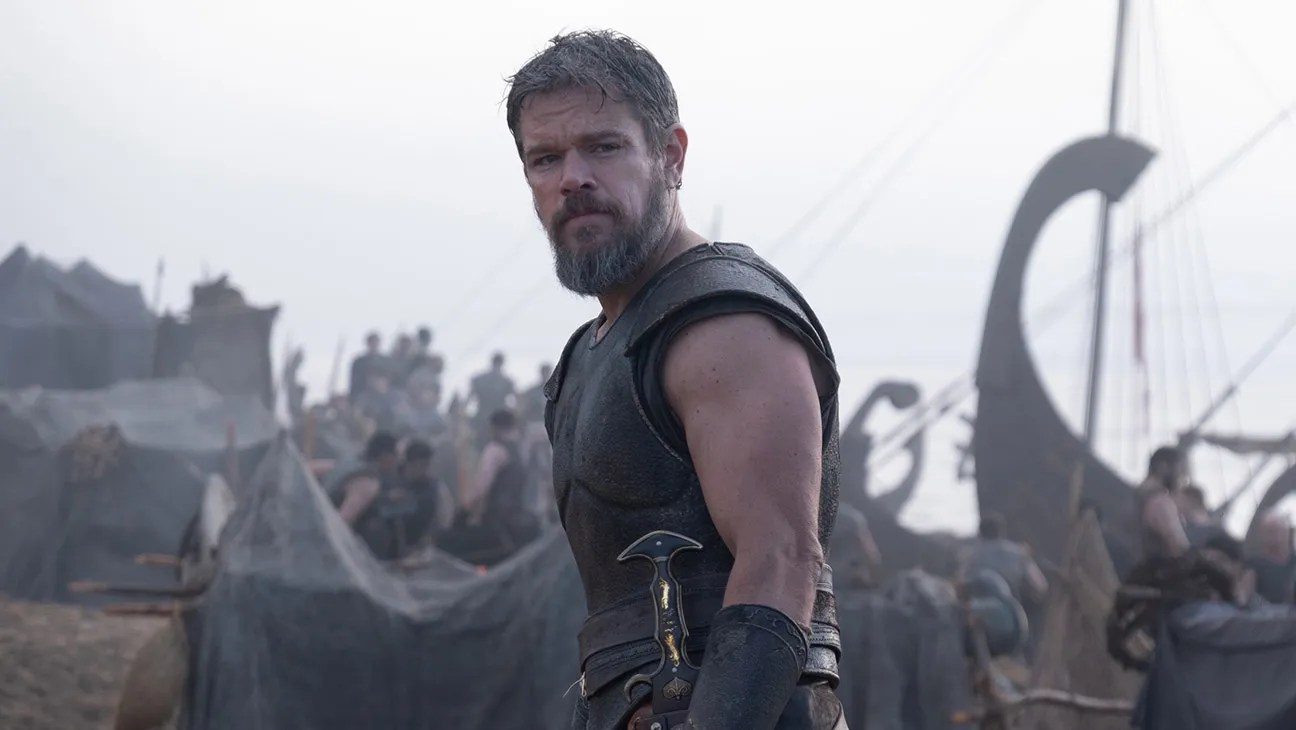
Director Nolan is one of the rare filmmakers who, in my opinion, has never made a bad film. From “Memento” to the “Dark Knight” trilogy to the Oscar-winning “Oppenheimer,” he has proven himself a true master of cinema. “The Odyssey” only adds to that distinguished resume’
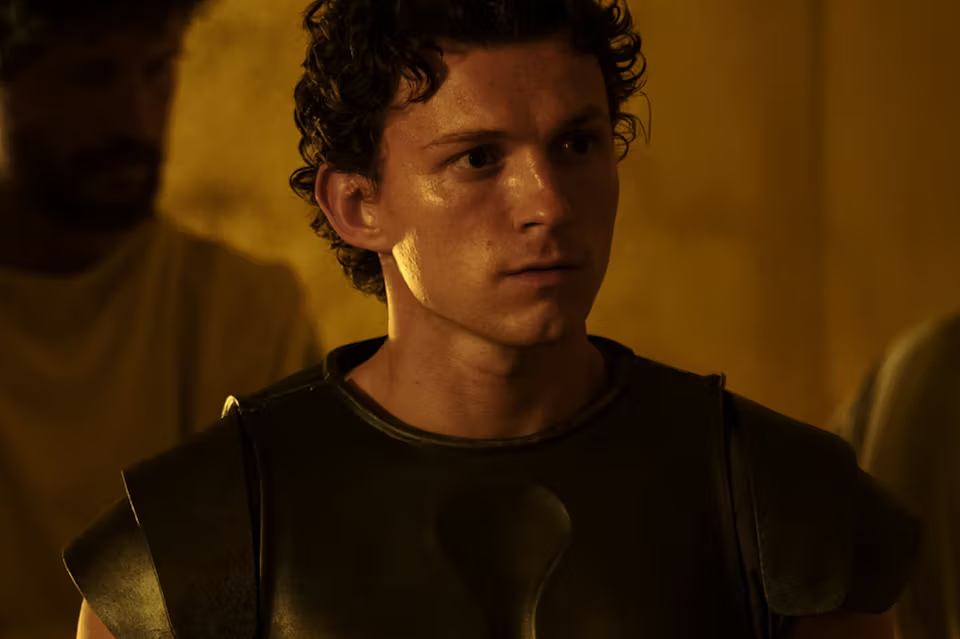
The cast is a tribute to Nolan himself who, like Woody Allen, can pretty much get anyone he wants for his films because, as an actor, why wouldn’t you want a credit in one of his films. Besides the three stars named above, the cast includes Robert Pattinson, John Leguizamo, Zendaya, James Remar, Jon Bernthal, Oscar nominees Samantha Morton and Elliot Page as well as Oscar winners Charlize Theron and Lupita Nyongo. As MGM used to advertise, “more stars than there are in heaven.”
The script and story are pretty faithful to the source material, though for some reason it bothered me whenever Telemacus referred to Odysseus as “dad.” Never father. The weird things you notice. Visual.y the film is stunning and the Trojan Horse and battle of Troy are worth the price of admission alone. I will add that I did see the film in 70 mm and, if that format is playing in your town, I urge you to see it in that format.
On a scale of zero to five, “The Odyssey” receives ★★★★ ½
Movie Reviews
Saari Review: Memory, Betrayal and Identity Converge at River Valley Film Festival – Hollywood Times


Premiering at the 2026 River Valley Film Festival, Saari uses fragmented memories, Finnish landscapes and restrained performances to explore betrayal, identity and reconciliation.
By Valerie Milano
Palm Springs, CA (The Hollywood Times) 7/14/26 – In the visually striking short film Saari—Finnish for “island”, a peaceful family retreat becomes the setting for the slow collapse of a relationship.
Co-written by Justin Seegmueller, Corey L’Esperance and Suvi Härkönen, the film follows Daniel, played by Seegmueller, as he reflects on the choices that damaged his relationship with Liina, portrayed by Ilona Karppanen. Told through fragments of the past, present and future, Saari gradually reveals how secrecy and betrayal can transform a place of safety into one of emotional confinement.
The nonlinear structure was not simply a stylistic choice. The project was developed and filmed over more than a decade, with footage captured in Finland, Boston and the desert. L’Esperance explained that the filmmakers divided the story into “past, present and future,” allowing audiences to experience the relationship from both characters’ perspectives.
Click below for our exclusive interview:
He described Daniel and Liina as two people who are “stuck in these moments in time,” making the fragmented narrative especially appropriate.
Seegmueller said Daniel’s internal struggle is rooted in the questions, “Am I that person? Am I still that person?” His restrained performance captures a man attempting to reconcile his current identity with the damage caused by earlier decisions.
For Seegmueller, the film is fundamentally about choice.
“It’s all about decision-making,” he said. “Are you an accumulation of all your decisions?”
Finland’s lush island scenery contrasts sharply with Daniel’s later isolation in the barren desert. Seegmueller described the progression as “lush and then dead,” a simple but effective visual representation of a relationship moving from intimacy and possibility to emotional aftermath.
For Liina, the island represents family history, comfort and security. By inviting Daniel there, she welcomes him into her sanctuary. His secrets, however, begin to contaminate that protected space.
“You let me into your life,” Seegmueller explained, “and now I’m here almost ruining your sense of security.”

 Because the couple reaches the island by rowboat, the setting also creates a sense of entrapment as suspicion and resentment begin to surface. L’Esperance noted that once they are there, “there’s not really anywhere you can go.”
The film’s cross-cultural perspective was strengthened by the collaboration between American co-director L’Esperance and Finnish co-director Härkönen. Their responsibilities shifted according to which character dominated a scene. L’Esperance generally led sequences centered on Daniel, while Härkönen took a stronger role when Liina’s experience was at the emotional forefront.
That approach helps prevent Liina from existing only as a reaction to Daniel’s behavior. Her journey eventually becomes more compelling than his guilt.
Karppanen traveled to the United States for the first time to film the Boston scenes, which were completed approximately three years after the original Finland footage. Seegmueller said the friendship they developed during production can be seen in the warmth between their characters during the relationship’s happier moments.
The filmmakers deliberately avoid explaining every detail of Daniel’s betrayal. Earlier edits revealed even less, but test audiences needed additional narrative guidance.
“We do need to have some breadcrumbs,” L’Esperance said, explaining that without them, the story became “a little too lost on the audience.”

 The challenge was to provide enough information while maintaining the film’s quiet, interpretive tone. L’Esperance said they wanted to leave room for viewers to “fill in some of the blanks.”
The lengthy production process also changed how the filmmakers viewed Daniel. L’Esperance acknowledged that they initially saw him as “this hero,” but over time recognized that “he is kind of a bad guy in some of these aspects.”
That evolving perspective gives the film greater moral complexity. Daniel is not granted an easy redemption, and his introspection does not erase the harm he caused.
Karppanen brings strength and emotional restraint to Liina, who emerges from the experience as what L’Esperance called “a completely different person.” A final city scene suggests that she is beginning to reclaim her identity and imagine a future beyond Daniel and the relationship that betrayed her.
Subtle, atmospheric and open to interpretation, Saari asks whether people are defined by their worst decisions, and what reconciliation means when the damage cannot simply be undone.
After more than 10 years of work, the film’s world premiere at the River Valley Film Festival is especially meaningful. Both L’Esperance and Seegmueller attended film school in Philadelphia, making the Pennsylvania premiere a return to the state where their filmmaking journeys began.

 Seegmueller hopes the film encourages audiences to examine their own choices and personal histories.
“What does that say about you?” he asked. “What does that say about your story and your own narrative?”
Saari will have its world premiere at the 2026 River Valley Film Festival. Seegmueller will attend the premiere in person, while members of L’Esperance’s family are expected to represent him at the festival.
-

 Los Angeles, Ca1 hour ago
Water main break floods West Hollywood streets, traps cars
-

 Detroit, MI2 hours ago
Detroit’s air quality early Thursday ranked as hazardous, worst in the world
-

 San Francisco, CA2 hours ago
‘It was a scene from the Titanic’: Fishermen recall rescuing passengers from sinking boat in SF Bay
-

 Dallas, TX2 hours ago
Big picture takeaways from the Dallas Mavericks first week at Summer League
-

 Miami, FL2 hours ago
“We’re going to be champions”. Argentina fans in Miami Beach celebrate team’s win against England
-

 Boston, MA2 hours ago
4 Red Sox Trade Targets to Solidify Boston’s Push for a Playoff Spot
-

 Denver, CO2 hours ago
RTD considers ending Denver’s 16th Street FreeRide shuttle due to budget issues
-

 Seattle, WA2 hours ago
Trump immediately fires the new court-appointed top prosecutor in Seattle | CNN Politics

