Michigan
Michigan Made: Xtended Threads


(CBS DETROIT) – For this week’s Michigan Made, CBS News Detroit’s Amyre Makupson introduces us to Xtended Threads.
Eva Toby took a life-long struggle and turned it into a triumph.
“I’ve been pretty much this height since I was like 12 or 13. I’m 6-foot-2, so it was just always a struggle. I mean, God bless my parents trying to find me clothes,” said Eva Toby, founder of Xtended Threads.
“One day, I was just so frustrated, and I saw this quote that said, ‘In the absence of resources, creativity is born,’ and that was kind of God’s way of like, ‘Remember that dream you had almost 16-plus years ago? Pick it back up.’ Then here we are today,” she said.
“I am my own brand, I am my own model, and you even see me on the website. Me and another young lady, and that’s another thing to kind of give people a different perspective,” Toby said.
As owner and designer of Xtended Threads, Toby created an athleisure line for tall women.
“The positive thing is that people were so excited for it. There was really a need. That’s what I tell people. I’m literally my own customer … just really feeling that gap and that need,” Toby said.
This is not to say that those longer in-seams and extra fabric didn’t come without a struggle.
“As a Black woman, the funding and the resources that are available, because we need the funding in order to grow the business, and purchase more inventory, and as we’re getting more feedback, and people are like, you should have this and that, and what about this? We need capital to get that started. That’s what I would say is one of the challenges in growing a business as a Black woman,” Toby said.
With faith and persistence, she prevailed.
“My faith is really what keeps me grounded, just really putting everything before God, asking for direction, and of course, with just the support of the growing community, it’s been really, really exciting,” Toby said.
And now, she’s defying those short-sided notions that cute stops a 5-foot-6.
“Our in-seams are longer. Sweatshirts that fit when it comes to length in the arms, which is a struggle,” Toby said.
With sought-after designs that show the sky is the limit.
“It’s a really good feeling … it was a lot of hard work in building it, you know, taking it from the idea of the idea that came back in 2022 to actually releasing it,” Toby said.




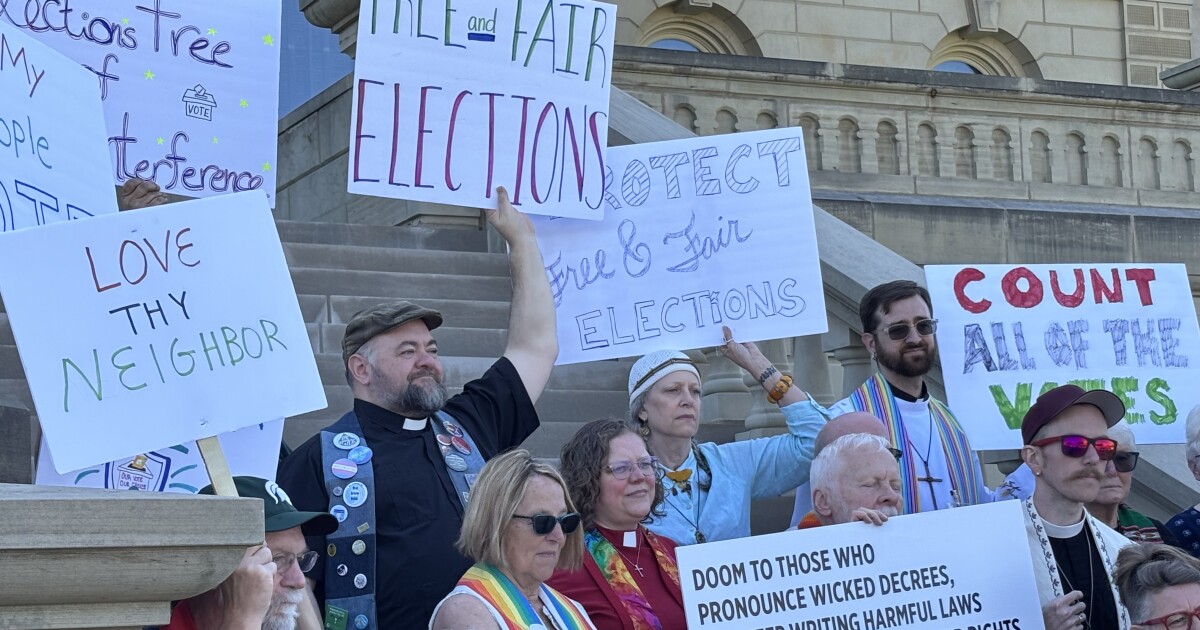
In Detroit, Grand Rapids and Lansing, religious leaders from many faiths gathered Tuesday to speak against what they described as efforts to intimidate and disenfranchise Michigan voters.
Speaking on the steps of the state Capitol building, Rev. Michael Young criticized the Trump administration’s actions leading up to this year’s midterm elections.
“We’re alarmed at the federal government’s attempts to interfere with election administration, efforts that suppress the vote, intimidate voters, limit access to the ballot box and shut eligible voters out of the process,” Young said.
The pastors are especially concerned about the U.S. Justice Department’s plans to send election observers to three Michigan cities to monitor the August primary.
Published reports indicate the monitors would be sent to Detroit, Lansing and East Lansing, communities with traditionally large Democratic voter turnout.
“Sending federal election observers to Michigan; they are not coming to protect the vote,” said Rev. Rudra Dundzila of Brighton. “They are coming to intimidate the voters and disrupt the vote.”
The religious leaders are also concerned about a proposed constitutional amendment that may appear on the November ballot in Michigan. The proposed amendment would require citizenship verification to vote in Michigan elections.

Abdul El-Sayed is leading in the polls ahead of Michigan’s Aug. 4 Senate primary. If he wins the nomination, Democrats will learn fast whether his politics can win a battleground state.

Senate hopeful Haley Stevens booed during Democratic convention
Representative Haley Stevens was met with boos while giving a speech at the Michigan Democratic Endorsement Convention in Detroit on Sunday, April 19.
In 2025, Elissa Slotkin, a Democratic U.S. senator from Michigan, observed the following about her political party: “We’re like a solar system with no sun. We don’t act as a team, and when we don’t work as a team, we turn our guns on each other, and it’s so, so, so, fruitless.”
Fast-forward to now, and the Democratic Party seems to be moving in a distinct direction: far left. Like, socialist left.
From New York to Colorado, newcomer democratic socialists have unseated sitting members of Congress.
But these victories, so far, have come in solidly leftist strongholds. What I’m watching closely is whether a far-left progressive can win in my state of Michigan, a battleground state that helped elect President Donald Trump in both 2016 and 2024.
The Democratic Senate primary here is Aug. 4, and it’s caught the attention of the country because control of the Senate could be decided in the Great Lakes State. Democratic Sen. Gary Peters isn’t running for reelection, giving Republicans a chance to win the seat back.
Democrats must flip four seats to take control of the chamber, and holding Michigan is essential to that math.
To the chagrin of more “moderate” Democrats, candidate Abdul El-Sayed – a former public health official who’s the darling of democratic socialists like Vermont Sen. Bernie Sanders – has done remarkably well in the polls, and he’s maintained a lead over more traditional opponents U.S. Rep. Haley Stevens and state Sen. Mallory McMorrow.
McMorrow suspended her campaign on July 5, first reported by The Detroit News, after weak polling numbers and likely pressure from Democratic Party insiders.
If El-Sayed pulls off a primary win, it could signal which sun the Democratic Party is heading toward.
What works in the primary may not play as well in the general
But El-Sayed may face bigger challenges if he makes it to the November election.
He’ll face off against Republican Mike Rogers, a former congressman who narrowly lost his 2024 Senate bid to Slotkin.
Michigan hasn’t elected a Republican to the Senate in more than 30 years. Yet while Slotkin is a Democrat through and through, she’s adept at appealing to independents and moderates.
That’s not true of El-Sayed, who has palled around with self-identified Marxist streamer Hasan Piker on the campaign trail, in addition to Sanders.
“El-Sayed joins the list of radical leftists running nationally that will also cause consternation amongst mainstream Democrats,” former Michigan Republican Party Chairman Saul Anuzis told me. “Slotkin has already raised the alarm bells and that probably indicates she’s hearing from her constituency, and El-Sayed will need them as well.”
Michigan could determine whether Republicans hold their Senate majority – and it’s the GOP’s best shot at flipping a seat outright.
El-Sayed may be able to rally more radical progressives and the anti-Israel base in the primary, but that message will be a tougher sell to Michigan voters as a whole. As Anuzis put it, El-Sayed’s strength in the primary is his weakness in the general.
“If he wins, then more mainstream Democrats, Reagan/Trump Democrats and culturally conservative, working-class independents will have to make a choice,” he said. “I think that greatly helps Rogers.”
Democratic leadership is shying away from El-Sayed. Will it matter?
Senate Democratic leader Chuck Schumer has openly backed Stevens, the sitting congresswoman, in the race. He and other Democrats clearly think she’s best suited to take on Rogers in November. Along those lines, ahead of McMorrow dropping out of the race, retiring Sen. Peters told associates that Democrats need to back one of the more mainstream candidates to oppose El-Sayed, according to The Wall Street Journal.
Still, El-Sayed has landed a coveted Michigan endorsement: that of the powerful United Auto Workers union, which praised the candidate for pushing forward “a strong working-class agenda with moral clarity.”
And while some believe that McMorrow exiting the race will boost Stevens, that’s far from a certainty. McMorrow notably did not throw her support behind one of the other contenders and her name will remain on the primary ballot.
Following Zohran Mamdani’s successful bid in 2025 for mayor of New York City, U.S. House Minority Leader Hakeem Jeffries said he didn’t think the democratic socialist represented the future of the Democratic Party.
With several more socialists recently winning seats in Congress, that looks a lot less certain.
Whether El-Sayed prevails in the primary, and then wins over Michigan voters in November, will be the biggest test yet of how far left Democrats are willing to go.
Ingrid Jacques is a columnist at USA TODAY. Contact her at ijacques@usatoday.com or on X, formerly Twitter: @Ingrid_Jacques

Detroit Economic Club: Kevin Guskiewicz Ph.D., J. Batt and Matt Elliott
Detroit Economic Club meeting with MSU President Kevin Guskiewicz Ph.D., Athletic Director J. Batt, and moderator Matt Elliott.
Weeks of waiting have paid off for Michigan State, to the tune of $2.5 million.
The reversal of President Kevin Guskiewicz’s decision to leave for Clemson means Kentucky will owe the full $5 million contract buyout for poaching athletic director J Batt last month. A clause in Batt’s contract had cut that buyout in half if Guskiewicz left before him, but Guskiewicz’s decision to stay after all leaves Kentucky with the full buyout.
Guskiewicz, 60, had accepted the presidency of Clemson University in South Carolina after two years on the job at Michigan State. Three weeks later, athletic director J Batt also took a new job at Kentucky, which will pay him nearly $3 million per year on a six-year term sheet signed June 17.
As of Monday, Michigan State’s athletic director position is still occupied by Batt, 44, whose departure date for Kentucky is still to be determined. It is still expected that Batt will depart for Kentucky, and with that Michigan State will still need to hire a new athletic director.
Monday afternoon, Kentucky President Eli Capilouto confirmed Batt will still leave Michigan State for Kentucky, posting a statement on X that, “J Batt and I spoke this afternoon and he has reinforced his commitment to UK and his excitement about joining the Big Blue Nation as soon as possible. We are working quickly to finalize his start date and his family is eager to join our community as well.”
However, Michigan State will embark on its athletic director search with a $5 million sum from Kentucky aiding its search.
Buyout sum opens up Michigan State’s options for AD hire
Michigan State made an aggressive move when it hired J Batt away from Georgia Tech. It signed him to a six-year, $12.6 million contract in June 2025 that ranked Batt in the top 10 nationally in base salary. Michigan State also paid his $2 million buyout at previous school Georgia Tech on top of that contract. Now, a little over a year later, Michigan State must repeat that process all over again.
Contractually, athletic directors are on the hook for liquidated buyouts, assessed as damages for ending a contract early. In practice, however, this is almost exclusively paid for by the hiring institution. Usually buyouts are scaled by contract length, with more expensive sums in the early years of a contract and cheaper costs to depart later on.
A $5 million buyout is on the high end of the spectrum, reflective of Batt’s departure early in the second contract year of his tenure.
If Michigan State wanted to poach Michigan’s Warde Manuel, for example, the cost would be twice his base salary, which amounts to $3.8 million. The latest contract for Western Michigan athletic director Dan Bartholomae lists a liquidated buyout of $5.1 million until 2027.
Gaining $5 million for Batt’s departure gives Michigan State with a strong sum to hire Batt’s replacement. If the school uses the whole sum toward a new candidate, it could have its pick of the litter, so to speak.
It could also choose to bank that money and hire someone outside of another university. It could look internally, particularly at executive deputy athletics director Jon Palumbo, who is the CEO of new fundraising arm Spartan Ventures. Or it could tap someone outside of the NCAA realm, such as former athletic director Mark Hollis, who has thrown his name in the ring. He resigned in 2018 after spending a decade as athletic director.
cearegood@detroitnews.com
@ConnorEaregood
-

 Alaska2 minutes ago
Alaska, Trump Administration Settle Biden-Era Oil, Gas Plan Case
-

 Arizona5 minutes ago
Man, woman found dead near Arizona-Utah border; suspect arrested
-

 Arkansas10 minutes ago
Sanders Appoints Steve Kueter to the Arkansas Game and Fish Commission • Arkansas Game & Fish Commission
-

 California17 minutes ago
California Film Tax Credits For ‘Shrek’, Disney & Ben Affleck Movies
-

 Colorado18 minutes ago
Colorado Peak Claims Another Life
-

 Connecticut25 minutes ago
Here’s How Much Rain Fell in Your Town
-

 Delaware32 minutes ago
Coastal Delaware Restaurant Week raises funds for local first responders – Milford LIVE! – Local Delaware News, Kent and Sussex Counties
-

 Florida35 minutes ago
US appeals court strikes down key part of Florida law restricting campus race and gender discussions

