Northeast
Fisherman whose boat was capsized by breaching whale speaks out: 'Was in fight or flight mode'

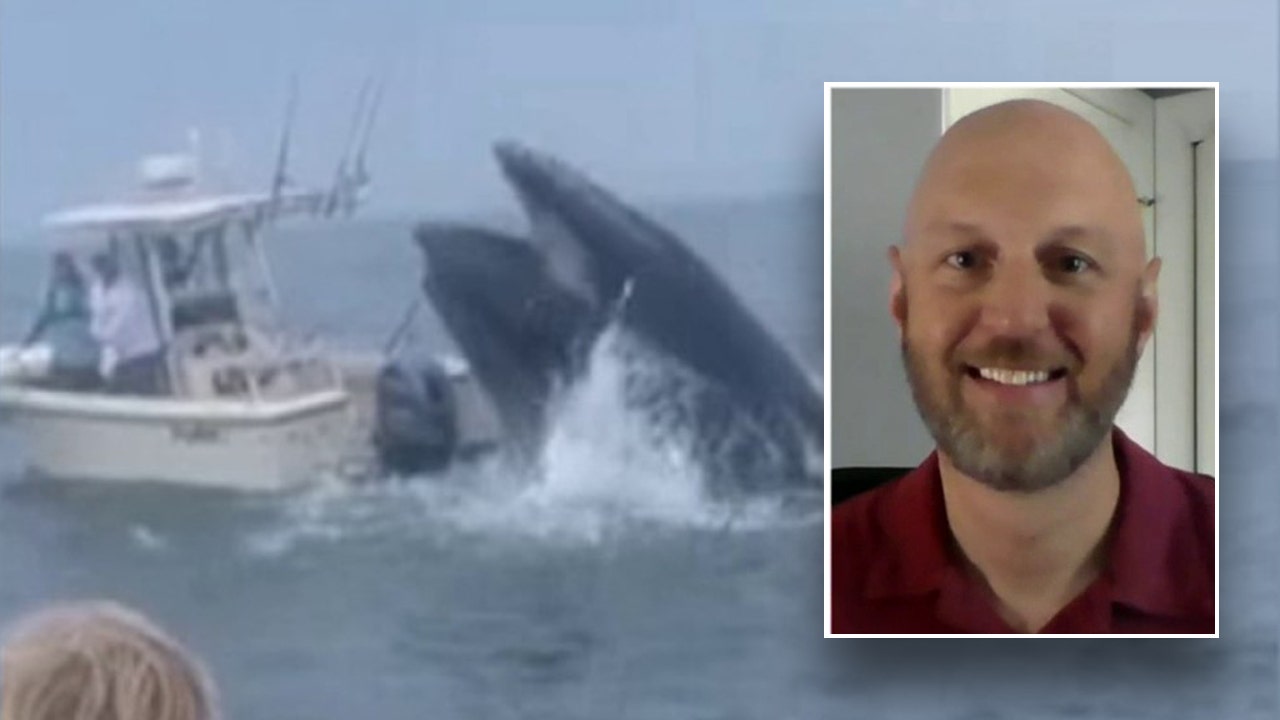
A New Hampshire fisherman whose boat was capsized by a breaching whale spoke out about the harrowing experience, detailing the moments leading up to and after the shocking incident caught on video.
Ryland Kenney, who was forced to jump in the water to avoid the whale, joined “America’s Newsroom” alongside one of the teens who helped rescue him, Colin Yager, to discuss his reaction to the incident and why he responded the way he did.
SHARKS TEST POSITIVE FOR COCAINE OFF BRAZIL’S COAST
“I was in fight or flight mode, so just trying to get off the boat as quickly as possible because I know it was going under once I heard the whale crunch the engine,” Kenney said on Friday. “So I just kind of jumped sideways, horizontally to get away from everything. When I hit the water… I was in kind of temperature shock because about 55 degrees, so it was really hard for me to catch my breath.”
“I couldn’t locate my friend Greg,” he continued. “He was actually underneath the boat at the time, and it felt like hours, but it was about maybe five seconds. I finally found him, so once we reunited, I felt a little more calm.”
Shocking video showed the whale breaching out of the water in Portsmouth Harbor on Tuesday morning and overturning the boat after it landed on the vessel.
Colin and his brother Wyatt were fishing on another boat in the harbor when the whale breached. After catching the moment on video, they rushed to help the distressed boaters, WMTW-TV reported.
MASSIVE HUMPBACK WHALE MYSTERIOUSLY WASHES UP ON BEACH
“It was just completely insane. I was just looking in the right direction, luckily, and I saw the whole thing happen, and I had my camera out, all ready to record whatever I saw, because I just wanted to record stuff,” Yager said. “I saw it start to go up, so I just pressed the record button and… the rest is on video.”
The U.S. Coast Guard confirmed that neither of the boaters were hurt, and the whale also appeared to be unharmed by the incident, according to WBTS-TV.
Whales are common in New Hampshire waters, especially between June and August, and a whale — possibly the one that breached over the boat — was seen in the same area before it happened.
Ironically, Kenney’s family asked him about the likelihood of something like this happening prior to the incident.
“I’ve actually taken pictures of the whale breaching, days before, and I had actually had a dinner with my family, and my family was asking me when I was showing them photos of the whale, ‘Aren’t you scared of the whale potentially knocking your… boat in the water?’ And I and I kind of said, ‘Oh, well, I’ve done a lot of research, and the probability of that happening is like lightning strikes,’” he said. “And of course lightning strikes the next day.”
Fox News’ Brie Stimson contributed to this report.
Read the full article from Here


VAN BUREN, Maine — Van Buren’s Acadian Village brought guests back centuries in time on Saturday as a blacksmith worked in his shop while others sewed quilts and prepared traditional French food.
It is northern Aroostook’s first large-scale immersion event. It coincides with the 50th anniversary of the Acadian Village. The village has seventeen buildings, with the oldest dating back to the 1790s, all of which are connected to early French heritage. The village is the second-largest of its kind in the United States.
The Saturday festivities cap off a “Living Acadia” (or “Acadie Vivante”) workshop that brought educators throughout the entire state together to learn about Maine’s French settlers and heritage. The workshop began Tuesday and ends on Sunday. Activities took place throughout the St. John Valley and included history lessons at the University of Maine at Fort Kent’s Acadian Archives, lectures on Acadian identity, French language lessons and cooking in a traditional outdoor bread oven.
Most of the workshop was specifically for instructors, but the Saturday immersion event was open to the general public.
Fort Fairfield French teacher Jonna Boure led the workshop’s activities. The immersion event at the Acadian was inspired by King’s Landing in Fredericton, which includes people acting out several historical roles. Boure has also worked at the Acadian Village for several years.
Boure, dressed in period clothing, said on Saturday morning after showing guests around the Roy House, the village’s oldest building, that everything was going fantastically. She also commended the work of Cindy Matthews, a Waterboro French teacher who also serves as vice president of the American Association of Teachers of French’s Maine chapter.
While Boure instigated the event, Matthews brought her prior experience with organizing institutes focused on studying Acadian history.
Matthews worked with Boure on creating the workshop. She ran the village’s post office during the event. Even the post office was tailored to accurately represent the experience of sending letters during the early days of French settlers. Guests could use hand stamps on their own postcards, and they would later be sent through the actual mail.
Some participants acted out roles based on historical figures and their heritage. Diane Michaud greeted guests in French as Evangeline, the protagonist in Henry Wadsworth Longfellow’s poem about a woman separated from her husband following the expulsion of Acadians in the 1700s. Michaud’s husband, Ron, was dressed as his ancestor Pierre Michaud, one of the first Acadians to come off the boat and settle in the Canadian village of Kamouraska.
At the blacksmith shop, Matt Grandy demonstrated how metal items were made using tools from the 19th century.
“The blacksmith was a very important person in town,” he said. “At the period of time when the Acadian Village was starting, basically everything that was metal would have come from the blacksmith shop – your door hinges, latches, the both on the inside of the odor, nails, different things in the kitchen, some of the pots and pans, and the irons in the fireplace.
The blacksmith’s shop, since nearly everyone had to go there at some point, was also a central community hub where people often met and even gossiped about what was happening in town.

“It was a good place for the exchange of information as well as the exchange of goods,” Grandy said.
People have already approached organizers about holding another event in the future, Matthews said, adding that part of the focus is emphasizing that French people, and the French language, is still alive in Maine.
“We want more people to know that there’s living French in our state, not just a historical thing that happened, but that there are still real people who speak French and that this is a place coming to and learning about,” Matthews said. “So, in terms of that, this has definitely been a success.”

Watch CBS News
New Hampshire
Concord Heights Abuse Of Corpse And Falsifying Evidence Case From May 2024 Inches Forward

Venus said after the hearing that Spataro remained in jail for bail jumping and fleeing to Connecticut, but he was not needed in court for the status conference.
A final pretrial hearing has been booked for Aug. 31, with jury selection to begin on Sept. 22.
Other Charges, Suspects
Along with the bail jumping felony, Spataro has seven felony acts, prohibited drug charges from February 2023 out of Concord — around the same time Meunier disappeared. He also has a subsequent drug possession charge from September 2024 in Hooksett. Those charges are also scheduled for a status conference on Aug. 31.
Jocelyn Cote, Spataro’s girlfriend at the time, was also charged with a felony accomplice evidence charge and an accomplice abuse of corpse charge. She was also arrested in January on a bail jumping charge and a bench warrant. The status of her cases is unknown at the time of publication.
A third person, Ryan Holton, also faces falsifying physical evidence and abuse of corpse charges. He had a status conference on June 10 and has a plea and sentencing hearing, with a capped plea, scheduled for Aug. 31.
-

 Louisiana1 minute ago
Louisiana State Games boxing comes to West Monroe
-

 Maine4 minutes ago
Educators bring Maine’s Acadian heritage to life
-

 Maryland9 minutes ago
Parents of former Maryland athlete killed in 2024 car crash start foundation in his honor
-

 Michigan16 minutes ago
Michigan State hockey breaks program record with nine NHL Draft picks
-

 Massachusetts19 minutes ago
Off-duty Massachusetts State Trooper seen on video punching another trooper at bar
-

 Minnesota31 minutes ago
How Minnesotans are coming together to support Venezuela after deadly earthquakes
-

 Mississippi34 minutes ago
McRae: Mississippi Firsts
-

 Missouri39 minutes ago
Children receive custom playhouses at Habitat for Humanity’s first-ever playhouse build event

