Northeast
Cousins arrested after bizarre incident involving possible pipe bomb, machete outside NYC police precinct

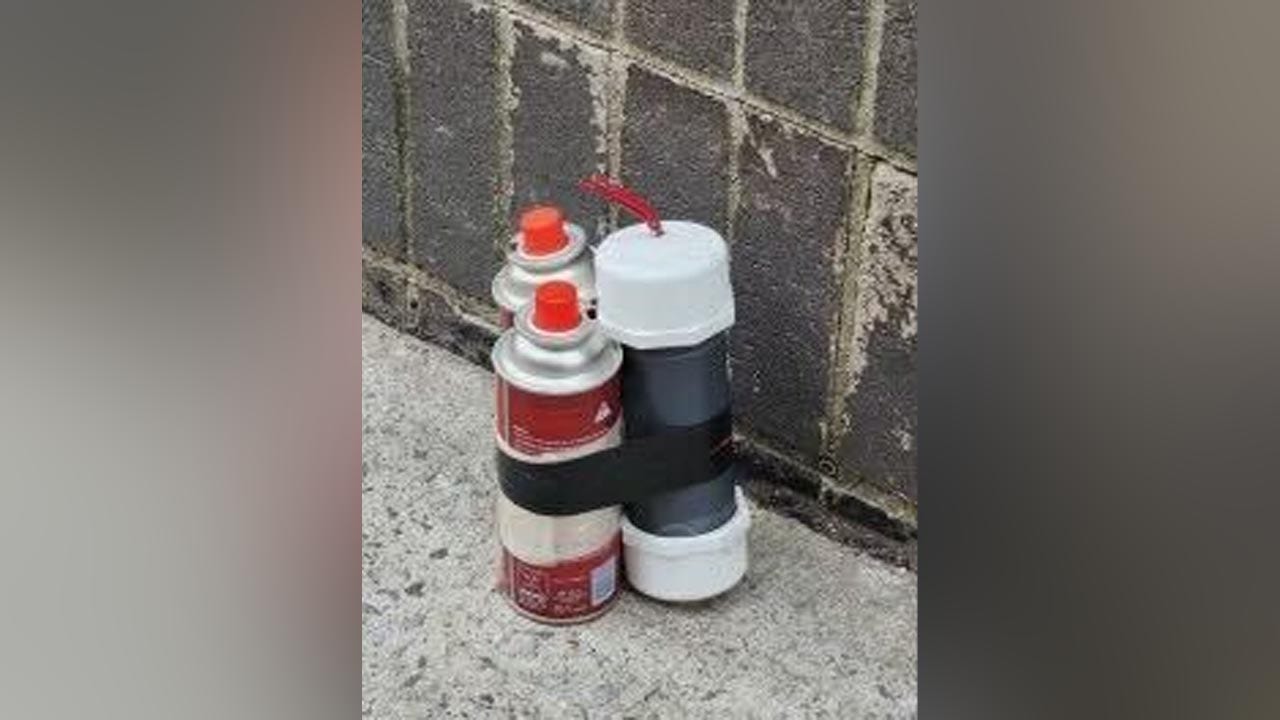
Two cousins were arrested Wednesday after a bizarre incident involving a machete and a possible pipe bomb unfolded outside a New York City police precinct.
The New York Police Department said the two men pulled up in a car to the 25th Precinct in East Harlem just before noon.
The driver of the car told officers he had been attacked by the other man with a machete. Police found the weapon in the car and took the suspect into custody.
Police said the victim then told them there was an explosive device in the car. Police found what they called a “potentially viable improvised explosive device.”
STILL NO ARRESTS IN 2021 CAPITOL HILL PIPE BOMB INCIDENTS
A possible pipe bomb was discovered outside a police precinct by the NYPD on July, 24, 2024 in New York City. (Obtained by Fox News Digital)
Fox News Digital obtained a photo of the rather large device.
The NYPD bomb squad was then called in to investigate.
At a Wednesday afternoon press conference, police said they were still working to determine if the device was operational.
NYPD BOMB SQUAD RESPONDS AFTER MAN LEAVES ‘BOMB’ BOX AT NYC FIRE DEPARTMENT
NYPD investigate the scene where two suspects were discovered with a possible explosive device on July, 24, 2024 in New York City. (Peter Gerber for Fox News Digital)
Deputy Chief Jason Huerta of the NYPD’s Counter Terrorism Division said the suspect who was in possession of the device was “rambling on about about incoherent ideas and paranoia.”
Police said both men involved in the incident had between 10 and 20 arrests, but no recent arrests within the last five to 10 years.
NYPD investigate the scene where two suspects were discovered with an explosive device on July, 24, 2024 in New York City. (Peter Gerber for Fox News Digital)
Authorities added that the incident does not appear to be motivated by terrorism, or political in nature.
“At this time, it looks like it was basically a domestic dispute. The person in possession of the device had potential emotional issues. That’s what it looks like to us at this time.”
Read the full article from Here


Maine marijuana growers are increasingly using radiation and other methods to remove contaminants from their products, a process consumers are likely in the dark about.
Despite a state policy requiring remediated products to be labeled as such, Maine’s Office of Cannabis Policy is not enforcing that rule.
In response to a complaint by a dispensary owner in late February, deputy director of operations Vern Malloch acknowledged, “we are not requiring labeling of remediated or treated product,” according to records obtained through a media request.
“We plan to issue guidance on this in the near future,” Malloch wrote.
Office of Cannabis Policy Director John Hudak also told lawmakers last year that the agency hasn’t enforced remediation labeling requirements since at least November 2024.
“The Office began receiving pushback from cannabis cultivators who did not want to label their cannabis if they ‘treated’ their cannabis with radiation or ozone prior to submitting the cannabis for mandatory testing,” Hudak wrote in testimony last year.
A spokesperson for the agency declined to answer specific questions Monday, but confirmed the agency stopped enforcing the rule after some growers raised concerns over the “misleading impact” that labeling treated cannabis has on consumers.
“Requiring label disclosure of the use of irradiation or ozone treatment implies a consumer risk that is not scientifically supported and is potentially misleading in its implication about potential harm from exposure,” Alexis Soucy, OCP’s director of media relations, wrote in an email.
Over the last couple years, several marijuana products have been subjected to recall because of high levels of mold, yeast and other contaminants. Unsafe levels of mold in cannabis can cause flu-like symptoms, including respiratory issues, sinus infections, headaches and dizziness.
But rather than tossing their product, growers can turn to a process called irradiation, often involving gamma rays or X-rays, to remove contaminants.
Supporters say it’s a safe way to reduce waste and prolong shelf lives. Mold and yeast grow naturally just about everywhere and many species are benign. Standard cannabis mold testing does not differentiate between harmful and harmless microbes.
Opponents, however, argue there isn’t enough research about remediating cannabis to say whether it’s safe or not. There is not much data on whether the various types of remediation are effective at killing microbes or are safe for consumers, most of whom don’t know about the practice.
“It’s a complex topic without many answers,” said Yasha Kahn, who co-founded MCR Labs, one of four licensed cannabis testing facilities in Maine. “Hopefully, the rescheduling can lead to more research.”
The federal government moved last week to reclassify cannabis from a Schedule I to Schedule III drug. Decades-long restrictions on cannabis research will be lifted, which acting Attorney General Todd Blanche said will allow for studies into “marijuana’s safety and efficacy.”
Kahn, who operates several testing labs throughout New England, said irradiating cannabis has become increasingly prevalent in legal markets across the country and the world. It’s still debated whether irradiation works as well as it’s supposed to, he said.
‘THIS IS A FAIRLY NEW PROCESS’
There are numerous kinds of cannabis remediation, each with its own pros and cons. Growers most commonly use X-rays, gamma radiation or ozone gas to remove mold and microbes.
Radiation does not kill all the mold, yeast and other microbes present in cannabis outright, Kahn said. Certain species of mold, like harmful mycotoxins, can often survive remediation. Others can remain dormant for months following the procedure.
“Irradiation gets rid of mold’s ability to procreate, and not necessarily permanently,” he said. “You can take that same product and test it again, months from then, and there’s going to be mold growth.”
Some in the industry, like organic marijuana farmer Lizzy Hayes in Mercer, fear that having the option to remediate cannabis removes the incentive to grow clean cannabis. If you can simply use radiation to eliminate mold from harvested crops, she said, why would you put effort into growing mold-free products?
Part of the blame, according to Hayes, lies at the feet of Maine’s recreational cannabis testing regime. Unlike the state’s medical marijuana market, batches of recreational cannabis products must be tested for contaminants like mold, yeast and heavy metals before they can be put on a dispensary shelf.
But since the mold test only detects the presence of mold, not whether it’s harmful, Hayes said many growers save themselves the trouble and irradiate their cannabis by default rather than risking a failed test.
“When you have a regulatory system that incentivizes irradiation, it’s also making it so that customers don’t have access to as high quality of a product,” she said.
Some in the industry disagree. A bill was proposed last year to codify requirements around labeling treated cannabis and inspecting remediation equipment. It was ultimately defeated after many Maine cannabis growers testified in opposition to the bill.
“Radiation and ozone treatment methods are well-established, scientifically validated technologies commonly used in industries far beyond cannabis,” wrote Jacob Racioppi, owner of Goose River Cannabis in Unity. “In fact, they are standard in the food industry.”
Joel Pepin, co-founder of JAR Cannabis Company, owns and operates one of about a dozen X-ray machines in Maine’s cannabis industry. He estimated that about half of Maine’s recreational cannabis has been treated by similar methods. It would be overkill, he said, to require all of that product to be labeled over scientifically unfounded concerns.
“If we apply this same logic to other industries in Maine, then why doesn’t this bill also require dental patients to wear a shirt that says, ‘treated by X-ray’ after leaving the dental office?” Pepin testified.
Neither Racioppi nor Pepin responded to requests for an interview.
Lorri Maling, laboratory director at cannabis testing facility Nelson Analytical, seconded Pepin that remediating cannabis is “more in use now than it was a few years ago.”
While some opponents of irradiation claim the process reduces THC content and eliminates terpenes — the chemicals that give different cannabis strains unique scents and effects — Maling said there’s no data to back that up. Nor is there much data to back up many other conclusions about the effects of irradiating cannabis.
Most of the studies on the effects of irradiation have been on fruits and vegetables, she said, which have not shown any negative effects — though there’s no guarantee that any remediation method will kill all bacteria.
“This is a fairly new process for cannabis,” Maling wrote in an email. “I really cannot say that it is safe or unsafe for cannabis as there really is not enough data on this.”

BENNINGTON, Vt. (WRGB) — A Massachusetts woman accused of killing her two children appeared in court virtually in Vermont on Monday.
Janette MacAusland joined the court hearing from Marble Valley Correctional Facility in Rutland and waived her extradition rights, signing a waiver to be transported back to Massachusetts.
The case began Friday night, when Bennington police were reportedly called for a welfare check on MacAusland. Police say she arrived at a family home distraught and with a neck injury.
PREVIOUS: Massachusetts mother arrested as fugitive in Bennington, charged in murder of two children
While speaking with police, officers reportedly became increasingly concerned for her children in Wellesley, Massachusetts — a boy and a girl, ages 7 and 6.
Authorities there conducted a welfare check and found the children dead.
MacAusland was arrested and charged with murder.
The Boston Globe reports MacAusland was going through a contentious divorce and seeking custody of both children.
A check-in will be required in two weeks to ensure she is picked up. In the meantime, she remains in jail without bail.
MORE: “Deeply disturbing”: Elderly woman attacked, son indicted
BE THE FIRST TO COMMENT
CBS6 will have updates on-air and online.

A new study showing deaths from rectal cancer are rising sharply among younger adults in their 30s and 40s — a troubling trend that researchers in a recent study say is not fully understood — is an important reminder for New Hampshire to include screening in their regular checkups.
The study, published March 2 in the American Cancer Society journal, found colorectal cancers — once more common in older adults — are increasingly diagnosed in younger people and are often more advanced at detection.
Colorectal cancer includes both colon and rectal cancer. In New Hampshire, 31.9 in 100,000 people were diagnosed from 2018 to 2022, according to the researchers’ analysis of federal health data. Death rates from 2019 to 2023 were 10.9 in 100,000 people.
Researchers said rectal cancer deaths could surpass colon cancer deaths by 2035 if current trends continue. Colorectal cancer is already the leading cause of cancer death among Americans under 50, with mortality in that group rising about 1% per year even as death rates decline among older adults, particularly those 65 and older.
Rectal tumors now account for about one-third of all colorectal cancer diagnoses, up from roughly one-quarter in earlier decades, indicating a growing share of the overall burden. Overall incidence has declined slightly, driven by a roughly 2.5% annual drop among adults 65 and older, but it is rising in younger groups—about 3% per year among those ages 20 to 49 and 0.4% annually among those 50 to 64. As a result, nearly half of new cases now occur in people under 65, up from about a quarter in the mid-1990s.
See also: AG: ‘Certain Issues…Warrant Further Review’ Of North Country Healthcare
Researchers estimate 158,850 new colorectal cancer cases and 55,230 deaths nationwide in 2026, with about 45% of diagnoses and nearly one-third of deaths expected in people younger than 65.
The reasons for the rise in younger adults remain unclear. Researchers point to possible links to diet, obesity, environmental exposures and other lifestyle factors, as well as changes in the gut microbiome.
See also: Botulism Risk On Certain Lots Of ByHeart Whole Nutrition Infant Formula, NH DHHS Says
As these generations age, the burden of rectal cancer “will continue to swell like a tsunami moving through time, underscoring an urgent need for etiologic research to discover the cause of rising incidence,” the researchers said.
-

 Indiana9 seconds ago
Monkee’s of Indianapolis: New boutique caters to Indy’s fashion needs
-

 Iowa6 minutes ago
Five Iowa dog breeders listed among this year’s ‘Horrible Hundred’
-

 Kansas12 minutes ago
Inspection underway after another fire damages Kansas City apartment building
-

 Kentucky18 minutes ago
2026 Kentucky Derby expert picks and predictions for Triple Crown race
-

 Louisiana24 minutes ago
Faimon Roberts: In Baton Rouge tragedy, Sid Edwards led while Jeff Landry lectured
-

 Maine30 minutes ago
Moldy Maine weed is being treating with radiation
-

 Maryland36 minutes ago
Maryland astronaut named to SpaceX crew ahead of possible moon mission
-

 Michigan42 minutes ago
Opinion | Why political elites fear a Michigan constitutional convention – Bridge Michigan