‘3 Body Problem’
Netflix


The 2024 SXSW Film Festival kicked off March 8 in Austin with the opening-night world premiere screening of Doug Liman’s Road House remake starring Jake Gyllenhaal and Conor McGregor. It started nine days of debuts including for movies starring Rooney Mara, Isabelle Huppert, Gael García Bernal, Kristen Stewart and more. The Anne Hathaway romantic dramedy The Idea of You from SXSW stalwart Michael Showalter closed the fest on Saturday.
Keep checking back below as Deadline reviews the best and buzziest movies of the festival. Click on the titles to read the full reviews.
‘3 Body Problem’
Netflix
Section: TV Premiere
Director: Derek Tsang
Cast: Jovan Adepo, John Bradley, Rosalind Chao, Liam Cunningham, Eiza González, Jess Hong, Marlo Kelly, Alex Sharp, Sea Shimooka, Zine Tseng, Saamer Usmani, Benedict Wong, Jonathan Pryce
Deadline’s takeaway: 3 Body Problem’s biggest existential threats are just how redundant it all seems, and how every plot development can be seen from a galaxy away, like Omar Sharif coming over the desert on horseback in Lawrence of Arabia.

‘Arcadian’
Patrick Redmond
Section: Narrative Spotlight
Director: Benjamin Brewer
Cast: Nicolas Cage, Jaeden Martell, Maxwell Jenkins, Sadie Soverall, Samantha Coughlan, Joe Dixon, Joel Gillman
Deadline’s takeaway: The filmmakers attempt to navigate the tumultuous waters of a post-apocalyptic narrative, showcasing a world decimated by an unspecified catastrophic event. But despite a cast that promises gravitas and the tantalizing premise of a stark, survivalist drama, the film ultimately fumbles and fails to terrify.

Kirsten Dunst in ‘Civil War’
Murray Close
Section: Headliner
Director: Alex Garland
Cast: Kirsten Dunst, Cailee Spaeny, Wagner Moura, Stephen McKinley Henderson, Jesse Plemons, Nick Offerman
Deadline’s takeaway: Ultimately, Civil War feels like a missed opportunity. In its attempt to navigate the complexities of war, journalism and the human condition, the film finds itself caught in the crossfire, unable to deliver the profound impact it aspires to achieve.

‘Desert Road’
SXSW
Section: Narrative Spotlight
Director-screenwriter: Shannon Triplett
Cast: Kristine Froseth, Frances Fisher, Beau Bridges, Ryan Hurst, D.B. Woodside, Max Mattern, Rachel Dratch, Edwin Garcia II
Deadline’s takeaway: Making her directorial debut, Shannon Triplett shows a sophisticated grasp of genre dynamics, with a bold use of space — a stretch of the Mojave Desert doubling for Death Valley — that proves more and more gripping as the film’s mysteries unfold.

Ryan Gosling in ‘The Fall Guy’
Universal Pictures
Section: Headliner
Director: David Leitch
Cast: Ryan Gosling, Emily Blunt, Aaron Taylor-Johnson, Hannah Waddingham, Stephanie Hsu, Winston Duke, Teresa Palmer
Deadline’s takeaway: The Fall Guy excels in its self-aware storytelling and stands as a hilarious and thoughtful tribute to the stunt community, blending action with a poignant exploration of the sacrifices made by these unsung heroes. It’s a testament to the spirit of collaboration and that defines Hollywood at its best.

‘Grand Theft Hamlet’
Altitude
Section: Documentary Feature Competition
Director: Sam Crane and Pinny Grylls
Cast: Sam Crane, Mark Oosterveen, Jen Cohn
Deadline’s takeaway: The film hits some rocks with its three-hour-plus running time, but the play-within-a-video-game premise is a winner, and there’s a lot to enjoy as the leads talk iambic pentameters while bullets fly, planes crash and bazookas unload.

Lucy Boynton in ‘The Greatest Hits’
Searchlight
Section: World Premiere
Director: Ned Benson
Cast: Lucy Boynton, Justin H. Min, David Corenswet, Austin Crute, Retta
Deadline’s takeaway: The heartfelt and deeply human but flawed film’s exploration of music’s role in our emotional lives and history is a moving portrayal that offers audiences a reflective journey through the intricacies of love, loss and, ultimately, hope.

‘The Idea of You’
Prime Video
Section: Headliner
Director: Michael Showalter
Cast: Anne Hathaway, Nicholas Galitzine, Ella Rubin, Annie Mumolo, Reid Scott, Perry Mattfeld, Jordan Aaron Hall, Mathilda Gianopoulos, Raymond Cham Jr., Jaiden Anthony, Viktor White, Dakota Adan
Deadline’s takeaway: The Idea of You shines when it delves into the introspection and self-awareness that comes with significant life milestones, but when it aims to capture the essence of shared vulnerability and trust it falters, stumbling over a narrative that feels uneven and, at times, contrived.

Sydney Sweeney in ‘Immaculate’
Fabia Lavino, Courtesy of Neon
Section: Headliner
Director: Michael Mohan
Cast: Sydney Sweeney, Alvaro Morte, Simona Tabasco, Benedetta Porcaroli, Giorgio Colangeli, Dora Romano
Deadline’s takeaway: Taking the reins as both lead actress and producer, Sydney Sweeney crafts a space for herself to explore a diverse array of characters, affirming her dedication to broadening her artistic range. A bold departure with the ending provides satisfying closure by finally subverting traditional expectations and concluding on an unconventional note.

Dev Patel in ‘Monkey Man’
Universal
Section: Headliner
Director: Dev Patel
Cast: Dev Patel, Sharlto Copley, Pitobash, Vipin Sharma, Sikandar Kher, Sobhita Dhulipala, Ashwini Kalsekar, Adithi Kalkunte,, Makarand Deshpande
Deadline’s takeaway: The film leaves audiences with a profound message: In a world rife with injustice, sometimes radical action is necessary to forge new paths. Dev Patel’s directorial finesse and meticulous attention to detail suggest a promising helming future.

From left: Ed Harris, Natalie Morales and Sonequa Martin-Green in ‘My Dead Friend Zoe’
SXSW Film Festival
Section: Narrative Spotlight
Director: Kyle Hausmann-Stokes
Cast: Sonequa Martin-Green, Natalie Morales, Utkarsh Ambudkar, Ed Harris, Gloria Reuben, and Morgan Freeman
Deadline’s takeaway: While the film occasionally falters in its pacing, My Dead Friend Zoe is a powerful testament to the resilience of the human spirit and the imperative to provide better support for our veterans. It challenges its audience to reflect on the collective responsibility to ensure their well-being long after their service has ended.

Conor McGregor and Jake Gyllenhaal in ‘Road House’
Prime Video
Section: Headliner
Director: Doug Liman
Cast: Jake Gyllenhaal, Daniela Melchior, Billy Magnussen, Jessica Williams, Joaquim de Almeida, Conor McGregor, Lukas Gage, Arturo Castro, B.K. Cannon, Beau Knapp, Darren Barnet, Dominique Columbus, Bob Menery, Catfish Jean, Kevin Carroll, Travis Van Winkle, Hannah Lanier
Deadline’s takeaway: In spite of a few flashes of technical brilliance in its action sequences and a few tries made by its cast, this rebuilt Road House stands as a testament to just how difficult it is to capture lightning in a bottle.

Eve Connolly in ‘Sew Torn’
UTA
Section: Visions
Director: Freddy Macdonald
Cast: Eve Connolly, Calum Worthy, John Lynch, K Callan, Ron Cook, Thomas Douglas, Werner Biermeier, Veronika Herren-Wenger, Caroline Goodall
Deadline’s takeaway: Its oddness certainly will be frustrating to those who like their crime hardboiled, but most of all, it’s a great discovery — the kind of film festivals were made for and streamers should fill their boots with. It will be fascinating to see where destiny takes Freddy Macdonald next.

Aneurin Barnard and Alice Lowe in ‘Timestalker’
Ludovic Robert/HanWay
Section: Narrative Spotlight
Director: Alice Lowe
Cast: Alice Lowe, Jacob Anderson, Aneurin Barnard, Tanya Reynolds, Nick Frost
Deadline’s takeaway: The ambitious film recalls classic Monty Python — it’s often very, very stupid and the same time very, very clever — but most of all, it’s an idea of what might have been if that all-male team had ever had a woman or two in its core lineup. Somehow, Alice Lowe has the wide-eyed innocence to carry it all off, a very subversive gift indeed.

From left: Nathalie Morris, Manaia Hall and Erana James in ‘We Were Dangerous’
SXSW
Section: Narrative Feature Competition
Director: Josephine Stewart-Te Whiu
Cast: Rima Te Wiata, Erana James, Nathalie Morris, Manaia Hall
Deadline’s takeaway: We Were Dangerous never quite comes together as the wry, subversive coming-of-age movie that it might have been, but the performances are powerful enough in Josephine Stewart-Te Whiu’s debut that its emotional heft is surprisingly indelible.

From left: Jaeden Martell, Rachel Zegler and Julian Dennison in ‘Y2K’
SXSW
Section: Headliner
Director: Kyle Mooney
Cast: Jaeden Martell, Rachel Zegler, Julian Dennison, Daniel Zolghadri, Lachlan Watson, Kyle Mooney, Eduardo Franco, Alicia Silverstone, Fred Durst
Deadline’s takeaway: What sets Y2K apart is its nuanced approach to nostalgia. In a cinematic landscape often saturated with attempts to capitalize on the past. The stands out for its authenticity and restraint. Ultimately, it’s a testament to Kyle Mooney’s vision and a promising start to his directorial career.


By and large, the zombie subgenre has bitten off more than it can chew in modern times. Between George Romero survival films and camp comedies, the well has become pretty infected. But once in a while, along comes a movie like This Is Not A Test.
Let’s sink our teeth into this new release and see how it stacks up against the classics.
The tone and tenor of this film represent the classic survival movies like Night Of The Living Dead. But the thing that grabs the audience about This Is Not A Test is the trauma of the characters. Holt shines as a withdrawn survivor of an abusive home, trying to cut through the wreckage to reunite with her sister. Each of the main characters have standout traits, and they bathe in strongly acted moments as the stress of the situation changes who they are.
The gore in This Is Not A Test is pretty strong. The attacks spring quickly and when they do, the special effects team does a good job showcasing the battle scars. The camera work is also frenetic in a good way, because the chaos of the chase scenes puts the viewers in a first-person perspective. This film lets you feel like a part of the survivors, so their journeys are interactive.

Longtime fans may say that there’s nothing new in This Is Not A Test, and maybe they’re right. There’s no fresh take on the monsters here, no crazy origin, nothing that we haven’t seen in the past fifty-eight years. But the pacing nails a great balance between getting to know the characters and getting the zombie splatter fest. The mental meltdowns of the characters feel well earned, and the arc of Sloane and her sister brings a lot of heart and investment to the story. Even the most jaded zombie horror fans will find something to appreciate here, even as a background movie.
Adam MacDonald has made another intense hit here, and This Is Not A Test is currently available to stream on Shudder.

Our score: 4.5 out of 5
EPIC. If I was asked to describe Christopher Nolan’s latest film, that is the word I would use. He has mounted a film that rivals the greatest achievements of filmmakers like Cecil B. DeMille or David Lean. And, like the films of those mentioned, it’s runs a tad too long.
I was shocked, but pleased, to see that my 12-year-old granddaughter recently did a school paper on King Agamemnon. Thank goodness they’re still teaching History in our schools. Based on Homer’s “The Odyssey,” the film tells the story of King Odysseus (Damon) and his adventures which, if you’ve read “The Odyssey,” include the Trojan Horse, the Cyclops and assorted angry Greek gods. The film covers each of these adventures in great detail, sparing nothing in the production design department. While Odysseus is away – and he’s gone for a l-o-n-g time, his wife Penelope (Hathaway) has to endure a never ending string of “suitors,” men lining up in the hopes of replacing the King should he not return. The men are nothing more then scavengers, taking advantage of the law of Zeus, which decrees no one should be turned away. This angers the Queen’s son, Telemachus (Holland), who must control his temper when the men try to bait him into a fight, the idea being if Telemachus is killed, the new husband would become the King. It’s all very interesting and complicated. And long.
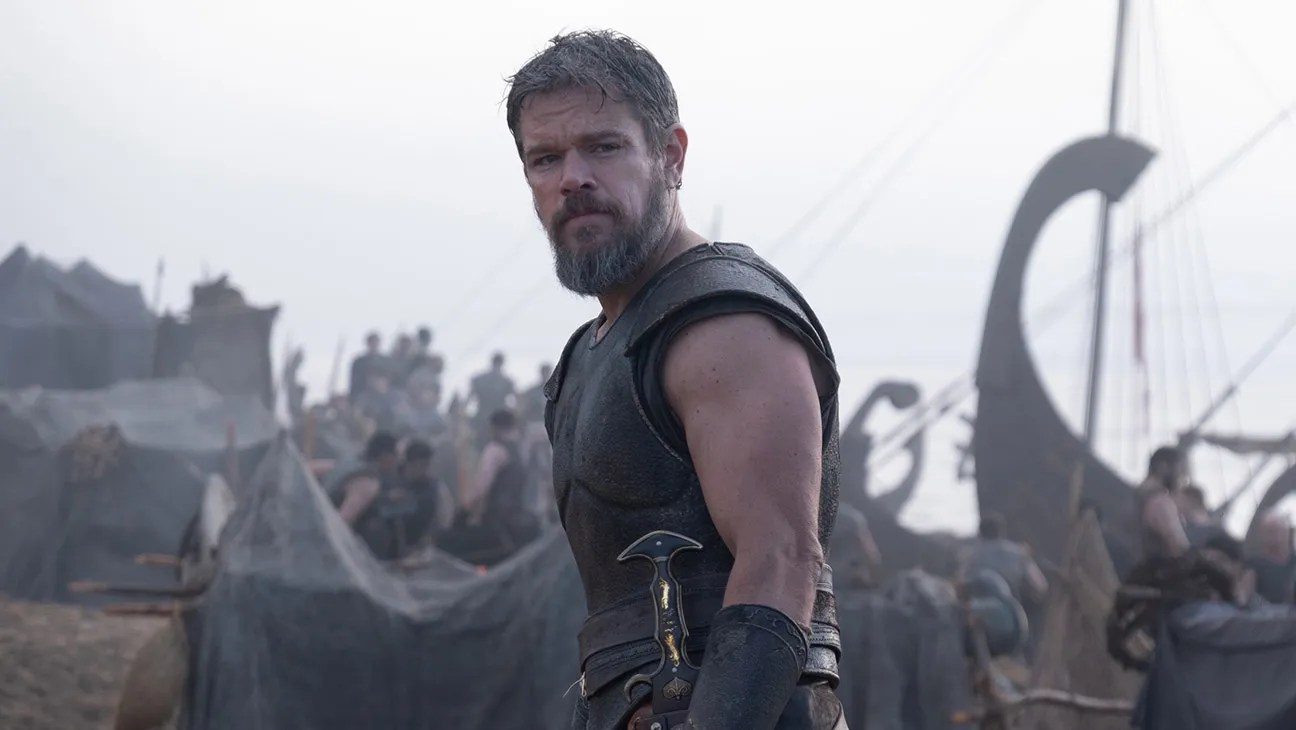
Director Nolan is one of the rare filmmakers who, in my opinion, has never made a bad film. From “Memento” to the “Dark Knight” trilogy to the Oscar-winning “Oppenheimer,” he has proven himself a true master of cinema. “The Odyssey” only adds to that distinguished resume’
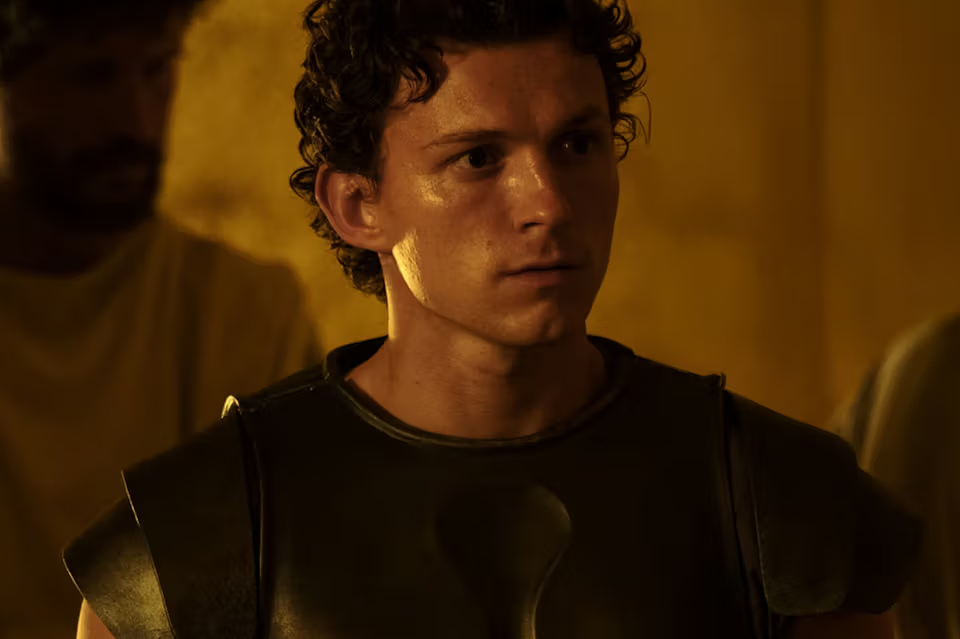
The cast is a tribute to Nolan himself who, like Woody Allen, can pretty much get anyone he wants for his films because, as an actor, why wouldn’t you want a credit in one of his films. Besides the three stars named above, the cast includes Robert Pattinson, John Leguizamo, Zendaya, James Remar, Jon Bernthal, Oscar nominees Samantha Morton and Elliot Page as well as Oscar winners Charlize Theron and Lupita Nyongo. As MGM used to advertise, “more stars than there are in heaven.”
The script and story are pretty faithful to the source material, though for some reason it bothered me whenever Telemacus referred to Odysseus as “dad.” Never father. The weird things you notice. Visual.y the film is stunning and the Trojan Horse and battle of Troy are worth the price of admission alone. I will add that I did see the film in 70 mm and, if that format is playing in your town, I urge you to see it in that format.
On a scale of zero to five, “The Odyssey” receives ★★★★ ½


Premiering at the 2026 River Valley Film Festival, Saari uses fragmented memories, Finnish landscapes and restrained performances to explore betrayal, identity and reconciliation.
By Valerie Milano
Palm Springs, CA (The Hollywood Times) 7/14/26 – In the visually striking short film Saari—Finnish for “island”, a peaceful family retreat becomes the setting for the slow collapse of a relationship.
Co-written by Justin Seegmueller, Corey L’Esperance and Suvi Härkönen, the film follows Daniel, played by Seegmueller, as he reflects on the choices that damaged his relationship with Liina, portrayed by Ilona Karppanen. Told through fragments of the past, present and future, Saari gradually reveals how secrecy and betrayal can transform a place of safety into one of emotional confinement.
The nonlinear structure was not simply a stylistic choice. The project was developed and filmed over more than a decade, with footage captured in Finland, Boston and the desert. L’Esperance explained that the filmmakers divided the story into “past, present and future,” allowing audiences to experience the relationship from both characters’ perspectives.
Click below for our exclusive interview:
He described Daniel and Liina as two people who are “stuck in these moments in time,” making the fragmented narrative especially appropriate.
Seegmueller said Daniel’s internal struggle is rooted in the questions, “Am I that person? Am I still that person?” His restrained performance captures a man attempting to reconcile his current identity with the damage caused by earlier decisions.
For Seegmueller, the film is fundamentally about choice.
“It’s all about decision-making,” he said. “Are you an accumulation of all your decisions?”
Finland’s lush island scenery contrasts sharply with Daniel’s later isolation in the barren desert. Seegmueller described the progression as “lush and then dead,” a simple but effective visual representation of a relationship moving from intimacy and possibility to emotional aftermath.
For Liina, the island represents family history, comfort and security. By inviting Daniel there, she welcomes him into her sanctuary. His secrets, however, begin to contaminate that protected space.
“You let me into your life,” Seegmueller explained, “and now I’m here almost ruining your sense of security.”

 Because the couple reaches the island by rowboat, the setting also creates a sense of entrapment as suspicion and resentment begin to surface. L’Esperance noted that once they are there, “there’s not really anywhere you can go.”
The film’s cross-cultural perspective was strengthened by the collaboration between American co-director L’Esperance and Finnish co-director Härkönen. Their responsibilities shifted according to which character dominated a scene. L’Esperance generally led sequences centered on Daniel, while Härkönen took a stronger role when Liina’s experience was at the emotional forefront.
That approach helps prevent Liina from existing only as a reaction to Daniel’s behavior. Her journey eventually becomes more compelling than his guilt.
Karppanen traveled to the United States for the first time to film the Boston scenes, which were completed approximately three years after the original Finland footage. Seegmueller said the friendship they developed during production can be seen in the warmth between their characters during the relationship’s happier moments.
The filmmakers deliberately avoid explaining every detail of Daniel’s betrayal. Earlier edits revealed even less, but test audiences needed additional narrative guidance.
“We do need to have some breadcrumbs,” L’Esperance said, explaining that without them, the story became “a little too lost on the audience.”

 The challenge was to provide enough information while maintaining the film’s quiet, interpretive tone. L’Esperance said they wanted to leave room for viewers to “fill in some of the blanks.”
The lengthy production process also changed how the filmmakers viewed Daniel. L’Esperance acknowledged that they initially saw him as “this hero,” but over time recognized that “he is kind of a bad guy in some of these aspects.”
That evolving perspective gives the film greater moral complexity. Daniel is not granted an easy redemption, and his introspection does not erase the harm he caused.
Karppanen brings strength and emotional restraint to Liina, who emerges from the experience as what L’Esperance called “a completely different person.” A final city scene suggests that she is beginning to reclaim her identity and imagine a future beyond Daniel and the relationship that betrayed her.
Subtle, atmospheric and open to interpretation, Saari asks whether people are defined by their worst decisions, and what reconciliation means when the damage cannot simply be undone.
After more than 10 years of work, the film’s world premiere at the River Valley Film Festival is especially meaningful. Both L’Esperance and Seegmueller attended film school in Philadelphia, making the Pennsylvania premiere a return to the state where their filmmaking journeys began.

 Seegmueller hopes the film encourages audiences to examine their own choices and personal histories.
“What does that say about you?” he asked. “What does that say about your story and your own narrative?”
Saari will have its world premiere at the 2026 River Valley Film Festival. Seegmueller will attend the premiere in person, while members of L’Esperance’s family are expected to represent him at the festival.


Minnesota United Statement on International Friendly | Minnesota United FC


GPS data tracks boat Mississippi teen Nolan Wells was on before he went missing


Missouri teen Gabbriana Boyster shot dead in home as mom makes horrifying discovery; 3 friends charged


Photos: Helena Senators sweep home doubleheader from Billings Royals


Omaha hospice nurse speaks out after Nebraska AG disciplinary action


Sparks weekend road closures are slated


N.H. police chief placed on leave after video released of him grabbing someone by the throat inside police station


Cyclists are frustrated, upset. Is NJ’s new e-bike law already broken?


