Northeast
Whistleblower reveals why Trump rally officer assigned to shooter’s perch moved

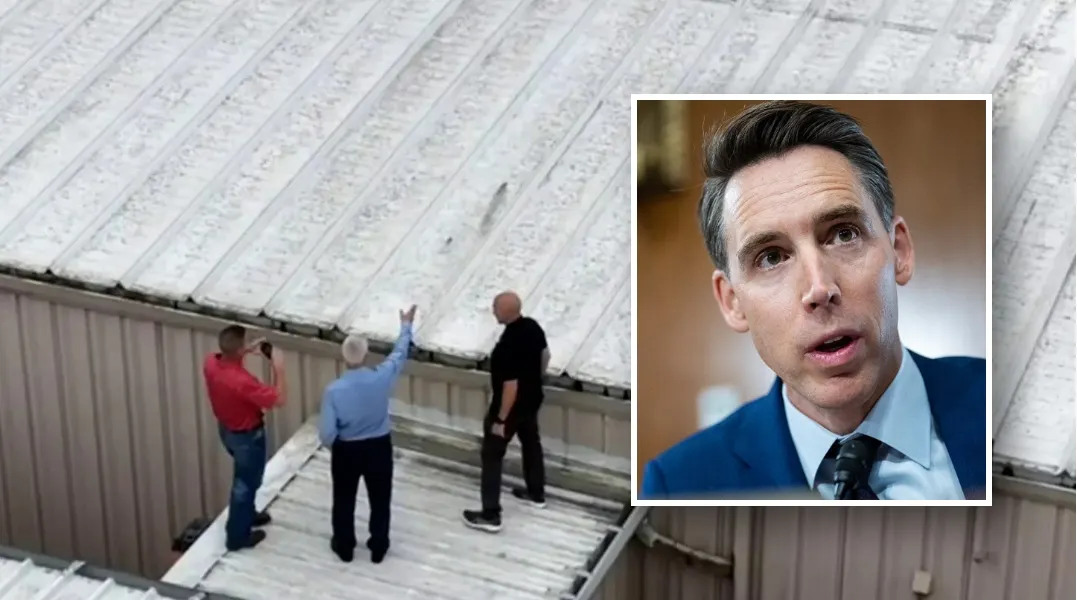
BUTLER, Pa. – Whistleblowers have told Republican Missouri Sen. Josh Hawley that a law enforcement officer who was assigned to monitor the roof of a building that would-be former President Trump assassin Thomas Crooks fired from on July 13 left their post because it was “too hot.”
Crooks, 20, fired multiple rounds from the roof of American Glass Research (AGR) Building 6, which was outside the rally perimeter but had a direct line of sight to where the former president was standing on stage at his campaign rally in Butler, Pennsylvania.
“This comes from a whistleblower with direct knowledge of the Secret Service plan and setup that day,” Hawley said. “And what this whistleblower tells my office is that there was at least one law enforcement person assigned to the roof itself. In other words, the plan called for a law enforcement individual to be on the roof at all times during the rally. And that did not happen. And what the whistleblower tells me is the law enforcement individual who was assigned to that roof abandoned it.”
Butler’s temperature reached a high of 92 degrees on July 13, and prior to the assassination attempt, emergency personnel at the rally were mostly focused on attending to people suffering from heat-related illnesses.
TRUMP ASSASSINATION ATTEMPT AFTER SECRET SERVICE FAILURES PROMPTS CALLS FOR DRASTIC AGENT RECRUITMENT CHANGES
Sen. Josh Hawley, R-Mo., says a whistleblower told him law enforcement personnel were assigned to cover the roof of the building Thomas Crooks fired from at a former President Trump rally on July 13, but they left because it was “too hot” that day. (Anna Moneymaker/Getty Images)
Hawley, who visited the rally site on Friday, noted that the AGR building in question was about 150 yards or fewer from the main stage of Trump’s rally.
TRUMP SHOOTING: TIMELINE OF ASSASSINATION ATTEMPT
While Congress has confirmed that Crooks purchased a ladder at Home Depot prior to the rally shooting that left 50-year-old firefighter and father Corey Comperatore dead and two others — 57-year-old David Dutch and 74-year-old James Copenhaver — critically wounded, he could have accessed the roof of the AGR building without a ladder. Lawmakers who visited the site on Monday were able to reach the roof without a ladder.
“…He or she was too hot and just thought it was unnecessary to be out there.”
The same whistleblower told Hawley that multiple law enforcement personnel were also assigned to patrol the perimeter of the building “to make sure that somebody couldn’t just jump up” onto the roof, possibly from one of the air-conditioning units jutting out from the windows of the building, the senator said.
The Butler Farm Show in Butler, Pennsylvania, site of a campaign rally for former President Trump, is seen on July 15. Trump was wounded on July 13 during an assassination attempt while speaking at the rally. (AP Photo/Gene J. Puskar)
The roofs at the Butler Fair Ground in Pennsylvania, where a group of bipartisan lawmakers visited on Monday. (Fox News Digital)
“All of these whistleblowers who’ve now come forward to my office, saying things like: law enforcement was assigned to be on the roof, and they weren’t. They were assigned to be patrolling the perimeter of that building, and they weren’t. They were supposed to be communicating over a common radio frequency, and they weren’t,” Hawley said. “I have to say, none of that surprises me because it is just astounding with those kind of failures and errors that this 20-year-old was able to get up on in plain view of everybody onto that low-slung roof and take multiple shots at the [former] president.”
AIR FORCE VETERAN AT TRUMP RALLY SAYS ‘SOMETHING WASN’T RIGHT’ BEFORE WOULD-BE ASSASSIN OPENED FIRE
Approximately one hour passed between the time law enforcement officials first identified a suspicious person near the rally grounds and the time Crooks fired. Officials temporarily lost sight of the suspicious person, but then around 5:52 p.m., a sniper “had eyes on him,” which was about 20 minutes before the gunfire rang out, Hawley said, citing a briefing he attended with former Secret Service Director Kimberly Cheatle last week.
The whistleblower also told Hawley that the Secret Service had delegated the AGR building and the roof to local or state law enforcement but noted that both local and federal officials have been pushing blame onto one another.
PENNSYLVANIA OFFICERS NOT ALLOWED IN SECRET SERVICE COMMAND CENTER AT TRUMP RALLY, LAWMAKERS SAY ON SITE
“There’s a lot of effort on the part of both Secret Service, on the one hand, and DHS on the other hand, and then also state and local law enforcement to push the responsibility off onto each other. So this is just why we need to get these facts into the open. We need to have real and substantive hearings, not like the one [on Monday] where the former Secret Service director wouldn’t even respond to questions. What a farce that was,” Hawley said.
Thomas Crooks seen at the Trump rally on July 13 in Butler, Pennsylvania. (Sen. Ron Johnson)
His comments came the same day Cheatle resigned from her position on Tuesday morning.
“To the Men and Women of the U.S. Secret Service, The Secret Service’s solemn mission is to protect our nation’s leaders and financial infrastructure,” Cheatle wrote in a letter to the agency obtained by Fox News. “On July 13th, we fell short on that mission.”
TRUMP SHOOTING SITE GIVES BIRDS-EYE VIEW OF ‘DISORGANIZED’ RALLY SCENE, WITNESSES SAY
Cheatle said that the “scrutiny” over the last week “has been intense and will continue to remain as our operational tempo increases.”
WATCH: EYEWITNESS SHARES NEW FOOTAGE OF TRUMP SHOOTING
“As your Director, I take full responsibility for the security lapse,” she wrote.
Now, Hawley is calling for Department of Homeland Security (DHS) Secretary Alejandro Mayorkas to resign, as well.
Sen. Josh Hawley, R-Mo., left, is calling for Homeland Security Secretary Alejandro Mayorkas to resign in light of the assassination attempt against former President Trump. (Getty Images)
“Alejandro Mayorkas needs to resign. He’s the head of DHS. All of this is in his purview — Secret Service, the DHS personnel,” the Missouri senator said. “Another whistleblower tells me that most of the federal security there that day were not Secret Service. Most of them were DHS personnel who had just been detailed over to this event for the day. And they were largely not prepared, not read into the security plan, and were not executing their duties according to what the plan called for.”
TRUMP ASSASSINATION ATTEMPT: BUTLER, PENNSYLVANIA TOWN MANAGER DEFENDS POLICE AMID RESPONSE ‘MISCONCEPTION’
Hawley suggested the DHS is overwhelmed under Mayorkas’ leadership of the agency.
A DHS spokesperson said the agency “cannot comment on matters related to an ongoing investigation. We, of course, are committed to working with the appropriate and relevant investigations of what happened on Saturday, including with Congress, the Inspector General, and both internal and independent reviews.”
The Secret Service did not respond to an inquiry from Fox News Digital regarding Hawley’s comments.
“The Department of Homeland Security is in total crisis.”
“I think the fact that you have so many of these DHS security folks, a lot of them are designated as investigators — DHS investigators — whose jobs are actually to be out in on the ground in the continental United States, searching for illegals, looking for crime. So many of them have been sent to the southern border. So there aren’t that many of them available to begin with. And then you’re pulling people off of other responsibilities and sending them to this rally. They’re not adequately briefed. They’re not trained to do that,” Hawley said.
Mayorkas on Sunday announced that he has tapped a bipartisan panel of law enforcement experts to conduct a 45-day independent review of the assassination attempt.
“The men and women of the U.S. Secret Service make it the greatest protective service in the world, with one of the most solemn and difficult missions in government,” the DHS secretary said. “This independent review will make the organization even better.”
Hawley’s office continues to communicate with whistleblowers about the Trump rally shooting and what went wrong in order for Crooks to gain access to the AGR building rooftop that evening with an AR-15.
Read the full article from Here


The Pittsburgh Penguins got what they wanted.
Friday night was life-changing for Pittsburgh Penguins’ first-round pick Liam Ruck of the Medicine Hat Tigers. The organization selected him with the 22nd overall pick. Saturday morning was life-changing for his identical twin brother Markus Ruck as the Penguins used the first of their second-round picks to select him.
And the twins and teammates in Medicine Hat, who have spent only four days apart in their first 18 years, got what they wanted, too. They’re both Pittsburgh Penguins.
Penguins general manager Kyle Dubas told reporters Friday night, following the conclusion of Round One, that it appeared more likely in the days leading to the draft that the team would not be able to trade up and that Liam Ruck would be available to them.
There were credible rumors emanating from the league side that some teams considered taking Markus to spur trade talks with the Penguins, but eventually, the other half of the WHL’s high-scoring duo was available Saturday morning with the 39th overall pick.
While Liam had 45 goals and 104 points in 68 games, Markus was the slick playmaking center who kept him fed. Markus Ruck had 108 points with 87 assists. Both brothers need to both add bulk but also improve their skating, which scouts consider a weakness.
Liam is the slightly larger twin, at 6-foot, 177 pounds. Markus weighs in at 6-foot, 167 pounds.
The story is developing, and Pittsburgh Hockey Now will update the story after Markus Ruck speaks with the media.
Categorized:2026 NHL Draft Pittsburgh Penguins

A person who was reported missing late Friday night in Brookfield has been found dead.
Police received a report of a missing person around 11 p.m. As officers were searching the area, they said they found an ATV off of the roadway and in the woods on Candlewood Shores Road.
According to investigators, the sole occupant of the ATV was found dead at the scene. The person’s identity has not yet been released.
The investigation is active and ongoing. Anyone with information is asked to contact Officer Brian Flanagan at (203) 740-4169.
The Maine Marine Patrol has launched the newest and largest patrol vessel in its fleet, the 57-foot P/V Allegiance, which will support safer and more effective offshore patrols, according to the Maine Marine Patrol, in a news release. The vessel was officially put into service on Thursday, June 11, during a christening event at Perry’s Lobster in Surry.
“Maine Marine Patrol routinely patrols commercial fishing activity offshore and hauls and inspects tens of thousands of lobster traps annually,” said Marine Patrol Colonel Matt Talbot, in the news release.
“While still capable of supporting Marine Patrol’s mission near shore, the new vessel will better position Marine Patrol to conduct offshore commercial fisheries enforcement, including the ability to safely haul and inspect large lobster trawls in federal waters,” said Colonel Talbot.
The vessel will also be used to respond to search and rescue incidents, monitor fisheries in addition to Lobster including scallop, Atlantic Herring, Menhaden, and Groundfish, and others.
The P/V Allegiance will be based in Boothbay Harbor and assigned to Marine Patrol Specialist Evan Whidden. It replaces the 29-year-old, 35-foot P/V Vigilant.
The P/V Allegiance was constructed and finished by Wesmac Custom Boats in Surry.
“This is the fifth patrol vessel built or refitted by Wesmac and we are once again very pleased with the quality of work and attention to detail by the Wesmac team,” said Colonel Talbot.
The P/V Allegiance is powered by a low-emission Tier 4 Man Diesel V-12 1450hp engine which can cruise in excess of 20 knots. It is equipped with state-of-the-art Furuno navigation electronics, and a heavy duty 17-inch hauler. It has significant deck space and an open stern which will allow Officers to safely handle and set back the larger offshore lobster trawls Marine Patrol Officers will be inspecting. The vessel is also equipped to carry a 15-foot Ribcraft Rigid Hull Inflatable boat on deck, which can be used for at-sea boardings to check vessels for compliance with marine resources laws.
-

 San Diego, CA3 minutes ago
Your Produce Man – Great produce at the San Diego Farmers Market! 8am
-

 Milwaukee, WI5 minutes ago
See the corpse flower in bloom this weekend at the Domes
-

 Atlanta, GA11 minutes ago
How to watch DR Congo vs. Uzbekistan today: TV channel, streaming and kickoff time
-

 Minneapolis, MN18 minutes ago
North Minneapolis shooting injures 2 near Logan Avenue
-

 Indianapolis, IN21 minutes ago
Storm chance today, then turning hot and humid through midweek
-

 Pittsburg, PA26 minutes ago
Reunited! Penguins Get the Other Twin Ruck in Round 2
-

 Augusta, GA32 minutes ago
Richmond County elections board seeks dismissal of Myles election challenge
-
Washington, D.C36 minutes ago
Your access has been blocked – The Atlantic

