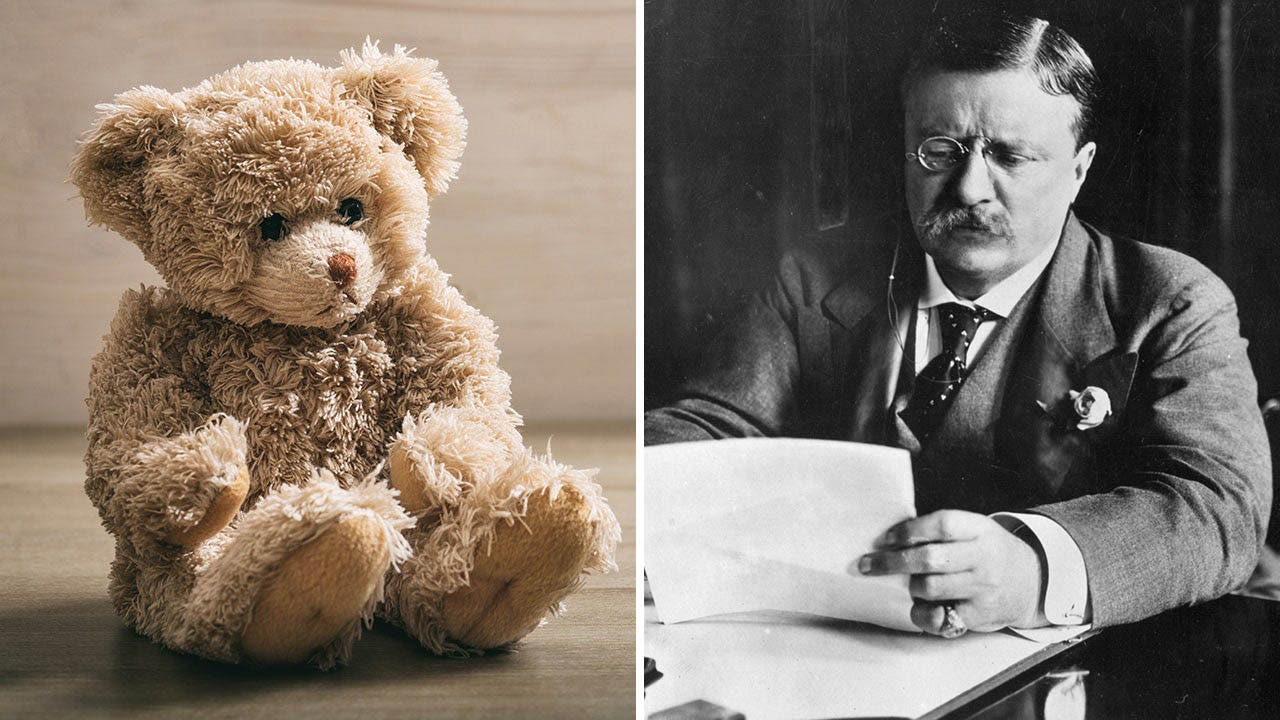
The first “Teddy bear” was put on sale on this day in history, Feb. 15, 1903.
Named after President Theodore Roosevelt, the stuffed bear was first sold by Morris Michtom, a Brooklyn, New York, resident who owned a candy shop, the website for the National Parks Service (NPS) says.
Michtom’s wife, Rose, who made stuffed animal toys, actually created the first teddy bears.
ON THIS DAY IN HISTORY, FEBRUARY 14, 270 AD, VALENTINE BEATEN, BEHEADED FOR DEFYING EMPEROR’S MARRIAGE BAN
Michtom was inspired to call the toys “Teddy’s bear” after reading a political cartoon published in the Washington Post on Nov. 16, 1902, notes the parks service website.
Advertisement
The cartoon was drawn by artist Clifford Berryman. It satirized an incident on a hunting trip in Mississippi in which Roosevelt refused to shoot and kill a black bear that had been tied to a willow tree.
The first Teddy bear was put on sale on this day in history, Feb. 15, 1903. (iStock)
Roosevelt was known to be a skilled hunter.
He thought it was “extremely unsportsmanlike” to shoot a bear that had been tied up, says the NPS website.
“I’ve hunted game all over America and I’m proud to be a hunter. But I couldn’t be proud of myself if I shot an old, tired, worn-out bear that was tied to a tree,” Roosevelt reportedly said at the time.
Advertisement
ON THIS DAY IN HISTORY, FEBRUARY 9, 1942, FEDS ENACT DAYLIGHT SAVINGS TIME IN DARKEST HOURS OF WORLD WAR II
The news of Roosevelt’s refusal to shoot the bear spread quickly around the country, resulting in the cartoon — and, eventually, the stuffed toy.
“Michtom decided to create a stuffed toy bear and dedicate it to the president who refused to shoot a bear,” says the site.
President Theodore Roosevelt gave permission to Morris Michtom to use his nickname, “Teddy,” for the new stuffed bear toys. (Hulton Archive/Getty Images)
Rose Michtom “cut out some pieces of fabric and sewed on some button eyes and put it in the window with the name, ‘Teddy’s Bear.’ It was an overnight hit,” says the website for the Carnegie Museum of Natural History.
Advertisement
The president later gave Michtom permission to use his nickname for the new product — and the toys quickly became popular, notes the museum.
QUEEN ELIZABETH AND PADDINGTON BEAR: WHY ARE PEOPLE LEAVING THE BOOK CHARACTER AT TRIBUTE SITES?
The success of the Teddy bear resulted in a career shift for the Michtoms.
The president later gave Michtom permission to use his nickname for the new product.
In 1907, Michtom and his wife founded the Ideal Novelty and Toy Co.
Advertisement
Although initially the company focused on Teddy bears, it eventually became known for producing a series of collectible dolls, the website Collector’s Weekly says.
The success of the Teddy bear resulted in a career shift for the Michtoms, who had previously owned a candy shop. They soon switched to making and selling toys, according to Collector’s Weekly.(iStock)
The Teddy bear’s popularity over traditional dolls also drew concerns from at least one figure, notes the Smithsonian Museum of American History’s website.
In 1908, five years after the toy was first sold, a minister in Michigan “warned that replacing dolls with toy bears would destroy the maternal instincts in little girls,” said the Smithsonian.
In 1963, for the Teddy bear’s 60th birthday, Benjamin Michtom — the son of Rose and Morris Michtom — attempted to unite the original bear with a descendant of its namesake.
Advertisement
“What does a 79-year-old doll want with a 60-year-old bear?”
“He first contacted Mrs. Alice Roosevelt Longworth, Teddy Roosevelt’s daughter, to offer her one of the original Teddy Bears if she would pose with it,” says the Smithsonian.
WHO IS ALICE ROOSEVELT LONGWORTH? WHITE HOUSE WILD CHILD AND ORIGINAL ‘WIT OF WASHINGTON,’ SAYS HISTORIAN
Longworth apparently declined the offer, reportedly asking, “What does a 79-year-old doll want with a 60-year-old bear?”
Undeterred, Benjamin Michtom then reached out to Kermit Roosevelt, Theodore Roosevelt’s grandson, and asked if he would allow his children to be photographed with the bear, the Smithsonian reported.
Advertisement
Theodore Roosevelt’s grandchildren participated in a photo shoot with the original Teddy bear and refused to part with it — taking it home, according to the Smithsonian.(iStock; Getty)
Benjamin Michtom intended for the bear to be given to the Smithsonian Institution after the photo shoot, but Mark and Anne Roosevelt had other plans.
They took a liking to the bear and hid it from their parents.
“A letter from Mrs. Roosevelt to Mr. Michtom said, ‘I was about to get in touch with the Smithsonian about presenting them with the original bear when the children decided they didn’t want to part with it yet,’” said the Smithsonian.
Advertisement
Eventually, the original Teddy bear was given to the Smithsonian Institution in January 1964, the website notes.
For more Lifestyle articles, visit www.foxnews.com/lifestyle.
Christine Rousselle is a lifestyle reporter with Fox News Digital.
The Pentagon released over a hundred newly declassified files related to UFOs (now officially referred to as Unidentified Anomalous Phenomena, or UAP) last month, including a handful of pages and memos about mysterious, flaming metal fragments that landed in a field in West Rindge, New Hampshire, in 1947, and the classified investigation that followed.
This is the story NHPR has pieced together from the incident summary sheet and official communications and memos from the Boston FBI Field Office to the director of the FBI.
A porchside discovery
Advertisement
At 3 p.m. on July 7, 1947, retiree Charles. N. Tasker was sitting on Earl Whitehead’s porch in West Rindge when he observed “little curls of smoke, which on inspection disclosed small burned spots about one and one half inches in diameter on the green lawn,” according to a now-declassified report from the FBI.
Nearby, on Route 202, “several little blazes had started” in the long dry grass on both sides of the road, creating a circle about 200 feet in diameter that seemed to be caused by small metallic fragments.
Tasker called the local fire department to extinguish the small fires while a fellow observer, a “Mr. Appel,” gave the metallic fragments to researchers at the Massachusetts Institute of Technology to study, where Dr. John W. Bunker, dean of the graduate school, led the research team and reported the findings to the Boston FBI field office.
Route 202 as it runs through the town of Rindge, N.H. (Mara Hoplamazian/NHPR)
The examination
Advertisement
The first step in studying the metallic fragments was to identify what they were made of. Using a spectrograph, which studies light waves to determine the material composition of objects, scientists at MIT found the metallic fragments were ordinary iron that had been “subjected to terrific heat,” which caused scales to form and thus created cast iron.
Where did the iron fragments come from?
Given that Tasker found the metal pieces in the grass about 700 feet from a railroad track, the researchers hypothesized that the fragments could be from the liner in a smoke stack or some other part of a steam engine. However, further testing ruled out that theory.
If not a train . . . then a plane?
Advertisement
One metallurgist at MIT speculated that the fragments could be the lining from a jet turbo plane.
But another scientist was unsure that the fragments were from an airplane, because if the fragments came from something at high altitude, most of the heat would have left by the time they reached the ground, meaning they wouldn’t be able to start the fires in the grass that Tasker observed.
And yet, if the iron fragments had originally been part of a larger object that fell a great height, this large iron object could have retained enough heat to start a fire, and probably would have smashed into smaller pieces upon striking the ground.
The scientists attempted to reconstruct this hypothetical larger object from the metallic fragments, finding they had most likely been part of one hollow cylinder that was 8 inches in diameter, 3/16th inches thick, and made using machinery.
Professor J. Francis Reintjes, an assistant professor in electrical engineering at MIT, (referred to as “Rentges” in the reports), thought the metallic fragments looked similar to the lining of V-2 missiles he had observed in New Mexico.
Advertisement
In the late 1940s, the U.S. had been adapting and testing the V-2 missiles designed by Nazi Germany in World War II to study space and the Earth’s atmosphere. The MIT scientists thought that cast iron cylinders of that size had been used during that research. However, the theory wasn’t definitive enough to “conclude to the exclusion of all other possibilities,” according to the final memo written to the director of the FBI.
A point for intelligent life beyond Earth?
Even 80 years ago, extraterrestrial theories floated around.
The American UFO craze had begun on June 24, 1947, when the first “flying saucer” observation was made in the Pacific Northwest. By June 25, the press had picked up an amateur pilot’s report of some “unidentified flying object” that was then referred to as both a “flying saucer” and “flying disk.”
Advertisement
The incident report in West Rindge is from just a few weeks later in July, with the memos to the director of the FBI from later that month. In those memos, there are several handwritten notes, with “FLYING DISCS” written on both of them.
An official memo addressed to the Director of the FBI from July 1947, now declassified by the Pentagon. (U.S. Department of Defense)An official memo addressed to the Director of the FBI from July 1947, now declassified by the Pentagon. (U.S. Department of Defense)
But how does this theory hold up today?
“I think it’s great that these documents came out; I don’t know if they are the smoking gun that we wanted them to be,” said Michael Panicello, the New England regional director of the Mutual UFO Network.
Panicello, like the scientist Reintjes at MIT, wondered if the metal was space debris from the V-2 rocket research happening in New Mexico.
But Panicello said this doesn’t make him rule out that the fragments could be a sign of extraterrestrial life.
“I’m not trying to be a debunker. I’m definitely not. I believe in aliens,” Panicello said. “But . . . it’s kind of hard to jump right to the UFO alien connection when you can’t truly rule out man-made objects.”
Advertisement
Fragments of a rocket?
At least one scientist thinks it is unlikely the fragments came from man-made rockets or objects launched into space, simply because of the material of which they are made.
“There would be very little reason to make any sort of space object out of iron because its strength to weight ratio just is not as good as something like aluminum, which is practically what all spacecraft are primarily made out of these days,” said James Clemmons, professor of physics and astronomy at the University of New Hampshire.
Clemmons also found it peculiar that these metal fragments were made of cast iron, as it is not considered very strong.
Advertisement
“To me, cast iron is a very crude thing, and the idea that crude things go into space purposefully is also kind of odd,” Clemmons said.
The V-2 launches took place at the White Sands Missile Range in New Mexico. Jenn Jett, a Museum Specialist at the White Sands Missile Range Museum in New Mexico, said via email that “V-2s being launched at White Sands typically landed within the White Sands boundary within a distance of 100 miles,” with the rare exception of landings in other parts of New Mexico and Juarez, Mexico.
Considering New Hampshire is over 2,000 miles from New Mexico, it would appear there is no way for any rocket debris to get anywhere close.
Furthermore, V-2 rockets were made primarily of steel. While steel’s main ingredient is in fact iron, the initial scientists determined the metal to be made of cast iron, which Clemmons said is very different.
“I would expect that the MIT scientists could distinguish between steel and iron,” Clemmons said.
Advertisement
So if these metal fragments are not from the classified V-2 rockets, nor from the nearby railroad, what could they be?
Might it be a meteorite?
According to NASA, more than 50,000 meteorites have been found on Earth. While most meteorites are stony, metal meteorites made of iron do make it down to the ground on occasion.
However, Richard Binzel, a professor of planetary science at MIT, said the written accounts were “not consistent with meteorites.”
Advertisement
“[Meteorites] do not arrive ‘hot’ when they land and would not spark a fire,” Binzel said. “While there are iron meteorites, their metal composition is distinctive, and the early analysis would have immediately declared the fragments as meteorites.”
An official memo addressed to the Director of the FBI from July 1947. (U.S. Department of Defense)An official memo addressed to the Director of the FBI from July 1947. (U.S. Department of Defense)
Where are the fragments now?
The final memo to the director of the FBI in the recently released files stated that “unless advised to the contrary by August 15, 1947, the Boston Office will destroy these specimens. In the interim they will be transmitted to the Bureau on specific Bureau instructions.”
NHPR contacted the Boston Field Office of the FBI to confirm whether the metal fragments had been destroyed. In response, the Boston Field Office said, “At this point in time, we haven’t been able to locate any records responsive to your request.”
This isn’t New Hampshire’s only potential counter with extraterrestrials. In 1961, Portsmouth residents Betty and Barney Hill famously had one of the first alleged UFO abduction encounters in the country, and Exeter has an annual UFO festival revolving around a famed 1965 incident nearby.
Advertisement
As for the mystery metal from West Rindge, theories about rocket debris and meteorites have come up short of solid evidence. For now, no one can conclusively determine the origins of the cast-iron fragments near Route 202. This unidentified anomalous phenomenon remains a mystery left unsolved.
This story is a production of the New England News Collaborative. It was originally published by New Hampshire Public Radio.
Saturday is a Gridlock Alert Day in New York City as France faces Sweden in the FIFA Men’s World Cup in New Jersey.
The game starts at 5 p.m., but major impacts will begin as early as 11 a.m.
Traffic is expected to be impacted in Midtown Manhattan as the city initiates shuttle bus corridors and closes streets around Penn Station for fans going to MetLife Stadium, which FIFA calls New York New Jersey Stadium.
NJ Transit service at Penn Station is reserved for ticketholders for several hours before and after the match to accommodate the crowd. Non-ticketholders will need to take an alternate route.
Advertisement
Here’s what to expect and when the changes are slated to take effect:
Penn Station
NJ Transit service
NJ Transit service at Penn Station New York is limited to ticketholders going to the France-Sweden match from 12:29 p.m. to 4:18 p.m.During that window, riders who are not going to the match should take PATH from 33rd Street to Hoboken or Newark Penn Station for trains to other destinations.
Penn Station New York access will be limited again after the match to accommodate trains bringing fans back from the stadium. NJ Transit says other eastbound trains heading to Manhattan will instead terminate at Newark Penn Station or Newark Broad Street from 7:10 p.m. until about 10:14 p.m.
PATH and NJ Transit bus service will remain available for all other riders.
Advertisement
Street closures
Street closures around Penn Station to accommodate fans lining up for trains to Monday’s match will begin no later than 11 a.m.
Here are the street closures:
33rd Street between Sixth Avenue and Eighth Avenue
32nd Street between Sixth Avenue and Seventh Avenue
Most streets will reopen soon after each match begins, with 33rd Street between Seventh and Eighth Avenues reopening three hours after the match concludes, according to the mayor’s office.
Shuttle bus corridor
France-Sweden ticketholders will also be taking shuttle buses to the stadium from three pick-up locations in Midtown.
NYC established special shuttle bus corridors to accommodate the buses, meaning additional streets and lanes will be closed to regular traffic from 11 a.m. to up to three hours after the match ends:
Advertisement
42nd Street from First Avenue to 12th Avenue.
Two lanes along Sixth Avenue from 42nd Street to 59th Street.
Two lanes along Fifth Avenue from 42nd Street to 59th Street.
West 40th Street between Eighth Avenue and 11th Avenue.
West 41st Street between Eighth Avenue and 10th Avenue.
Truck deliveries
There will be restrictions on truck deliveries in Midtown from 11 a.m. to 10 p.m. between 30th Street and 60th Street.
Smaller delivery vehicles, including cars, vans and bikes, are exempt, the mayor’s office said.
“Emergency vehicles, service vehicles and essential delivery providers operating within the zone are also exempt,” the announcement said.
Click here to see the full Midtown Transportation Plan.
In Burrell School District, teachers are preparing for a fourth consecutive year with fewer than 100 students in kindergarten.
That would be fine if small kindergarten classes were what Burrell was built to accommodate. It is not, however, the historical norm. The district’s kindergarten enrollment has fallen by about 23% over the past decade. That might not seem like a problem. It could mean more space in the classroom or more opportunities for participation.
But that’s not quite how it works.
Burrell is not alone. Eight of the 11 districts in the Alle-Kiski Valley have also seen slumping enrollment in recent years. The same is true of Franklin Regional, Greensburg Salem, Ligonier Valley, Penn-Trafford and others in Westmoreland County.
Advertisement
It isn’t just smaller districts, either. Pittsburgh Public Schools has just moved forward with a plan for closings and restructuring based on declining numbers.
The problem comes because school districts play a long game. They plan years down the road because making last-minute changes is difficult when those changes affect thousands of children’s lives.
Declining enrollment is also a more complicated issue than increasing numbers, even though it might seem easier to handle. More students might be handled with larger class sizes or wedging in more desks. It could require temporary trailers to accommodate more students. In the long term, it means building projects.
But fewer students can have costs, too.
It might seem to point to smaller class sizes. But it can sometimes mean the opposite as classes might be reconfigured, pushing two smaller groups into an oversized one. Operating a building too large for the student body can mean a disproportionate use of staffing, equipment and utilities. Consolidating buildings can increase transportation costs.
Advertisement
That hurts because, if student enrollment is down, it also can mean overall district population is falling, leaving fewer people to foot the bills.
And that circles back to a problem that has plagued Pennsylvania for generations — funding school districts based on property taxes. It builds on the inequality outlined in the 2023 Pennsylvania Commonwealth Court ruling that called the way schools are funded unconstitutional.
Declining enrollment can exacerbate the unfairness as it increases the burden and potentially leaves it to fall on fewer shoulders.
The solution, in any other business, would be to correct such a decline. However, it’s not a school district’s job to recruit residents, only to support the ones there.
Districts are left to cut staff or let it wither through attrition, to merge physical facilities and possibly to trim services where possible. All of that means districts from shrinking areas, like poorer areas, can have a very different educational experience than larger and wealthier locations.
Advertisement
The reality of tax burden and changing population is seen in the state’s demographics. Census data shows, while the state overall isn’t losing population, growth isn’t robust or uniform. While some city centers are increasing, others are slipping away. At the same time, the population is aging rapidly.
Commonwealth Court recognized inequality in education cannot be ignored simply because it has existed for a long time.
Demographic decline deserves the same attention. Pennsylvania can’t build an equitable education system for tomorrow while pretending it still serves the Pennsylvania of yesterday.