Northeast
Maine state police to discuss Lewiston mass shooting with investigative panel

- A panel investigating the deadliest shooting in Maine’s history will hear testimony from state police commanders who led the law enforcement response.
- The testimony, scheduled for Thursday, aims to provide insight into the attacks, aftermath and the search for the gunman, Robert Card.
- Tens of thousands of people were ordered to shelter as police searched for Card, an Army reservist armed with an assault rifle.
A panel investigating the deadliest shooting in Maine’s history is set to hear from commanders with state police, which led the multi-agency law enforcement response after 18 people were gunned down at a bar and bowling alley in Lewiston.
Testimony on Thursday from the state police chief, Col. William Ross, and members of the command staff and commanders of specialty teams could shed new light on the Oct. 25 attacks, the aftermath and the search for the gunman.
Tens of thousands of people were ordered to shelter in their homes as police converged on the sites of the shootings and searched for an Army reservist armed with an assault rifle. The gunman, Robert Card, was quickly identified, and his abandoned vehicle was found in a nearby community, but he wasn’t located until 48 hours after the shooting, dead from suicide.
US ARMY INVESTIGATING MAINE SHOOTER WHO KILLED 18 PEOPLE
Democratic Gov. Janet Mills and Attorney General Aaron Frey assembled the independent commission to determine whether anything could have been done under existing law to prevent the tragedy, and whether changes are needed to prevent future mass shooting incidents.
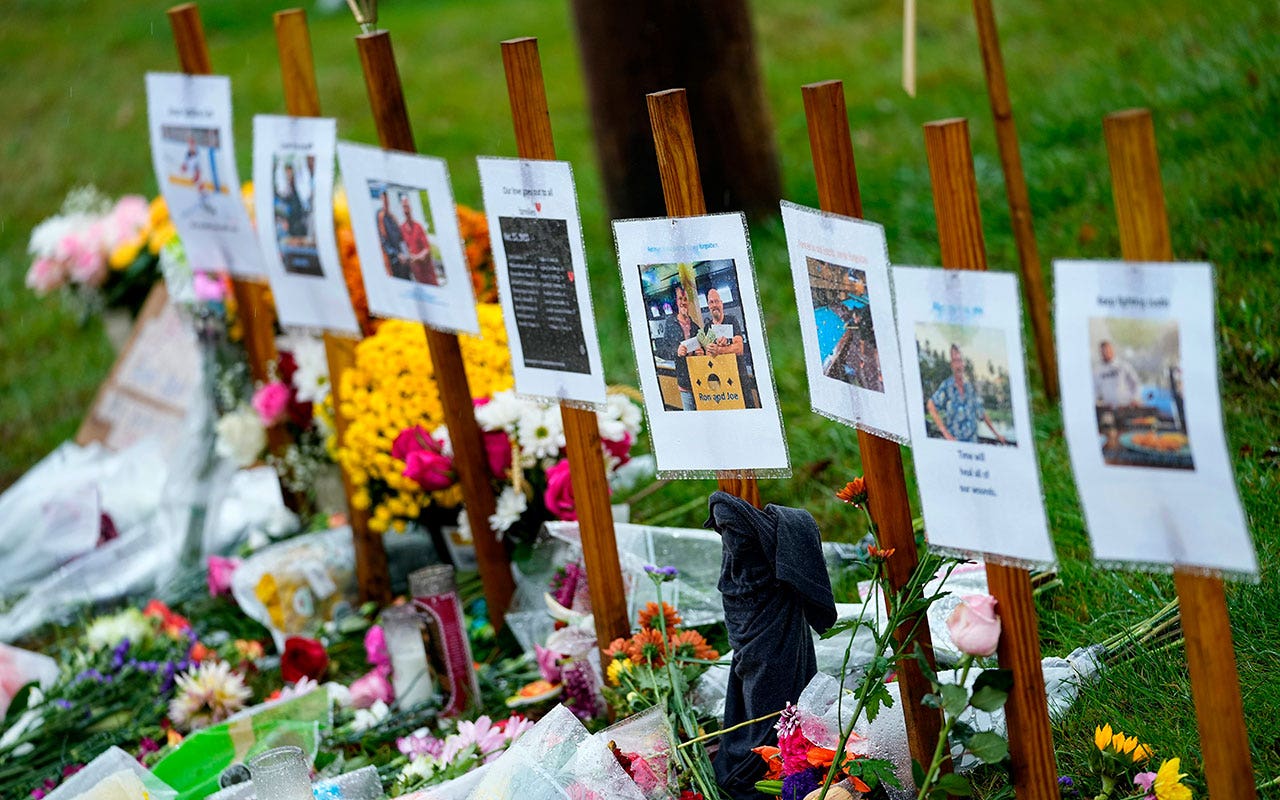
Rain-soaked memorials for those who died in a mass shooting sit along the roadside by Schemengees Bar & Grille, on Oct. 30, 2023, in Lewiston, Maine. An independent commission investigating this deadliest shooting in Maine history is set to hear from state police on Feb. 15, 2024, the lead law enforcement agency. (AP Photo/Matt York, File)
Both police and the Army were warned that Card was suffering from deteriorating mental heath in the months before the shooting.
In May, relatives warned police that the 40-year-old Card was sinking into paranoia, and they expressed concern about his access to guns. In July, Card was hospitalized for two weeks after shoving a fellow reservist and locking himself in a motel room during training in upstate New York. In August, the Army barred him from handling weapons on duty and declared him nondeployable.
LEWISTON, MAINE SHOOTING INVESTIGATION COMMISSION SEEKS TO OBTAIN GUNMAN’S MILITARY RECORDS
Then in September, a fellow reservist provided a stark warning, telling an Army superior that Card was going to “snap and do a mass shooting.”
Army officials later downplayed the warning, but it prompted local police to go to Card’s home in Bowdoin to check on him. Card didn’t come to the door and the deputy said he didn’t have legal authority under Maine’s yellow card law to knock in the door.
The deputy told the commission that an Army official suggested letting the situation “simmer” rather than forcing a confrontation. The deputy also received assurances from Card’s family that they were removing his access to guns.
Read the full article from Here

Connecticut
New Haven asks for retrial after jury awards Connecticut man $38M in wrongful conviction lawsuit

NEW HAVEN, Conn. — The City of New Haven is asking for a retrial after a jury awarded a Connecticut man $38 million in May for being wrongfully convicted of murder and imprisoned for 21 years.
Stefon Morant was allegedly wrongfully convicted of a double homicide in 1994. According to the New York-based law firm of Neufeld Scheck Brustin Hoffmann & Freudenberger, LLP, the jury ruled New Haven police officers and the City of New Haven were liable for his wrongful imprisonment.
The jury found that New Haven police detectives made up false evidence to frame Morant and that the city was liable for suppressing evidence favorable to criminal defendants.
A judge has issued a temporary stay, pausing any payments until the motion is resolved.

PORTLAND (WGME) — The third annual Celebration of America 300 is set for Thursday night at Oxford Plains Speedway.
This race was a favorite of NASCAR star Kyle Busch, who tragically passed away back in May. He was just 41.
Now, a Maine-born driver who worked on Busch’s team is ready to take the 8 car into victory lane.
For the past five years, Windham native Derek Kneeland was Busch’s eye in the sky, working as a spotter for the cup star. Kneeland says his relationship with Busch was like a brotherhood.
“I was fortunate enough where I got to have a personal relationship with him,” Kneeland said. “He came up, and he ran several races with me in late models and stuff at Oxford and Lee Speedway, and we got to do a lot of cool things together.”
Kneeland says dealing with the sudden loss has been both painful and difficult.
“It’s still hard,” Kneeland said. “I’m having a hard time with it. The weekdays are the hardest. At the track is where I’m most comfortable.”
Kneeland will be at the track and behind the wheel Thursday night, competing in the Celebration of America 300, driving the number 8 car.
“You know, a few days after everything went down, his dad called me, and his dad is a man of very few words, and I said, ‘You know, I’m thinking about running the 8 or 51 as long as I have your guys’ blessing, I would like to do that.’ And he said, ‘Short track world knows him as 51, but the world knows him as 8,’” Kneeland said.
Kneeland says it will be an emotional race, but he’s confident he’ll have a special co-pilot leading the way.
“Hoping he’s going to be on my shoulder and give me the guiding way and but to win it for Kyle, I think that would put the stamp on it,” Kneeland said.

Approximately eight million gallons of wastewater are currently being discharged into the river per day.
HAVERHILL, Mass. (WWLP) – Those traveling for the Fourth of July weekend are being advised of a wastewater pipe break on the Merrimack River.
The Massachusetts Environmental Police stated that over the weekend, a major wastewater pipe in Haverhill broke, releasing millions of gallons of sewage into the river. The broken pipe was carrying wastewater from the main pumping station to the treatment plant.
Police estimate that approximately eight million gallons of wastewater are currently being discharged into the river per day.
At this time, fishing in the river is not prohibited, and the estuaries and beaches remain open. However, the information is being released to the public to help community members be aware of current conditions and use caution.
To access more information on water quality testing results, you can visit the official DPH website. Updates will be provided as more information becomes available.
Local News Headlines
WWLP-22News, an NBC affiliate, began broadcasting in March 1953 to provide local news, network, syndicated, and local programming to western Massachusetts. Download the 22News Plus app on your TV to watch live-streaming newscasts and video on demand.
-
Arkansas3 minutes ago
Arkansas Lottery Powerball, Cash 3 winning numbers for June 29, 2026
-
 California8 minutes ago
What you should know about the $351.7 billion state budget Newsom just signed
-
Colorado15 minutes ago
Colorado Democrats choose between insurgent progressives and veteran incumbents
-

 Connecticut18 minutes ago
New Haven asks for retrial after jury awards Connecticut man $38M in wrongful conviction lawsuit
-

 Delaware23 minutes ago
Rutgers Basketball Adds St. Peter’s and Delaware State to 2026-27 Non-Conference Schedule
-

 Florida30 minutes ago
50 tons of South Florida aid headed to Venezuela following earthquakes
-

 Georgia32 minutes ago
MLB's No. 39 Draft prospect Daniel Jackson of Georgia wins 2026 Golden Spikes Award
-

 Hawaii38 minutes ago
Historic Hawaiian Kukui Tree Cut Down After Nearly 30 Years at Disney’s Polynesian Village Resort – WDWNT


