Northeast
Baltimore bridge collapse survivor 'fought for his life' after car plunged into river

One of two construction workers who survived the Francis Scott Key Bridge collapse in Baltimore on March 26 is alleging that workers were not told to evacuate as the Dali cargo ship approached a support beam on the bridge.
Attorneys representing Julio Cervantes Suarez told reporters on Monday that workers were taking a break in their cars on the bridge when the cargo ship crashed into the bridge, causing the collapse that killed six construction workers and injured two others. Authorities are still working to recover two of the six deceased after a fourth body was recovered on Monday.
“He fought for his life, and he survived,” attorney Justin Miller told reporters of Suarez during a Monday press conference recorded by FOX 45 Baltimore.
Attorney L. Chris Stewart told the outlet that Suarez was able to narrowly escape the collapse with his life because the windows of his vehicle were manual. Suarez was able to roll his windows down and escape when his car plunged into the Patapsco River while others were trapped.
BALTIMORE BRIDGE COLLAPSE: SALVAGE CREWS RACE AGAINST CLOCK AFTER FOURTH BODY FOUND, FBI LAUNCHES PROBE
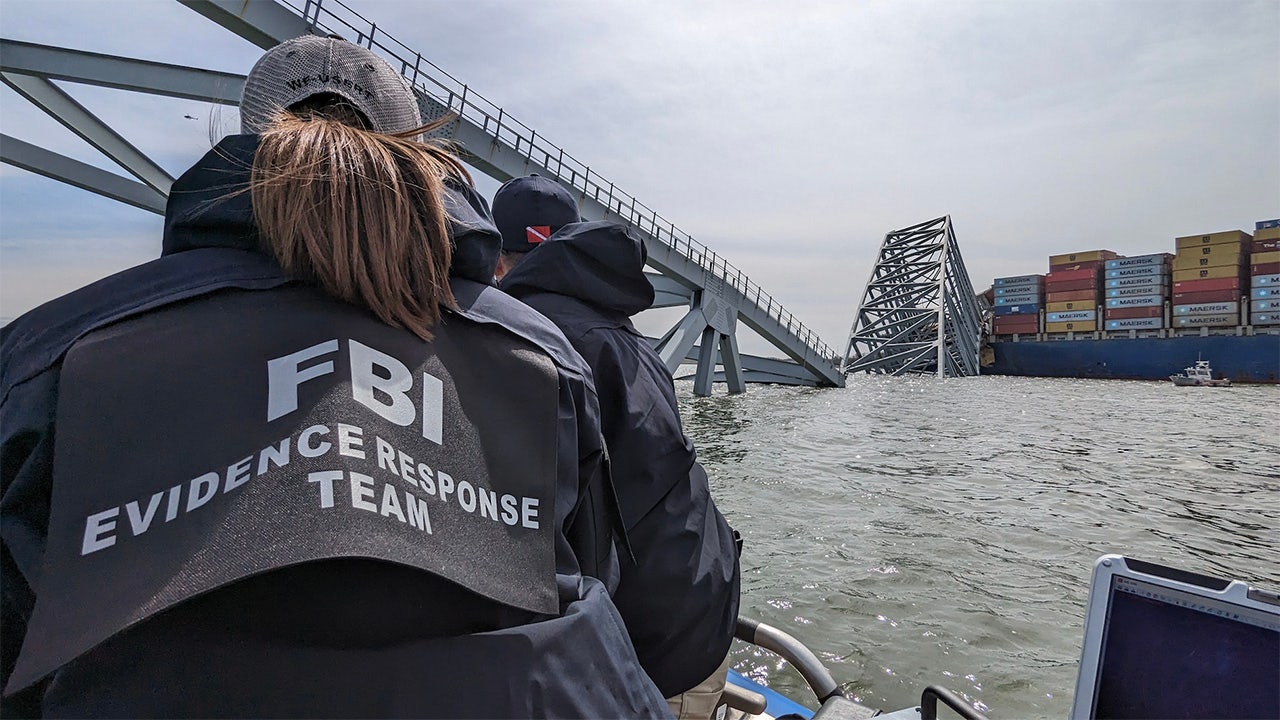
FBI Evidence Response Team members work at the site of the Francis Scott Key Bridge collapse in Baltimore on Tuesday, March 26, 2024. (FBI)
“They were living the American dream. Fixing America’s infrastructure,” Stewart said of the workers on the bridge that day, adding that the six deaths resulting from the collapse were “all preventable.”
Stewart noted that some of the workers were related, and Suarez lost some of his family members in the freak collision.
FBI OPENS CRIMINAL PROBE INTO BALTIMORE BRIDGE COLLAPSE: SOURCE
Attorneys Justin Miller, left, and L. Chris Stewart speak about their client Julio Suarez’s fight for survival during the Key Bridge collapse on March 26. (WBFF)
“It’s left him with severe mental and emotional pain and suffering,” Stewart said of his client. “He lost family members in that. Some of the workers were related, including some of his family who perished.”
AUTHORITIES RECOVER FOURTH BODY FROM FRANCIS SCOTT KEY BRIDGE WRECKAGE IN BALTIMORE
The Francis Scott Key Bridge is seen after collapsing into the water in Baltimore on March 26, 2024. A cargo ship struck a support beam on the bridge, causing it to fall into the Patapsco River. (Baltimore Fire Rescue)
Suarez does not know how to swim but was able to hang on to a piece of debris in the water, Stewart said.
“He survived because his window was manual. He was able to roll down the window and escape. And then he was able to hang on to some drifting steel and survive,” the attorney explained.
BALTIMORE BRIDGE COLLAPSE: SECOND TEMPORARY CHANNEL OPENED, ROUGH WEATHER SLOWS DEBRIS REMOVAL
According to reports, rescuers are still searching for people, while two survivors have been pulled from the Patapsco River. (Tasos Katopodis/Getty Images)
Attorneys on Monday announced that they will be conducting an independent investigation into Grace Ocean, which owns the Dali. The FBI also announced on Monday that it has opened a criminal investigation into the collapse.
Grace Ocean filed for legal protection of its assets earlier this month, attorneys noted during Monday’s press conference.
MARYLAND GOVERNOR SAYS CONDITIONS ARE ‘UNSAFE’ FOR RESCUE DIVERS AFTER BRIDGE COLLAPSE
The Francis Scott Key Bridge, a major span over the Patapsco River in Baltimore, collapsed after it was struck by a large cargo ship, prompting a massive emergency response for multiple people in the water in Maryland on Tuesday, March 26, 2024. (Jasper Colt/USA Today)
“The Casualty was not due to any fault, neglect, or want of care on the part of Petitioners, the Vessel, or any persons or entities for whose acts Petitioners may be responsible,” the petition states. “…Petitioners claim exoneration from liability for any and all losses or damage arising out of the Casualty and from any and all claims for damages that have been or may be filed. Petitioners further allege that they have valid defenses to any and all such claims.”
An attorney representing Grace Ocean and Synergy Marine did not immediately respond to an inquiry from Fox News Digital.
Read the full article from Here



Pittsburgh voted best Fourth of July celebration in America
In 2026, Pittsburgh gets the bragging rights for the nation’s Best Fourth of July Celebration, as determined by voters in USA Today 10BEST Readers’ Choice Awards.
Pittsburgh has long been known for its connections to horror films starting with George A. Romero’s Night of the Living Dead in 1968.
Now, in honor of that designation and the legacy of Romero, who died in 2016, the Pittsburgh Film Festival has announced it is introducing a new award this year.
The inaugural Romero Awardfor Best Horror Feature will be presented at the 45th annual Three Rivers Film Festival, scheduled to run from Nov. 4-15, according to the group’s website. Presented with support from the George A. Romero Foundation, the award will be selected by a panel of industry judges.
Named in honor of Romero, the award celebrates bold, visionary work in the horror genre. As the birthplace of Night of the Living Dead, Pittsburgh remains a vital home for horror storytelling, making the Romero Award a natural addition to the festival’s juried honors, the group said.
“The GARF is devoted to preserving Romero’s legacy and continues to support creatives and independent filmmaking in genres and horror spaces,” Suzanne Romero, George’s widow and founder and president of the George A. Romero Foundation, said recently. She died June 24 at her home in Toronto after a long illness.
Film Pittsburgh’s executive director, Shanna Carrick, added, “We are proud to partner with the GARF to introduce an international competition for best independent horror film. Pittsburgh has a deep love of horror films and we believe that our audiences will be thrilled to experience new voices in the genre.”
The festival is currently accepting submissions, with the full lineup to be announced in October.
The festival will also continue to celebrate its horror offerings with its beloved Chiller Theater, named in honor of the late Pittsburgh horror show host Chilly Billy Cardille. The spooky showcase features the best new independent horror shorts from around the globe and Allegheny County.

Powerball, Mega Millions jackpots: What to know in case you win
Here’s what to know in case you win the Powerball or Mega Millions jackpot.
Just the FAQs, USA TODAY
The Connecticut Lottery offers several draw games for those willing to make a bet to win big.
Those who want to play in Connecticut can enter the CT Lotto, Millionaire for Life and Cash 5 games as well as play the national Powerball and Mega Millions games. There are also two drawings a day for the Play 3 with Wild Ball and Play 4 with Wild Ball games.
Drawings are held at regular days and times, check the end of this story to see the schedule.
Here’s a look at Sunday, June 28, 2026 results for each game:
Winning Cash 5 numbers from June 28 drawing
03-09-10-28-35
Check Cash 5 payouts and previous drawings here.
Winning Play3 numbers from June 28 drawing
Day: 2-9-9, WB: 8
Night: 4-1-0, WB: 1
Check Play3 payouts and previous drawings here.
Winning Play4 numbers from June 28 drawing
Day: 2-7-6-6, WB: 9
Night: 1-9-7-4, WB: 4
Check Play4 payouts and previous drawings here.
Winning Millionaire for Life numbers from June 28 drawing
04-11-31-54-58, Bonus: 03
Check Millionaire for Life payouts and previous drawings here.
Feeling lucky? Explore the latest lottery news & results
Are you a winner? Here’s how to claim your lottery prize
Connecticut Lottery prizes up to $599 can be easily claimed at any authorized CT Lottery Retailer without additional forms or documentation or by mail. For prizes between $600 and $5,000, winners have the option to claim by mail or in person at any CT Lottery High-Tier Claim Center or CT Lottery Headquarters. For prizes between $5,001 and $49,999, winnings must be claimed in person at the Connecticut Lottery headquarters or by mail. All prizes over $50,000 must be claimed in person at CT Lottery Headquarters. Winners are required to bring a government-issued photo ID and their Social Security card.
CT Lottery Claims Dept.
15 Sterling Drive
Wallingford, CT 06492
For additional details, including locations of High-Tier Claim Centers, visit the Connecticut Lottery’s claim information page.
When are the Connecticut Lottery drawings held?
- Powerball: 10:59 p.m. on Monday, Wednesday, and Saturday.
- Mega Millions: 11 p.m. on Tuesday and Friday.
- Lucky for Life: 10:30 p.m. daily.
- Lotto: 10:38 p.m. on Tuesday and Friday.
- Cash 5: 10:29 p.m. daily.
- Play3 Day: 1:57 p.m. daily.
- Play3 Night: 10:29 p.m. daily.
- Play4 Day: 1:57 p.m. daily.
- Play4 Night: 10:29 p.m. daily.
- Millionaire for Life: 11:15 p.m. daily.
This results page was generated automatically using information from TinBu and a template written and reviewed by a Connecticut editor. You can send feedback using this form.

Maine’s blueberry barrens, which have been part of the state’s iconic scenery since before Europeans first arrived, are not as permanent as some might think.
Many are not just used for growing the state’s signature wild fruit, but also are beloved spots for hiking, hunting and picnicking, and provide important habitat and food for many species of animals and birds. The barrens are also testament to an ancient, and continuing, interplay of human stewardship and the unique features of the land.
But the fate of these Maine landscapes is increasingly uncertain, and preserving them for future generations is not so simple, according to land stewards and nonprofit groups that help protect parcels throughout the midcoast from being developed.
More than a thousand acres of blueberry land are currently on the market or have been sold recently. Larger blueberry producers are withdrawing from the region in the face of low prices and the intensifying effects of climate change, which has made weather patterns more erratic, sometimes whipsawing between early frosts, soggy conditions and drought in a single growing season.
Adding to the uncertainty is the fact that some large tracts of blueberry land that were for sale have recently been withdrawn from the market. Some of this land appears to be being cultivated for berries again this year, though it’s unclear whether it will be put back up for sale after the harvest.
“With what’s happening with our blueberry land, we’re seeing how vulnerable we are when private corporations have been holding or stewarding something that is a community asset and a part of the community’s local food system,” said Alivia Moore, a citizen of the Penobscot Nation and co-director of Niweskok, a Wabanaki-led nonprofit focused on reconnecting Wabanaki people with the land and their cultural food systems. The group has a farm and education center in Swanville.
The midcoast blueberry parcels that are for sale include several plots owned by Wyman’s, including 122 acres on Clarry Hill in Union priced at $499,000 and 40 acres in Penobscot being sold for $299,000. It also includes a 247-acre parcel known as Patterson Hill in Belfast being sold for $1.8 million by a member of the family that operates Allen’s Wild Maine Blueberries.
Worried that this land will be lost to development, a couple of local efforts have sprung up in recent months to try to protect some blueberry land. A group of women in Searsport is gaining traction in their effort to raise $750,000 to save more than 150 acres of land being sold by Wyman’s.
And on June 15, Northport voters overwhelmingly approved a moratorium on new RV parks, “glampgrounds” and event centers after a Massachusetts couple bought over 100 acres, much of it in blueberry barrens, with plans to turn the parcel into an RV park with up to 80 sites and geodesic domes.
Wyman’s did not respond to requests for comment.
In neighboring Hancock County, a would-be developer faced strong local opposition last year to converting a Blue Hill blueberry barren into house lots. He ended up selling the 38-acre property, which used to be owned by blueberry businessman Kermit Allen, to the project’s opponents.
Small-scale blueberry producers have also stepped in in some cases to buy fields or contract with land trusts to manage blueberry fields they already steward. But despite public concern, and the unusually large amount of blueberry land currently at stake, there is no large-scale coordinated effort to protect the midcoast’s blueberry barrens from being developed into new uses.
When it comes to an emblem of local culture, “blueberries are second only to lobsters,” said Ian Stewart, the executive director of Coastal Mountains Land Trust, which is headquartered in Camden.
But “it’s hard to react” to so much blueberry land being on the market at the same time, he said.
It’s not that people don’t care, Stewart said. His group, which manages large blueberry barrens at its Beech Hill Preserve in Rockport, hears frequently from people who are worried that this land will be lost to development.
Many local land trusts already have some blueberry land in their portfolios but adding more presents real challenges, he said. The land needs to be managed in perpetuity in order to keep it from reverting back to forest, and finding people to take that on isn’t easy.

When the land trust protects a block of forest, it takes a “fairly hands-off approach,” Stewart said. It may just leave the forest alone, or manage invasive species, or build a trail.
“Blueberry land is quite the opposite,” he said. It requires mowing and bushogging in perpetuity, otherwise it will revert to scrub and then forest.
Coastal Mountains has a reserve account for maintaining its blueberry land at Beech Hill. Stewart estimates that it costs $25,000 to $35,000 per year in staff time and other costs to manage the land trust’s blueberry land.
It’s with these costs in mind that the land trust evaluates opportunities to conserve more blueberry land.
“We’re aware that it is a real investment, so we don’t take it on lightly,” Stewart said.
“Conservation isn’t the tool that keeps [this land] blueberries,” said Linnea Patterson, land conservation manager at Georges River Land Trust, which is headquartered in Rockland. “Managing is what keeps it blueberries. And a lot of land trusts aren’t equipped to become a commercial-scale blueberry grower or steward.”
The fact that many of the parcels currently for sale cost hundreds of thousands of dollars makes conserving some of the tracts on the market even more challenging, she said.
Still, she says that blueberry barrens have a lot of qualities that make them good candidates for conservation such as scenic views, habitat, and potential for public access.
Georges River Land Trust currently works with blueberry growers at two of its preserves and the land trust is eager to help find a solution to protecting the region’s blueberry landscapes, Patterson said.
“It’s a very emotional thing to think about losing native Maine blueberry fields,” she said.
Moore, of Niweskok, said the current moment presents “an important, sudden, fragile opportunity.”
Wabanaki people are a big part of the reason we have so many blueberry barrens in Maine, she points out. “Yes, it’s the soils, it’s the topography, it’s the geology. It’s also the millenia of relationship and stewardship of Wabanaki people.”
That relationship, which she characterized as “caretaking for collective abundance,” provides a way forward that could help protect land and also restore communities’ stewardship of the land.
This could include land trusts, farming coops and other grassroots efforts to protect and care for the land, she said.
“I think there’s a really important opportunity with so much land [listed] for sale right now where we can reorient and shift away from private land holding of something that really needs to be part of stabilizing our local food system and putting it back into local community control,” Moore said.
One grassroots effort, The Wild Blueberry Collective, has been organizing to protect a tract of land that Wyman’s is selling in Searsport. They have approached land trusts but found the groups were able to offer resources, but not to take on the effort to buy the land.
“It feels like the way to make this happen is through grassroots organizing,” she said.
Instead of putting the land directly on the market, Wyman’s has offered the group a purchase and sale agreement if they can raise the funds by October. To date, the group has raised $100,000 in grants and $35,000 from donors and small fundraisers. They also have an agreement with an entity that will loan them half of the money if they can come up with the first half, said Gloria Pearse, though she declined to provide more specifics about the agreement.
While the collective is currently focused on fundraising to protect the parcel in Searsport, they would not be opposed to working to protect other blueberry landscapes, Pearse said.
“Land is being developed and here’s our opportunity to protect the reason why we like where we live,” she said. “This is the time to save that land.”
-

 Seattle, WA4 minutes ago
Seattle Mariners acquire INF Buddy Kennedy from San Francisco
-

 San Diego, CA11 minutes ago
Feds Will Finally Help Oceanside 73 Years After Admitting Fault for Its Disappearing Beaches
-

 Milwaukee, WI14 minutes ago
Brewers open 4-game series with the Reds
-

 Atlanta, GA19 minutes ago
Atlanta Braves Manager Makes Honest Statement After Giants Game
-

 Minneapolis, MN26 minutes ago
MN weather: Extreme Heat Warning issued for Minnesota Monday
-

 Indianapolis, IN29 minutes ago
Where to find cooling stations in central Indiana
-

 Pittsburg, PA34 minutes ago
Pittsburgh horror film history honored with new award
-

 Augusta, GA41 minutes ago
Augusta Fire Department holds hurricane season preparedness event

