Midwest
Kansas brothers on death row for 'Wichita massacre' quadruple killing seek resentencing hearing

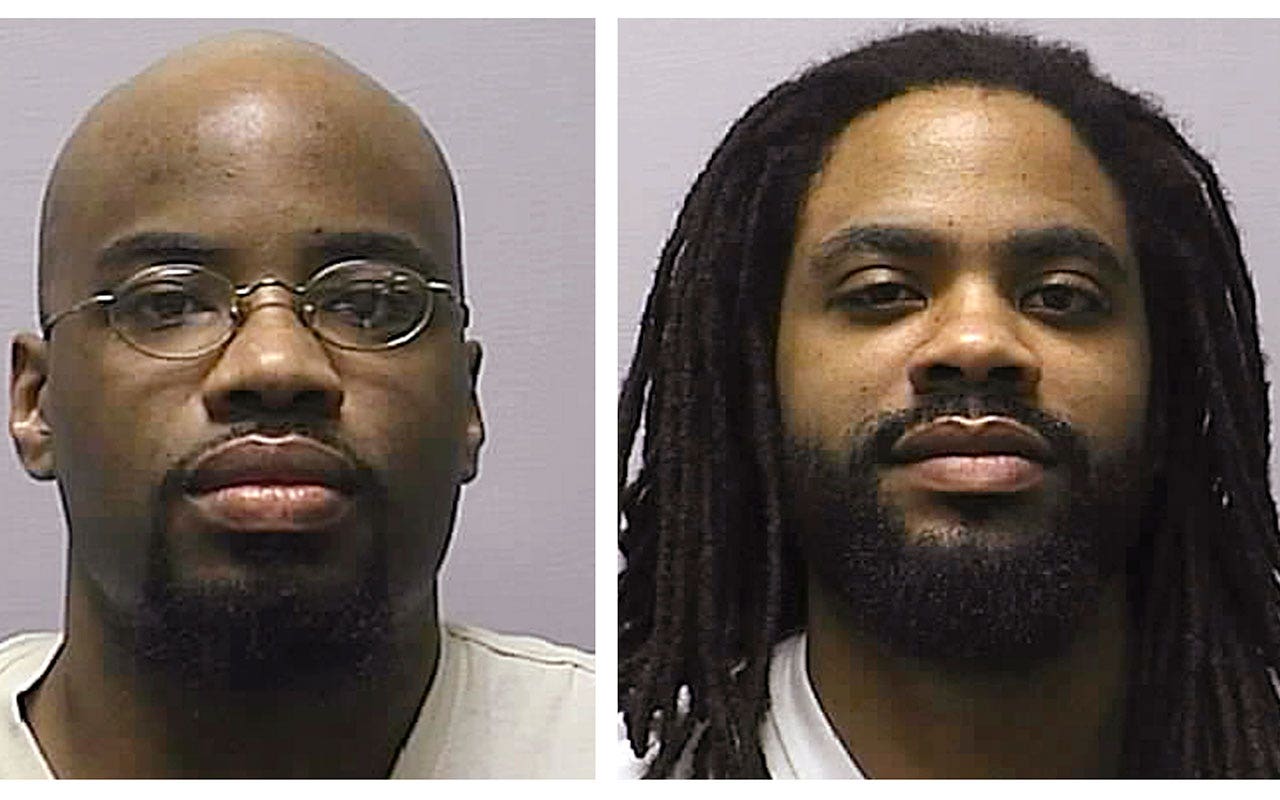
- Attorneys representing two brothers sentenced to death in the “Wichita massacre” quadruple killing will argue on Monday for a formal resentencing hearing.
- Jonathan and Reginald Carr allegedly forced five victims into sexual acts and robbed them before fatally shooting them in 2000.
- Kansas currently has nine men on death row, with no executions since 1965.
Attorneys for two brothers who were sentenced to die in a quadruple killing known as the “Wichita massacre” will argue Monday for a formal resentencing hearing, the latest in a long series of appeals.
How the sentencing was handled has long been a point of contention because the two brothers — Jonathan and Reginald Carr — had a joint hearing when jurors considered their punishments. Prosecutors plan to oppose the latest effort.
The prosecution has long argued that the brothers broke into a home in December 2000 and forced the three men and two women there to have sex with one another and later to withdraw money from ATMs. Jonathan Carr was 20 and Reginald Carr was 23 when the murders occurred; they are now 44 and 46, and both are incarcerated at the state’s maximum-security prison in El Dorado, about 30 miles northeast of Wichita.
US SUPREME COURT REFUSES TO HEAR APPEALS FROM ‘WICHITA MASSACRE’
According to authorities, the women were raped repeatedly before all five victims were taken to a soccer field and shot. Four of them died: Aaron Sander, 29; Brad Heyka, 27; Jason Befort, 26; and Heather Muller, 25. The woman who survived testified against the Carr brothers. They were also convicted of killing another person in a separate attack.
This combination of 2013 file photos provided by the Kansas Department of Corrections shows Reginald Carr, left, and Jonathan Carr. Attorneys for two brothers who were sentenced to die in a quadruple killing known as the “Wichita massacre” will argue on Monday for a formal resentencing hearing. (Kansas Department of Corrections via AP, File)
Each of the brothers accused the other of carrying out the crimes.
Kansas has nine men on death row, but the state has not executed anyone since the murderous duo James Latham and George York were hanged on the same day in June 1965.
Attorneys for both brothers raised concerns in the latest round of court filings that the trial attorneys were ineffective — Reginald Carr’s defense said they were “egregiously” so — and failed to aggressively push for a continuance to give themselves more time to prepare. They also agreed that prospective jurors weren’t properly questioned about racial biases. The brothers are Black, their victims white.
SUSPECTS CHARGED WITH KILLING KANSAS WOMEN BELONGED TO ANTI-GOVERNMENT ‘GOD’S MISFITS’ GROUP, AFFIDAVIT SAYS
Reginald Carr’s attorney’s also brought up an investigation into members of the Wichita Police Department exchanging racist, sexist and homophobic texts and images. Several were ultimately disciplined, and Carr’s attorney wrote that one of them was involved in the investigation of the brothers.
From there, the attorneys for the brothers deviate in their court filings. Jonathan Carr’s attorneys argued that the trial attorneys failed to investigate and present evidence that Reginald Carr, who is older, had a powerful influence over his younger brother and sexually abused him. A Kansas Department of Correction evaluation conducted just days after Jonathan Carr was sentenced to death said he “appears to idolize his brother,” his attorneys wrote.
Meanwhile, Reginald Carr’s attorneys wrote the trial attorneys were unprepared to rebut Jonathan’s defense, which it described as “largely consisting of family members prepped to promote saving Jonathan Carr’s life over his older brother’s life.” And they further argued that DNA evidence and identification was actually stronger against Jonathan Carr.
Last year, the U.S. Supreme Court refused to request a formal resentencing hearing for each defendant. That action came a little less than a year after the Kansas Supreme Court ruled that the two brothers had received fair trials and upheld their death sentences.
The Kansas court upheld their convictions in 2014 but overturned their death sentences, concluding that not having separate hearings violated the U.S. Constitution. The U.S. Supreme Court reversed that decision in 2016, returning the case to the Kansas Supreme Court.
When the Kansas Supreme Court took up the brothers’ cases again, their attorneys raised questions about how their cases weren’t conducted separately when jurors were considering whether the death penalty was warranted. Other issues they raised included the instructions that were given to jurors and how closing arguments were conducted.
The Kansas court’s majority concluded that while the lower-court judge and prosecutors made errors, those errors did not warrant overturning their death sentences again.
Read the full article from Here

The Missouri Lottery offers several draw games for those aiming to win big.
Here’s a look at July 3, 2026, results for each game:
Winning Mega Millions numbers from July 3 drawing
05-09-29-47-57, Mega Ball: 16
Check Mega Millions payouts and previous drawings here.
Winning Pick 3 numbers from July 3 drawing
Midday: 1-7-3
Midday Wild: 6
Evening: 9-9-8
Evening Wild: 4
Check Pick 3 payouts and previous drawings here.
Winning Pick 4 numbers from July 3 drawing
Midday: 6-9-7-0
Midday Wild: 0
Evening: 9-3-1-1
Evening Wild: 6
Check Pick 4 payouts and previous drawings here.
Winning Cash Pop numbers from July 3 drawing
Early Bird: 13
Morning: 12
Matinee: 05
Prime Time: 07
Night Owl: 05
Check Cash Pop payouts and previous drawings here.
Winning Show Me Cash numbers from July 3 drawing
02-04-07-22-36
Check Show Me Cash payouts and previous drawings here.
Feeling lucky? Explore the latest lottery news & results
Are you a winner? Here’s how to claim your lottery prize
All Missouri Lottery retailers can redeem prizes up to $600. For prizes over $600, winners have the option to submit their claim by mail or in person at one of Missouri Lottery’s regional offices, by appointment only.
To claim by mail, complete a Missouri Lottery winner claim form, sign your winning ticket, and include a copy of your government-issued photo ID along with a completed IRS Form W-9. Ensure your name, address, telephone number and signature are on the back of your ticket. Claims should be mailed to:
Ticket Redemption
Missouri Lottery
P.O. Box 7777
Jefferson City, MO 65102-7777
For in-person claims, visit the Missouri Lottery Headquarters in Jefferson City or one of the regional offices in Kansas City, Springfield or St. Louis. Be sure to call ahead to verify hours and check if an appointment is required.
For additional instructions or to download the claim form, visit the Missouri Lottery prize claim page.
When are the Missouri Lottery drawings held?
- Powerball: 9:59 p.m. Monday, Wednesday and Saturday.
- Mega Millions: 10 p.m. Tuesday and Friday.
- Pick 3: 12:45 p.m. (Midday) and 8:59 p.m. (Evening) daily.
- Pick 4: 12:45 p.m. (Midday) and 8:59 p.m. (Evening) daily.
- Cash4Life: 8 p.m. daily.
- Cash Pop: 8 a.m. (Early Bird), 11 a.m. (Late Morning), 3 p.m. (Matinee), 7 p.m. (Prime Time) and 11 p.m. (Night Owl) daily.
- Show Me Cash: 8:59 p.m. daily.
- Lotto: 8:59 p.m. Wednesday and Saturday.
- Powerball Double Play: 9:59 p.m. Monday, Wednesday and Saturday.
This results page was generated automatically using information from TinBu and a template written and reviewed by a Missouri editor. You can send feedback using this form.

So, 6:15 kickoff, an average game length of just under 3 & 1/2 hrs (3:26 is the avg.) plus the 30 minute break to set up afterward (which might be generous) and we’re looking at the show starting at around 10:15 after the game.
So, thoughts on North Dakota post-game concert:
A) Yes, please, love it!
B) Pass on Cole Swindell, but open to the idea.
C) Nope nope, game day by itself is plenty.

BOWMAN COUNTY, N.D. — A 67-year-old Bowman, North Dakota, man is dead following a crash in southwestern North Dakota Friday morning, July 3.
According to a North Dakota Highway Patrol news release, at approximately 8:45 a.m. Friday, a 2019 Dodge Ram 1500, driven by the Bowman man, was traveling westbound on Highway 12 near mile marker 30, west of Bowman. The man experienced a suspected medical incident, causing the vehicle to leave the roadway to the left and enter the south ditch, the release said.
The vehicle continued westbound through the ditch, where the front of the vehicle struck a tree. After the impact, the vehicle traveled onto a gravel frontage road before coming to rest in the ditch. The man was transported by Bowman Ambulance Service to Bowman Hospital, where he was pronounced dead.
The man was wearing his seat belt.
The crash remains under investigation by the North Dakota Highway Patrol.
Our newsroom occasionally reports stories under a byline of “staff.” Often, the “staff” byline is used when rewriting basic news briefs that originate from official sources, such as a city press release about a road closure, and which require little or no reporting. At times, this byline is used when a news story includes numerous authors or when the story is formed by aggregating previously reported news from various sources. If outside sources are used, it is noted within the story.
-

 Mississippi1 minute ago
Mississippi Lottery Mississippi Match 5, Cash 3 results for July 3, 2026
-
Missouri6 minutes ago
Missouri Lottery Mega Millions, Pick 3 winning numbers for July 3, 2026
-
Montana13 minutes ago
Montana Lottery Mega Millions, Big Sky Bonus results for July 3, 2026
-

 Nebraska16 minutes ago
NEBRASKA REACTS Survey Results: Husker Football Plus a Concert? Here’s What You Said
-

 Nevada21 minutes ago
Exclusive | California’s illegal fireworks trade fueled by nefarious interstate pipeline
-

 New Hampshire28 minutes ago
Fireworks Near Me: July 4th Events Around Concord For 2026
-

 New Jersey31 minutes ago
New Jersey has had an image problem for 250 years. We love it anyway
-

 New Mexico36 minutes ago
New Mexico father, son reunite in El Paso after 3-year abduction

