West
Police nationwide using high-tech weapon to apprehend suspects without injury: bodycam

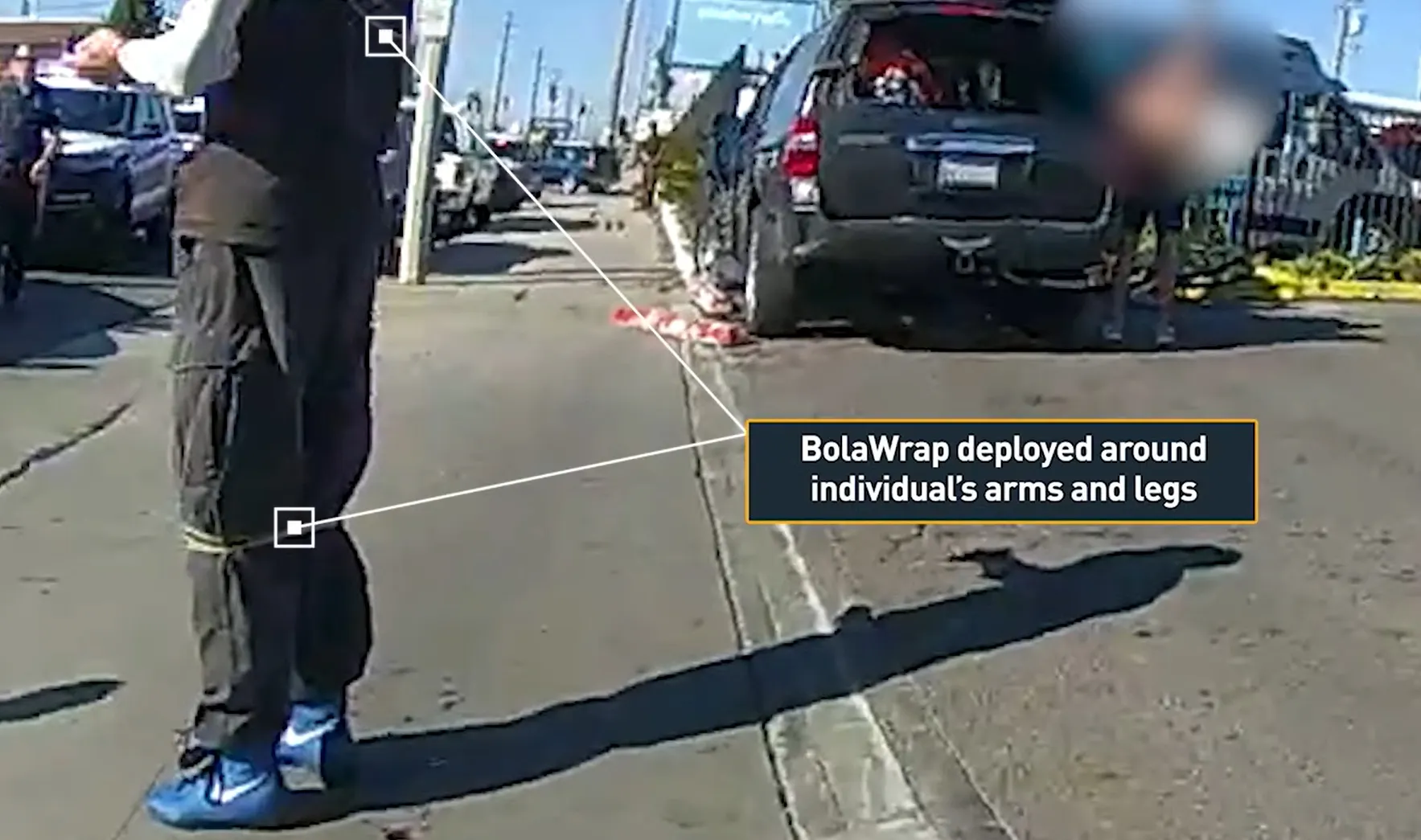
Several bodycam videos show police officers ending foot chases and taking down emotionally disturbed gunmen after shots rang out by wrapping them in wires from a distance.
The responding officers immobilize out-of-control suspects, who appear to be going through a mental health crisis or were on drugs, without hurting their targets and de-escalate situations that in the past might have spiraled out of control and ended in deaths.
It’s part of a “High Purpose Police Movement” that coincides with increased police run-ins with erratic suspects, who are 10 times more likely to be involved in a fatal law enforcement confrontation, according to the National Alliance on Mental Illness (NAMI).
Fairfax County, Virginia, Police Chief Kevin Davis said it “prioritizes safety and emphasizes de-escalation” and it’s “expected to transform our incident resolution capacity, especially in crisis situations.”
UNSOLVED CASE WITH CONSTANTLY CHANGING CAUSES OF DEATH TORE FAMILY APART, LED TO VICTIM’S SISTER’S SUICIDE: ‘I WANT ANSWERS’
A suspect is heard in the bodycam video saying, “I don’t have control of my body. You’re trying to decapitate me out here,” but the new tech wraps the erratic suspect without pain and allows police to take him into custody. (Mountlake Terrace Police Department via WRAP)
As tools are pulled from law enforcement’s toolbox, including physical restraints like certain choke holds, which are banned in about half the states, they need to be replaced.
That’s where technology, like the hand-held restraint device dubbed “the Bola” comes in.
In several bodycam videos of police in Mountlake Terrace, Washington state, which were shared with Fox News Digital, responding officers yell commands like “Prepping Bola” before launching the device.
SLAIN ARTIST PENS FOREBODING POST BEFORE CLASSMATE WITH MURDER MANIFESTO ALLEGEDLY STABS HER 37 TIMES
An armed suspect is immobilized and subdued from a distance without any injuries. (Mountlake Terrace Police Department via WRAP)
In each video, the suspect is immobilized and on the ground without hand-to-hand combat or the use of a firearm. In one video, a gunman threatened to open fire.
A couple of shots were heard in the background, but no one was injured, and the video shows the captured suspect wrapped like a Spider-Man villain and taken into custody.
WATCH: Police bring down armed suspect in bodycam footage
Scot Cohen, CEO of WRAP, said the mental health crisis, especially in major cities, is worsening every year, and responding officers are dispatched to tumultuous scenes where anything can happen.
“Thousands of people who get in violent altercations with police each year are battling a mental health crisis,” Cohen told Fox News Digital. “Our tools don’t hurt people to get them the help they need, whereas other tools that have been used in the past rely on pain-compliance.”
“While there are surely many cases where force is the only way to subdue a suspect, there are many others where force is not necessary.”
WOMAN WHO SURVIVED SEX ASSAULT AS TEEN REACTS TO JUDGE BENCHED AFTER OVERTURNING HER ATTACKER’S CONVICTION
The restraint wraps wires around the suspect and immobilizes him/her. (Mountlake Terrace Police Department via WRAP)
The Fairfax County Police Department, which is near the nation’s capital, is the latest department to implement the new technology after a pilot program that started in November 2022.
“With a number of positive outcomes achieved, the department determined the deployment of BolaWrap to all patrol officers would be an invaluable asset to our police toolkit,” the Fairfax County Police Department said in a press release.
Fairfax County police in Virginia show how the hand-held restraint device called “the Bola” works. (Fairfax County Police Department)
Mental health and opioid crisis
Police and WRAP sent Fox News Digital several bodycam videos that showed a variety of situations where the BolaWrap was deployed.
In one of the videos, a suspect yells at police, “I don’t have control of my body. You’re trying to decapitate me out here.”
VOLUNTEER DIVERS FOUND HUMAN REMAINS IN CAR FROM 42-YEAR-OLD MYSTERY: ‘WE PASSED THAT POND EVERY DAY’
Responding officers ready their BolaWrap as they chase a suspect. (Mountlake Terrace Police Department via WRAP)
It’s unclear if the subject in the video was going through a mental health crisis or was under the influence, but officers from the Mountlake Terrace grabbed the Bola and went to work.
In the video, a green laser dot appears on his leg. That’s the target. From several feet away, an officer fires the wire, and the subject quickly surrenders without incident.
Watch full bodycam video of the situation
“America is in the midst of a mental health and opioid crisis, and police have never before spent more time dealing with mentally ill suspects,” the company WRAP said in a statement.
“Their day-to-day job is now less a matter of chasing violent criminals, and more so a matter of pacifying non-compliant individuals who don’t pose a deadly threat.”
‘BIBLE BELT STRANGER’ UNCOVERED AS SERIAL KILLER CULPRIT IN ‘REDHEAD MURDERS’
NAMI details a list of obstacles for law enforcement when confronting EDPs – emotionally disturbed persons – or individuals on drugs.
NAMI said “use of force disproportionately impacts people with mental illness,” making it imperative for law enforcement to revamp training and utilize technology.
Officers in the Fairfax County Police Department conduct training on how to use the BolaWrap. (Fairfax County Police Department)
“Interactions between law enforcement and people with mental illness often escalate and can even be deadly,” NAMI says on its website, “often because a person in a mental health crisis may have symptoms that appear threatening or impact their ability to listen to police commands.”
While the advocacy group suggests police shouldn’t be the first on the scene with someone with mental illness, it’s not the reality.
With that said, “it is critical that law enforcement has the tools, resources and training to reduce the use of force when they do respond,” according to NAMI.
Fox News Digital’s Emily Robertson contributed to this report.
Read the full article from Here


San Francisco Supervisor Jackie Fielder will resume her duties next week after taking a three-month leave of absence due to mental health.
“I’m coming clear-eyed and grounded and eager to serve in this role again,” Fielder said in a video posted to social media Tuesday.
Fielder was first elected in 2024 to serve District 9, which includes the Mission District and Bernal Heights and Portola neighborhoods. In late March of this year, her staffers announced she was taking a leave of absence to address an “acute personal health crisis” after missing a few weeks of Board of Supervisors meetings.
“I left the work that I love so much, not because I wanted to, but because my mental health demanded it, and I say that with no shame,” she said.
In the video statement, Fielder mentioned that the pressure of serving as a supervisor took a toll on her mental health.
“I’ve often felt like the weight of this district and city is on my shoulders, and I, through this leave, have had the silver lining of understanding that it never has,” she said. “I was going 100 miles an hour since early 2023 when I started the campaign for supervisor, and being a grassroots candidate is a lot of elbow grease.”
Fielder’s staff continued some of the work in her district while she was gone. She thanked her colleagues and Mayor Daniel Lurie for their support and allowing her to be excused from meetings.
Fielder will return to work Monday and appear at the June 30 board meeting. She is also expected to host listening sessions in her district through July.
“I am an example that it is possible to come back and heal,” she said. “I could not be more honored to serve and more ready to serve.”

The NBA Draft kicks off Tuesday night at the Barclays Center in New York.
The Nuggets, who own the 26th overall pick, are looking to improve a team that was eliminated in the first round of the playoffs for the first time since the 2021-22 season.
Here’s a look at who national draftniks are thinking will land in Denver.
The Athletic | Zach Harper | Updated June 23
Sergio de Larrea, guard, 6-6, Valencia
“It’s hard to say whether the Nuggets will have the roster flexibility to use this pick or if they kick it down the road by trading it. This team needs offensive creation outside of what Nikola Jokić does. Jamal Murray is more of a scorer than a creator, and they’ve been missing that guard off the bench to run some offense through. With de Larrea in the mix, they’ll have good size at the guard position and someone who can orchestrate more.” See the full mock draft.
Sports Illustrated | Kevin Sweeney | Updated June 23

Isaiah Evans, F, Duke
“Evans is a polarizing prospect after two years at Duke. At his best, he’s one of the most dynamic shooters in this draft, capable of getting his shot off with next-to-no separation and regularly going on streaks of multiple threes in short spurts. His overall impact on the game can be muted at times though, especially when threes aren’t falling. He’s a below-average athlete and mediocre defensively.” See the full mock draft.
Other picks:
- Second round, 49th overall pick: Aaron Nkrumah, G, Tennessee State
The Sporting News | Stephen Noh | Updated June 23
Isaiah Evans, F, Duke
“Denver has built a great offense without relying much on 3-pointers. What if they could take an even bigger step on that end of the floor?
“Evans could provide that extra oomph. He’s a good shooter who should be able to drill wide open looks while playing off Nikola Jokic. He has the size to defend capably. And he’s a decent athlete who can attack closeouts well.” See the full mock draft.
CBS Sports | Adam Finkelstein | Updated June 22

Ebuka Okorie, G, Stanford
“The Pistons, Grizzlies, and Wolves have done the most work on Okorie, but Denver has a real need for a paint touch point guard, especially as Nikola Jokic begins to age and they are forced to explore other ways of creating offense. Ejiofor has reportedly been to Denver as well. Veesaar would fit their system; Reed would be another potential backup five if he were available, and Isaiah Evans and Meleek Thomas could provide floor spacing.” See the full mock draft.
Yahoo Sports | Kevin O’Connor | Updated June 22
Ebuka Okorie, G, Stanford
“The Nuggets need some variety to their half-court offense aside from having Nikola Jokić initiate everything. Well, here’s a guy who could help. Okorie is the best driving guard in the class, a 6-1 jitterbug who manipulates defenders with a tight handle, sudden changes of speed, and an advanced feel for the game. He’s not an above-the-rim athlete, though, and not long ago he was a kid from New Hampshire who ranked outside the top 100 and committed to Harvard. Then Stanford found him, he flipped his commitment, and he proceeded to lead the ACC in scoring with eight 30-point games and a habit for hitting clutch shots. NBA teams will have to decide whether what carved up the ACC will survive against bigger, longer defenders.” See the full mock draft.
Other picks:
- Second round, 49th overall pick: Tobe Awaka, F, Arizona
CBS Sports | Gary Parrish | Updated June 23

Koa Peat, F, Arizona
“Peat impacts winning in a variety of ways and was among the reasons Arizona won the Big 12’s regular-season championship before advancing to the Final Four. Good size. Good body. Intriguing prospect. The issue is that he’s a 6-7 wing who doesn’t really shoot, evidence being that Peat only took 20 3-pointers in 36 games with the Wildcats. That’s not ideal for the modern-NBA and why Peat’s draft-range seems vast.” See the full mock draft.
SB Nation | Ricky O’Donnell | Updated June 23
Koa Peat, F, Arizona
No writeup available. See the full mock draft.
ESPN | Jeremy Woo | Updated June 23

Labaron Philon Jr., G, Alabama
“This would be quite a fall for Philon, who has interest in the late lottery from the Bucks if they opt for a guard at No. 13. But it seems likely that one of the point guards falls toward the back of the first round with the way the board has shaped up — particularly in this scenario, where the Pistons don’t take one.
“Philon’s range has seemed particularly wide of late, and teams have speculated that he could slip, with his recent workout for the Timberwolves (who have since traded out of the first round) raising some eyebrows.” See the full mock draft.
Other picks:
- Second round, 49th overall pick: Jaden Bradley, G, Arizona
Bleacher Report | Jonathan Wasserman | Updated June 22

Tarris Reed Jr., C, UConn
“Tarris Reed Jr. has been receiving strong reviews from workouts after putting together a rare statistical season, posting a 9.0 block percentage, 13.0 offensive rebounding percentage and 15.0 assist percentage.
“His combination of strength, paint touch, passing and rim protection should put him in first-round conversations for teams that want bigs.” See the full mock draft.
Other picks:
- Second round, 49th overall pick: Dillon Mitchell, F, St. John’s
USA Today | Bryan Kalbrosky | Updated June 23

Meleek Thomas, G, Arkansas
“The Denver Nuggets tend to look for players with a strong assist-to-usage ratio because they rely on high-efficiency passing and off-ball movement. Arkansas freshman Meleek Thomas averaged 16.0 points, 4.4 rebounds, 2.5 assists and 1.5 steals per game while shooting 43.2 percent on 3-pointers during his 21 games as a starter last season.
“He was efficient using off-ball screens and handoffs and occasionally showed some on-ball flashes as a pick-and-roll ball handler as well. He led the SEC in corner 3-pointers made (32) last season, per CBB Analytics, and his plus-four wingspan gives him solid length as a young guard who is still improving on both sides of the court. Thomas answered one of the biggest questions in college basketball when he decided to turn pro rather than return to the NCAA.” See the full mock draft.
Other picks:
- Second round, 49th overall pick: Dillon Mitchell, F, St. John’s
Want more Nuggets news? Sign up for the Nuggets Insider to get all our NBA analysis.


World Cup fans land in Seattle for first Belgium-Egypt game
Fans from around the globe arrived in Seattle for the FIFA World Cup matchup between Belgium and Egypt Monday, June 15 — the first of six games to be played at the downtown Seattle Stadium.
Soccer fans waiting for affordable World Cup tickets might be in luck this week.
Two games in Seattle — Bosnia and Herzegovina vs Qatar (12 p.m. PT), Egypt vs. Iran (8 p.m. PT) — are dipping well below the $1,000 minimum price for Seattle’s first two games.
After an opening tie between Egypt and Belgium and a dominant 2-0 USA win over Australia, the city welcomes four more teams this week to finish out group play at the 2026 World Cup in Seattle.
Here’s everything you need to know ahead of the final group stage matches.
How much are tickets for the Bosnia vs. Qatar game in Seattle?
Tickets for the next World Cup match in Seattle start at $380, and $276 via FIFA.
How can I watch the Bosnia vs. Qatar game?
- Location: Seattle, WA
- Date: June 24, 2026
- Kickoff: 12 p.m. PT
- TV: FS1
- Streaming: FOX One, Peacock
When are the remaining World Cup games in Seattle?
- Wednesday, June 24, 12 p.m. PT (Bosnia and Herzegovina vs. Qatar) – Shop tickets
- Friday, June 26, 8 p.m. PT (Egypt vs. Iran) – Shop tickets
- Wednesday, July 1 (Round of 32 match) – Shop tickets
- Monday, July 6 (Round of 16 match) – Shop tickets
Seattle ticket prices by game
- Bosnia and Herzegovina vs. Qatar (June 24, 12 p.m. PT): starting at $380, $276 via FIFA
- Egypt vs. Iran (June 26, 8 p.m. PT): starting at $630, $529 via FIFA
- Round of 32 match (July 1): starting at $1,119, $977.04 via FIFA
- Round of 16 match (July 6): starting at $3,011, $3,393 via FIFA
Where can I buy FIFA World Cup tickets?
Zachary Fletcher is a trending news reporter with USA TODAY Network’s Washington state team. Keep up with him on X (@zdfletch), BlueSky (@zfletcher.bsky.social) or reach him at zfletcher@usatodayco.com.
-

 San Francisco, CA2 minutes ago
San Francisco Supervisor Jackie Fielder to return following mental health leave
-
Dallas, TX5 minutes ago
Impact: How Jeffery Simmons’ extension could affect Quinnen Williams
-
Miami, FL10 minutes ago
Jaylen Brown bidding war? Haslem drove this? All the fallout from Antetokounmpo trade to Miami
-

 Boston, MA17 minutes ago
Your next Uber ride in Boston could be a taxi
-

 Denver, CO20 minutes ago
Nuggets 2026 NBA mock draft tracker 2.0: What national experts predict Denver will do
-

 Seattle, WA25 minutes ago
How to watch Bosnia vs. Qatar in next Seattle World Cup match
-
 San Diego, CA32 minutes ago
San Diego Unified leaders propose policy to limit technology in classrooms
-
 Milwaukee, WI35 minutes ago
Racine’s Greek community reflects on Giannis’ celebration of Greek culture


