West
Jillian Michaels sounds off on why she left California: The 'woke victimology poker' became 'too crazy for me'

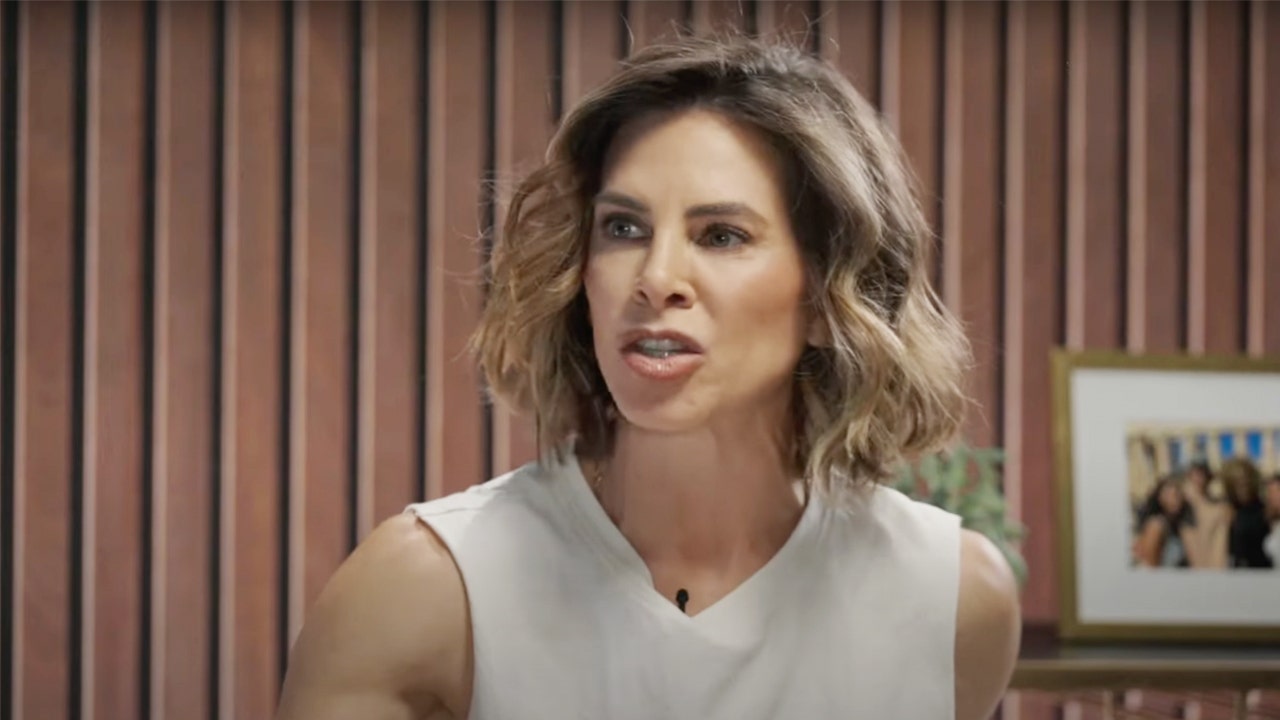
Fitness guru Jillian Michaels went off on how “insane” her home state of California has become in recent years and how “woke victimology poker” drove her away.
“California got too crazy for me,” Michaels said Wednesday on “The Sage Steele Show.”
“I grew up here. I’m a woman. I’m a gay woman. My mom’s a Jew. My dad’s an Arab. I have a Black kid. And believe it or not, my son is half Latin, even though he doesn’t look like it,” Michaels told host Sage Steele. “I hold a million cards in your game of woke victimology poker. And when I leave California, maybe you’ve lost your f—ing mind. Just maybe! Like when you have me running from home, maybe it’s gone way too far.”
JILLIAN MICHAELS SAYS SHE LEFT CALIFORNIA BECAUSE OF NEWSOM’S LEADERSHIP, PRAISES HOW FLORIDA IS ‘LESS CRAZY’
Fitness guru and California native Jillian Michaels rails about the woke policies that drove her away from the Golden State during her appearance on “The Sage Steele Show.” (Screenshot/Club Random Media)
Michaels, who now lives in Miami, insisted she hasn’t changed but “the world around me is shifting and I haven’t moved.”
“Some of these laws that are passing here are absolutely f—ing mind-boggling,” Michaels said. “In relation to crime, protecting our kids, like, we’re decriminalizing everything, which arguably I would probably be okay with but we’re not regulating any of it. So it’s like, okay, you’re gonna decriminalize sex work but only so women can loiter on the streets, not to keep them safe, not to have them pay taxes, not to make them, you know, regularly check for STDs, not to take away the pimps out of the equation. Like if you made that argument to me, I’d be like, ‘well, yes, of course.’”
CALIFORNIA EXODUS CONTINUES AS CONSERVATIVE STATES ATTRACT BLUE-STATE RESIDENTS: REPORT
Michaels slammed California’s far-left policies of not enforcing laws and allowing children to receive so-called “gender affirming” medical care. (Slaven Vlasic/Getty Images)
“I could be liberal! I could go there with you! I grew up this way!” she added.
Michaels continued criticizing California laws.
“Or the fact that a 12-year-old child can be put on off-label cancer drugs to irreparably change their body,” she said. “Again, if my son came to me and said, ‘Mom’ — or my daughter — ‘I think I’m trans.’ I’d say okay, you know, like, you want to dress this way. You want me to call you whatever the heck you want, dress, fine. Explore it. I love you. I’m cool, do you as long as we’re safe, but we’re not changing your body until it’s fully developed. I’m sorry. Conversation’s over. Can’t get a f—ing tattoo!”
“Exactly,” Steele said.
“Are you crazy? It’s insane! Like I just can’t. It’s madness. It’s madness to me. I can go on and on and on. And it’s madness,” Michaels said.
EX-CALIFORNIA FAMILIES SAY MOVE TO RED STATES WAS CAUSED BY LEFTIST POLICIES AND TAXES: ‘TIME FOR US TO LEAVE’
Michaels previously attacked Democratic California Gov. Gavin Newsom while discussing why she moved away from her home state. (AP Photo/Rich Pedroncelli)
Earlier this year, Michaels had a combative exchange with “Club Random” host and loyal California resident Bill Maher after she said living in Florida “feels less crazy.”
She also repeatedly took aim at Democratic California Gov. Gavin Newsom.
“You’re going to decriminalize everything, but regulate nothing. You’re prioritizing the craziest s— I’ve ever seen in my life. C’mon, really?” Michaels said.
“I can’t stand him,” she later added.
Read the full article from Here


Arraignment of Amos Lane in District Court
Utqiagvik (formerly Barrow), Alaska
August 6, 1993
Article continues after advertisement
When I pushed open the heavy gray doors of the courtroom, heads turned toward me as though it were a wedding, but nobody smiled. I wished I weren’t dragging a suitcase, but I’d come straight from the airport because my office said arraignment had already begun. I stashed the suitcase in a back corner and headed up the aisle.
The courtroom usually sat empty on a Friday morning, and usually was as quiet as a church, which it resembled with its pinstriped gray carpeting and blond wood spectator pews. Instead of an altar, we had a judge’s bench and jury box. Today the place was standing room only, and it buzzed with the murmurs of impatient spectators.
“Amos Lane is his name,” Liz, our office manager, had said when she phoned me in South Carolina in the middle of my first vacation in three years. “They’re holding him on misdemeanors now, but they think he killed the Ipalook sisters.”
“The Ipalook sisters!”
Fred Ipalook Elementary School in Utqiagvik was named for the family patriarch, the first Inupiaq (formerly called Eskimo) school principal.
“Both of them strangled, one raped,” Liz said.
I was standing in my parents’ kitchen, looking through the magnolia trees blooming on their lawn, trying to register what Liz was saying.
“Listen…I know you haven’t been out in a while,” she went on. “Do you want me to have Anchorage send somebody up temporary?”
It took me a while to answer.
“No, I’ll come. It’s my territory.”
My parents’ friends had asked me why I went so far away to defend people who might be dangerous. I had two explanations. The first involved money, the second was hard to explain, so I usually tried to change the subject.
The first was that my daughter was in law school and my son had just started college. Financial aid departments were generous to a widow like me, with meager resources, but the schools were still expensive. I learned that oil-rich Alaska provided good salaries for public defenders, especially if you were willing to go to a bush office, so I sold the old farmhouse near Olympia, Washington, that had been our family home for eleven years; managed to get through the Alaska bar exam; and moved to Arctic Alaska.
The second answer was that the midnight sun and the polar night and the white owls and white bears and white foxes of the Arctic fascinated me. Especially the white owls.
Public Safety officers filled the back pews. Their presence tended to put pressure on the magistrate to set a high bail. I knew it would be part of my job today to remind the court and the prosecutor that we were only here on misdemeanors. My new client might be a suspect in these shocking murders but had not been charged with them. No one had.
I spotted Ed Ellingsworth, local lead detective, his cadaverous frame drooping over a corner of a pew. A young female reporter sat beside him, plump and giggly. I rather liked the way she never spelled the district attorney’s name right. The name was Slusser, but she always wrote Slusher. She also garbled some Inupiat words, and used k, q, and g interchangeably, but so did a lot of people. The language is not yet entirely standardized, but then, neither is English. At least she had learned that Inupiat was a noun and Inupiaq an adjective.
Words that still confused me were the names of the area. When I first arrived, I was told that historic areas in the middle of town were referred to as “Ukpeagvik,” with a “p,” and that the name meant “place where the snowy owls gather.” How lovely, I thought—both the name and the glorious creatures themselves. At the time, the town was called Barrow, a proper British name, but then the townspeople voted to return to the ancient name of Utqiagvik, or “place where roots are dug.” No doubt both names are accurate, and the difference between them perhaps neither the reporter nor I will ever fully understand, but I preferred the owls.
Two entire middle pews were occupied by members of the Ipalook family, looking stricken and exhausted. There were also many spectators who came to court out of boredom. Utqiagvik didn’t have a movie theater. In the front row, there was a group of young women in summer parkas, some with babies folded inside their front zippers.
A faint, comforting scent of seal cooking oil pervaded the room.
My new client, Amos Lane—it would have to be him—sat alone in handcuffs at the defense table, bearing the angry stares at his back. All I could see was that he was a Native man with long black hair and muscular shoulders wearing an orange jumpsuit, and that he needed some company. I passed through the pony gate in the bar and took my place beside him.
His eyes flicked sideways over me, and I saw in his glance that he lumped public defenders together with bailiffs, clerks, police, DAs, judges, and everyone else who put him and kept him in jail.
“You’re Amos Lane? My name’s Rebecca Wright. I’m the public defender for the North Slope Borough. Let’s see what we’ve got.”
Alaska is divided into boroughs rather than counties. The North Slope Borough, an area the size of Wyoming, occupies the northern tier of the state. The Inupiat control the North Slope Borough financially and politically. While many teachers, doctors, and lawyers are taniks, non-Natives, they serve at the pleasure of Native authorities—and may be, and have been, asked to leave if they don’t serve well.
Without a word, Amos passed me the mess of papers in front of him. There were two misdemeanor complaints filed yesterday, and a petition for misdemeanor probation revocation filed instanter. Now.
The first complaint declared Lane was the subject of a citizen’s arrest by one Harold Killbear, whom he had assaulted.
He whispered, “That’s bullshit. The guy was beating up his girlfriend and I stopped him, is all. I got witnesses.”
I shrugged.
What struck me about the complaint was the “citizen’s arrest” part. It signified that no law enforcement officer had witnessed Lane committing any crime. To arrest on a misdemeanor, according to Alaska law, an officer actually had to see the offense happening. Otherwise, the defendant could only be summoned to come into court at a later time. But Killbear could file his own complaint and ask for assistance in taking anyone into custody right away.
I recalled that Killbear himself had appeared in court some weeks previously on a charge of DUI. I wondered, if I ever made it so far as my office this morning, whether I would find that the case against Killbear had been opportunely dismissed.
I felt my hackles rising. It was bad enough for Lane to sit alone in a courtroom of people who wanted somebody, anybody, to be jailed for a serious crime, without Public Safety piling on fake charges. I wished I’d had a chance to read over the file or even just talk to him before the hearing. The initial stages of a case of this magnitude had to be done right.
And I would have liked to tell Mr. Lane my initial reaction to the Killbear complaint, but we couldn’t afford to appear to furtively conspire in front of the crowd. Utqiagvik was so small that each and every person in the courtroom was a potential juror.
“I’ve heard of you,” Lane muttered.
He didn’t say whether what he’d heard was good or bad.
I gave him a polite smile. “I’ve heard of you, too,” I said, “all the way to South Carolina.” Lane started to inquire what I had heard, but I held up a hand and focused on the next charge.
In this complaint, Johnny Aveoganna accused Lane of stealing some ivory from his home. Uh-huh. I knew Aveoganna. He was a talented and prolific carver of ivory, a friendly and generous man, and a heavy drinker. He sold a lot of ivory. I had bought from him myself, a classic polar bear carved from part of a walrus tusk, and a smaller gull and a seal of fossilized ivory. He also gave away a lot of his work, especially to friends who dropped by for a drink.
If Public Safety had found some ivory signed by Aveoganna in Lane’s possession, he could be accused of stealing it. At trial Aveoganna could explain the ivory was a gift. Even if Amos had, in fact, stolen the ivory, the easygoing Johnny might call it a gift, just for old times’ sake.
On the other hand, Aveoganna’s ivory was not the tourist-trinket kind that sold cheaply in Anchorage. Its real value could kick the charge up from misdemeanor into felony if Public Safety decided they really wanted Lane and couldn’t find anything else with which to hold him, at least until the grand jury met to indict someone in the murder case. Hopefully, as an ultimate last resort, an Utqiagvik trial jury of people who knew Aveoganna as Lane and I did, and Fairbanks didn’t, would make short work of the charge.
“Mr. Lane, are you on any kind of parole or probation status?”
“No. I maxed out.”
Only the hardcore went the route of serving every day of their suspended time, the time that would be held over their heads when they were released to parole. That Lane had served every day told me that he didn’t want anybody, anywhere, having a leash on him.
I picked up the remaining papers, a misdemeanor probation revocation petition, with two fingers and looked at him inquisitively.
“That was just this stupid fight write-up I caught right before I got out. The guy lied. They were going to charge it as a felony, but then we copped this deal and I pled to it as a misdemeanor. They did it mostly so they could release me into alcohol treatment instead of the street.”
My head had begun to ache. What he was saying could be true. A lot of inmate squabbles, or misunderstandings by guards, led to empty charges. On the other hand, his previous record might show that he was a dangerous drunk who tended to get violent, and that whatever parole or probation officer had tried to guide him into treatment was doing the right thing.
Beyond those considerations, I grew puzzled that nowhere in this stack of paper was there any reference to the deaths of the two sisters. I had missed a birthday celebration and flown 3,800 miles to represent Amos Lane. If Liz was right and this guy was a suspect in the case, so far no one had come up with any evidence against him. Liz was Inupiaq herself, and she and her extended family members always knew what had happened, who was accused, and who was probably guilty.
Unlike Public Safety, I might add.
I studied his face. “Mr. Lane, I don’t recall seeing you in court before. You’re not from Utqiagvik, are you.”
It was not a question.
“No way,” he said. “I’m from Point Hope.”
Utqiagvik was on the northern edge of Alaska and was in fact the northernmost community in the United States. Point Hope was home to a few hundred people on the western rim, so remote it made Utqiagvik seem like a world hub. The people of Point Hope had once successfully resisted the federal government’s plan of detonating a thermonuclear device to create a harbor on their coast.
Good for them.
Point Hope is also one of the oldest continually inhabited communities on the North American continent. Inupiat have lived there 2,500 years.
***
Excerpted from Sisters of the Midnight Sun: A Murder in Arctic Alaska. By Rebecca Wright Stevens. Copyright 2026. Reprinted with permission. All rights reserved.

The Week 7 matchup between K-State and Arizona State will feature two of the youngest coaches in all of college football: Kenny Dillingham and Collin Klein. They are tied for the youngest in the Power 4 conferences, and only Kirby Moore of Washington State (35) and Zach Kittley (34) are younger Division I coaches.
While Dillingham didn’t play football at Arizona State, like Klein, he is at his alma mater. An injury in his high senior year forced him to stop playing and get into coaching. He became the offensive coordinator at Chaparral High School at 21 years old, and was hired just two years later by Mike Norvell as an offensive analyst at Arizona State. He went back to Tempe in 2023, after spending the previous season as the offensive coordinator at Oregon.
Both of these guys are looking to lead their alma maters to a Big 12 Championship, and this is one of those games that could be pivotal in that pursuit.
K-State Early Opponent Preview Series: Nicholls| Washington State| Tulane| Cincinnati| Houston| Kansas
Offense
Quarterback Sam Leavitt wasn’t able to live up to the hype after leading the Sun Devils to the Big 12 Championship in 2024, and he announced he was transferring to LSU during the off-season. Dillingham and his staff were quick to fill the vacany, as they picked up former Kentucky quarterback Cutter Boley in the transfer portal.
Boley was the highest-rated quarterback to ever commit to Kentucky, as he was a consensus 4-star recruit. He had an up-and-down freshman year in 2025, as he threw for 2,160 yards, 15 touchdowns and 12 interceptions. In a loss to Tennessee, he showed off the talent by throwing for 330 yards and five touchdowns.
The offense lost two great playmakers in Kaleek Brown and Jordan Tyson. Brown was one of the best running backs in the Big 12, as he rushed for 1,141 yards and 4 touchdowns. Tyson had to deal with injuries, but he still had 61 catches for 788 yards and eight touchdowns and ended up going No. 9 to the New Orleans Saints in the 2026 NFL Draft.
One guy who could make a strong impact in the Arizona State offense is Boston College transfer Reed Harris. He had 39 catches for 673 yards and five touchdowns. He is a matchup nightmare, as he towers over defensive backs with his 6-foot-5 frame. He plays a style similar to Tyson, and he stands three inches taller and 17 pounds heavier.
Defense
There are a lot of changes on the defense at Arizona State, but defensive lineman C.J. Fites is a player who is capable of being an anchor on a defense. He took a major leap last season, finishing the year with 27 tackles and 6.5 sacks. He was named a preseason All-Big 12 defensive tackle and is a guy who figures to hear his name in the 2027 NFL Draft. Fite’s presence will force offenses to throw double-teams at him, and should open up opportunities for others to get after the quarterback.
The two leading tacklers last year were linebackers Jordan Crook and Keyshaun Elliott, who had 101 and 98 tackles, respectively. With both of these players gone, Martell Hughes is a guy who the Sun Devils will need to step up.
While there were losses in the off-season, the Sun Devils’ secondary has a chance to be one of the better units in the country. They bring back two very talented safeties in Adrian Wilson and Jessiah McGrew. The cornerback duo of Rodney Bimage Jr. and Montana Warren was good, but the arrival of LSU transfer Ashton Stamps.
He made major news last year after he hit the transfer portal after playing in only one game against Louisiana Tech. While it was a weird year, he is the type of talent that could give the Sun Devils the best secondary in the Big 12.
Schedule
In today’s college football, many teams are becoming hesitant to take big challenges during the non-conference season. However, that isn’t the case with the Sun Devils, as they go to College Station to take on Texas A&M in Week 2. After that game, the schedule lightens up. Including the matchup against K-State, four of Arizona State’s next five games will be at home.
The challenging part of the Sun Devils’ conference schedule is that some of their toughest matchups are on the road. They have road trips at Texas Tech, BYU, and Arizona, who are looked at as contenders in the Big 12.
Outlook
Dillingham has been outstanding early in his tenure in Tempe. After going 3-9 in his first year in 2023, he helped lead the Sun Devils to an 11-2 record and an appearance in the College Football Playoff during the 2024 season. Last year, they finished the year 8-5, despite losing quarterback Sam Leavitt early in the year.
The Big 12 is wide-open, and the Sun Devils once again to have the pieces to compete for a spot in the conference championship.
Game Info
Date: Saturday, October, 24
Time: TBD
TV: TBD
Location: Mountain America Stadium
Series history: Arizona State leads the all-time series, 6-1. The Sun Devils have dominated this series, and won the most recent game 24-14 in 2024. The only time the Wildcats have knocked off Arizona State was in the 2002 Holiday Bowl.
Follow

SANTA BARBARA — The late-morning sun peeked through a gauzy veil of fog, bright laughter echoing over the giddy whisper of tulle as the brides posed for pictures outside the Santa Barbara County Courthouse.
Moments earlier, Zoë Weber and Jordan Cantor of Hollywood had traded vows above the compound’s famous Sunken Garden. The brief, heartfelt legal ceremony was made sweeter because the date, June 26, was the anniversary of the Supreme Court decision that legalized gay marriage across the U.S. in 2015.
Minutes before that, their officiant, Santa Barbara County Supervisor Roy Lee, had married off Brittney Hua, 27, and Steven Ly, 26. The Arroyo High School sweethearts made their relationship official that same day 11 years ago, an anniversary that matches their San Gabriel Valley area code, 626.
Lee was soon rushing across the lawn to join Carmen Cardenas Ayon and Santiago Martinez, both 28, who’d come up from Compton for the last-minute wedding of their dreams.
The groom, a bus mechanic, was starting his shift around 4:30 am Wednesday morning when he happened to check the courthouse website for cancellations and saw Friday’s open call event.
“He was like ‘We can get married on Friday in Santa Barbara!’” the bride recalled. “And I was like ‘OK, let’s do it!’”
Minshi DeHuff, 35, and Andrew DeHuff, 39, of San Francisco marry at City Hall on June 26.
(Sarahbeth Maney / For The Times)
Less than a decade ago, courthouse weddings were still the purview of camera-shy celebrities, mid-life second marriages and mother-to-be brides. But since the pandemic, their popularity has boomed — transforming certain courthouses and municipal buildings into sought-after locales to tie the knot.
Snagging an appointment to elope has become almost as difficult as scoring Olympics tickets.
In Santa Barbara, marriage appointments open 90 days in advance, with new slots released every hour while the courthouse is open. On a recent weekday, slots in October vanished in less than five minutes.
“They pretty much get picked up as soon as we release them,” said County Clerk Melinda Greene. “We have people from all over the world.”

-
Share via
Here comes the bride — and another, and another and another…
So-called “micro weddings” have emerged as an industry unto themselves amid the soaring costs of a traditional ceremony. A recent Bank of America analysis pegged the average cost of an American wedding at $36,000 — significantly more expensive than a year of rent at the median price in Los Angeles, or two years of in-state tuition at UC Berkeley.
“A lot of my elopement brides are low-key and private,” said Asha Marshall of So Fetch Photography, who specializes in courthouse ceremonies. “They don’t want to be spending all that money.”
The shift toward boutique legal ceremonies has transformed the marriage business and the municipal buildings where such nuptials take place, turning elopement from a breezy wedding alternative into a formal contact sport.
“It books up so fast, you have to be online at the exact time [of day] you plan on having your appointment,” explained the photographer, whose viral 2024 snaps helped supercharge the Santa Barbara courthouse’s popularity on social media. “A lot of my brides get stressed out.”

Shuting Zang, 28, is photographed on her wedding day at San Francisco City Hall.
(Sarahbeth Maney / For The Times)
Santa Barbara’s Moorish Revival hall of justice has long been Southern California’s most coveted civil marriage spot. Vice President Kamala Harris and Doug Emhoff took their vows in its storied Mural Room in 2014. Reality TV star Kourtney Kardashian and Blink-182 drummer Travis Barker were wed on the steps outside in 2022.
But officials say demand has exploded in recent years, thanks in part to Pinterest and TikTok.
“We see dozens a day, starting at 8 o’clock in the morning,” said Lee, the county supervisor and officiant for the day, whose office is across the street. “I see them line up right there outside the doors.”
Ly, the newlywed from El Monte, said that in order to secure their spot at the Santa Barbara courthouse, he and his bride were prepared for an experience akin to buying stadium tour tickets.
“Both of us were on two separate computers, each of us trying to copy and paste the details so we could get in early,” he said.
“I let him do the first one,” his wife, Hua, said. “He didn’t get it, so I did the second one and I got it.”
Others, including Amy Rodriguez, were left scrounging for cancellations.
“I decided one night, let me double check if there’s an opening,” the bride said as she waited for her groom-to-be near the front entrance to the courthouse, where wedding parties must pass through a metal detector. “I logged in — it was literally midnight, maybe one o’clock — and got the slot.”
The race to the clerk’s window is not limited to Santa Barbara. Other popular courthouses such as the L.A. County Courthouse in Beverly Hills and the Old County Courthouse in Santa Ana have seen a similar spikes in demand.
But no municipal building in the state compares to San Francisco City Hall, where Marilyn Monroe and Joe DiMaggio tied the knot in 1954.

Elias Salem, 33, left, and Samuel Tyler, 33, of San Francisco pose after being married at San Francisco City Hall.
(Sarahbeth Maney / For The Times)
Today, the gilded Beaux-Arts building sees as many as 7,000 marriage ceremonies a year. That’s two-thirds again more than its Santa Barbara rival, which does about 4,000, and roughly the same number as take place at the Norwalk headquarters of the Los Angeles County Registrar, a top contender for the country’s busiest wedding venue after New York’s Manhattan Marriage Bureau and the Office of Civil Marriages in Las Vegas.
“Over the last three to four years it’s been really dramatic,” said Cheri Tran, a popular elopement photographer in San Francisco. “When I did my first City Hall elopement six or seven years ago, we were only dodging 20 or 30 people. Now it’s hundreds.”
The TikTok-driven crowds leave many locals in the lurch. Tran nudges her brides toward the Marin County Civic Center, Frank Lloyd Wright’s final public building. Others, like photographer Anna Perlman, encourage “adventure elopements” in Joshua Tree or Big Sur.
Officials, too, have sought creative ways to relieve the pressure. On the last Friday in June, San Francisco and Santa Barbara both opened their books to scores of additional couples, ushering in a brief return to the romance of last-minute marriage.
“There were simultaneously four or five couples trying to take a picture on the staircase,” said newlywed Daniel Tran, 28, who chanced upon one of the extra slots opened for San Francisco’s annual Pride wedding event. “One of our witnesses took a picture, and you could see couples on every floor getting married. It was a little jarring.”

Newlywed couples wait their turn for photos on the grand staircase during the busiest wedding day of the year at San Francisco City Hall.
(Sarahbeth Maney / For The Times)
A similar scene played out in Santa Barbara, where officials agreed to marry couples without an appointment for “Palindrome Day,” a sought-after anniversary that reads the same backwards and forwards.
“This is the first time we’ve ever done no appointments out here,” Greene said. “We authorized overtime and we’re gonna take short lunches and we’re just gonna get as many as we can through.”
By 11 a.m., the building’s lush courtyard was aflutter with white dresses and mascara-streaked tissues, cameras snapping from every angle as clerks flitted back and forth with marriage licenses.
Some, like the El Monte couple, had planned their nuptials for months. Others, like the pair from Compton, had pulled their ceremony together virtually overnight.
But few had managed an eleventh-hour affair quite as swiftly as Susie Villacis and Gaspar Garcia Jr., who cruised into town around 2 a.m. Friday morning after hunting down an all-inclusive civil ceremony from halfway across the state.
“To be honest, it was last minute — it was yesterday,” the bride said of the decision to marry in Santa Barbara.
With their Catholic wedding in Ecuador looming, the San Francisco couple needed a license and a civil ceremony ASAP.
“We were going to get married at San Francisco City Hall, but the earliest appointment was September,” Villacis said. “This was the only place we could do everything in one go.”
Lee, the county supervisor, was happy to oblige. The black-robed officiant led the pair through their wedding vows, pronouncing them husband and wife as their mothers looked on with tears in their eyes.
Garcia dipped Villacis for a dramatic first kiss. Then the trio posed for a selfie.
-

 Indianapolis, IN5 minutes ago
Indiana heat index to hit 100 as hot, dry pattern holds | July 14, 2026
-

 Pittsburg, PA11 minutes ago
Another stretch of high temperatures in the 90s hitting the Pittsburgh area this week
-

 Augusta, GA17 minutes ago
Flash flooding impacts multiple areas across Columbia County
-

 Washington, D.C23 minutes ago
ARCO Design/Build Deepens Its Presence in Washington, D.C. Market
-

 Cleveland, OH29 minutes ago
LeBron James Could Give the Cavaliers the Mentality They’re Missing
-
 Austin, TX35 minutes ago
Documentary on the fight against a bat-killing plague flies into Austin
-

 Alabama41 minutes ago
What are the best SEC college football programs? Start with Alabama, Oklahoma
-

 Alaska47 minutes ago
Rebecca Wright Stevens on Amos Lane and Repping Alaska’s Indigenous Citizens in Court

