Business
Spirit Airlines’ Demise Could Help Other Airlines


Spirit Airlines was once a potent force in the U.S. aviation industry. Its demise will reveal how strong that influence had been in recent years when air travel had already begun moving away from the low-fare model that Spirit pioneered.
The airline’s shutdown on Saturday after years of financial troubles resulted in the loss of 17,000 part-time and full-time jobs, and disrupted the plans of tens of thousands of travelers. But aviation experts say it is not entirely clear whether Spirit’s absence will have a significant, long-term impact on the industry, travelers or the U.S. economy.
Airlines will probably have an easier time raising fares and many will absorb Spirit’s gates, check-in counters and other assets at airports in the New York area, Las Vegas, Ft. Lauderdale and elsewhere. But the effect may not be huge, aviation experts said, because Spirit had shrunk a lot recently and was in its second bankruptcy in two years.
“By the time the plug was pulled, Spirit was no longer a major player,” said Michael Boyd, an aviation consultant with the Boyd Group International. “Half the fleet was parked and sold off.”
In May 2024, the airline operated 3.4 percent of all domestic flights, according to Cirium, an aviation data firm. It filed for bankruptcy later that year and again in 2025. Before it shut down, Spirit’s schedule for May would have amounted to just 1.1 percent of domestic flights.
The airline’s diminished business was a major reason many analysts and economists were befuddled by the Trump administration’s efforts to save Spirit, which ultimately went nowhere because the government and the airline’s creditors could not reach a deal.
Most airlines are temporarily offering discounted fares to Spirit’s customers. But many experts believe the company’s absence will result in somewhat higher fares over time, though how much prices will rise is hard to predict.
Spirit’s presence at an airport helped keep fares down, a phenomenon that was studied by economists and earned the name the “Spirit effect.” Even in its reduced state, the company played an important role in forcing other airlines to keep fares low, some experts said.
“It’s at the low-fare end of the spectrum where the market price is established,” said Robert Mann, an aviation industry consultant and a former airline executive. “And it’ll make it easier for everyone else to raise prices at that level.”
But some aviation experts said the consequence may be overstated. Other airlines have spare seats and can absorb many of the customers Spirit catered to. And many people who flew on Spirit tended to travel only when they found very low fares, so they may simply choose not to fly as often now.
Fares would most likely have risen with or without Spirit, some analysts said. Airlines started raising prices in March to make up for the higher fuel costs caused by the Iran war and many have warned further increases are coming.
“It is the industry that is the big winner as unprofitable domestic capacity is further reduced,” William Swelbar, an aviation consultant and economist, wrote in an email. “Fares have to increase or we will lose more airlines to bankruptcy/consolidation.”
Spirit’s slow decline in recent years had broadly helped other airlines, most notably larger carriers like American Airlines, Delta Air Lines, Southwest Airlines and United Airlines. The cities where Spirit flew most included Atlanta, Los Angeles, Detroit, Dallas, Houston, Newark and Miami.Those urban areas are home to important airports for those large airlines.
Those carriers had already found an effective way to compete against Spirit: “basic economy fares.” In the 2010s, American, Delta and United introduced these fares, which were cheaper than standard economy tickets but did not include things like the ability to pick a seat or bring multiple bags on the plane. In recent years, use of these fares has grown a lot, reducing demand for tickets from low-fare carriers like Spirit.
Some smaller airlines also stand to gain by Spirit’s absence, notably JetBlue Airways. JetBlue had already been expanding at Spirit’s home base, Fort Lauderdale-Hollywood International Airport, just north of Miami.
JetBlue said last month that it had added nonstop flights to 21 cities from Fort Lauderdale over the past year, which it views as its third big hub airport after Kennedy International in New York and Boston Logan International. On Saturday, after Spirit shut down, JetBlue said it would add flights from Ft. Lauderdale to 11 more destinations.
“It is full steam ahead in Fort Lauderdale,” Joanna Geraghty, JetBlue’s chief executive, said on a call with investors and analysts last month.
Spirit’s collapse may have a disproportionate effect on some smaller, regional airports. For example, it was the only airline flying to Arnold Palmer Regional Airport in Latrobe, Pa., which is a little more than an hour’s drive from Pittsburgh International Airport.
Spirit also accounted for nearly all flights to Atlantic City International Airport in New Jersey. But other growing budget carriers, such as Allegiant Air and Breeze Airways, which both recently started flying to Atlantic City, may well replace some of the flights smaller airports lost with Spirit’s shutdown.
Frontier Airlines, perhaps Spirit’s biggest competitor in the low-fare segment of the industry, stands to benefit, too. But it is facing many of the same challenges as Spirit did.
“The data suggests that Frontier will win because of its route overlap with Spirit,” Mr. Swelbar said. “But that overlap is also filled with basic economy seats.”
Spirit may help other airlines in another way. Its demise has suddenly made thousands of experienced airline workers available, including more than 2,000 pilots and hundreds of mechanics. United Airlines this weekend began an effort to recruit Spirit employees, saying it would pay special attention to their applications. Demand for pilots, mechanics and other professionals has been high for years.
But Spirit’s assets — planes, airport gates and other real estate, including at LaGuardia Airport in New York — won’t become available immediately. Many of those assets were used as collateral for Spirit’s loans, meaning they will be distributed through bankruptcy court proceedings, which could take some time.
“It’s not going to happen by Monday,” Mr. Mann said, “or next month, or probably for several months.”




Johnny Beig may have played in a semi professional cricket league in Australia, but this summer he’s a big fan of soccer in the United States.
It’s not just because he’s rooting for the World Cup team, though.
FIFA emblems are featured on jerseys that were created by the Dioz Group and distributed for all employees at the 16 FIFA World Cup venues this summer.
(Genaro Molina / Los Angeles Times)
Last year, Beig’s Beverly Hills-based company, Dioz Group, won a $2.5 million contract with On Location, FIFA’s hospitality partner, to design, manufacture and distribute uniforms for all employees working at FIFA World Cup venues this summer.
These include the people welcoming attendees into stadiums, VIP lounge chefs, waiters and the flagbearers during the opening ceremony.
After a multi-step application process, including presentations of its planning and strategy, Dioz says it produced more than 50,000 clothing garments including suits, jackets, shirts and hats and delivered them to the 16 World Cup venues around the U.S., Canada and Mexico in June.
Thanks in part to the World Cup contract, the company’s revenue has reached $15 million so far this year, compared with $20 million last year, Beig said. He declined to disclose the company’s net income but said the business was profitable.
“We are working with larger names that we would have never imagined we would,” he said. “The FIFA World Cup is the pinnacle. Working with the largest sporting event in the world is what we’re very proud of. I don’t think it gets any bigger than that.”

Volunteers line up to prepare to display the Canadian flag before a World Cup round of 32 knock-out match between Canada and South Africa at SoFi Stadium on Sunday.
(Kelvin Kuo / Los Angeles Times)
Dioz is among the many small businesses across Los Angeles that are getting a boost from the global sporting event, said Kevin Klowden, a senior fellow at the Milken Institute.
The influx of hundreds of thousands of fans into the city has been a boon to hotels, transportation services and restaurants, in addition to those in the special events and logistics economy, Klowden said, calling the event the “equivalent of multiple Super Bowls.”
“The number of contracts that are there, it’s a big deal,” he said. “Given the fact that L.A.’s filming is only slowly recovering, having something like the World Cup is definitely a boost.”
Dioz was co-founded by Johnny, 44, and his brother Tony in 2006. The brothers were born in India and raised in Australia, where Johnny enjoyed a brief career as a semi professional cricket player.
He realized his future wasn’t as a professional athlete, but he wanted to stay connected to the sports world, so he began making uniforms for his cricket team in 2006.
He then got a referral to make uniforms for multiple teams in the area before starting an apparel company.
“I wanted to stick with something I was passionate about, which is sports,” he said.

Volunteers unravel the center field display before a World Cup round of 32 knock-out match between Canada and South Africa at SoFi Stadium on Sunday.
(Ronaldo Bolanos / Los Angeles Times)
In 2012, Beig moved to Los Angeles and established Dioz‘s Los Angeles headquarters to tap into the U.S. market. During the pandemic, the company started supplying medical apparel to hospitals and schools, and the business took off, with revenue doubling in 2020, Beig said.
Dioz now has over 150 employees, including 15 in L.A., and manufactures its apparel at factories in China, India, Bangladesh, Turkey and the Philippines. Tony runs an office in Dubai.
Before the World Cup, Dioz provided employee uniforms for events including Super Bowl LIX and Copa America, which may have given it a leg up on the FIFA contact.
Now, with a World Cup contract on their resume, Beig said he’s setting his sights on even bigger events.
“This gives us an edge over the next FIFA events worldwide as well, where we can showcase our skills and we can handle it,” Beig said. “So it gives us a good opportunity to work with sporting events like the UEFA Championship and Premier League.”
As companies get new business from the World Cup, Klowden said it’s important that they leverage their new position to continue that growth.
Companies that benefited from the World Cup might be in a position to bid on even bigger contracts, especially with the Olympics coming up in 2028, Klowden said.
“The really important part in any of these deals is that if a company ran something like this, then they are able to build off of that success,” Klowden said. “Let’s say you’re a company that did a big uniform order or a big food order, and the World Cup goes, and you invested in new manufacturing capacity, or you invested in new clothing machines, or whatever you do; suddenly you don’t have that market anymore, then you’ve just wasted all that money ramping up.”
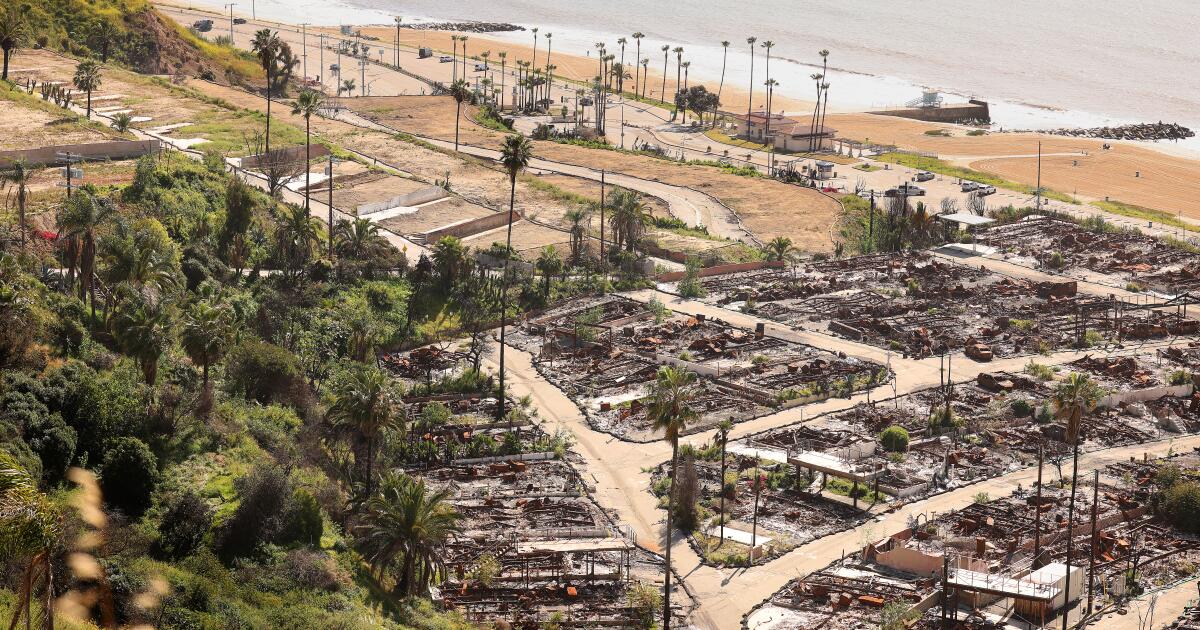
Surcharges that California homeowners have been hit with statewide by insurers defraying the costs of Los Angeles County’s wildfires were ruled legal in a decision released late Tuesday.
L.A. County Superior Court Judge Tiana Murillo turned down a petition by advocacy group Consumer Watchdog to halt the charges, which insurers began levying last year after the state’s insurer of last resort couldn’t pay all its January 2025 fire claims.
The California FAIR Plan, financially backed and operated by the state’s licensed home insurers, needed a $1-billion bailout from the insurers after it was hit with some $4 billion in claims.
Under a deal Insurance Commissioner Ricardo Lara worked out with the FAIR Plan in 2024, the insurers could seek state approval to surcharge their residential policyholders for up to half of any assessment totaling $1 billion in case the plan needed a bailout in an “extreme worst case scenario” — as it turned out it did.
A total of 105 insurers, including State Farm General — California’s largest home insurer — Farmers and Mercury sought and received approval for the surcharges.
Because the FAIR Plan assessed its member insurers based on their share of the state’s home insurance market, the policyholder surcharges were in the same ballpark. The median fee for homeowners was $28, according to the department of insurance.
The fee can be more or less according to the size of a homeowner’s premium and is split into monthly payments that insurers can spread over one or two years. Condo owners and renters on average were surcharged less.
In a court filing, Consumer Watchdog said $420 million in surcharges were approved.
In its April 2025 lawsuit filed against Lara, the Los Angeles group made a series of arguments in seeking to overturn the residential surcharges, which it deemed an industry bailout. It did not sue over related commercial surcharges.
Consumer Watchdog contended in its lawsuit that the surcharges violated Proposition 103 — the 1988 measure that governs insurer rate hikes — because the proposition does not allow for them.
It also claimed Lara did not follow regulatory protocol in promulgating the new policy.
The group further alleged that the FAIR Plan’s governing statutes do not give Lara the authority to permit the surcharges — and that the statutes require insurers to share in the plan’s profits and losses, and not shift losses to policyholders.
Murillo, and another judge who previously heard the case, turned down all of the consumer group’s arguments in separate rulings, the last of which Murillo issued Tuesday night.
Lara celebrated his legal victory over Consumer Watchdog, which has accused Lara of having close ties to insurers and sought to oust him from office. His terms ends in January.
“This victory sends a loud and clear message: The era of allowing special interests to derail consumer choice is over. We have the momentum, we have the authority, and we will continue to fight until every Californian has access to the coverage they deserve,” Lara said in a statement.
Attorney Will Pletcher, litigation director of Consumer Watchdog, said the group disagreed with the decision and would “consider all options to move this forward.”
“It’s important to try to protect California consumers from these surcharges that we think are in pretty clear conflict with both Proposition 103 and the FAIR Plan,” he said.
Hilary McLean, a spokesperson for the plan, said in a statement it did not have any position on the ruling, given the plan “does not have a role in determining how insurers manage costs associated with assessment.”
Denni Ritter, vice president of state government relations for the American Property Casualty Insurance Assn., a major industry trade group, said the decision rejected “the reckless lawsuit brought by the self-interested group Consumer Watchdog…”
“This ruling preserves a vital tool to protect the stability of the California insurance market. Blocking cost recovery would have undermined the state’s last-resort coverage option,” she said in a statement.
The 2024 policy was issued in response to the rapid growth of the plan due to a series of wildfires over the last decade that prompted multiple insurers to retreat from the state’s home insurance market.
The plan had 264,000 homeowners on its rolls in September 2022, a figure that rose to 452,0000 in the months before the fires — and its residential policyholders have since increased to 663,000 as of March.
The FAIR Plan offers policies that typically cost more than those issued by regular insurers while offering less coverage.
A Times analysis last year found that in the Palisades and Eaton fire zones, the plan’s rolls nearly doubled to 28,440 from 2020 to 2024.
That concentration of policyholders led to the plan’s large losses during the Jan. 7 wildfires, which damaged or destroyed more than 18,000 structures, killing at least 31 people.
It’s been estimated that the insured losses for the wildfires could ultimately total as much as $40 billion, exceeding any past wildfires worldwide. Ritter said that so far insurers have paid $23.7 billion in claims.
The 2025 wildfires were not the only time the FAIR Plan has needed a bailout, though it is the first time its member insurers surcharged policyholders.
In 1993, it assessed carriers after fires in Altadena and Malibu, and in 1994 it did so after the Northridge earthquake. The assessments totaled $260 million.
The plan received approval this year from the insurance department for a 29% rate increase for its homeowner dwelling policy that will take effect in October.

An electric Tesla Semi truck crashed into two vehicles in Dayton, Nev., over the weekend, killing two people and raising questions about the truck’s safety features.
The Lyon County Sheriff’s Office responded to a major collision around 7 a.m. on Sunday at the intersection of Highway 50 and Traditions Parkway about 40 miles east of Reno, the office said.
The office confirmed a semi-truck was involved in the accident, and footage of the scene shows it was a Tesla Semi.
It is the first known crash involving a Tesla Semi, an electric Class 8 truck that Tesla is building in Nevada and plans to ramp up production of. As interest in Tesla’s electric passenger vehicles wanes, the company is betting on the truck to give it a needed boost.
The trucks do not have the Full Self-Driving mode available in Tesla cars, but Tesla’s website says they come standard “with active safety features that pair with advanced motor and brake controls to deliver traction and stability in all conditions.”
According to the Lyon County Sheriff’s Office, preliminary statements obtained at the scene suggest the truck driver may have fallen asleep behind the wheel.
The crash is under investigation by the Nevada State Police Highway Patrol, which said additional information may be released next week.
The Record-Courier identified the victims as Sergio and Jennifer Villanueva, a couple who got married in 2022.
Tesla has not clarified if its semitruck has an automatic emergency braking system. Federal regulators are currently weighing a mandate for emergency braking systems in vehicles more than 10,000 pounds.
-

 Missouri19 seconds ago
Missouri Highway Patrol investigates death of staffer at youth ranch in Reynolds County; 1 juvenile arrested
-

 Montana7 minutes ago
Montana DEQ warns of algal blooms ahead of holiday weekend
-

 Nebraska10 minutes ago
Some Nebraska communities ban fireworks in year marked by drought, wildfires
-

 Nevada15 minutes ago
How Chinese-Americans contributed to mining in Nevada
-

 New Hampshire22 minutes ago
Man From Concord Arrested On Drug Sale, Subsequent Possession Charges: Concord Police Log
-

 New Jersey25 minutes ago
Mikie Sherrill welcomes July 4 tall ships to NJ at Sandy Hook
-

 New Mexico30 minutes ago
Wildfire smoke moves through Taos Valley, Northern New Mexico
-
North Carolina37 minutes ago
More than 60 North Carolina cases tied to parasite behind ‘explosive diarrhea’


