Business
The Cannabis Industry’s New Best Friend? President Trump


By some measures, the legal cannabis industry is flowering. It has grown to around $30 billion today from less than $20 billion just six years ago. But investors have remained wary of its high taxes, marijuana’s illicit status at the federal level and the operational costs of complying with a patchwork of state regulations.
Now the Trump administration is pushing major policy changes that could hand marijuana companies a huge windfall and unlock new investment in the industry.
Last week, the government relaxed federal controls on medical marijuana. While that does not make medical marijuana legal under federal law, it moves the product from a class of highly addictive drugs, such as heroin, to a category of lower-risk medicines, like prescription Tylenol, that are overseen by the D.E.A. The Trump administration has also started a process to reclassify cannabis more broadly.
For some cannabis businesses, reclassification could cut tax bills in half. Companies that sell marijuana are currently taxed largely on their income, rather than their profits, resulting in effective tax rates of around 70 percent, more than double those of other businesses. Under the new category, those licensed to sell medical marijuana can claim common tax deductions for expenses like rent and payroll, according to accountants and tax lawyers. A broader reclassification would do the same for recreational marijuana.
The Treasury is considering making the tax relief retroactive, which would be a boon for the industry. Legal cannabis companies owed the Internal Revenue Service $2.24 billion in 2025, according to Whitney Economics, a cannabis research firm. A handful of publicly traded companies, including Trulieve, Florida’s largest medical cannabis company, and Curaleaf, a global juggernaut based in New York, owed more than $1.6 billion in federal taxes, according to their financial disclosures.
It is unclear how the change would be put in place and how extensively businesses would benefit. The Treasury and Internal Revenue Service have yet to issue guidance, though the Drug Enforcement Administration has begun allowing businesses to register with the agency. And there are questions about how the many businesses that sell both medical and recreational cannabis will be treated.
“I’m ecstatic that this happened,” Joe Andreae, the chief executive of CULTA, a cannabis company in Maryland that sells both recreational and medical marijuana. “But it creates a challenge. Will they force us to actually delineate?”
Despite the confusion, and the exclusion of recreational marijuana, many in the industry have welcomed the administration’s acknowledgment of the medical benefits of cannabis as a meaningful first step toward broader reform and public acceptance.
Patrick Rea, the managing director of Poseidon, a cannabis-focused venture capital firm, said the tax relief will make the industry more attractive to investors. “The upshot here for investors is that you can invest and get a return,” he said.
A windfall in sight
Nationally, cannabis businesses are facing rising supply-chain costs, and a glut of legal crops is driving down prices. Beau Whitney, an economist specializing in cannabis, said that 24 of the 40 states that have legalized medical or recreational marijuana, or both, saw revenues decline in 2025.
A big tax break could offer significant help. Austin Ownbey, a Washington, D.C.-based partner at Akerman LLP, said the tax break will make some businesses profitable or more profitable.
Many cannabis companies have delayed filing taxes in anticipation of rescheduling. Jeffrey Schultz, a cannabis lawyer at Foley Hoag LLP in New York, said that he was advising clients who have been granted extensions from the I.R.S. to consider holding off longer, while telling those that have filed already to think about amending their returns. “They may not owe that money,” he said.
Paying less in taxes could help cannabis companies fund research required for marijuana to gain approval from the Food and Drug Administration, which would make it legal to prescribe at the federal level.
The chief executives of Trulieve, Curaleaf and Tilray, a New York-based alcohol and pharmaceutical company with cannabis operations in Canada, said in interviews that they wanted to invest in research to gain approval for cannabis-based treatments for cancer, nerve pain and seizures.
Kim Rivers, the chief executive of Trulieve, said rescheduling cannabis was a long overdue step that recognizes how much the industry has evolved. Rivers was instrumental in persuading President Trump to issue an executive order last December directing the Department of Justice to quickly reclassify marijuana.
“This is not some plants in a closet or on a dirt floor,” she said in an interview. “This is real, regulated, highly nuanced business. Millions of Americans are finding relief and want to have assurance that these products are backed by real research in the United States.”
Left out
It came as a surprise to many in the industry that recreational marijuana was left out of the initial rescheduling. Shawn Hauser, the co-chair of the cannabis practice at Vicente LLP, based in Colorado, said the treaty powers that the Trump administration used to bypass the bureaucratic rule-making process allowed the reclassification only of medical cannabis.
The Trump administration is seeking the same change for recreational marijuana at a hearing scheduled to begin on June 29. But it is certain to be opposed by anti-legalization groups like Smart Approaches to Marijuana, which led opposition that ultimately derailed an earlier attempt to reschedule marijuana under President Biden.
Businesses that sell cannabis solely for adult recreational use are worried that the new rules for medical marijuana could put them at a competitive disadvantage.
That includes Beak & Skiff, a 115-year old apple orchard in New York that makes a line of cannabis and hemp products called Ayrloom. In addition to the possibility of being excluded from rescheduling, the company is preparing for a looming national ban on hemp products containing more than .4 milligrams of THC per container. For Beak & Skiff, the ban would reduce the number of states in which it sells hemp from 13 states to just one, New York.
“It feels like we’re just getting crushed in the middle of two things,” Eddie Brennan, the company president, said.
Hurdles remain
Moving medical marijuana to a lower-risk category does not make it legal, which would require either an act of Congress, F.D.A. approval or removal from the federal controlled substances list. Companies will still contend with the legal risks associated with cannabis that have kept banks, institutional investors and insurance companies on the sidelines, leaving them with limited access to financial services and higher borrowing costs.
The effect can be seen at the dispensary register, where consumers are required to pay with cash or PIN debit because major payment processing companies like Visa and Mastercard do not allow cannabis transactions. Even the Drug Enforcement Administration is requiring the medical cannabis businesses now seeking federal registration to submit their application fees using PayPal or bank transfer.
Efforts in Congress to pass legislation providing protections for federally regulated financial institutions that serve state-licensed businesses have been unsuccessful so far.
It is also unclear how rescheduling will interact with state laws.
“There’s just a lot of questions, a lot of murkiness,” Whitney, the economist, said, adding: “The devil’s in the details.”
IN CASE YOU MISSED IT
Spirit Airlines is preparing to shut down. The distressed airline, which has filed for bankruptcy twice in the last two years, had been hoping to secure a $500 million loan from the government before running out of funds. But the deal fell apart as some of Spirit’s investors and some Republican lawmakers opposed it.
Fed drama continued. Kevin Wash, Trump’s nominee for Fed chair, cleared an important Senate Banking Committee vote and is expected to be confirmed in time for the next Fed meeting in June. The Fed voted on Wednesday to keep rates unchanged at a range of 3.5 to 3.75 percent, and the current chair, Jerome Powell, announced that he will break with tradition to remain a governor at the central bank after his term as chair ends on May 15.
A.I. spending set a record. Google, Amazon, Microsoft and Meta reported more than $130 billion in quarterly capital expenditures on Wednesday, about 70 percent more than they spent in the same quarter last year.
The F.C.C. ordered a review of ABC’s broadcast licenses. The extraordinary order came amid a fight between President Trump and Jimmy Kimmel over a joke by the late-night host and represented an escalation by the Trump administration to punish media outlets for their coverage. It faces long odds in court.
More big deals: Bill Ackman’s new fund had a lukewarm I.P.O. PayPal is said to be spinning out Venmo. G.D.P. grew 2 percent in the first three months of the year. And the Senate banned its members from trading on prediction markets.
Taylor Swift’s deepfake defense
A.I. threatens the business of being a celebrity, and Taylor Swift’s legal team just set up a new layer of defense. Last week, the artist filed applications to trademark snippets of her voice and a photo of herself, which lawyers who specialize in intellectual property say could help build a legal argument against unauthorized deepfakes. The actor Matthew McConaughey has made similar moves.
DealBook’s Sarah Kessler talked with Josh Gerben, the head of a trademark-focused law firm that was one of the first to point out the applications, about Swift’s legal strategy. The conversation has been condensed and edited.
How do these trademarks potentially help in a case over deepfakes?
One potential defense is right to publicity law, which basically says, I can’t put Taylor Swift’s image on a T-shirt and go sell it, because that would violate her right to exploit her name, image and likeness. If I were to take her voice and make a new song, I’m arguably violating her right to publicity.
But courts haven’t really looked at this yet. So we’re not sure how they would view it.
Now you’re also trying to trademark the voice to have another cause of action, where you could say, by using my voice, you’re also violating my trademark rights.
Is there something about trademark law that makes it particularly useful in this context?
Trademark law gives you the ability to police against anything that’s confusingly similar. So it doesn’t even have to be an identical copy, or it doesn’t have to actually be Taylor or her voice. It could just be something that’s similar to that. So it’s arguably a little bit of broader protection.
Why haven’t we seen a big lawsuit over celebrity deepfakes yet?
It looks like everybody’s kind of setting up. You’re going to be testing novel legal theories and you want to make sure that if you’re actually going to spend the time and money to litigate it, that you have a really good chance of setting a good precedent.
Because the last thing you want to do is lose and set a bad precedent, where then it just becomes kind of open season on your intellectual property.
Are your clients worried about this?
Even brand owners are starting to pay attention, because you could use A.I. to create fake advertisements that say something that’s untrue or derogatory about a brand.
Quiz: Palantir’s new merch
This question comes from a recent Times article. Click an answer to see if you’re right. (The link will be free.)
On Thursday, the technology company Palantir added a new product to its online store that Eliano Younes, the company’s head of strategic engagement, told The Times was intended to demonstrate a commitment to “re-industrializing America.” What was it?



Decades of Hollywood empire-building ended with a quake in 2017 when Australian media mogul Rupert Murdoch decided to sell much of his Fox entertainment holdings amid the rise of Netflix and other tech giants.
This week, another titan who has been instrumental in shaping American media and telecommunications began to unwind his Hollywood holdings.
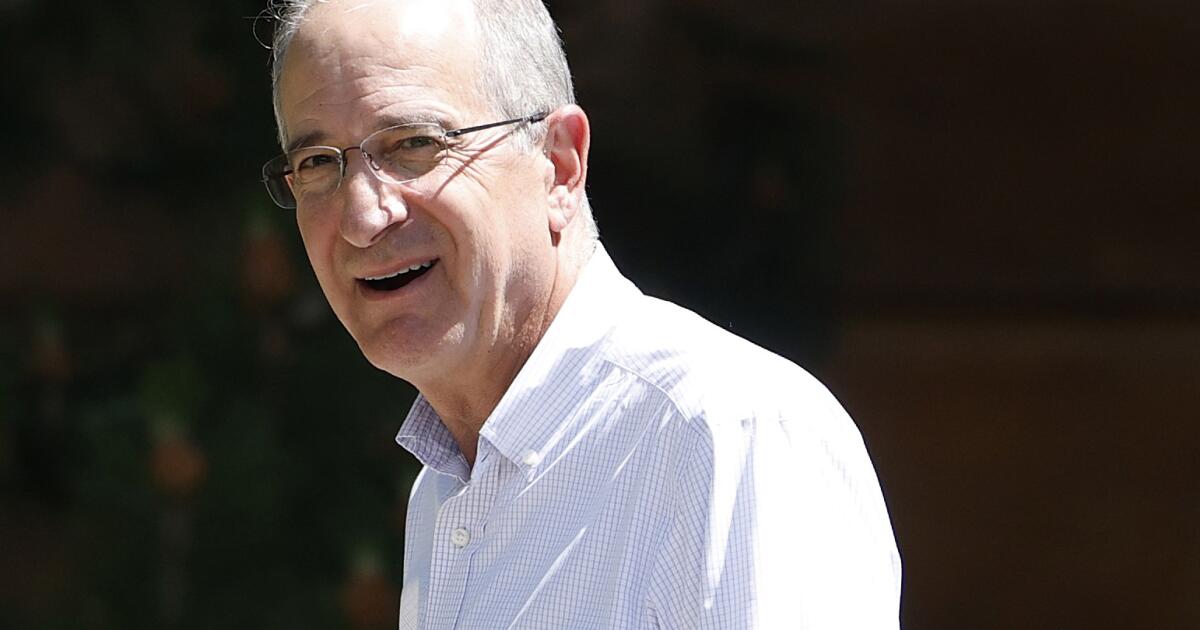
Brian L. Roberts — who with his father built Comcast into a cable TV and internet colossus — announced his company would spin off its prestigious NBCUniversal unit into a separate publicly traded company sometime next year.
The move reverses Roberts’ purchase of NBCUniversal in 2011 — a bold bet that created a behemoth with popular programming and cable pipes to pump that content into consumer homes.
Comcast’s breakup marks the close of a Hollywood era, one dominated for 40 years by a class of maverick moguls: Murdoch, CNN founder Ted Turner, Viacom’s Sumner Redstone, cable titan John Malone and the Philadelphia-based Roberts family.
Now, a new crop of leaders has emerged, reflecting Silicon Valley’s vast influence over the film and and TV business, which has been upended by streaming and, now, artificial intelligence.
“There was a time that Murdoch, Malone and Brian were really industry leaders who could affect change,” said Bank of America managing director Jessica Reif Ehrlich in an interview. “That’s not true any longer.”
Analysts widely believe Monday’s announcement is a prelude to eventual sales of both Comcast and NBCUniversal, a theory that Comcast rejects.
Roberts, 67, told analysts he will remain involved in both NBCUniversal and Comcast after the separation. Still, he plans to relinquish his chief executive role after 25 years and a half century at Comcast. Roberts has picked trusted associates to run each firm, and his family will continue to hold controlling shares of both companies.
But the shift underscores a dramatic loss of clout by Comcast and other traditional media enterprises. Netflix, Apple, Amazon and Google’s YouTube have diminished the industry’s financial pillars — box office receipts and cable programming fees — and given consumers control over when and how they watch programming.
Murdoch was the first to flee. In 2014, he was rebuffed in his $80-billion bid to beef up his 21st Century Fox by buying HBO, CNN and other Time Warner assets. Murdoch’s defeat led to the Fox asset sale to Walt Disney Co.
Last fall, Comcast made a run for the same properties with a plan to unite NBCUniversal with Warner Bros.
Instead, 43-year-old tech scion David Ellison — with help from his billionaire father, Oracle software co-founder Larry Ellison — scooped up the prize for a staggering $111 billion.
The pending blockbuster merger of Ellison’s Paramount Skydance and Warner Bros. Discovery is expected to reshape the industry and leave NBCUniversal increasingly vulnerable to a takeover.
“It looks like Comcast’s NBCUniversal was left standing on the dance floor without a partner,” MoffettNathanson media analyst Robert Fishman wrote in a Tuesday note to investors.
Paramount’s play for Warner Bros. came a month after Ellison finalized his family’s purchase of cash-strapped Paramount from Shari Redstone. The one-two acquisition punch would propel the Ellison family to top-tier moguls with influence over CNN, CBS News, HBO, Turner Classic Movies and two historic Hollywood studios.
“It’s a flagging industry. … The industry will have to consolidate to survive,” said C. Kerry Fields, a USC Marshall School of Business economics professor. “Those who have content plus [streaming] distribution are going to be the winners.”
Roberts knows distribution. His father in 1963 bought his first cable TV system in Tupelo, Miss. It was a quirky bet for Ralph Roberts, who figured his belts and suspenders business would soon be toast as beltless polyester pants became the rage.
Brian Roberts joined Comcast as a high school intern, setting up supermarket promotions. In 1975, he became a trainee cable installer, climbing poles and stringing cables. He joined Comcast full time in 1981 after graduating the Wharton School at the University of Pennsylvania.
For more than 30 years, he worked in tandem with his dad. With key associates, they built the nation’s foremost cable TV service — then the entertainment gateway — and grew stronger by offering internet, phone and then wireless service.
Analysts credit the 2011 purchase of NBCUniversal as a huge success; Comcast rescued a company that was on the ropes due to General Electric’s under-investment.
Over the years, Comcast rebuilt NBC and Spanish-language Telemundo, writing big checks for the best sports rights, including the FIFA World Cup, NFL, NBA and Major League Baseball.
Comcast also recognized value in theme parks and invested heavily, building Universal Studios as a formidable rival to Disney. NBC finished the season in first-place among traditional TV broadcasters and its L.A. film studio is an industry leader.
But the world has changed.
“One of the defining characteristics of this company has always been our willingness to look ahead, embrace change, and position ourselves for the future,” Roberts told analysts during a Monday call.
Reif Ehrlich, the Bank of America analyst, said Comcast needed to do something — or watch its stagnant stock sink farther.
Wall Street has punished the company amid steep losses in its cable TV and broadband internet units, and because NBCUniversal has historically generated its biggest profits from its cable channels.
In January, Comcast spun off those networks, including CNBC, MS NOW, USA Network and Golf Channel, to create a new entity called Versant.
But the move failed to boost Comcast’s battered stock, which dropped 3.3% on Wednesday to $23.73.
Five years ago, Comcast stock topped $50 a share.
“It was just a very challenged market on both sides, and it’s getting worse, not better,” Reif Ehrlich said.
Comcast faces competitors beyond traditional telecommunications firms, including AT&T and T-Mobile. SpaceX’s Starlink provides satellite internet service.
NBCUniversal must jockey alongside other well-capitalized players, including Amazon, Netflix and Disney. NBC’s streaming service, Peacock, has struggled to get traction. It counted 46 million paying subscribers as of the first quarter, a fraction of Netflix’s 325 million and the nearly 132 million subscribers of Disney+.
“It’s kind of a subscale player,” Reif Ehrlich said. “It’s just a real battle, and NBC has expensive sports rights.”
Roberts conceded the difficult landscape on the analyst call.
“The world is changing faster than ever,” Roberts said. “Technology, consumer behavior, competition, capital requirements are all evolving at an unprecedented pace … When we acquired NBCUniversal, more than 15 years ago, the industry looked very different.”
He will retain control for at least three years. The NBCUniversal spin-off is envisioned as a tax-free transaction for shareholders, providing a short-term buffer from deal-making to preserve that structure.
NBCUniversal could be up for grabs by 2029 — a pivotal year when the NFL is expected to open negotiations for a new round of broadcast rights. That auction is expected to draw heavy interest from Amazon and other streamers — not just veterans Fox, NBC, Disney’s ESPN and Paramount’s CBS.
“Brian Roberts has already proven his willingness to play the long game and with continued control should be the end decision maker,” Fishman said.
Much like Murdoch, who is now 95 and partially retired.
“Rupert was the smartest guy in Hollywood — he got out at the top,” Reif Ehrlich said.
He entrusted power to his 54-year-old son, Lachlan, who has been busy remaking Fox after the 2019 sale to Disney, which included Fox’s film and TV studios, streaming service Hulu and the FX and National Geographic channels. Fox also unloaded its regional cable sports networks — a savvy move before that business cratered.
The Murdochs kept Fox Sports, the Fox broadcast network, TV stations, Fox News Channel and the studio lot.
The company has been expanding. Lachlan Murdoch led Fox’s purchase of Tubi, which provides free TV channels and movies for smart televisions, keeping Fox in the streaming game. The company launched Fox News and weather products, and subscription service Fox One, which streams the company’s sports and news.
Earlier this month, Lachlan Murdoch stunned the industry by agreeing to pay $22 billion for Roku, a leading streaming platform that reaches 100 million viewers worldwide. Murdoch called the proposed purchase “a defining moment for Fox.”

Ethics experts sounded the alarm Wednesday after new financial disclosure reports revealed that President Trump’s income ballooned to $2.2 billion in 2025, with $1.4 billion coming from various new cryptocurrency-related businesses.
“It’s bribery. It’s graft. It’s exploitation of public power for private financial gain,” said Kathleen Clark, a law professor at Washington University and an expert in government ethics. “Trump has — with the acquiescence of a somnolent, GOP-controlled Congress and the active assistance of John Roberts’ Supreme Court — transformed the presidency into a massive corruption racket.”
Trump reported income of over $600 million in 2024. But after he entered the White House in 2025, he reported that his income had soared to more than $2.2 billion.
The 2025 annual disclosure report filed with the Office of Government Ethics shows that Trump ramped up his real estate business in countries across the globe, particularly in the Middle East, at a time when his government was negotiating over vital issues of military aid and economic tariffs. The president also expanded his dealings in the relatively new realm of cryptocurrency.
According to the 927-page report, Trump made $635 million in royalties from Celebration Coins and more than $500 million from his World Liberty Financial crypto firm. He drew in millions from a raft of Trump-branded merchandise including God Bless the USA Bibles and sneakers depicting him with his hand raised in a fist. He also brought in $10.4 million from a property in the United Arab Emirates and $9 million from a property in Saudi Arabia.
Noah Bookbinder, an ethics expert and former president of Citizens for Responsibility and Ethics, a nonprofit watchdog group in Washington, described Trump’s business dealings while in the White House as “entirely unprecedented, certainly in modern history, but I think by most ways of measuring, in all of American history.”
“This is corruption,” Bookbinder said. “You have a president who has been quite transparently using the presidency in ways that benefit his business interests and intertwining the presidency and business interests.”
But the president and the White House brushed aside ethics concerns about the money Trump is making.
Trump told reporters Wednesday that he made a lot of money before he came to the White House, he had “big institutions” run his money, and that he had benefited, like every other American, as the stock market went up.
“We’re all profiting,” he said. “I’m profiting because I have a lot of money and a lot of cash.”
In a statement, White House spokesperson Anna Kelly said: “Neither the President nor his family has ever engaged — or will ever engage — in conflicts of interest. … All actions by President Trump and his administration are taken in the best interest of the American people.”
Although the report does not show exactly how much Trump is earning — it provides details of revenue, rather than profit — the scale of the president’s cryptocurrency dealings elevated ethics watchdogs’ long-standing concerns.
Jordan Libowitz, a vice president at Citizens for Responsibility and Ethics, said the most concerning detail of the new report is the hundreds of millions of dollars coming in from various crypto ventures partnered with companies that the American public knows little about.
“At a time when his own administration itself is setting regulation for these types of companies,” Libowitz said, “there’s just this massive opportunity for corruption when foreign governments and foreign nationals can pour tens of millions of dollars into the president’s pocket.”
As a real estate mogul, Trump has long invested in hotels, condominiums and golf courses. But cryptocurrency, Libowitz said, offers vastly more potential for corruption.
“There’s only so many hotel rooms you can book, so many rounds of golf, but there’s no limit with crypto,” Libowitz said. “You can just buy his meme coin and he gets a cut, so you kind of take out the middleman, but also the cap or the amount of money you can funnel to the president.”
Libowitz said it was also problematic for Trump to expand his real estate empire in foreign countries, particularly in the Middle East.
“Now it seems that almost all his new developments are in foreign countries, and that opens up, if you’re building this giant resort, you’re going to need help from the local government, whether it’s tax breaks or utility issues, or building a road, or speeding up permits,” Libowitz said. “These are ways that foreign governments can do favors for the American president.”
In the half a century before Trump was elected, ethics experts say, presidents from Nixon to Obama publicly released their tax returns, sold properties or put the proceeds in a blind trust managed by someone they did not know.
“They weren’t doing it because they legally had to, but because they thought it was the right thing to do,” Libowitz said.
Ever since Trump was first elected in 2016 and opted to not sell his businesses or put them in blind trusts, ethics experts have urged Congress to impose more aggressive financial oversight over money in politics.
“Congress needs to update the law, and basically, mandate blind trusts and sale of assets and disclosure of tax returns,” Libowitz said.
Noting that the Constitution’s Emoluments Clause explicitly states that the president cannot accept things of value from foreign or domestic governments, ethics experts say Trump is flouting the law and Congress has chosen to not enforce it.
Richard Painter, a law professor at the University of Minnesota and former White House ethics lawyer under President George W. Bush, said Congress needed to close loopholes that exempt presidents from federal conflict of interest laws as well as enforce the Foreign Emoluments Clause.
“Nobody holding a position of trust with the United States government can accept emoluments, profits and benefits from foreign governments, and that is flatly prohibited under the United States Constitution,” Painter said. “Now, if the United Arab Emirates put money into Liberty Financial, as I understand they did … and then Trump makes money off Liberty Financial, that’s a Foreign Emoluments Clause problem.”
Congress, he said, should empower an independent prosecutor to investigate such conflicts.
“The problem with the Foreign Emoluments Clause is how do we enforce it?” Painter said. “The founders and head of the Congress enforced it by impeaching anybody who took a bunch of foreign government money, but I guess that system’s not working. That’s a serious problem.”

The race to bring air travel to the sky is heating up as Santa Cruz-based Joby Aviation and Toyota launch a joint venture to commercially produce air taxis.
The companies said in a news release Tuesday that they will work together on productivity, quality and costs and move toward mass production of Joby’s electric vertical takeoff aircraft. Joby and Toyota were first linked when Toyota made a nearly $400-million investment in the company in 2020. It has since increased its backing of the company to $900 million.
“It’s really meaningful for us to take on this challenge together with Joby, a partner that shares the same vision,” Toyota Chair Akio Toyoda said. “We believe this strengthened relationship is an important step forward in realizing the future mobility society.”
Joby‘s all-electric vertical takeoff vehicles are designed to hold four passengers and a pilot and can travel at up to 200 mph. The vehicle uses six tilting propellers to achieve vertical takeoff before switching to forward flight.
In February, Joby announced a partnership with Uber to start service in the United Arab Emirates this year, bringing on-demand air taxi rides to the country. It plans to expand to the U.S. after the completion of its final stage of Federal Aviation Administration testing.
Prior to its full FAA certification, Joby is hoping to launch early flight operations later this year as part of a White House program that will bring flights to several states, including New York, Texas and Arizona. Flights in California will not begin until after obtaining FAA certification.
Joby has been in a fierce battle to be the first with taxis in the sky with its Northern California competitor Archer Aviation. The two companies are involved in overlapping lawsuits, with Joby alleging corporate espionage against Archer, and Archer filing a suit alleging dubious ties to China that sparked an investigation into Joby by the U.S. International Trade Commission.
“Toyota has been by Joby’s side for nearly a decade, providing invaluable guidance and support as we built the foundation for manufacturing our aircraft,” JoeBen Bevirt, Joby’s chief executive and founder, said in the news release. “Together, we share a vision of making aerial mobility an everyday reality, and we look forward to delivering on that promise together.”
Joby Aviation’s shares, which have fallen more than 30% this year, climbed 3% on Tuesday to $8.92.
-

 Miami, FL2 minutes ago
FIFA World Cup Miami Host Committee lends a helping hand to people of Venezuela after deadly earthquakes
-

 Boston, MA7 minutes ago
Review & setlist: It was 100 degrees in Boston, and Goose was on fire
-

 Denver, CO14 minutes ago
Where to Celebrate the 4th of July in Denver This Weekend – 303 Magazine
-

 Seattle, WA17 minutes ago
COUNTDOWN: Two days until West Seattle Fourth of July Kids’ Parade! Here’s the newest info
-

 San Diego, CA22 minutes ago
Man Stabbed 4 Times Outside San Diego Bar; Suspect Arrested
-

 Milwaukee, WI29 minutes ago
Dominique Noth impacted Milwaukee arts, culture scene for six decades
-

 Atlanta, GA32 minutes ago
FBI orders field offices to send analysts to Atlanta for 2020 election investigation, sources say
-

 Minneapolis, MN36 minutes ago
MN Street Style: Minneapolis People’s Pride 2026 – Racket

