Entertainment
Opinion: ‘All the President’s Men’ is 50 years old. A former Post staffer tells us why that matters


“All the President’s Men” was released 50 years ago this month, an anniversary that’s been greeted with equal parts rue and reverence by the journalists, political junkies and discerning cinephiles who have worshiped the film for five decades.
As a member of all three of those constituencies, I’ve done my share of genuflecting, most recently as chief film critic at the Washington Post, whose city room was as vivid and fully realized in the movie as Robert Redford’s Bob Woodward and Dustin Hoffman’s Carl Bernstein.
Like so many Posties of my generation, I’ll never forget the so-real-it’s-surreal experience of walking into the fifth-floor newsroom for the first time in 2002. By then, standard-issue electric typewriters and six-ply carbon paper had been replaced by far less visually interesting computers. But the office’s pervading atmosphere of hard work and quiet focus felt uncannily similar to its big-screen analog.
For the last two years, I have been researching a book about the making of “All the President’s Men,” whose production involved almost as many contingencies and unresolved questions as Watergate itself. Among the film’s many mysteries, one I’ve found particularly intriguing has to do with Katharine Graham, publisher of the Washington Post and CEO of its parent company during the Watergate investigations. As the movie amply demonstrates, it took guts for Woodward and Bernstein to persevere with their reporting in the face of terrified sources and their own growing paranoia. But, unbeknownst to many observers at the time, Graham was enduring even more withering pressures, with determination that was all the more impressive for being almost entirely invisible.
I’m still in the process of discovering why she remained invisible in “All the President’s Men.” For now, it’s clear that the backstory is more nuanced than mere oversight or, as many are quick to assume, simple sexism.
In fact, William Goldman’s first script of the film featured a sequence with Graham and Woodward, a scene that appeared in every subsequent draft. Based on an actual meeting between the two, it’s a cagey game of cat-and-mouse, with the publisher taking the measure of a nervous, still-inexperienced journalist, looking for reassurance that his reporting will prove out.
Earlier this year, at a January staged reading of “All the President’s Men” at Harmony Gold Theater in Hollywood — a fundraiser for the Stella Adler Academy — it was possible for fans to conjure what might have been. Mark Ruffalo played Woodward and Ethan Hawke played Bernstein in a version of the movie assembled from different Goldman drafts.
A high point of the evening was when Ruffalo and actor Susan Traylor brought the Graham-Woodward scene to tentative, tense and teasingly playful life. After grilling Woodward about his sources and coyly asking him about Deep Throat’s identity, Traylor’s Graham asked him if the truth about Watergate would ever be revealed. “It may never come out,” Ruffalo’s Woodward replied. “Don’t tell me ‘never,’” Graham laments, before bringing the meeting to a close with a gently peremptory “Do better.”
In poring over director Alan J. Pakula and Goldman’s papers, I’ve probably read that scene dozens of times. But when I heard it play out in real time, I was ambushed by the emotions it stirred — a mixture of pride in Graham’s legacy and deep sadness at how that legacy has been so inexplicably ignored in recent years.
I was also sad that Redford, who died in September, wasn’t there. He often expressed regret that Graham wasn’t a featured character in “All the President’s Men.” Keenly aware of how her spine and steadfastness made Woodward and Bernstein’s work possible, he wanted to honor that crucial support. When I interviewed him for the first time in 2005, he insisted that fearless owners were every bit as important in preserving democracy as the reporters he and Hoffman helped glamorize.
Over the next two decades, every time I saw Redford, he bemoaned the “downward slide of this thing,” by which he meant the constellation of institutions “All the President’s Men” celebrates: not just journalism and a robust First Amendment but a Washington where investigators, prosecutors, judges, the Senate and Congress did their jobs regardless of partisan loyalties, and a Hollywood where a studio as mainstream as Warner Bros. would agree to finance a tough-minded film about a contentious and still-raw period in recent history.
Granted, that film was based on a bestselling book and anchored by two huge stars. But today, with political and corporate leaders — including media companies — falling over each other to curry favor with President Trump, “All the President’s Men” feels like an artifact from a vanished age.
Nowhere is this more distressingly true than at the Post itself, where the newsroom immortalized by the movie has been slashed by more than a third, and where Jeff Bezos, who bought the paper in 2013, seems intent on erasing Katharine Graham’s legacy until it vanishes completely. During the first Trump administration, Bezos stood up to threats against the Post and the press at large that would make Nixon blush, or at least pea-green with envy.
Now, Bezos has become a one-man meme of what author Timothy Snyder calls “obedience in advance,” quashing an endorsement of Kamala Harris, ostentatiously grinning his way through Trump’s second inauguration, vastly overpaying for a promotional film about First Lady Melania Trump and staying conspicuously mum (at least publicly) when a Post reporter’s home was raided by the FBI in January.
All of this has come at an enormous moral and material cost, with thousands of readers canceling their subscriptions and an alarming number of the Post’s finest reporters and writers leaving for other publications and platforms. As my former boss Marty Baron told my former colleague Ruth Marcus in the New Yorker in February, Bezos’ turnaround has been “sickening” to witness: “a case study in near-instant, self-inflicted brand destruction.”
Of course, that brand was built, in no small part, by “All the President’s Men,” which taught a generation how to walk, talk, dress and act like real reporters. (Hint: A good corduroy jacket and a pen in your mouth can’t hurt.)
In 1976, Pakula was interviewed about his dealings with Graham, whom he admired tremendously and with whom he would become close friends. “I could do a film about the Katharine Graham story,” he enthused. “It’s a superb story.”
Thirty years later, Steven Spielberg would bring Pakula’s idea to fruition with “The Post,” about Graham’s decision to publish the Pentagon Papers, a dress rehearsal for the even higher stakes of Watergate a year later.
“The Post,” which starred Meryl Streep in a shrewdly judged performance of aristocratic assurance and creeping insecurity, premiered in Washington less than a year into Trump’s first administration. Bezos attended that screening, which many of us saw as tacit acknowledgment that he was taking her lessons in character, comportment and competence to heart.
That was clearly wishful thinking. Graham may have finally assumed her rightful place in the newspaper-movie canon, but we’re still left to ponder her absence from the most iconic journalism movie of the 20th century.
It’s no longer the shoe-leather reporters who need a big-screen tutorial in how to do their jobs. It’s their bosses. A simple place to start would be to memorize the best two-word speech to never appear in a major motion picture: Do better.
Ann Hornaday was a film critic at the Washington Post from 2002 to 2025, when she retired. “All the President’s Men” plays at TCM Classic Film Festival Saturday at 2:45 p.m.



Movie Reviews
‘Bob and David Climb Machu Picchu’ Tribeca 2026 Review: A Travelogue of Old Friends, Older Knees, and Same Absurd Timing

The first thing we see in “Bob and David Climb Machu Picchu” is Bob Odenkirk and David Cross facing each other inside a tent, freezing, exhausted, and quiet in the way only old friends can be quiet. They don’t need to say the obvious. Even without a single word spoken, we can see their faces already asking it: what on earth did we get ourselves into?
That’s a good way into this tender documentary, because Michael LaHaie‘s film isn’t just about two famous comedians going on a difficult hike. The hike actually is the excuse, and a pretty good one at that. What we’re really watching is the kind of friendship that survives time, distance, professional detours, old irritations, and the body’s increasingly rude reminders that “getting older” isn’t just a phrase people say on birthdays.
Focus on the Journey, Not the Punchline
The premise is simple. Cross wants to climb Machu Picchu. Odenkirk says yes, partly because he’s game and partly because a recent heart attack has made the bucket list feel less hypothetical. So off they go to Peru, where the Andean scenery is gorgeous, the trail is punishing, and the two men remain funny enough to make shortness of breath sound like a sketch premise.
There’s a long tradition of famous people traveling somewhere beautiful, physically exerting themselves, and landing on gentle reflections about life. Some versions have done it better, slicker, or with more formal ambition. Michael Winterbottom‘s “Trip” films (starring Rob Brydon and Steve Coogan) turned meals and impressions into a running autopsy of male ego and middle age. Meanwhile, the Ewan McGregor–Charley Boorman series “Long Way Round” found camaraderie and self-discovery on the road. Even the lesser celebrity travelogues tend to lean on the same basic appeal: put recognizable people somewhere unfamiliar, wait for the guards to drop, and hope that scenery plus discomfort produces something honest.
“Bob and David Climb Machu Picchu” doesn’t pretend to reinvent that setup. It’s too ragged for that, and sometimes too casual. But that looseness is also part of its charm. LaHaie doesn’t over-direct the trip into importance. He lets Odenkirk and Cross walk, complain, riff, reminisce, eat, sweat, and occasionally look around long enough to remember they’re doing something ridiculous and beautiful at the same time.
The comedy isn’t always polished, which is probably for the best. Some bits land because they’re sharply timed; others work because they’re stupid in the way a joke between friends is allowed to be stupid. A scene in which they sit at a small table in a Peruvian town square and wait to be recognized is funny not only because of the awkwardness, but because it gently punctures their celebrity. When recognition comes, it mostly belongs to Odenkirk’s “Breaking Bad” and “Better Call Saul” fame, which Cross absorbs with the wounded dignity of a man who’s spent decades being very funny and still has to watch his friend get all the Saul Goodman heat.
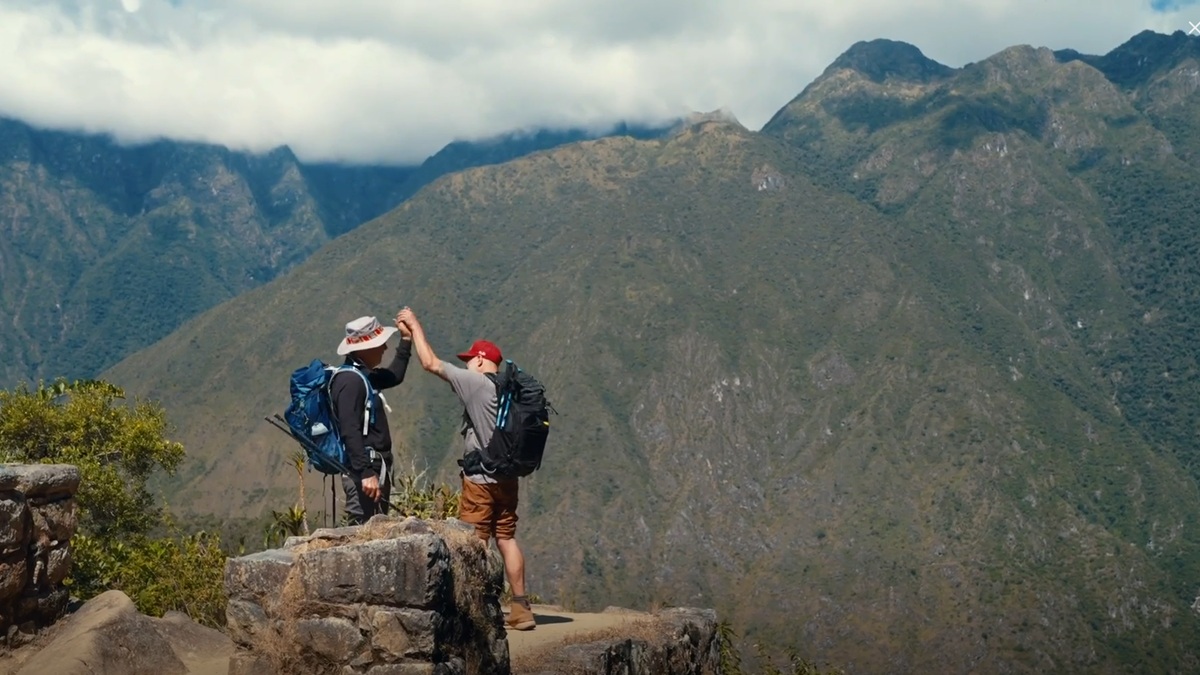
Old Friends and Older Knees
I have a tightly knit group of male friends who, for reasons both sentimental and mildly embarrassing, call ourselves The Roadtrippers. Every so often, we get together for dinner, a short drive, or—just recently—a trip over a thousand miles away from home to feel like a small act of devotion. Nobody says it that way, of course. Men rarely do. We just show up every time, eat too much, talk nonsense, geek about random things, and pretend the friendship maintains itself. Watching Bob and David wheeze their way through a bucket-list hike, I kept thinking about that unspoken vow.
Keep going. Keep checking in. And keep making memories before the body starts filing formal complaints.
That’s why the film becomes more affecting than its goofy surface suggests. Odenkirk and Cross aren’t selling us a grand thesis about male friendship; they’re simply showing one. Their bond has the friction of people who know each other too well and the ease of people who don’t have to explain the rhythm anymore. They can insult each other, admire each other, poke at old career disappointments, then pivot into absurdity before anything gets too damp with feeling.
That tenderness hit home with me because I know, in my own way, what it means to keep choosing the same friends across time.
More Tribeca Coverage: ‘That Friend’ is a Chaotic Buddy Comedy About the Friend You Can’t Quite Outgrow
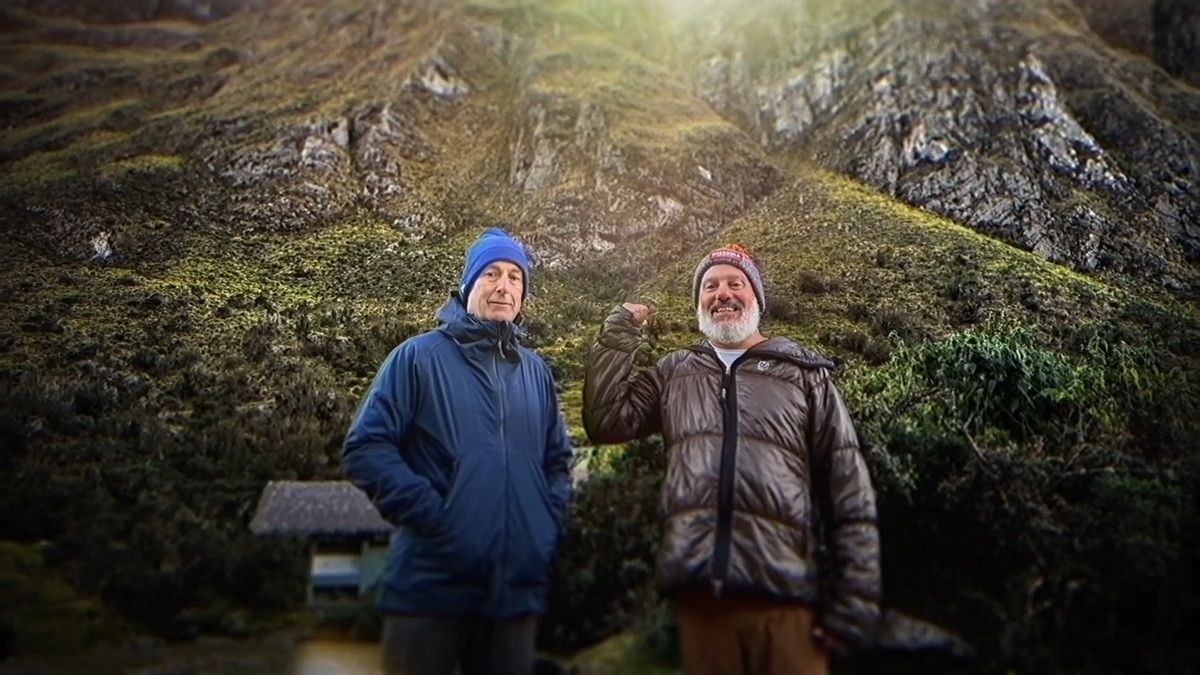
‘Bob and David Climb Machu Picchu’, and the Joke Between the Breaths
The film works best when comedy opens into reflection without announcing the shift. Odenkirk’s heart attack isn’t treated as the dramatic centerpiece, but it’s always somewhere nearby, especially when the climb starts to feel less like a lark and more like a dare issued to mortality. Cross comes across as both instigator and witness: the friend who proposed the insane thing and now has to keep walking beside the man who agreed to it.
LaHaie keeps the film moving at an amiable pace, and the editing understands that the best travel moments aren’t always the scenic payoffs. They’re the half-formed jokes, the bad meals, the language gaps, the tired silences, and the private laughter that would sound idiotic if explained to anyone else. Yo La Tengo’s music adds to that easygoing mood without trying to turn the hike into a spiritual awakening with better footwear. That both Odenkirk and Cross starred in the band’s music video for the 1997 song “Sugarcube” is extra nostalgic.
Michael LaHaie’s funny, ragged, unexpectedly tender documentary follows Bob Odenkirk and David Cross up a mountain and into a reflection on friendship, mortality, and staying in sync.
The documentary, of course, has limits. It’s slim, and some of the career material plays more like an affectionate scrapbook than a deeper reckoning. Fans of “Mr. Show” may want more, while newcomers may only get a partial sense of why this partnership mattered so much to a particular corner of American comedy. A few stretches also have the relaxed shapelessness of a vacation video, though admittedly one starring two extremely funny men with better cameras and worse altitude tolerance.
But I didn’t mind the looseness much, because the pleasure is in the company. Odenkirk and Cross are still magnificently in sync, even when they’re wheezing, bickering, or making the kind of joke that exists mainly because the other person is there to receive it. “Bob and David Climb Machu Picchu” is simple, funny, occasionally moving, and blessedly unpretentious. It understands that some friendships don’t need a dramatic breakthrough. Sometimes they just need a trail, a tent, a stupid bit that runs too long, and enough breath left to laugh before the next climb.

Michael LaHaie’s “Bob and David Climb Machu Picchu” had its world premiere at this year’s Tribeca Festival in the Spotlight Documentary category. The festival took place on June 3-14, 2026. Follow us for more coverage.


PARIS — There’s a present-day answer to the question that was posed in verse by the French medieval poet and street brawler François Villon: “Where are the snows of yesteryear?”
They’re right here, in high summer, on Paris’ oldest bridge, the Pont Neuf, where an enormous art installation, a trompe l’oeil inflatable snow-clad mountain range, has arisen over the river Seine.
Using about 200,000 square feet of printed fabric, Paris-born street artist JR has created “La Caverne du Pont Neuf.” It’s his version of and homage to the innovative work of groundbreaking environmental artists Christo and Jeanne-Claude.
They’re the fabled duo who first wrapped the arches of this same bridge in straw-colored fabric in 1985. Over the years, they also surrounded 11 islands in Florida’s Biscayne Bay with flamingo-pink cloth, hung saffron-colored fabric “gates” in New York’s Central Park, installed a “running fence” of billowing white material across nearly 25 miles of Sonoma and Marin counties and, in 1991, planted 3,100 yellow umbrellas, blooming like 20-foot-tall poppies, through the Tejon Pass north of L.A.
I interviewed Christo in 2011, and he was eloquent about how his and his wife’s work alters perceptions of nature, and about the deliberately transient character of the art itself. JR, an acolyte of their work, told me in an email that “an ephemeral artwork forces you to come now, and usually to come with other people. The visit becomes a shared moment … and this moment becomes a memory.”
In a city celebrated for artworks that have survived for centuries, this installation was very nearly too transient. A kooky hailstorm in late May, a heat wave in June, followed by ruthlessly ripping winds, delayed the opening by days. At last, beginning one midnight, the air pumps began and the work arose like a limestone-colored soufflé. It will be open around the clock until June 28.
Plus ça change, plus c’est la même chose. Back in 1985, Christo’s engineer on the Pont Neuf project, Ted Dougherty, pointed out that above 25 mph, “wind is not our friend.”
The piece works from two vantage points: from afar — visible from a lot of central Paris — and also from inside it, in the “cave” part. Pedestrians crossing the bridge pass through a fabricated interior, a cavern-like space printed in 3D realism and enhanced with a specially designed scent to evoke the dank, earthy aroma of humankind’s early habitations.
JR and Thomas Bangalter in “La Caverne du Pont Neuf” in Paris.
(Tara-Jay Bangalter)
JR intended it to be both. “From the start I designed two works in one. There is the silhouette — what you catch from the quais, from the bridges, from a boat on the Seine or simply walking past on your way somewhere else. That image belongs to everyone, including the people who never chose to look at art that day.”
And then, he said, “there is the inside, which is slower and more intimate, almost in the dark, hard to photograph.” That aspect is “a journey to cross the bridge, to go from darkness to light.”
When Christo and Jeanne-Claude wrapped the arches of the Pont Neuf more than 40 years ago, it took years of planning and permits to make it happen. “La Caverne du Pont Neuf” was a breeze by comparison.
JR, whose other vast outdoor works have delivered double-takes of humans’ scale and their architecture, told me that cities have come to understand “that public art brings people together and that the image travels around the world. Once Christo showed it could be done safely and beautifully, the conversation changed. It was much easier for me to have my project accepted, thanks to them. They also proved the economic positive impact to the cities they worked in. I believe there should be more large-scale, ambitious public art projects.”
It’s one thing to conceive of such a project and another altogether to make it happen — so much technology, compared to, say, mixing paints and choosing a paintbrush. But the science that “La Caverne” required “is the art, not an obstacle to it,” JR said.

“Trompe l’oeil turns adults back into children,” JR said.
(Elea Jeanne Schmitter)
All the canvas, the engineering, the meticulous assembly, the permits — “none of that is preparation for the work, it is the work. Christo taught me this. The process is visible, and even more after the storm we experienced a couple of days before opening to the public. Nature always reminds you who is in charge. When the wind tore the canvas before we opened, we took it down, re-sewed it, reinforced it,” all in full public view.
“Where I stay careful is in not letting the technology become the subject. The augmented reality by Snap’s AR Studio adds to the project, doesn’t take you away from it.”
That air should be JR’s vital collaborator — no complex and costly scaffolding for these magic mountains — is nothing new in Paris.
The first free flight of humans above the earth, on Nov. 21, 1783, sent aloft two men in a hot-air balloon crafted by the Montgolfier brothers from silk fancifully painted in blue and gold with figures of the zodiac. It wafted across Paris for about 25 minutes at about 3,000 feet. Ephemeral, yes — and unforgettable.
Artists and couturiers are fond of the whimsy of trompe l’oeil, the trick of the eye, the illusion of reality. I am a sucker for it, for fashion like that of clothing designer Elsa Schiaparelli. JR has used it often, as a massive-scale magical deception to make the Louvre Pyramid “disappear” into the old Louvre, and opening up an imaginary subterranean world below the Eiffel Tower.
“Trompe l’oeil turns adults back into children,” he told me. “You know it isn’t real, you know that ‘La Caverne du Pont-Neuf’ is not made of rock, that this is printed canvas. And yet your eye wants to believe it, and for a moment you let yourself. That gap between knowing and believing is where the play happens, and people love being inside that gap.”

In the modern entertainment age, franchising for the sake of it has become entirely commonplace. So long as intellectual properties are financially successful and capable of regularly turning a profit, no franchise is ever truly finished. Strangely enough, over the past decade, this has become especially true even in the medium of animation. Where sequels to animated films used to be predominantly relegated to straight-to-DVD releases and bargain bins at discount stores, they are now the bread and butter of the industry.
I say all of this to say that it’s easy to get jaded and uber-cynical when you see a title like “Toy Story 5” preparing for release. However, what’s so wonderful about Andrew Stanton and Kenna Harris’ long-gestating sequel is that it’s about as far from an easy cash grab as humanly possible. Instead, this fourth sequel to Pixar’s seminal original launching pad of a film overtly embraces several of the themes and subtextual threads that have emerged organically throughout the series, recontextualizing the three-decade-long-running franchise of cinematic bangers in a way I had never really thought about before: modern mythology.
TOP FIVE THINGS ABOUT “TOY STORY 5”
5. The Dynamic Duo of Andrew Stanton and Kenna Harris
Toy Story 5 is written and directed by the duo of Andrew Stanton and Kenna Harris. Stanton is a longtime Pixar veteran, a creative who has a writing credit on the first Toy Story and who also directed films like Finding Nemo and the masterpiece that is WALL-E. Harris, meanwhile, is a newer voice within Pixar, having made their directorial debut on the Luca-adjacent short film Ciao Alberto. In this combination of old and new, Toy Story 5 is able to strike a balance that is both traditional and innovative.
The film is both ruthlessly focused and astoundingly audacious. The first act spends time juggling multiple story threads, all of which inevitably collide in the latter half of the film. However, the fact that Stanton and Harris have crafted a structure that allows for these big, ambitious narrative swings while still remaining firmly rooted in the distinct perspective of Jessie as a character is nothing short of mesmerizing. Toy Story 5 is very much a film that could have simply played the hits and raked in the cash, but Stanton and Harris’ combined work, alongside their collaborators at Pixar, results in something far more nuanced, articulate, and affecting.
4. The Music
Randy Newman has long been the stalwart of the Toy Story franchise, writing original songs for all of the films and orchestrating the entire musical scores for them as well. That remains predominantly the case in this fifth entry, though he does receive a musical assist from Taylor Swift as well, with her bespoke end credits song, “I Knew It, I Knew You.”
The song is killer (and that is coming from someone who was kind of dreading new Swift music after the debacle that was The Life of a Showgirl), and Newman’s score is fantastic. The venerated musician finds inspiration anew in key elements of the plot, such as the legion of marooned high-tech Buzz Lightyear toys, who get their own operatic vocal arrangements to underscore their scenes. Elsewhere, Newman digs even deeper into the roots of his earlier inspirations, most notably with Jessie as a character, who receives a stronger twang in her theme music, along with numerous symphonic renditions of the iconic “When She Loved Me” from Toy Story 2. All in all, it’s phenomenal music across the board, worth hearing on the best sound system you can get.
3. The Playtime Setpieces
The masterpiece that is Lee Unkrich’s Toy Story 3 opens with one of my favorite sequences from any Toy Story film: a playtime sequence that sees the animators bringing young Andy’s imagination to cinematic life in thrilling fashion. It’s exciting, hysterical, and altogether enthralling. In Toy Story 5, with the toys and the films as a whole having shifted over to Bonnie, she gets numerous instances of her own playtime set pieces, and they are all just as fantastic.
Incorporating an entirely new animation style and aesthetic, these sequences bring the imaginations of these young girls (newcomer Blaze gets a playtime set piece as well) to life in the same way that the third film brought Andy’s to life. These sequences are full of innovation and bursting with creativity, while also gaining an immense amount of traction from contrasting themselves with the playtime sequences from earlier in the franchise. They are thrilling, insightful, and enlightening all at once, more than worth the price of admission.
2. The Performances
There are so many fantastic vocal performances throughout Toy Story 5. Tim Allen is as reliably broad as ever as Buzz, but it’s the other two-thirds of the main trio here that really get to shine in unexpected ways. First up is Joan Cusack as Jessie, who gets to be this film’s full-on protagonist and absolutely rises to the occasion. Jessie has long been a rich character, but seeing her get more room to breathe is a bona fide treat, and Cusack delivers her greatest vocal performance of the series as a result.
Then there is Tom Hanks as Woody, who absolutely soars as a result of the exact opposite approach: he’s unencumbered by the narrative and instead freed up to go kind of bonkers. In installments past, Woody has often been relegated to the role of the comedic straight man in one way or another. But here, Woody is unleashed, and Hanks subsequently goes completely off the rails. This is the most scenery he has ever chewed in one of these movies, hamming it up with several line deliveries in absolutely gut-busting ways.
Also, the scene-stealer of the movie is Conan O’Brien as Smarty Pants, a tech-based toilet aid. Conan goes full-blown gonzo in the ways that only Conan can, while also delving into some unanticipated nuance and pathos. All around, miraculous stuff.
1. What They Grow Beyond
The central narrative hook of Toy Story 5 is “tech versus toys.” There are about a million different ways this could have gone horribly wrong, and yet Stanton, Harris, and the team manage to pull it off with aplomb. The film is ultimately about the ways childhood has changed over the course of the franchise’s run: how technology has infiltrated this once-idyllic daydream of playtime and the implications of outsourcing childhood imagination to a series of devices.
On top of this, the franchise’s treatment of its characters remains consistent and earnestly authentic as ever. The way the Toy Story films continue to function as “yes, and” storytelling, building off each installment in ways that feel organic and deeply satisfying, is astounding. I don’t want to spoil some of this film’s greatest moments, but suffice it to say it engages meaningfully with its past while also charting a new course forward.
Where the previous two installments each brought things toward a sense of closure for the series as a whole, Toy Story 5 distinctly does not. Instead, it recontextualizes the franchise and redefines what a Toy Story film can be in the process.
GRADE
(A-)
Andrew Stanton and Kenna Harris’ Toy Story 5 is a Pixar film that more than lives up to the studio and franchise’s reputation. In an entertainment ecosystem full of seemingly unyielding franchises that keep proliferating for the sole sake of producing more monetizable content, Toy Story 5 stands in stark contrast as a passion-filled artistic statement. It is almost certainly not the sequel many Toy Story fans want, but it is instead the one they need: a film about the intrinsic beauty of growing, to infinity and beyond.

Discover more from RGM
Subscribe to get the latest posts sent to your email.
-

 Finance1 minute ago
San Diego County finances teetering toward structural deficit, watchdog study finds
-

 Fitness6 minutes ago
At 31, I’m the Strongest I’ve Ever Been—This Female-Focused Training Plan Is to Thank
-

 Movie Reviews16 minutes ago
‘Bob and David Climb Machu Picchu’ Tribeca 2026 Review: A Travelogue of Old Friends, Older Knees, and Same Absurd Timing
-
World28 minutes ago
In Taylor Swift’s beach town, every clue becomes a wedding rumor
-
 Lifestyle1 hour ago
‘Wait Wait’ for June 20, 2026: With Not My Job guest Caro Claire Burke
-

 Technology1 hour ago
Sony’s Xperia 1 VIII is still a phone for the fans
-

 World1 hour ago
Trump-backed ‘El Tigre’ looks to crush cartels, end Colombia’s socialist era in pivotal election
-

 Politics2 hours ago
Obama Center visitors say project symbolic of ‘Black excellence,’ claim scandal-free legacy while Trump ripped

