Science
How Running Shoes Have Evolved, From Ancient Greece to a Record-Breaking Marathon Time


When the messenger Pheidippides ran from the battlefield of Marathon to Athens to announce the Greek victory over the Persians in the 5th century B.C., he did it without shoes. His time was not officially tracked.
Millenniums later, at the London Marathon on Sunday, Sabastian Sawe and Yomif Kejelcha became the first to break the two-hour barrier in an official marathon, and Tigist Assefa set a women’s world record. All three did it in featherweight footwear.
The shoe, the Adidas Adizero Adios Pro Evo 3, weighs 97 grams, or about 3.4 ounces, depending on the shoe size. It’s the lightest running sneaker approved for competition. It sold out on Monday.
The race to near-weightlessness has been a driving force of innovation in running sneakers in the 25 centuries since shoeless Pheidippides’s run.
Heavier shoes are slower, a 2016 study showed, although that analysis was only for three-kilometer time trials. The study’s authors hid lead pellets in some Nike racing shoes and didn’t tell the subjects.
“When we added 100 grams per shoe, they ran about 1 percent slower, and when we added 300 grams, they ran about 3 percent slower,” said Rodger Kram, an emeritus professor of integrative physiology at the University of Colorado, Boulder. He called the 1 percent per 100 grams “a rule of toe.”
But it took many steps before running shoes evolved to the blistering pace they now allow.
‘The Platonic ideal’
Shoes once relied on leather, wood or metal reinforcements that were heavy and stiff. The rise of the rubber sole added flexibility and waterproofing. Better durability and grip were bonuses.
People could also run or walk in rubber soles without being heard. That’s why they’re called sneakers.
The first flat-soled rubber and canvas shoe was developed in 1868, almost 30 years after Charles Goodyear discovered the process of curing rubber called vulcanization. Converse and Keds made them popular in the 1920s.
“Converse All Stars are the Platonic ideal of the sneaker,” said Nicholas Smith, the author of “Kicks: The Great American Story of Sneakers.”
He noted they have not changed much.
“Canvas on top, rubber at the bottom.”
‘Chariots of Fire’
Competitive runners soon faced a trade-off: a heavier shoe with better traction or a lighter flat sole.
The heavier option, which transferred maximum force from the runner’s foot to the ground for acceleration, came from J.W. Foster of Bolton, England, who had the insight that led to the first metal spikes in shoes in the 1890s. Top British runners, including those competing in the 1924 Paris Olympics, wore these new spikes to notch their fastest times. Their story is told in “Chariots of Fire,” the Oscar-winning 1981 film.
It was at another Olympics, in Berlin, that Jesse Owens wore six-spiked shoes created by Adidas to become the most successful runner of the 1936 Games. His shoes, made of specially tanned calf leather and cowhide, weighed 201 grams.
A broken waffle iron
Running tracks made of urethane, a rubber compound, began to emerge in the 1960s. When one was installed in 1969 at the University of Oregon, the track coach, Bill Bowerman, found that runners’ spikes dug in too deep while flat shoes offered too little traction.
Having breakfast one morning in 1971, he noticed that the grid pattern on the waffle iron his wife was using might just be what his runners needed to get a grip on the track.
He tried pouring liquid urethane into the waffle iron, but only managed to seal it shut. He kept trying other waffle irons until he had the mold he wanted, according to Nike archivists.
But Bowerman wanted more than grippier sneakers.
“He was also devoted to making the lightest running shoe possible,” said Elizabeth Semmelhack, the author of “Out of the Box: The Rise of Sneaker Culture.”
Bowerman’s shoe, which Nike called the Waffle Trainer, “stands out because it had an extremely thin rubber sole but with a high tread, and then the upper of the shoe was made out of nylon.”
The light weight also helped bring running to the masses.
“You can bet there wouldn’t be so many people running today if they had to carry all the extra baggage we had back then,” Bowerman, a Nike co-founder, said in 1979.
The waffle-pattern nubs on the soles compressed under weight and helped bring spring to a runner’s step. But they only hinted at how sneakers could be cushioned. For many runners, it was not enough.
Then Nike introduced ethylene-vinyl acetate, better known as EVA foam, on the heel of its Cortez shoe in 1972. EVA offered a thicker, air-infused layer of separation from the road and absorbed more of the shock. The age of adding thick slabs of rubber for cushioning was over.
That led to a new quest that continues today: How much cushioning can you build into a shoe?
Lighter than foam
Sneaker makers next turned to a gas and a semisolid to help spread the energy of a foot’s impact with the ground.
In 1979, the Nike Air Tailwind began the airbag era, in which pressurized gas is stored in a flexible urethane bag within the sole.
Asics pioneered gel cushioning technology in 1986 with its silicone-based shock absorption. Nike countered in 1987 with the Air Max 1, which had a “window” in the sole designed to show off the air pocket. “At the time that was the cutting edge,” Mr. Smith said.
Though air is lighter than foam, it had to be kept in a rubber vessel, which added weight. So did adding silicone gel packets to the heel and forefoot.
While air bubbles felt more springy, and gel more dampening, they both were able to absorb shocks longer than the standard foam.
An icon of the 1990s tackled a different problem: how laces become loosened during a run. Reebok, building upon its wildly successful Pump basketball sneakers, which could be inflated with the press of a button on the tongue, introduced the Instapump Fury, a colorful, open-paneled, split-soled running sneaker.
“The Instapump used an air bladder that could fit your particular foot, the nuances of your own foot, very, very closely,” Ms. Semmelhack said. “Then you didn’t have to adjust any lacing throughout your run or at any time. So it was very innovative.”
Rise of the super shoes
But as new technologies made foam lighter, shoemakers soon couldn’t get enough of it.
One brand, Hoka, wedged so much cushy foam into its soles, beginning in 2009, that the shoes looked swollen. Runners could hardly “feel the ground anymore,” Smith said. The company’s designs helped push amateur runners to chunkier shoes.
But it was the thick-soled Nike Vaporflys that captured the most attention. They came with a carbon-fiber plate in the midsole that was very light and gave stability to all the squishy foam. The plate stores and releases energy with each stride, and is meant to spring runners forward.
The Vaporflys also use polyether block amide, or PEBA, a bouncier, lighter foam. The twin technologies led to the nickname “super shoes.”
“There was concern that this additional innovation in the running shoe was the equivalent of doping,” Semmelhack said. The shoes cushioned the feet of all three medalists in the men’s marathon at the 2016 Rio de Janeiro Olympics. The New York Times found in 2019 that the shoes gave a significant advantage, but they were never banned.
Adidas used its lightest foam in the sole of the Adizero Adios Pro Evo 3, which were worn by Sunday’s record-breaking marathoners. It also said that the shoe has carbon fiber rods to mimic the human foot’s bone structure.
In other words, closer to the bare feet in Pheidippides’s run.



Few substances are as deeply woven into everyday life as alcohol. It is a fixture at holiday celebrations, work-related social gatherings, sporting events, airports, and brunch or dinner tables. All demonstrate how deeply alcohol has become embedded in social customs and cultural traditions.
Yet alcohol contributes to millions of deaths globally each year and is linked to cancer, liver disease, unintentional accidents, violence and, importantly, dependence and addiction. Despite this, the disconnect between alcohol’s cultural role and its serious health burden is striking. An estimated 2.3 billion people worldwide consume alcohol.
As a physician working in addiction medicine, I regularly care for patients whose alcohol use affects nearly every organ system. It is often not until these patients end up admitted to the hospital that they learn the effects of alcohol on various parts of their body besides their liver.
Newer evidence challenges assumptions about what was long considered “safe drinking.” Even moderate drinking carries risk and is not as harmless as people, including experts, once thought.
Many people associate alcohol risk primarily with addiction or dangerous behaviors such as driving while intoxicated. However, its effects extend far beyond this, into nearly every aspect of a person’s well-being.
While alcohol may transiently improve mood and ease social anxiety, long-term alcohol use can lead to a worsening of mood, cognition and sleep, which can further compound use.
A 2021 literature review found that consuming approximately two standard drinks roughly doubles the odds of sustaining injuries — with or without a vehicle involved. The review also found that heavy episodic (binge) drinking can increase the risk of injury by 50-fold, depending on the amount of alcohol consumed and the type of injury. While alcohol’s effects on the liver are well known, it can also lead to gastrointestinal complications and heart disease
The World Health Organization estimates that 2.6 million deaths each year are attributable to alcohol, accounting for nearly 1 in every 20 deaths worldwide.
While many people recognize the risks of alcohol addiction, people are generally much less aware of the links between alcohol use and cancer risk.
The World Health Organization classifies alcohol as a Group 1 carcinogen — the same category as tobacco and asbestos. In 2025, the U.S. surgeon general emphasized that alcohol increases the risk of at least seven cancers, including cancers of the breast, colorectal, liver, oral, esophagus and larynx. An advisory called for updated warning labels.
Yet fewer than half of Americans recognize alcohol as a risk factor for cancer, particularly for cancers such as breast cancer that are not commonly associated with alcohol use.
Throughout the 1990s and early 2000s, observational studies suggested that moderate alcohol consumption might offer cardiovascular benefits. Over the past decade, however, higher-quality studies have challenged these findings, suggesting that much of the apparent benefit may have reflected differences in the health and lifestyles of moderate drinkers rather than a protective effect of alcohol itself.
Current evidence increasingly suggests that even low levels of alcohol may increase cancer risk.
Federal guidelines acknowledge that adults should “consume less alcohol for better overall health.” However, the most recent version of the “Dietary Guidelines for Americans,” updated in January, removed the previous recommendation to limit intake to no more than one drink per day for women and two for men. It also omitted explicit discussion of alcohol’s links to cancer.
These changes have drawn criticism from public health experts, who argue that the revised language plays down the growing evidence of alcohol-related harms and provides less specific guidance to consumers. The current administrator of the Centers for Medicare & Medicaid Services characterized alcohol as a “social lubricant” that brings people together, rather than emphasizing its well-established health risks.
This may be true physiologically, at least temporarily, but obscures the fact that relying on it as a social lubricant can lead to chemical and psychological dependency. In my view, statements to that effect are shortsighted, prioritizing short-term social effects over more insidious and long-term issues, including addiction.
While many dangerous mind-altering substances are hidden from public perception, alcohol is often placed at the center of it – a trend that shows no sign of changing imminently.
Further, large companies often profit from ads that appeal to young people.
Looking back at the history of tobacco smoking provides some helpful insights. In 1965, 42.4% of the U.S. population smoked. By 2022, that figure had dropped to 11.6%.
This steep decline did not happen because of a single intervention, but through decades of accumulating scientific evidence, public education campaigns, warning labels, restrictions on advertising, smoke-free policies, higher tobacco taxes and shifts in social norms. Together, these efforts transformed smoking from a widely accepted social behavior into one broadly recognized as a major health risk and correspondingly, less socially accepted.
Although alcohol consumption has modestly declined in recent years, it remains deeply embedded in social life in ways cigarette smoking no longer is.
People often assume that if a substance is legal, common and widely socially accepted — even encouraged — it must also be safe. But public health history suggests those assumptions can and should change.
Emma Fenske is an addiction medicine fellow and internal medicine physician at Oregon Health & Science University. This article was produced in partnership with the Conversation.
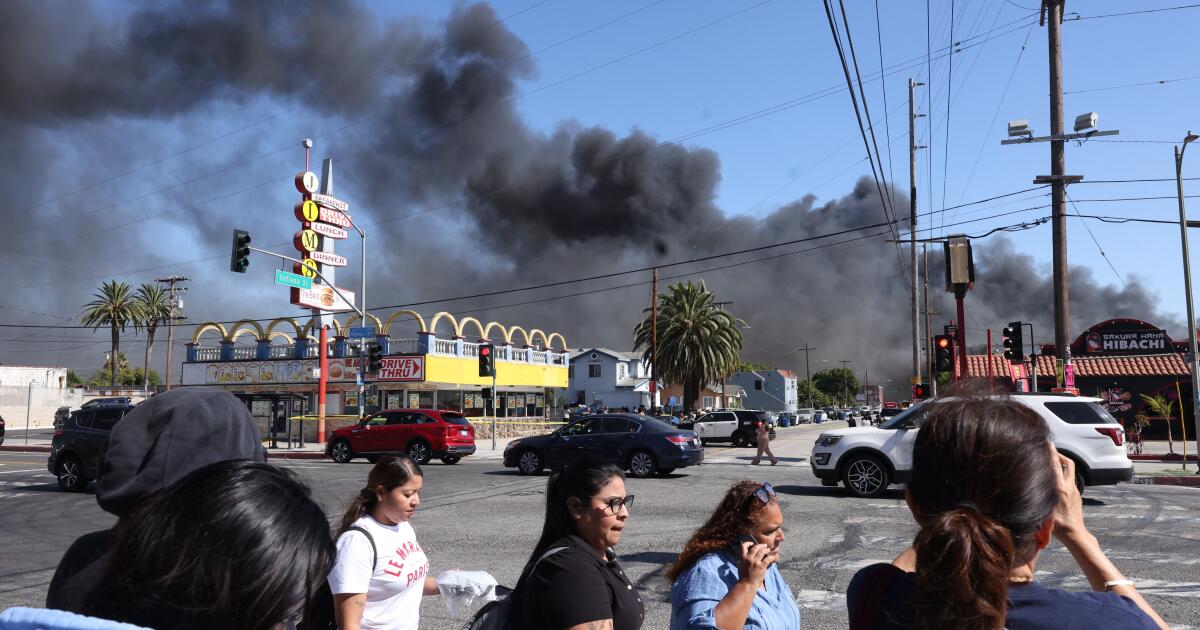
The air near the Lineage refrigerated warehouse fire in Boyle Heights carried astronomically high levels of smoke and soot, surpassing some of the worst air pollution during the Los Angeles County fires in January 2025, according to preliminary data from air officials.
The fire spewed thick black smoke for days. From downtown Los Angeles to the San Gabriel Valley, tens of thousands were enveloped in unhealthful levels of smoke, even as some local officials told residents that the air posed no danger.
As the days wore on, worst off were communities nearest the blaze. On June 19, three days after the facility ignited, a temporary air quality monitoring station at Eastman Elementary in unincorporated East Los Angeles measured an extremely hazardous 755 micrograms per cubic meter of fine particles for more than an hour, according to the South Coast Air Quality Management District.
For comparison, a Caltech air monitor in Pasadena recorded about 650 micrograms per cubic meter during the Eaton fire.
These high levels of fine particles, known as PM 2.5, probably resulted in the surge of residents into local emergency rooms during the fire, according to local health officials. But even now with the smoke gone, people still have not been told what chemicals they were breathing in during the weeklong ordeal.
Michael Jerrett, an environmental health professor at the UCLA Fielding School of Public Health, said his concern is the composition of materials emitted when the building burned.
“These contain many particularly toxic components,” Jerrett said, “and we know little about how these mixtures affect health.”
There is no completely safe level of fine particulate pollution, he noted, meaning higher concentrations are always worse.
During the 2025 L.A. County fires, local air officials announced that several monitors downwind had detected elevated levels of brain-damaging lead and cancer-causing arsenic from toxic paint and construction materials used in older homes.
The Lineage warehouse, built in 2018, is likely to contain different materials of concern. Thick insulation foam required for a massive refrigeration operation, solar panels and refrigerants were burned, leaving many residents on edge.
Even though three public agencies conducted air monitoring, the picture is still murky.
“[Public officials] are speaking with a lot of confidence but not a lot of information,” said mark! Lopez, a community organizer with East Yard Communities for Environmental Justice. “We’ve gotten in the room with folks to discuss where the gaps lie and where assumptions are being made. And I think they are realizing these agencies supposed to protect our air and our health aren’t as reliable as they thought they were.”
In response to the Boyle Heights fire, the South Coast air district deployed a mobile monitoring vehicle to screen for toxic substances in the community near the fire, according to Nahal Mogharabi, a spokesperson for the air district. It found increased levels of bromine, a chemical commonly found in fire retardant, and chlorine, often released from burning plastic. Both were below short-term health-based exposure thresholds.
Toxic metals, including lead and arsenic, were not elevated, according to air district data.
“That was the reassuring piece, that they were not picking up any of the metals,” said Dr. Nichole Quick, chief medical advisor for the Los Angeles County Department of Public Health. “But … that smoke is unhealthy. “You don’t want to be breathing it, regardless.”
The U.S. Environmental Protection Agency set up air monitors around the perimeter of the facility to test for toxic air contaminants, has the results and has not made them public. Julia Giarmoleo, an EPA spokesperson, said the monitors did not detect elevated metals, but would not provide a copy of the data without a federal records request.
The Los Angeles Fire Department’s hazardous material team also tested for ammonia, which is used in refrigeration, and hydrogen fluoride, a toxic chemical that could be released by burning lithium-ion batteries and solar panels.
Fire officials previously said they measured low levels of hydrogen fluoride on the second day of the fire. But the department would not answer questions about its air monitoring. It also told a reporter to submit a public records request.
It remains unclear whether any agency has tested for hydrogen cyanide or isocyanates, highly toxic gases that could be released from burning chemical-laden insulating foam inside the building.
“The real issue is what monitoring has not been done to protect the fence-line community from the air toxics,” said Jane Williams, executive director of California Communities Against Toxics.
Without the EPA or LAFD data, what is known of the smoke’s toxicity rests on the air district’s mobile monitoring.
Jerrett, the UCLA researcher, said that is not ideal for understanding the kind of plume released by the Boyle Heights fire, which rapidly changed direction with the wind.
“This can in some instances lead to levels that look low, but they are resulting from a mismatch between the location of the vehicle and the plume,” he said.
The Boyle Heights blaze, similar to the Eaton and Palisades fires, has revealed the region’s air monitoring can’t always tell people what they’ve been exposed to in a disaster.
“We do need a better monitoring system in place,” he said.
Local officials are now shifting their focus to the rancid odors from millions of pounds of rotting food in the ruined wing of the warehouse. Decomposing food can release hydrogen sulfide, a toxic gas synonymous with landfills and garbage. Lineage hired contractors who are measuring this noxious gas and other pollution. Their data indicate they have not detected hydrogen sulfide.
As Lineage workers haul the rotting food to local landfills, they are using deodorizing mist and have discussed using shrink wrapping to suppress the stench and minimize issues for nearby homes.
At this point, the odors are believed to be an inconvenience rather than a public health threat, according to Quick, the county medical advisor. She said running air purifiers may help to reduce odors indoors.
“It’s very important for folks to understand that the odors themselves do not indicate any dangerous levels of toxins, mold, bacteria, and so forth,” Quick said. “But the odors are a public nuisance.”
The air district is still encouraging residents to report odors to its online complaint system or by calling (800) 288-7664.

Federal employees who were axed during waves of cuts by the Trump administration have fought back against the dismantling of a key climate science website, Climate.gov, and put up a new site, Climate.us, that can now do everything the original did.
The site, with millions of users each year, was known for colorful charts that anyone could freely download and that simplified giant sets of data, such as temperature readings. Now it refers to another page and is no longer being updated.
Daniel Swain, a UC Agriculture & Natural Resources climate scientist, called the resources available at Climate.gov “the most efficacious dollars spent by NOAA on public-facing science, possibly ever.” He has used graphics from the former website on his popular weather blog.
“I am a terrible artist or illustrator. It would be very bad if I had to create those on my own.” Swain said. The website didn’t just make graphics that were beautiful, he said, they were accurate and reliable because of the network of researchers who fact-checked them.
Rebecca Lindsey was the editorial lead and program manager for Climate.gov until February 2025, when her position at the National Oceanic and Atmospheric Administration was eliminated by the Elon Musk-led Department of Government Efficiency, or DOGE. She explained that the online resource was “a bridge between scientists, data and the public.”
Lindsey and her team have now rebuilt the bridge piece by piece, if just a bit further downstream.
The team is made of the same editorial and technical staff that ran Climate.gov. It’s paid for through a crowdfunding campaign and one large, anonymous donation.
The group has raised some $380,000, about $100,000 of which came in the last week. They also have recruited 80 scientists who are willing to volunteer as subject matter experts and fact checkers. It’s enough to keep the work going through February while they seek more long-term funding.
The first iteration of Climate.us went online in 2025 to keep the last 15 years of work from the government website available. The newest version restores the full function of the previous website.
For Californians, the timing could be important.
“We’re headed for a very strong El Niño event that will have significant implications for Southern California,” Swain said. “Climate.gov and the scientists behind it did a great job walking people through the last one, and I would expect that’s the case this time as well.”
Climate.gov excelled at tapping into a pool of academic experts to explain what was happening in nearly real time. This allowed the public to see how events such as wildfire, drought or large weather patterns such as El Niño were shaping their lives when they needed the information most. Research from academic institutions, by contrast, can take years to publish results from major natural disasters.
Swain emphasized that cuts to resources that give context to hard-to-interpret data is not just a loss for the research community.
“It’s getting more and more difficult for the American public to access the science and the scientists that their tax dollars have supported for over half a century,” he said.
With the revival of Climate.us, Swain said he plans to directly use the site and its graphics to keep Californians connected to the world of climate science.
-
 Lifestyle19 minutes ago
To be or not to be a parent : It’s Been a Minute
-

 Technology31 minutes ago
Sony’s PlayStation disc factory is already being repurposed
-

 World34 minutes ago
Couple publicly caned after alleged TikTok kiss sparks outrage in Indonesia
-

 Politics39 minutes ago
WATCH: Controversial SCOTUS decision strikes a divide among lawmakers
-

 Health46 minutes ago
Big Medicare change slashes weight-loss drug costs for eligible seniors
-

 Sports49 minutes ago
VAR denies Croatia’s game-tying goal as Cristiano Ronaldo leads Portugal to Round of 16
-

 Technology54 minutes ago
New sodium-ion battery could reshape grid storage
-
 Business1 hour ago
Home insurer surcharges for wildfires is legal, judge rules

