West
Former Trump official in crucial battleground Senate race hits back at major endorsement snub

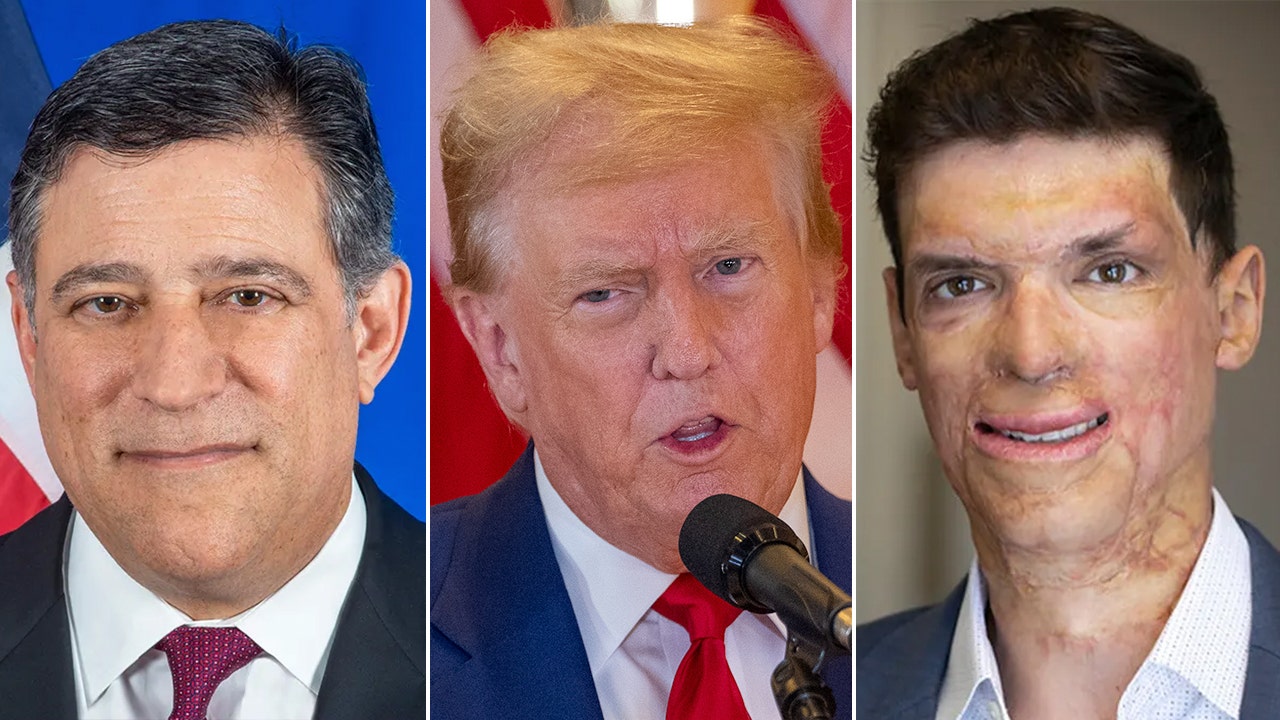
LAS VEGAS – A former Trump official running for Senate in the crucial swing state of Nevada hit back Monday after being snubbed for a major endorsement from his old boss.
Dr. Jeffrey Gunter, who served as the U.S. ambassador to Iceland, had hoped to win former President Trump’s backing in his bid to flip Nevada red, but that honor instead went to his primary opponent, former U.S. Army Capt. Sam Brown, late Sunday.
Both candidates and their respective supporters close to Trump had battled for weeks behind the scenes to win the former president’s backing.
TRUMP ANNOUNCES MAJOR ENDORSEMENT IN CRUCIAL BATTLEGROUND SENATE RACE
Dermatologist and former U.S. Ambassador to Iceland Dr. Jeffrey Gunter, former President Trump, and former U.S. Army Capt. Sam Brown (State Department | Getty Images | Sam Brown for Nevada)
“Mitch McConnell money wins, the American people lose. Rinse and repeat,” Gunter told Fox News Digital after news of the endorsement broke, a clear swipe at national Republicans who have remained staunchly behind Brown’s candidacy.
Gunter later claimed in an early Monday X post that the endorsement came down to a “big check,” something the National Republican Senatorial Committee (NRSC) dismissed as an “unglued” attack against Trump.
“California Democrat Jeff Gunter became totally unglued after President Trump endorsed war hero Sam Brown. Gunter took to Twitter to falsely smear President Trump and sounds more Adam Schiff than a conservative,” NRSC communications director Mike Berg told Fox.
Some close to Trump blasted Gunter for accusing the former president of “pay for play,” calling on him to delete the post.
TRUMP ENDORSEMENT IN BATTLEGROUND STATE ANOTHER VICTORY FOR SENATE REPUBLICAN CAMPAIGN CHAIR
“Didn’t accuse President Trump of anything. Will always support him 110% His ‘top advisers’ on the other hand, have some explaining to do,” Gunter responded in another post.
Fox News Digital interviewed Gunter just hours before Trump announced his endorsement of Brown on Truth Social. He expressed confidence heading into Tuesday’s primary, citing internal polling he said showed him either tied or leading Brown.
“Word on the street is we’re doing great, very exciting, and we’re working hard,” Gunter said. “So we’re very optimistic that we will make Nevada great again as the true Trump supporter 110% and MAGA candidate.”
Brown’s campaign has also cited internal polls, but they show him with a significant lead over Gunter, who argues he is the only one in the race able to defeat incumbent Democrat Sen. Jacky Rosen in the general election.
TRUMP RILES UP FIERY SWING STATE CROWD IN FIRST RALLY SINCE NEW YORK CONVICTION
Former Ambassador to Iceland Jeff Gunter is running for Senate in Nevada as a Republican. (Dr. Jeff Gunter for Senate)
Gunter cited polls showing Rosen leading Brown, but a New York Times poll released last month showed Brown and Rosen tied at 41% each with a number still undecided. Little independent polling has been done on a hypothetical matchup between Gunter and Rosen.
“I am the true MAGA candidate… If you like Mitch McConnell, and if you like Nikki Haley, then maybe you’ll like Sam Brown,” Gunter said. “But if you like America First, and if you love Donald Trump – I worked for him. I was his U.S. ambassador, and I’m true to my principles, and, I’m your guy. And that’s why we’re surging so much and doing so well in the great state of Nevada.”
Gunter said his experience as an ambassador and doctor, as well as his “loyalty” to Trump, were what undecided voters should consider as they head to the polls.
Fox News Digital repeatedly attempted to interview Brown ahead of Tuesday’s primary, but his campaign would not commit to doing so at the time of this article’s publishing.
Rosen is expected to easily win her primary on Tuesday, and will likely face either Brown or Gunter in the general election.
Republicans view Nevada as one of the party’s top flip opportunities as it seeks to win back control of the Senate from Democrats, who currently hold a slim 51-49 majority.
Get the latest updates from the 2024 campaign trail, exclusive interviews and more at our Fox News Digital election hub.
Read the full article from Here


Warsaw, N.Y. — Speedy cow, a new community owned internet service is now online in Wyoming County.
The service will bring faster, more reliable internet to Wyoming County residents.
The county received $15 million in grant funding to build the broadband network.
Anyone living in Wyoming County can sign up on the Speedy Cow website.
With the network being community run, that means all customer service experiences will be locally based.
“At the end of the day we own the system, so if there’s an issue with the system, the service or anything like that, you call the county and we’ll take care of it,” a county official said. “We’ll reach out to community broadband networks necessary and resolve any issues that the residents might have and at the end of the day, the residents of the county, the taxpayers of the county, own this system.”
Net profits from the service will be returned to expand and improve the system.
$3.8 Million in funding awarded for Affordable Broadband in Genesee County
___
San Francisco, CA
First of its kind queer museum in San Francisco Chinatown amplifies Chinese LGBTQ artists

On one side of the world, Xiangqi Chen can be punished for her LGBTQ+ activism. But on the other, the activist and artist is lauded as a trailblazer — the architect behind the first of its kind Chinese queer art museum.
The irony that she left her home in China and found a public platform for her LGBTQ+ artistic expression in San Francisco’s Chinatown — the country’s oldest — is not lost on her.
“Here in San Francisco Chinatown, I still continued my journey and met so many like-minded community members and friends,” Chen told The Associated Press through an interpreter. “It kind of actually encouraged me and gave me lots of strength to do what I know is my mission, my calling.”
The OUT Museum opened with a rainbow-ribbon cutting at the end of May — between Asian American Pacific Islander Heritage Month and Pride Month. Situated across from the Chinese Historical Society of America Museum, the bilingual museum is giving recognition to a demographic that has long felt invisible. It seems like an ideal fit in the progressive city at a time when some cities, states and the federal government are restricting or banning certain LGBTQ+ rights.
To start, the museum is only open on Saturdays and is one room with fewer than a dozen artworks by artists from China and the Chinese diaspora. But there is hope to expand the museum’s exhibits and days of operation.
Museum allows Chinese artists to fully tell their stories
While still living in China, Chen launched a Kickstarter for a proposed museum six years ago — more than 2,000 donated on the platform. But she knew it likely wouldn’t be built there. In 2022, she came to the U.S. on a J-1 visa as a visiting scholar at Georgetown University. By 2024, Chen gained attention in San Francisco for her role in an exhibition at the Asian Art Museum. That led to a residency with the Chinese Culture Center of San Francisco.
The organization was “proud to be the incubating space for the OUT Museum prototype,” executive director Jenny Leung said in an email.
The level of support that followed amazed Chen.
“I got so many chances to connect with the local Asian American queer community and even the Chinatown community in general,” she said.
Interest soon followed from longtime collaborators and younger artists who reached out via Instagram. They are represented in the inaugural exhibition, which includes photography, zines and an interactive installation where visitors use thread to trace their self-discovery journey with gender and sexuality.
For Hong Kong-born artist Dixon Ngai, this museum offers an outlet to tell his story as mainstream media typically overlook the Chinese LGBTQ+ community. He contributed a hand-painted, Chinese porcelain wine pot inspired by the Cantonese opera “Di Nü Hua,” or “The Flower Princess.”
Ngai said the OUT Museum, unlike other exhibitions, is very specific to the experience of the Chinese queer community, allowing “more people to see our voice.”
Museum affirms evolving attitudes toward LGBTQ+ presence
Since the museum’s opening, Chen has been “one hundred percent moved” by unexpected feedback from one particular demographic: Chinese immigrants, both queer and straight, who have lived in California for decades.
A 60-year-old transgender man who visited shared how he immigrated to the U.S. in the 1970s for crucial gender-affirming care. There was also a mother looking to connect with her gay adult son.
“She later emailed me saying that she’s so grateful for all the events the art museum has organized,” Chen said. “Her son came out to her, and she’s very proud of her son and she wants to express gratitude.”
These reactions are proof the museum is elevating the visibility of Chinese, Chinese American and Asian American LGBTQ+ people, said author and activist Helen Zia, a museum advisory board member. It also shows how attitudes have shifted, she said, as it would have been difficult to mount even 20 years ago.
“There were Asian churches who would have demonstrations week after week with thousands of people just condemning same-sex couples,” Zia said, recalling the response from the Chinese community in 2008 when she handed out pro-gay marriage flyers in Oakland’s Chinatown. “We got people yelling at us, spitting.”
Later that year, Zia and her wife were among many couples who wed after the California Supreme Court rejected a same-sex marriage ban. Even today, she says the museum’s presence sends a needed message.
“See our humanity,” Zia said. “Here’s the beautiful art that we create and imagine and contribute to the world.”
LGBTQ+ life in mainland China
versus the US
Being homosexual in China means living under the radar and discriminatory policies. In 2001, the Chinese Psychiatric Association stopped listing homosexuality as a mental disorder. But LGBTQ+ couples still cannot marry or adopt. They are also limited in their right to publicly advocate. When Chen lived in Shanghai, she ran a grassroots center for lesbians. One of the reasons she left was because during the pandemic the government started cracking down on spaces for LGBTQ+ activism.
She likely could not even put on an art show, let alone a museum.
“From 2013 to 2015, that kind of art exhibition by queer artists (could) exist, but only if you don’t explicitly show or tell the audience that your work or yourself identify as queer or LGBTQ,” Chen said. “But not nowadays.”
That Shanghai center is how Zia met Chen a decade ago. Zia was doing research for a book and toured the center.
“She’s been just incredibly brave in China, creating a center that attracted a lot of state attention,” Zia said.
A key difference Chen has noticed among American-born Chinese LGBTQ+ people versus those in China is they are more educated about gender and sexual identity and have more access to support.
Under the second Trump administration, LGBTQ+ rights are increasingly under threat. President Donald Trump’s administration has targeted gender-affirming care and sought to ban transgender people in the military. Some anti-Pride lawmakers recently proposed “Nuclear Family Month.”
San Francisco also recently dealt with shifting LGBTQ+ attitudes after Giants baseball players wrote Bible verses on Pride Night hats.
Nevertheless, the Chinese artists say the social landscape here is a breath of fresh air.
“Here in San Francisco, in California, we enjoy the air of freedom, there is equal human rights, there is security,” Ngai said. “So, we are very proud to be ourselves.”
This Sunday, Chen will proudly walk in her first San Francisco Pride Parade. She will plug the museum while dressed fittingly as a woman warrior from a Cantonese opera.
“I think completing this opening will be a start for me. It’s not the end,” Chen said. “We still have a long way to go.”
___
Tang reported from Phoenix.
Denver, CO
Denver Broncos Foundation launches extension of ‘ALL IN. ALL COVERED.’ emphasizing youth football participation

DENVER (KKTV) – In extension of the Denver Broncos Foundation’s helmet distribution program, they have launched the “ALL IN. ALL COVERED.” Statewide Youth Football Participation Program, in partnership with Every Kid Sports and Good Sports.
Over the course of five years, the program will aim to reduce financial barriers to play by providing financial support and essential equipment to increase youth participation in tackle and flag football.
The Foundation will fund registration fees for underserved youth through Every Kid Sports, while increasing access to both individual and shared team equipment through Good Sports.
The program aims to serve more than 17,000 children across Colorado, using football as a pathway to drive equitable access and sustained participation in sport.
“We’re excited to work with Every Kid Sports and Good Sports to grow youth football participation across Colorado and help open doors to the sport for both boys and girls,” said Bobby Mestas, Broncos Senior Director of Youth & High School Football.
Coaches and players from across the Pikes Peak Region had their first look at the new helmets they received for free from the Denver Broncos Foundation back last year.
Copyright 2026 KKTV. All rights reserved.
-

 Vermont1 minute ago
Vermont Attorney General will not prosecute state trooper who fatally shot unarmed Putney man – VTDigger
-

 Virginia4 minutes ago
Virginia Tech introduces Brian White as new Athletics Director
-

 Wisconsin16 minutes ago
Top 100 Prospect Visiting Wisconsin on Wednesday
-

 West Virginia19 minutes ago
Yeager Airport director receives four percent pay increase – WV MetroNews
-

 Wyoming24 minutes ago
Speedy Cow community-owned internet service goes live in Wyoming County
-

 Crypto31 minutes ago
14 AI Models Including Claude, ChatGPT and Grok Predict Bitcoin’s Price Outlook
-

 Finance34 minutes ago
G7 Recommits to Development, Investment Finance to Drive Shared Prosperity
-

 Fitness34 minutes ago
Social Fitness: Why Independent Living Communities Are Vital for Healthy Aging

