West
California homeowner shoots home invasion suspect, another dead in targeted heist: police

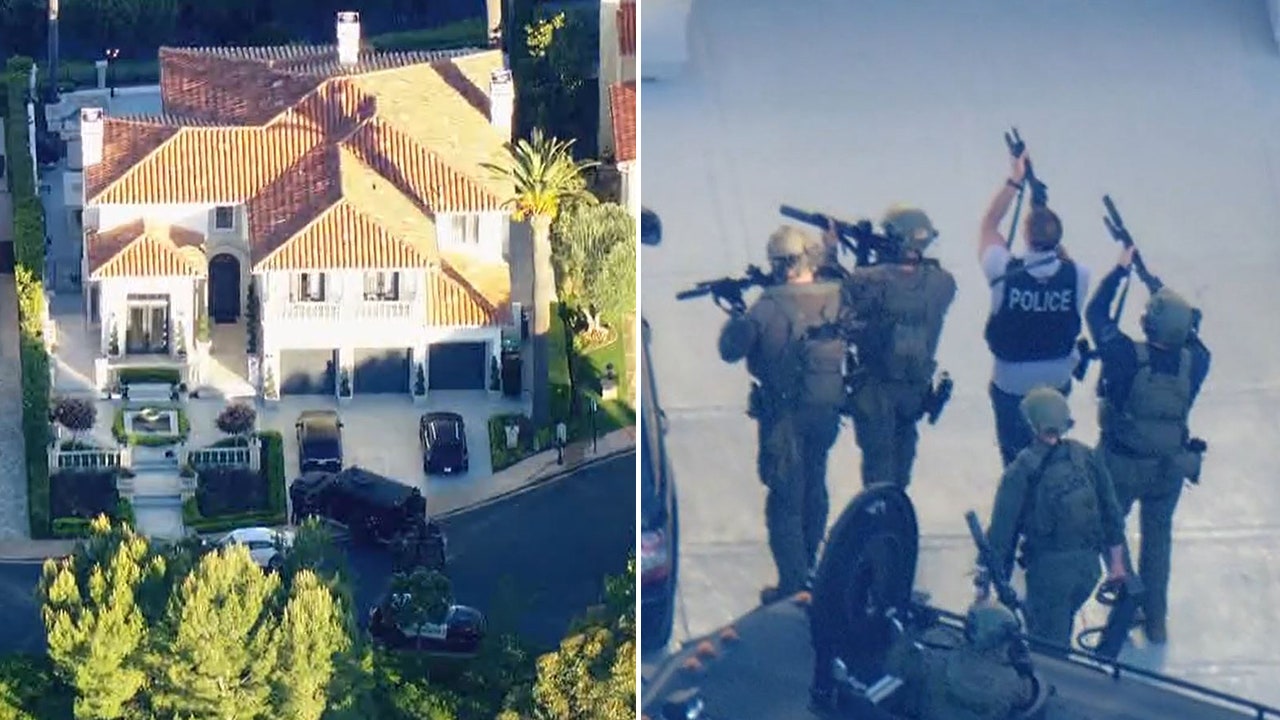
A resident in an affluent Southern California neighborhood shot a suspected home intruder Tuesday morning, police said.
The homeowner shot the suspect inside a gated home in coastal Newport Beach, authorities said.
“The crime appears to be a targeted incident involving a prior connection between the suspects and the victims,” a police statement said.
SCOTT PETERSON, KILLER OF PREGNANT WIFE, SPORTS NEW LOOK IN COURT IN LATEST BID FOR FREEDOM
Newport Beach police officers draw their weapons at the scene where a home invasion suspect was shot and another killed himself, authorities said. (KTTV)
Newport Beach police officers responded around 4:45 a.m. to a home at Pelican Hill Road and Newport Coast Drive. A 911 caller stated they shot one of the suspects inside the home, police said.
When officers arrived, they found one of the suspects lying in the street with a handgun and suffering from gunshot wounds. The suspect was taken to a hospital for treatment.
Details about the suspect’s injuries or medical condition were not disclosed.
Newport Beach police officers outside a home where a home invasion suspect was shot and another took his own life, police said. (KTTV )
Investigators also found a second suspect in some bushes near the home with a self-inflicted gunshot wound to the head. He was pronounced dead at the scene.
The four people inside the home at the time of the invasion were unharmed, police said.
“If you are thinking about coming into our city to commit crime, know that we will defend ourselves,” Newport Beach Mayor Will O’Neill said in a video statement.
Read the full article from Here


The Mariners have made the first move in what’s sure to be a rip-roaring Trade Deadline season, acquiring INF Buddy Kennedy from the Giants in exchange for cash considerations.
Kennedy was designated for assignment by San Francisco earlier this morning as outfielder Heliot Ramos returned from the Injured List.
Advertisement
The 5’10” infielder has spent most of the season with Triple-A Sacramento, hitting well, even for the PCL. He’s in the 78th percentile for xWOBA, has a nearly identical K% and BB% (12.6%/12.1%) and rarely whiffs. This all has come out to a .322 batting average and a 152 wRC+. He’s made just a minimal impression in the bigs this season, with 8 plate appearances in 7 games, and zero hits.
Kennedy is likely to head to Tacoma. He can play 3B and 2B in a pinch, and will likely backfill Patrick Wisdom’s role if Wisdom is called up to take over right-handed pinch hitting duties from the currently-employed Rob Refsnyder.
The 27-year-old has not found much traction in the five years since his debut with Arizona in 2022. He’s amassed less than 200 plate appearances across 74 games, with a career 50 wRC+. On the mound, Kennedy has made one appearance this season, pitching one inning and giving up four runs, all earned.
San Diego, CA
Feds Will Finally Help Oceanside 73 Years After Admitting Fault for Its Disappearing Beaches

When the U.S. military built the Camp Pendleton Harbor complex just north of Oceanside in 1942, it didn’t set out to steal Oceanside’s beaches for decades to come.
But that’s exactly what’s been happening for the past 73 years.
In 1953, the federal government admitted that construction of harbor jetties at Camp Pendleton was directly contributing to the erosion of Oceanside’s beaches. The jetties block the ocean’s currents that carry sand along the coast, which causes Oceanside’s beaches south of the military base to lose out on sand that would have naturally flowed to them.
Rising sea levels caused by climate change also play a part, but in Oceanside, naturally occurring erosion has been exacerbated by the military base.
But the military is only just now stepping in to help. While the government’s admission of guilt seemed like a win, it somewhat backfired; because the federal government was on the hook for the entire cost, the project got swallowed by a bureaucratic black hole. Tired of waiting, Oceanside launched its own plan to save its beaches, one the military now refuses to help fund.
What Took so Long
In 2000, Congress passed a law mandating the Army Corps to study how it could restore Oceanside’s beaches to pre-harbor conditions.
The government was supposed to pay for the study and complete it in 44 months. The U.S. Army Corps of Engineers finally released the draft report of the study earlier this month – 26 years later.“Studies require both authorization and funding,” said Shawn Davis, public affairs specialist for the Army Corps, via email. “While the study was initially authorized in 2000, there have been gaps in funding that have impacted the timeline to complete the study.”
Those funding gaps happened until 2022 when Rep. Mike Levin, D-San Juan Capistrano, whose district includes much of North County’s coastal cities, helped secure $1.8 million in federal funding and another $2.27 million in 2025 to complete the study.
So, why did the funding dry up for so long at the federal level? According to Davis, “federal projects can only proceed and continue with appropriations from Congress.”
In other words, the project was stuck in bureaucratic limbo; it had the legal authorization to exist, but it couldn’t secure funds in a highly competitive budget that favored bigger projects.
Jayme Timberlake, Oceanside’s coastal zone administrator, told Voice of San Diego that the city and its representatives tried lobbying Congress for years, but there are often a lot of unknowns when it comes to Army Corps projects.
“It’s very political. It’s very much dependent on what the rest of the nation is going through and where the funds are going and how they’re getting allocated,” Timberlake said. “It’s very tough to navigate and there’s a lot of risk associated with it, meaning we can’t really rely on it.”
Other coastal cities received a plan before Oceanside did: The Corps completed similar studies for two sand replenishment efforts. One is a joint effort in Encinitas and Solana Beach, the other in San Clemente. Congress has already approved both of these projects for sand deliveries every seven to 10 years for the next 50 years.
“The difference is that the … projects that are happening in Encinitas, Solana Beach and San Clemente were initiated by a request to the Army Corps from these cites, and they were cost shared,” Timberlake said.
That means these cities are paying 35 percent of the costs, and the federal government is paying 65 percent. That also applies to sand deliveries every seven to 10 years. These types of projects can cost upwards of $100 million.
“In Oceanside, our mitigation project, at least the study was not cost shared. It was the full responsibility of the federal government because they admitted fault,” Timberlake said. “So, it’s really unfortunate that the mitigation for Oceanside beaches didn’t happen before those requested projects.”
Meanwhile, Oceanside’s Sand Was Disappearing

While Oceanside officials and residents waited for the government’s help, the city’s beaches were rapidly disappearing before their eyes.
Previous Army Corps studies estimate the Harbor has caused a loss of 1.4 to 1.6 million cubic yards of sand volume from Oceanside’s beaches since 1942, with some areas retreating at a rate of 6.6 feet per year. That’s 84 years of consistent and severe sand loss.
El Niño conditions over the years have also exacerbated the problem.
“There was such a dramatic loss of sand that the community really started asking for solutions,” Timberlake said. “There’s a whole generation that has been able to use the beach and then have it be gone, so it has triggered a lot of community interest.”
After 20 years of waiting, Oceanside decided to take matters into its own hands.
“Once there was momentum to fix the problem itself and not rely on the Army Corps any further, the city did a feasibility study in 2020, and that study really unearthed all the possible things that Oceanside could do in the short and long term to fix its beaches,” Timberlake said.
A few years later, city officials held a competition that brought together three design teams from around the world to develop sand retention pilot projects. They chose a concept that includes the construction of two headlands that will aim to stabilize sand on the back beach, with an offshore artificial reef aimed at slowing down nearshore erosive forces.
The project is called RE:Beach and it’s already funded up to the construction phase, Timberlake said. The city has applied for a few different grants to cover construction, which will cost upwards of $60 million.
Timberlake said the city asked the Army Corps to help fund the rest of the RE:Beach project, and the Army Corps denied the request.
The Government’s Plan

Oceanside’s RE:Beach project and the federal government’s recent recommendations won’t conflict with each other, Timberlake said. In fact, the two projects will complement one another.
The Army Corps’ draft feasibility report identified beach nourishment (a lot of sand) as the tentatively selected plan to restore Oceanside’s beaches.
It calls for dredging 4 million cubic yards of sand from an offshore borrow site and then placing it along Oceanside’s beaches, with the goal of sustaining a minimum 85-foot wide beach from Oceanside Harbor south to Buena Vista Lagoon. Sand replenishment would be 1 million cubic yards the first cycle, then repeated every 10 years.
Realistically, though, it could be another couple decades before Oceanside’s beaches start receiving sand, Timberlake said.
That’s because there are other competing projects the Army Corps is working on. Plus,, Congress still has to appropriate funding for the rest of the project to move forward once the feasibility study is completed. Initial costs of construction are currently estimated to be $243,540,000, Davis, spokesperson for the Army Corps, said via email.
It’s still unclear if the government will cover the full costs of construction and the subsequent sand renourishments for Oceanside, but Levin told Voice he thinks it’s unlikely.
“I will advocate for every penny to come from the federal government, given that the government did acknowledge responsibility,” Levin said. “But I do also know how the Army Corps works, and it’s very likely they’ll want some sort of cost share.”
Meanwhile, the Trump administration is proposing major funding cuts to the Army Corps’ budget for fiscal year 2027. If those cuts are approved by Congress, it could have an impact on projects like this one.
Related Posts

JUNEAU, Alaska (KTUU) – The Supreme Court of Alaska will be taking up the case of the State of Alaska, Division of Elections v. Daniel J. Sullivan, Jr.
The oral arguments will be held Monday at 10 a.m. via Zoom, according to an order and opening notice.
The document also specifies that a decision is expected to be made before noon on Tuesday.
According to documents from the Division of Elections, the state must start printing ballots at noon on the same day.
This comes after an Anchorage Superior Court Judge ordered Dan J. Sullivan on to the ballot Friday.
See a spelling or grammar error? Report it to web@ktuu.com
Copyright 2026 KTUU. All rights reserved.
-

 Seattle, WA5 minutes ago
Seattle Mariners acquire INF Buddy Kennedy from San Francisco
-

 San Diego, CA12 minutes ago
Feds Will Finally Help Oceanside 73 Years After Admitting Fault for Its Disappearing Beaches
-

 Milwaukee, WI15 minutes ago
Brewers open 4-game series with the Reds
-

 Atlanta, GA20 minutes ago
Atlanta Braves Manager Makes Honest Statement After Giants Game
-

 Minneapolis, MN27 minutes ago
MN weather: Extreme Heat Warning issued for Minnesota Monday
-

 Indianapolis, IN30 minutes ago
Where to find cooling stations in central Indiana
-

 Pittsburg, PA35 minutes ago
Pittsburgh horror film history honored with new award
-

 Augusta, GA42 minutes ago
Augusta Fire Department holds hurricane season preparedness event

