Virginia
What Virginia Woolf’s “Dreadnought Hoax” Tells Us About Ourselves


I first read Virginia Woolf’s novels in the early 1980s as a visiting undergraduate at the University of Sussex, its campus nestled in the South Downs just seven miles from Monks House, Woolf’s country home in Rodmell village. Since then, I have been fascinated by her pacifism, and by the veterans, shell-shocked soldiers, and war dead who haunt her books.
In Mrs. Dalloway (1925), I am drawn not to the tinselly Clarissa, but to the brain-fissured Septimus Warren Smith. Each time I read To the Lighthouse (1927) I am once again shocked by World War I encapsulated in square brackets. In Jacob’s Room (1922), it is the dismay of a mother cradling an empty pair of her dead son’s shoes that chokes me up. Writing about the Dreadnought hoax seemed the natural extension of my long admiration for Woolf, the pacifist.
The Dreadnought hoax took place on a cloudy afternoon in early February 1910. Woolf—then the unmarried 28-year-old aspiring novelist Virginia Stephen—joined her brother and friends in a practical joke on the British Navy. Putting on blackface makeup and theatrical costumes, they went aboard the nation’s most famous battleship, the H.M.S. Dreadnought, posing as African princes.
Incredibly, they got away with it. When the story of the stunt was leaked to the press, it made headlines around the world for weeks, embarrassed the Royal Navy, and even provoked heated discussions in parliament. Exactly what the hoax meant has been debated ever since.
When I first read about the Dreadnought prank in the waning decades of the twentieth century, it was celebrated as Woolf’s cheeky act of defiance targeting militarism, empire, and patriarchy, a perfect skewering of war mongers and their war machines. It seems impossible to believe now, but there was little concern that the young Virginia Woolf boarded the formidable warship wearing blackface make-up as she masqueraded as an African prince, an act of unthinkable offensiveness. The past, they say, is a foreign country. What they don’t tell you is how even your own past can feel like a bewildering, inexplicable land.
We don’t seem to know how to deal with the lives and the works of writers who are at once revolutionary and deeply flawed.
After the racial reckoning of the last twenty years, it is impossible to look at the hoax as merely an audacious pacifist prank. No serious writer can ignore the racist attitudes at its core.
Once I realized that I needed to see Woolf’s life afresh, to reimagine it in the context of Black British history, my view opened to a host of extraordinary individuals invisible to traditional approaches. I found that Woolf’s Bloomsbury neighborhood was home to many Black people, some of whom would go on to play crucial roles in the dismantling of empire. I discovered that her personal history was intimately connected to a nineteenth-century Ethiopian prince ripped from his homeland by a British general and brought to England to live out what would be a short, unhappy life.
I also realized that her blackface masquerade linked her to the exploits of a Jamaican swindler who impersonated African royalty and became something of a folk hero. As I spent time exploring the rich world of Jamaicans living in early twentieth-century London, I also understood that the redoubtable Caribbean writer Una Marson’s play London Calling was, in fact, a rewriting of the Dreadnought stunt as an anti-imperialist, anti-racist comedy. As I researched, I saw that telling the story of the hoax was inseparable from talking about the lives of Black people in Britain.
As I worked, I found a wealth of materials describing the prank, including naval memoranda, newspaper stories, interviews, photographs, telegrams, letters, and memoirs. There were innumerable retellings in newspapers, popular magazines, Wikipedia, YouTube, Facebook, and all manner of blogs and podcasts. The practical joke even played a bit part in an episode of the hit television show Downton Abbey. It seemed as if nothing could be easier than to describe what had taken place.
And yet, once I started digging into the historical documents, I discovered that nearly every account I had read about the hoax was wrong including, amazingly enough, Woolf’s own. Since 1910, writers—even those who were there—have misconstrued the most basic facts: the day it occurred, who was being impersonated, even the top-secret status of the Dreadnought.
There were times writing this book when no one could have been more afraid of Virginia Woolf than I was. As I reread her diaries, I delighted in her wit and thrilled at her brilliant insights even as I winced at her easy racist remarks, her cruel caricatures of her friends, and her sense of superiority over the people who had been so shortsighted as to be born into a lower class. Rereading her novels, some dazzled me all over again. Others put me to sleep.
Returning to her biography, I pitied her for the bereavements that darkened her youth, cringed as she covered her face with burnt cork, admired her work ethic in the face of recurring mental illness, envied her easy entrée into the literary world, and mourned her early death by her own hand. I thought about our desire as readers to place our literary heroes on pedestals because their books have moved us with their beauty and wisdom. We don’t seem to know how to deal with the lives and the works of writers who are at once revolutionary and deeply flawed.
Some people may argue that they should be discarded altogether. But if we do that, we lose the lessons that past lives offer. Could looking closely at the Dreadnought hoax, I wondered, and the stories we have been spinning about it for over a hundred years, tell us not only about this iconic writer and her world, but also about ourselves?
If Virginia Woolf had not put a stone in her coat pocket and walked into the Ouse on 28 March 1941 when she was 59 years old, it is possible she might have altered her bigoted ideas about race. In one of her last book reviews, she observed that even people of “genius and learning” have difficulty swimming against the current of their times. And while their genius and learning may “come downstream untouched,” as she put it, it soon becomes obvious that the social conventions which dictated their lives are “obsolete and ridiculous.”
Just as Woolf predicted, her talent, intelligence, and sensitivity have sailed downstream to us intact, and the racist conventions that bound and blinded her look obsolete, hateful, and absurd. Had she lived into her sixties, seventies, or eighties, would she have seen their absurdity, too? We will never know, of course. Death has made her unchangeable.
Yet Virginia Woolf’s writing can still be alive to us, revealing as it so often does that lives are a messy, confusing miasma of emotion and reason swirling around together and apart, blinding us, holding us back, or thrusting us forward toward our blunders and our triumphs.
__________________________________
Adapted from The Girl Prince: Virginia Woolf, Race, and the Dreadnought Hoax by Danell Jones and published by C. Hurst & Co. (Publishers) Ltd. in the UK and Oxford University Press in the US © Olga Onuch and Henry E. Hale 2023. Used by permission. All rights reserved.


RICHMOND, Va. — Jerrod Buford first picked up a paintbrush as a kid, never imagining that same creative outlet would carry him through his darkest days in prison.
Buford, who grew up in Williamsburg, was convicted and arrested as a young man and spent almost a decade behind bars. During that time, he struggled deeply.
“Turning to drugs and alcohol to kind of shadow over emotions,” Buford said. “Looking for acceptance, approval. Not just from my parents, but from friends, from, you name it. I mean, I tried to commit suicide, I don’t even know how many times,” Buford said.
WTVR
It was inside prison walls that art became more than a hobby.
“Throughout my prison time, I learned, the freedom that I desired, I’ve always had it. I got, I found it, in a box,” Buford said.
More than three years after his release, Buford continues to advocate for art as a tool for healing. He describes his work as a gift he feels called to share.
“I received a blessing from God that just allowed me to display what he’s given me,” Buford said.
For Buford, creating art is also a way of processing his past.
“That’s what art has done for me. It’s given me the ability to look at parts of my life, all parts of my life, and find the good and the negative, learn from the negative,” Buford said.
He shares his story and artwork with a wide audience through social media, including live sessions on TikTok, and holds art classes with new communities.
The Story Cafe
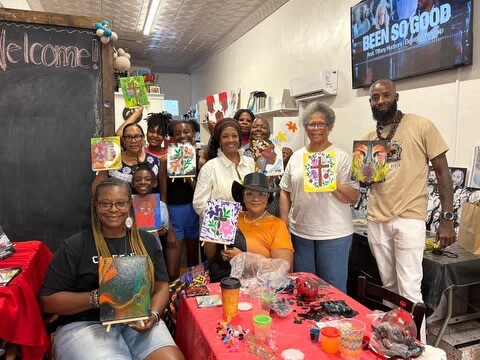
Buford said his mission is to help others find their own path toward healing — whatever form that takes.
“What I strive to do is guide this person to just create, man. Don’t care what people think about your creation, you just need to get it out,” Buford said. “Whether it’s with art, addressing your mental health, getting your life right — just do it.”
CBS 6 is committed to sharing community voices on this important topic. Email your thoughts to the CBS 6 Newsroom.
📲: CONNECT WITH US
Blue Sky | Facebook | Instagram | X | Threads | TikTok | YouTube

This story was initially reported by a journalist and has been converted to this platform with the assistance of AI. Our editorial team verifies all reporting on all platforms for fairness and accuracy. To learn more about how we use AI in our newsroom, click here.

Lovingston, VA (7News) — Good Morning Washington interviews Amanda Beckwith of Virginia Distillery Company- one of the contributing distilleries to the Virginia Spirits Board’s 250th Celebration Trio Pack, a special, exclusive release created to commemorate America’s upcoming 250th anniversary. This limited-edition package features a curated collection of a rum, a gin, and a whiskey, all crafted from scratch by distillers in Virginia to celebrate the rich history and current state of distilling within the Commonwealth.
Beckwith elaborates on VA Distillery Company’s role in the project, noting her focus on Virginia-grown grain to make the bottle of unique whiskey that is included in the Trio Pack. It is also worth noting that the Trio Packs themselves were bottled and produced right here at Virginia Distilling Company!
American single malts are the newest official category of American whiskey, distilled from one grain and from a single distillery. Virginia Distillery Co specializes in this new category of whiskey and crafted their contribution to the Trio Pack with this very specialty. Given the limited remaining availability of the Trio Pack, its historical value and collectible nature, the message it loud and clear encouraging viewers to grab a pack before they are all gone!
BE THE FIRST TO COMMENT
21+ Please drink responsibly, this content is sponsored by Virginia Distillery Company.


Powerball, Mega Millions jackpots: What to know in case you win
Here’s what to know in case you win the Powerball or Mega Millions jackpot.
Just the FAQs, USA TODAY
The Virginia Lottery offers multiple draw games for those aiming to win big.
Here’s a look at June 24, 2026, results for each game:
Powerball
Powerball drawings are held Monday, Wednesday and Saturday at 11 p.m.
13-14-16-21-38, Powerball: 14, Power Play: 2
Check Powerball payouts and previous drawings here.
Saturday, June 27, 2026
Pick 3
DAY drawing at 1:59 p.m. NIGHT drawing at 11 p.m. each day.
Night: 3-1-5, FB: 8
Day: 7-8-8, FB: 4
Check Pick 3 payouts and previous drawings here.
Pick 4
DAY drawing at 1:59 p.m. NIGHT drawing at 11 p.m. each day.
Night: 4-7-2-1, FB: 7
Day: 7-3-4-6, FB: 3
Check Pick 4 payouts and previous drawings here.
Pick 5
DAY drawing at 1:59 p.m. NIGHT drawing at 11 p.m. each day.
Night: 7-5-2-6-9, FB: 0
Day: 6-9-4-0-7, FB: 0
Check Pick 5 payouts and previous drawings here.
Cash Pop
Drawing times: Coffee Break 9 a.m.; Lunch Break 12 p.m.; Rush Hour 5 p.m.; Prime Time 9 p.m.; After Hours 11:59 p.m.
Coffee Break: 12
After Hours: 08
Prime Time: 13
Rush Hour: 01
Lunch Break: 14
Check Cash Pop payouts and previous drawings here.
Cash 5
Drawing every day at 11 p.m.
09-12-15-24-43
Check Cash 5 payouts and previous drawings here.
Bank a Million
Bank a Million draws are held every Wednesday and Saturday at 11 p.m.
18-21-25-33-36-39, Bonus: 13
Check Bank a Million payouts and previous drawings here.
Millionaire for Life
Drawing everyday at 11:15 p.m.
03-04-10-36-37, Bonus: 05
Check Millionaire for Life payouts and previous drawings here.
Feeling lucky? Explore the latest lottery news & results
This results page was generated automatically using information from TinBu and a template written and reviewed by a Center for Community Journalism (CCJ) editor. You can send feedback using this form.
-

 New Jersey2 minutes ago
1 injured after vehicle hits tree in West Deptford, NJ
-

 New Mexico4 minutes ago
1 dead following shooting involving Rio Arriba County Sheriff’s Office
-

 North Carolina10 minutes ago
Former Madison County chief deputy in North Carolina custody after Arizona arrest
-

 North Dakota17 minutes ago
North Dakota composer launches statewide virtual choir project
-

 Ohio20 minutes ago
UC Bearcats baseball playing Ohio State, Vanderbilt in Nashville in 2027
-

 Oklahoma25 minutes ago
Four arrested after 30 pounds of meth, dozens of animals seized from Oklahoma City home
-
Oregon32 minutes ago
Oregon Lottery Pick 4 results for June 25
-

 Pennsylvania35 minutes ago
Measles detected in two more counties in Pennsylvania as health department recommends early vaccination

