Louisiana
Internet company started with an antenna in a tree. Now it’s leading Louisiana’s broadband push.


ABBEVILLE — At an event celebrating the completion of another project by Cajun Broadband, the little internet company that could, there were speeches by local officials, a video message from Gov. Jeff Landry, a ribbon-cutting.
And there was seafood gumbo, cooked the night before by Chris Disher, the company’s co-founder.
His grandmother made her gumbo with tomatoes, but Disher skipped them, knowing the crowd, and used shrimp and oysters harvested from parish waters.
The gathering in Vermilion Parish, like much of what Cajun Broadband does, had a personal feel that belied a bigger truth: The company is among those leading Louisiana’s push to bring speedy internet to the state’s rural reaches.
This fall, it won $18.2 million in federal funding from the Broadband Equity Access and Deployment Program, or BEAD, to connect another 4,000 homes and businesses. This month, they’ll be among the companies breaking ground with that funding: “We’re small, so we can build fast,” Disher said.
Already, the Broussard-based company provides fiber internet across Acadiana, in a doughnut-like shape surrounding Lafayette. In 2023, Inc. Magazine named it among the fastest-growing companies in the U.S. — landing at 603 out of 5,000 and fourth among those based in Louisiana.
“We kept doubling the size every year,” Disher said, “because we didn’t understand just how big this need was in the rural communities.”
Humble beginnings
But it started in 2017 with an antenna in a pine tree.
Disher’s two then-teenage sons had been nagging him for years about the slow, spotty internet. One Sunday before church, they’d hooked up their Xbox for a software update, “and the game wasn’t even 5% done updating after being gone for like three and a half hours,” said his son Matthew.
Meanwhile, Chris Disher’s close friend and now partner Jimmy Lewis, an IT professional struggling with his own internet service, had been driving by an empty tower on his way to work each day.
He wondered: What if we put an antenna on that?
They got the OK, grabbed a chain saw and mounted a dish. “And Chris is hollering up at me, ‘We’ve got 60 megs!” Lewis said, short for 60 megabytes per second. “We’ve got 60 megs!”
They hooked up one neighbor, then another, then 10. They kept their day jobs, at first, working nights and weekends.

Matthew Disher splices fiber in a Cajun Broadband truck for a Maurice home in December.
Within two years, they had more than 1,000 customers, said Daniel Romero Jr., operations manager. (Disher declined to give a current count, but the company’s website touts “nearly 10,000 customers across seven Louisiana parishes.”)
“We just kept going and kept building and kept working,” said Lewis, Cajun’s managing director.
When Louisiana’s Granting Underserved Municipalities Broadband Opportunities, or GUMBO, program was announced, Disher bought a nice tie and went door-to-door, parish to parish. In late 2022, with nearly $20 million in GUMBO funding, Cajun Broadband installed some 90,000 feet of fiber in St. Martin Parish.
It was the first completed project in the state under GUMBO, whose mission is in its name. Cajun Broadband competed with and beat bigger companies to nab GUMBO funds, said Veneeth Iyengar, executive director for the Louisiana Office of Broadband Development and Connectivity.
“They bootstrapped this business,” he said. “They saw a need in their community that was not fulfilled, and they decided to bootstrap it through entrepreneurial capitalism and build a business which is now impacting thousands of lives.”
Still, the business has stayed small and nimble. Ask an employee how many of them there are, and they’ll begin ticking off names, counting the number on two hands. It feels like family, said Steven Creduer, field supervisor. “I’m leaving my house to go to my other house.”
Disher’s son, Matthew, works in the field as a splicer now. Romero’s daughter works for the company, too.
Employees exchange “Merry Christmas” texts with customers. Many of them had long struggled to use Zoom, to upload and to stream, and were thrilled to spot Cajun Broadband’s trailer on their rural roads. Technicians see firsthand how people rely on the internet for necessities, from health care to homework.
“People are really happy you’re there,” Disher said.

Company founders and state and local officials hold a ribbon-cutting ceremony for the expansion of Cajun Broadband into Vermilion Parish Tuesday, December 9, 2025, at the LSU AgCenter Cooperative Extension Building in Abbeville, La.
‘Issues on top of issues’
A Louisiana-born-and-educated engineer, Disher hadn’t yearned to be an entrepreneur, the 55-year-old said. “I never wanted to do anything on my own.”
For years, he worked for General Electric in the oil fields of Singapore and Brazil, eventually supporting six regions from Broussard — but traveling often. Then GE downsized, and Disher lost his job.
With his wife’s encouragement, he became Cajun Broadband’s first full-time employee, he said. “She just kept saying, ‘You can do it, you can do it.’”
At first, he felt responsible to his family, his mortgage in mind. Then, he felt responsible for the company’s employees, their families in mind. Now, he feels responsible for the region and its residents.
Several broadband customers were in at the LSU Ag Center office in Abbeville for last month’s ribbon-cutting, which marked the completion of three broadband projects in Vermillion Parish comprising some 500,000 feet of fiber to 1,750 homes and businesses.
Among the beneficiaries: Michelle Romero, a 38-year-old mother, nurse and health coach who can now upload her workout videos in a few minutes, rather than several hours. (Disher used healthier oils in his gumbo, knowing she’d be in the crowd.)
And there’s the North Vermilion Youth Athletic Association, which for years had struggled to make credit card sales in its concession stand using Cox internet.
“We had issues on top of issues,” said Josh Broussard, the nonprofit’s president.
Cajun Broadband offered the athletic association free hookups, Wi-Fi service and boosters in exchange for some publicity. Now, the park has strong enough service to fuel live scoreboards and stream games, Broussard said, which means that they can host regional tournaments.
Broussard, who played sports at the park as a child, said the change is much needed.
“I saw what it was, and I just want to improve it,” Broussard said, “and make it better than what it was when we were there.”



NEWTON COUNTY, Texas. (KPLC) – A DeRidder man reported missing was found dead in the Sabine River Sunday morning, according to the Newton County Sheriff’s Office.
Newton County Sheriff Colton Havard said Jordan Jamal Allen was located around 7:50 a.m. on July 12 with help from Texas Parks and Wildlife game wardens, the Beauregard Parish Sheriff’s Office, and 409 Search and Rescue.
Authorities say the body was recovered not far from where Allen went under Friday night near the U.S. 190 bridge east of Bon Wier at the Texas-Louisiana state line.
The sheriff said that Allen and a woman were said to be wading across the river Friday when the current began pulling the woman.
The sheriff said Allen tried to help her, but went under around 8:45 p.m. and wasn’t seen again. He said the woman made it back to land safely.
We will have more in this story as it develops.
Copyright 2026 KPLC. All rights reserved.

MONDAY
RED STICK FLY FISHERS PROGRAM: 7 p.m., Bluebonnet Regional Library, 9200 Bluebonnet Blvd., Baton Rouge. Open to the public. Email Brian Roberts: roberts.brian84@gmail.com. Website: rsff.org
WEDNESDAY
FLIES & FLIGHTS: 7-9 p.m, Rally Cap Brewing, 11212 Pennywood Ave., Baton Rouge. Casual fly tying. Open to public. Email Chris Williams: thefatfingeredflytyer@gmail.com
THURSDAY
ACADIANA FLY RODDERS PROGRAM: 6 p.m., Pack and Paddle, 601 E. Pinhook, Lafayette. Open to public. Email Darin Lee: at cbrsandcdc@gmail.com. Website: acadianaflyrodders.org
FRIENDS OF NRA/SOUTHWEST LA BANQUET: 6 p.m., Riverside Bar & Grill, 3748 Louisiana 3059, Lake Charles. Call Brack Cole 337-912-1620. Email: jbcoleair@yahoo.com
ONGOING
STATEWIDE TOURNAMENT & ANGLERS RODEO/S.T.A.R.: Through Sept. 7, Coastal Conservation Association’s summer-long fishing event. Tagged redfish, coastal/offshore species categories & youth division. CCA membership required. Website: ccalouisiana.com/star
LOTTERY HUNTS
DOVE/TEAL: July 27 application deadline for dove hunt on Elbow Slough Wildlife Management Area and teal hunt on White Lake Wetlands Conservation Area. Website applications only on Wildlife & Fisheries/Louisiana Outdoors License, Permits and Tags webpage. Fee $8.50. Details: dove hunt, David Hayden at dhayden@wlf.la.gov; teal hunt, Lance Ardoin at lardoin@wlf.la.gov
AROUND THE CORNER
JULY 21 — LAFAYETTE KAYAK FISHING CLUB MEETING: 6 p.m., Pack and Paddle, 601 E. Pinhook, Lafayette. Call 337-232-5854. Website: lafayettekayakfishing.com
JULY 21-22 — GULF COUNCIL SHRIMP COMMITTEE MEETING: Gulf Council office, 4107 W. Spruce St., Tampa, Florida. In conjunction with Scientific and Statistical committees. Website: gulfcouncil.org
JULY 23 — ACADIANA BUGS & BREWS: 6 p.m., Pack and Paddle, 601 E. Pinhook, Lafayette. Casual fly tying and local beers provided. Open to the public. Email Darin Lee: cbrsandcdc@gmail.com. Website: packpaddle.com
JULY 23-25 — International Grand Isle Tarpon Rodeo, Grand Isle Marina & Otto Candies Pavilion, Grand Isle. Website: tarponrodeo.org
JULY 24-25—BASSMASTER JUNIOR CHAMPIONSHIP: Kentucky Lake, Paris, Tennessee. Website: bassmaster.com
JULY 26 — SOUTH LOUISIANA HIGHPOWER CLUB MATCH: 8:30 a.m., Ascension Parish Sheriff’s Range, St. Landry Road, Gonzales. NRA XTC & F-Class match rifle or service rifle, 200-yard/50-rounds match course. Fee $15 members, $20 nonmembers, $5 juniors. $25 annual club (first match free) and Civilian Marksmanship Program membership (allows purchases from CMP). Call Mike Burke, 337-380-8120. Email: SouthLAHighPower@hotmail.com
FISHING/SHRIMPING
SHRIMP: Spring inshore season closed except for Breton/Chandeleur sounds; all outside waters open.
OPEN RECREATIONAL SEASONS: Private recreational red snapper; gray triggerfish; flounder; lane, blackfin, queen and silk snappers and wenchmen among other snapper species; all groupers except closed for goliath and Nassau groupers in state/federal waters.
CLOSED SEASONS: Greater amberjack; bluefin tuna; gag, goliath and Nassau groupers in state/federal waters. Commercial greater amberjack season closed.
LDWF UPDATES
Closed: Roads on Pomme de Terre, Richard Yancey & Bogue Chitto WMAs (flooding)
Drawdowns: Saline Lake (Natchitoches/Winn parishes through Oct. 5); Iatt Lake (Grant Parish through Oct. 5).
-
 Politics4 minutes ago
States sue to block Paramount’s $111-billion Warner Bros. takeover
-
 Sports16 minutes ago
Commentary: Inside the Shohei Ohtani Economy driving a wild auction for his worn cleats
-

 World28 minutes ago
EU sanctions Russia’s VK Company for helping expose Putin’s critics
-

 News58 minutes ago
One person killed in Maine in second fatal ICE-involved shooting in less than a week | CNN
-

 New York2 hours ago
How a Family of 5 Lives on $46,000 a Year in Wakefield
-

 Los Angeles, Ca3 hours ago
Southern California braces for 110-degree heat, thunderstorms this week
-
 Detroit, MI3 hours ago
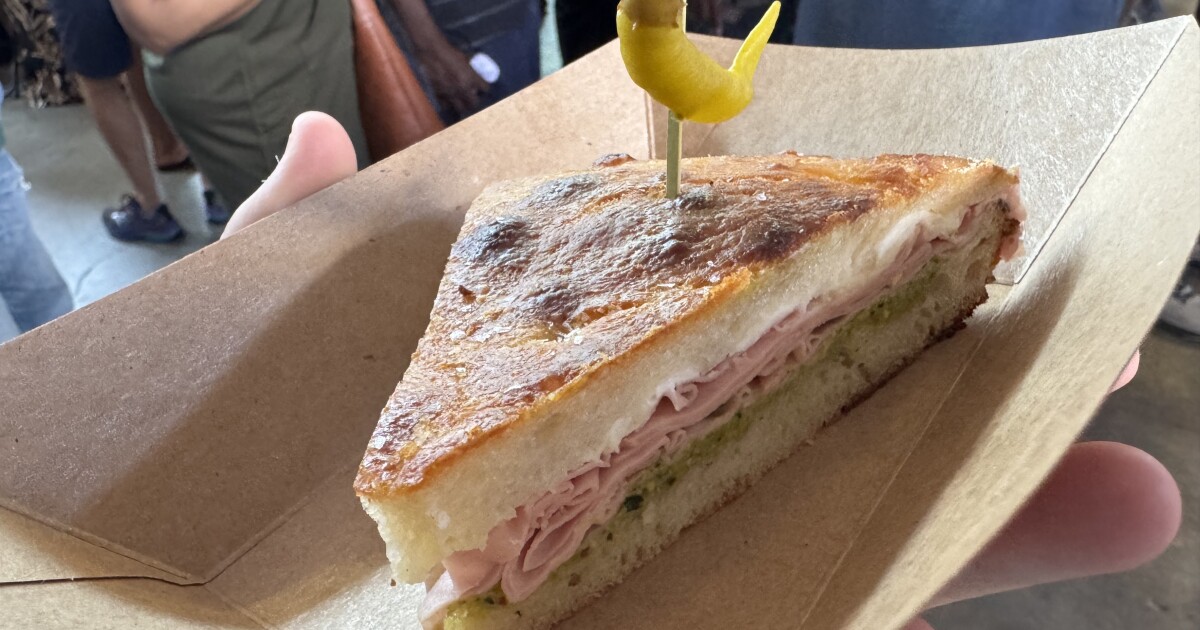
Detroit Sandwich Party returns to Eastern Market on Sept. 6
-

 San Francisco, CA3 hours ago
A Leak of San Francisco Police Drone Footage Exposes the New Reality of Urban Surveillance

