Politics
As questions of temperament persist, Katie Porter tries to regain edge in governor’s race

In Congress, Katie Porter’s blunt, combative style helped rocket her to progressive stardom. It has also become her biggest vulnerability as she campaigns to be California’s next governor.
Her brusque approach, prosecutorial instincts and suburban mom appeal fueled Porter’s rise during her three terms in the U.S. House of Representatives, where she rattled CEOs and Trump administration leaders and batted away GOP challengers in a competitive Orange County district.
Her tack, however, made her a polarizing force within her own party, where fidelity remains an essential currency of success and power. In Congress, Porter clashed with then-House Speaker Nancy Pelosi and L.A.’s Rep. Maxine Waters.
The same rough edges that endeared Porter to many voters have also alienated some Democratic insiders and interest groups whose support could prove critical in the race to replace outgoing Gov. Gavin Newsom.
Then-Rep. Katie Porter meets with parents, doctors and diabetic patients in her Irvine office in 2019.
(Mark Boster / For The Times)
“She came in [to the governor’s race] as an outsider, as a mom, as a fighter. She wasn’t pulled into the establishment,” said Lorena Gonzalez, president of the California Federation of Labor Unions. “I think that’s why she’s popular with voters, because they want somebody who’s going to fight, and sometimes that ruffles feathers.”
In the campaign for governor, Porter, a single mother of three, has struggled to convert grassroots popularity into broader institutional support. Even after former Rep. Eric Swalwell dropped out of the race amid allegations of sexual assault, she has yet to see a major surge in support or endorsements from Democratic power brokers.
A pair of embarrassing videos continue to hang over her campaign. The videos, which surfaced in October, showed Porter yelling at a staff member and threatening to walk out of a television reporter’s interview.
As former U.S. Health and Human Services Secretary Xavier Becerra has ascended and she remained stagnant in polls following Swalwell’s exit, Porter has increasingly sought to redeem her image. She poked fun at the incident with her staffer in an ad, smilingly asking a group of whiteboard-wielding supporters behind her to “please get out of my shot.”
In recent debates, Porter has sought to play up the qualities that made her a standout among resistance-era progressives, needling former hedge fund executive Tom Steyer over his past investments in private prisons and pressing Becerra for a “yes” or “no” on statewide single-payer healthcare. Porter emphasizes her support for single-payer healthcare, providing free child care and college tuition and making wealthy corporations pay their “fair share” in taxes.
Porter said she wants to increase taxes on the state’s wealthiest residents but doesn’t support the proposed billionaire’s tax ballot measure because it is a “one-time tax” that won’t solve the state’s underlying budget issues.
During a particularly chaotic debate last week, she scolded her opponents’ incessant interruptions and called out what she considered a double standard over her behavior.
“I can’t believe, with [the] interrupting and name-calling and shouting and disrespect for everyone up here who’s stepping into public service that anyone wants to talk about my temperament,” she said during the May 5 debate on CNN.
Though she acknowledged she mishandled both caught-on-tape situations and said she apologized to the staffer, the videos hindered her early momentum and have undercut her efforts to make inroads with potential allies in the race.

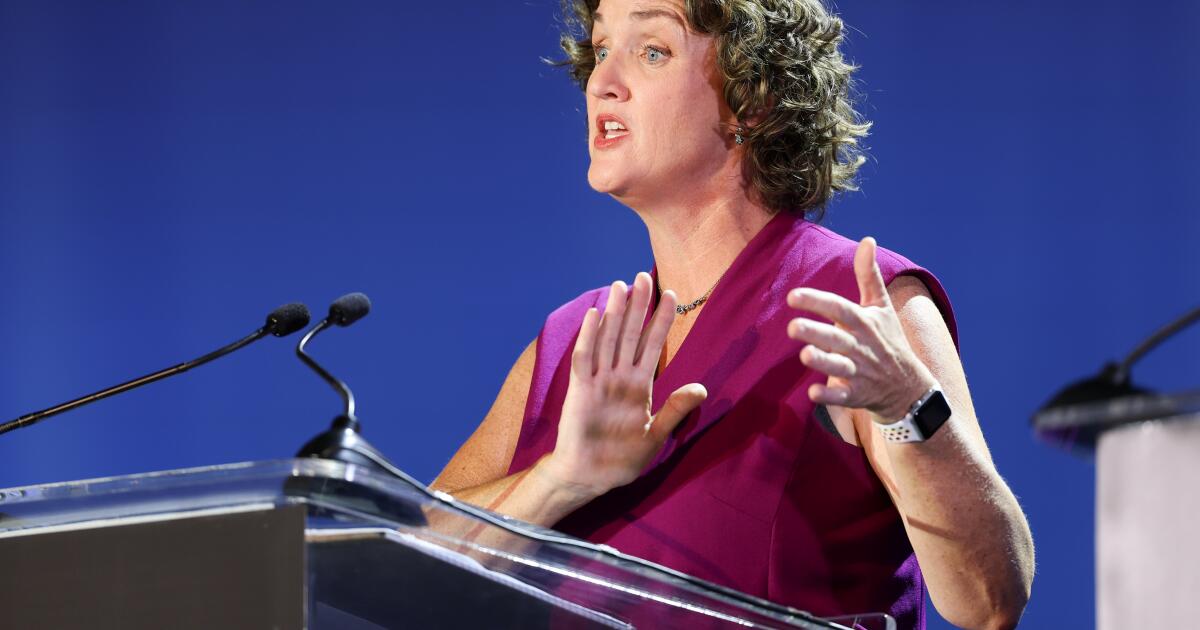
Porter speaks at a gubernatorial candidates forum on Sept. 28, 2025, in Los Angeles.
(Carlin Stiehl / Los Angeles Times)
Influential lawmakers, labor groups and party insiders have coalesced behind Becerra and Steyer, her top Democratic rivals.
Porter has scored some key endorsements. She is one of three candidates backed by the California Federation of Labor Unions, along with Steyer and former Los Angeles Mayor Antonio Villaraigosa. She also has support from Teamsters California, the National Union of Healthcare Workers and progressive groups such as Emilys List and California Environmental Voters, which dual-endorsed her and Steyer.
Union support is pivotal for Democratic candidates in California, sending a clear signal that they support the priorities of working-class voters. For Porter, who has proudly refused to accept corporate donations throughout her political career, the labor endorsements also help her attract the small-dollar donations that are essential to her campaign.
While in Congress, Porter proved to be a prodigious fundraiser. In her last reelection campaign for the House of Representatives in 2022, she raised more than $25.6 million in contributions — the second-most in Congress, behind only Bakersfield’s Rep. Kevin McCarthy, who was then the House Republican leader.
Still, her backing from elected Democrats remains comparatively thin. Along with her mentor, Sen. Elizabeth Warren (D-Mass.), just three members of Congress have endorsed her gubernatorial bid: Reps. Robert Garcia of Long Beach, Dave Min of Irvine and Derek Tran of Huntington Beach. She also picked up an endorsement from Assemblywoman Cottie Petrie-Norris (D-Irvine) after Swalwell dropped out.
Though none would speak publicly, multiple sources who work in and around the state Capitol expressed concerns about Porter’s temperament and her willingness to work collaboratively with people she disagrees with.
“Katie Porter hurt herself big time because she needs anger management and she doesn’t have the temperament” to be governor, Democratic former Sen. Barbara Boxer said during a recent interview with NewsNation’s Leland Vittert.
Through her campaign spokesperson, Porter declined to be interviewed for for this story.

Porter questions Tim Sloan, president and chief executive officer of Wells Fargo, during a House Financial Services Committee hearing in Washington in 2019.
(Andrew Harrer / Bloomberg)
Defenders argue the backlash reflects a double standard for women in politics — a salient point in a state that, despite its liberal reputation, has never elected a woman as governor.
“Sacramento sizes up every gubernatorial candidate the same way: Can they win, and is this someone I actually want to work with?” said Elizabeth Ashford, a Democratic consultant who is not working with any of the candidates running for governor. “The videos showed an angry woman, and for a lot of people that translated to ‘I don’t want her as my boss.’
“It’s a double standard that dogs women in politics. Jerry Brown was famous for his loud, unfiltered outbursts and nobody questioned whether he was up to the job,” said Ashford, who served as the former governor’s deputy press secretary.
Gonzalez agreed, arguing that women who stand up for themselves “are often labeled as ‘difficult.’ Probably a lot of people think I’m difficult,” the labor leader added with a laugh.
Born in Iowa, Porter often connects her politics to her family’s financial struggles after losing their farm during the 1980s farm crisis. She earned degrees from Yale and Harvard, where she studied bankruptcy law under Warren. In 2012, while working as a law professor at UC Irvine, Porter was appointed by then-Atty. Gen. Kamala Harris to oversee California’s $18-billion mortgage settlement.
After defeating Republican incumbent Rep. Mimi Walters in 2018, Porter quickly emerged as one of the Democratic Party’s most recognizable progressives. Armed with a whiteboard and other visual aids in congressional hearings, she confronted banking and pharmaceutical executives over drug prices, consumer debt and corporate profits.
The props, theatrical at times, seemed to aggravate Waters, then the Democratic chairwoman of the Financial Services Committee. On several occasions, Waters sided with Republicans who challenged Porter’s use of visual and audio aids during hearings.
“Please do not raise your board. We’ve talked about this before,” the chairwoman scolded when Porter tried to hold up a “Financial Services Bingo” card during a 2019 hearing on debt collection. (She later got to show the board on “Late Night with Seth Meyers.”)
Eager to force change they campaigned on, Porter and other freshmen, including members of “The Squad,” at times clashed with Pelosi and other Democratic leaders.
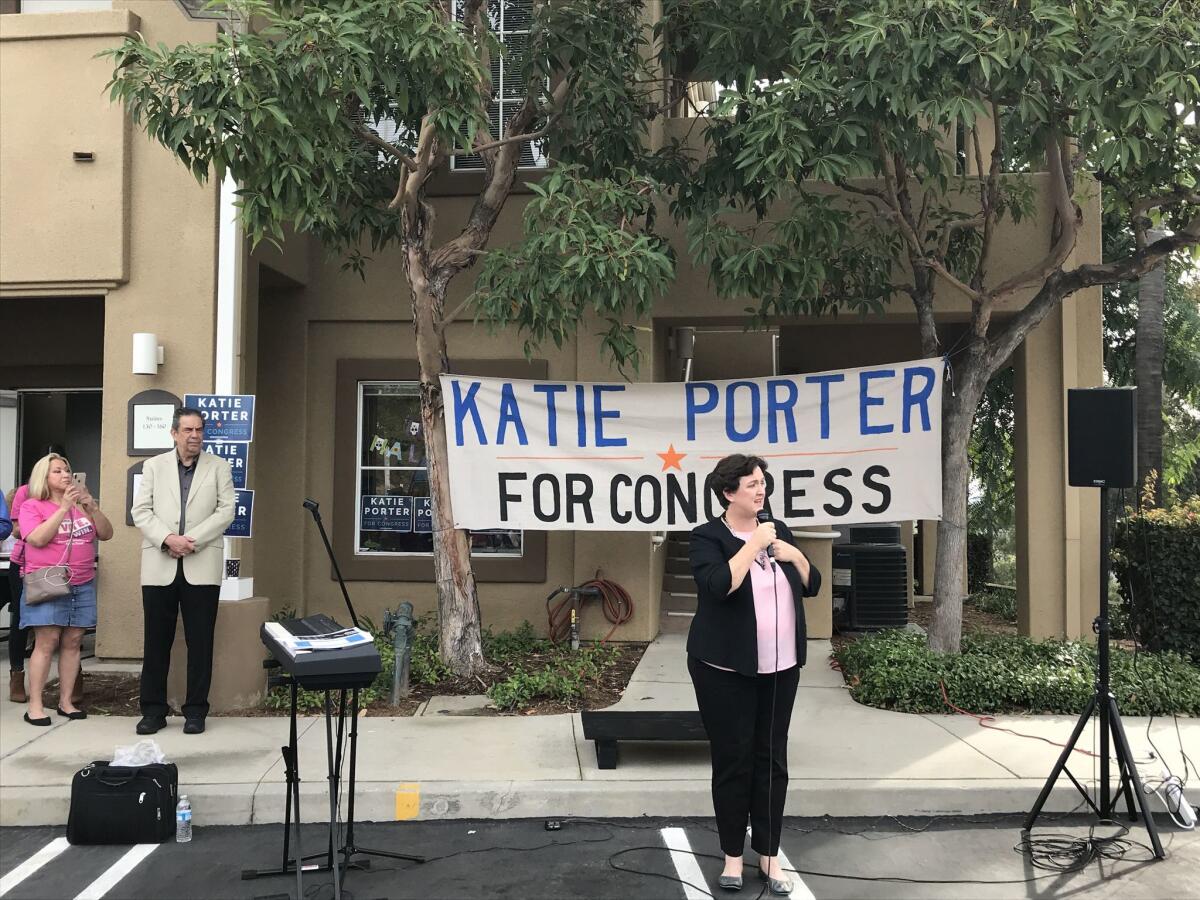
Porter speaks to volunteers while campaigning in Mission Viejo in 2018.
(Victoria Kim / Los Angeles Times )
Porter has slammed lawmakers, including Democrats, for stock trading and funneling earmark funding to their home districts, arguing that such practices breed corruption and mistrust in Congress. The critiques irked Pelosi, a powerful force in California politics.
In her second term, the Orange County Democrat lost her coveted spot on the Financial Services Committee after she listed it as her third choice and requested a waiver to stay on it. Typically, members prioritize such high-profile committees and request waivers to serve on lesser ones in addition. The move was seen as a risk, the result a check on Porter’s ambition.
“So many of us, regardless of ideology, run on ‘shaking up Washington.’ But then when you actually come here, there’s a lot of consequences for doing that,” Rep. Alexandria Ocasio-Cortez (D-N.Y.) told The Times after Porter lost the committee position.
Porter’s willingness to buck party norms also raised eyebrows during her Senate campaign, when she entered the race for Sen. Dianne Feinstein’s seat before Feinstein had announced retirement plans in early 2023. Although then-Rep. Adam Schiff also launched an early campaign, he did so only after privately seeking Feinstein’s blessing. She ultimately finished third in the primary.
Her decision to run for Senate did not ingratiate her with Washington’s Democratic leadership. The party was forced to spend millions to ensure another Democrat was elected to her contested Orange County congressional seat, and Schiff, her top rival in the race, was a close ally of Pelosi — who endorsed him — and helped lead the first impeachment effort against President Trump.
Controversy surrounding Porter’s personal relationships have also surfaced during previous campaigns. In 2024, she obtained a five-year restraining order against a former boyfriend who she said bombarded her and her children with threatening messages.
When a whisper campaign about the end of her marriage threatened her first House run, Porter shared details of her 2013 divorce with the Huffington Post, including that her ex-husband, Matthew Hoffman, physically intimidated and verbally abused her. Hoffman also claimed to be the victim of abuse, including an incident in which Porter allegedly threw hot mashed potatoes at him. Both filed for restraining orders and sought anger management during the divorce.
Former employees have also rallied to her defense. In an open letter last month, 30 former staffers described Porter as a “workhorse” who “asked of us what she expected of herself.”
“She demanded a lot, but she also fought for us, mentored us, and stood by us when life got hard,” the former aides wrote. “We believe the public should understand the full person we know, not a caricature built from a few clips on a bad day.”
Porter has argued that voters are looking for someone willing to challenge powerful interests rather than accommodate them.

Katie Porter is interviewed after the California Gubernatorial debate at Skirball Cultural Center on Wednesday.
(Jason Armond/Los Angeles Times)
“It’s on me to keep campaigning and keep demonstrating that,” she told reporters after a recent gubernatorial debate in San Francisco. “It’s also not lost on me that the last time the Democratic Party had a woman nominee for governor was 1994, when I was in college.”
The affordability crisis is at the forefront of the race to replace term-limited Newsom. As a single parent, Porter argues she is acutely aware of gas and grocery prices — as well as higher-stakes consequences.
She described feeling shocked when, during a recent conversation with her 17-year-old son, he asked if she would visit him if he moved to another state.
“I said, ‘Paul, you love California, why would you leave California?’ And he said, ‘Well, I’m thinking I might want to have a family and I might want to have a house, and I know that means I’ll have to leave California,’” Porter recounted at a March forum hosted by the California Assn. of Realtors. “We need to be a state that doesn’t just retain people like my son … but welcomes new families.”
The centerpiece of her proposed “affordability solutions” are free child care, free tuition at UC and CSU schools for students who complete two years of community college, and ending income taxes for those who earn less than $100,000 — an idea she acknowledges she “stole” from Republican candidate Steve Hilton. “I will take a good idea anywhere I can get it,” she said at a recent forum.
To pay for it, Porter would impose a progressive corporate tax, meaning more profitable businesses and corporations would pay a higher rate. A less than 1% tax hike on businesses that earn hundreds of millions in profit would bring in around $8 billion, according to her website.
“I think she deeply and personally understands the everyday struggles that so many Californians are grappling with right now,” said Petrie-Norris, who last month became the first state legislator to endorse Porter.
While Petrie-Norris describes herself as more politically moderate than Porter, the Irvine assemblywoman praised her as a “pragmatic problem-solver” and “proven fighter” who has taken on corporate interests and the Trump administration.
For a while, Porter was one of four women among the major candidates running for governor. One by one they have dropped out of the race, citing difficulties raising money and support.
After sharing the debate stage with five men recently, Porter was asked whether California is ready for a female governor.
“I sure as hell hope so,” she said.


NEWYou can now listen to Fox News articles!
The Department of Justice (DOJ) says it has opened an investigation into a New York City coffee shop after it blasted Rep. Dan Goldman, D-N.Y., in a social media post, saying it should not have served him, and he should never come back due to his support of Israel.
Assistant Attorney General for Civil Rights Harmeet Dhillon said the DOJ has opened an investigation into the Poetica Coffee Shop in Brooklyn.
Dhillon says the department is aware of the “denial of service taunts” directed at Goldman and says federal law prohibits public accommodations, including coffee shops, from discriminating against patrons based on race, religion, or national origin. Dhillon says the alleged denial of service could violate federal anti-discrimination law and says enforcement action is possible.
In a now-deleted Facebook post, Poetica Coffee said it issued a refund to Goldman after learning that he had stopped by the location with his young daughter. The shop added that it would have simply turned Goldman away if staff had recognized him at the time.
SMOOTHIE KING FIRES EMPLOYEES WHO REFUSED TO SERVE CUSTOMERS OVER TRUMP SWEATSHIRT
Rep. Dan Goldman, D, N.Y., was criticized by Poetica, a left-leaning coffee shop in Brooklyn, which called scolded him over his support for Israel. (Dan Goldman)
“Hey Congressman Dan Goldman, we see that you stopped by our shop today for a coffee. Do you see how it doesn’t taste like genocide juice? Or are you still having a hard time telling the difference?” the post stated, referring to Goldman’s support for Israel and accusations that the Jewish state has committed genocide against Palestinians during the war in Gaza.
“See, here at Poetica, we don’t serve racists, fascists, homophobes, genocide enablers, or anyone in between,” the post continued. “Too bad we didn’t recognize you right away, or we would have turned you away. We issued you a refund—we don’t need your money (it’s probably coming from AIPAC anyways). Enjoy your loss on Tuesday. Don’t ever come to Poetica.”
A Brooklyn, N.Y., coffee shop refunded a purchase made by Rep. Dan Goldman, D-N.Y., over the weekend over his support for Israel, saying the company doesn’t serve “genocide enablers.” (Getty Images; Google Maps)
In a statement on social media, Goldman said he was disappointed by the shop’s remarks.
“I’m sorry to see this post,” he said. “The barista could not have been nicer to my 7-year-old daughter and me—allowing her to use the bathroom even though we had not purchased anything. I made sure to buy a coffee in return for her kindness. I hope you at least make sure she gets the tip that she deserved.”
In response, the shop said it was the barista’s idea to refund Goldman’s purchase. The poster added that they will be voting against Goldman, who faces a Democratic primary challenge from former city Comptroller Brad Lander.
DEMOCRATIC REP FEARS PARTY TURNING ANTISEMITIC PROTESTERS INTO ‘MARTYRS’ IN BATTLE AGAINST TRUMP DEPORTATIONS
Fox News Digital has reached out to Goldman and the coffee shop, as well as the offices of New York State Attorney General Letitia James and Mayor Zohran Mamdani, and the city’s Department of Consumer and Worker Protection.
“No comment. We stand against genocide,” a staffer told the New York Post.
The shop’s social media post was quickly criticized online.
Mark Treyger, the CEO of the Jewish Community Relations Council of New York, said the incident warrants a review under city and state human rights laws.
MAMDANI IN THE HOT SEAT AFTER FIRST VETO DERAILS BIPARTISAN EFFORT TO COMBAT ANTISEMITISM: ‘DISAPPOINTED’
Poetica Coffee in Brooklyn, N.Y., criticized Rep. Dan Goldman, N.Y., over his support for Israel. (Dan Goldman)
“Turning a cup of coffee into a Jewish identity litmus test is an affront to the law, our values, and every New Yorker who rejects discrimination,” he wrote on X. “If an identifiable Jewish customer walks into a coffee shop wearing a kippah or Magen David, are they expected to first disclose their views on Middle East policy before being served?”
The incident appears to contradict the opening statement on Poetica Coffee’s website by its owner, Parviz Mukhamadkulov, an Uzbek immigrant who opened his first location in 2020.
“In practice, it looks like a café where the door doesn’t close on anyone, where tea gets poured before anyone asks who you are,” the website states. “The guest is sacred because the act of welcoming is how a community keeps itself intact.”
Rep. Dan Goldman, D-N.Y., stands outside the Delaney Hall Detention Center in Newark, New Jersey, on May 28, 2026. (Rashid Umar Abbasi for Fox News Digital.)
CLICK HERE TO DOWNLOAD THE FOX NEWS APP
The shop also claims on its site that “whoever walks through the door is treated with unconditional dignity.”
“Not as a customer. Not as a transaction. As someone who arrived and deserves to be welcomed,” the site reads.

Walt Disney Co. is rallying public support for ABC as it faces an early Federal Communications Commission review of its TV station licenses and the guest booking policy of its daytime talk show “The View.”
ABC began running spots Monday asking viewers to comment on the FCC’s recent actions that Disney sees as an effort to stifle speech seen as critical of President Trump. The president has repeatedly threatened to pull broadcast licenses of TV outlets that feature journalists and hosts he dislikes.
In April, the FCC called for an early review of the licenses for Disney’s eight broadcast TV stations, a day after Trump demanded that ABC fire late-night host Jimmy Kimmel over a joke about First Lady Melania Trump. FCC Chair Brendan Carr has repeatedly threatened to use the levers of power he has to punish TV and radio stations that irritate Trump.
The licenses for the TV stations, including KABC in Los Angeles, were originally scheduled for renewal between 2028 and 2031. Calling for an early review is highly unusual, but the agency said it’s related to an inquiry into Disney’s diversity, equity and inclusion policies and whether they violated federal anti-discrimination rules.
The FCC has not declined to renew a TV license since the early 1980s. With court challenges, such a process can take years to enact.
Carr also has taken aim at ABC’s daytime talk show “The View.” He publicly questioned whether the program should have the status of news programs, which are exempt from having to give equal time to the opponents of political candidates who appear as guests.
“The View” was granted an exemption from the rarely enforced rule in 2002. ABC’s Houston station KTRK filed a petition with the FCC in May asking for a declaration that the program can maintain that status.
“The Commission’s actions threaten to upend decades of settled law and practice and chill critical protected speech, both with respect to The View and more broadly,” KTRK-TV said in the filing.
ABC has maintained that “The View” books politicians based on newsworthiness and not partisanship. The program featured Vice President JD Vance last week, where he received a cordial welcome.
ABC’s message asking consumers to support “The View” amid an FCC investigation.
(ABC)
ABC is airing spots warning viewers that the FCC wants to control what viewers see on “The View.” The message opens with the voice of legendary broadcaster Barbara Walters giving her introduction to the program she founded — “I had this idea for a show — different women, with different points of view.”
Walters is followed by an announcer who says, “‘The View’ has welcomed your favorite guests and covered the issues you care about for nearly 30 years. Now the FCC wants to control who is allowed to appear on the show.”
The spot says “the FCC is questioning our support to the community.” A QR code shows up on the screen that takes viewers directly to the FCC’s electronic comment filing system where they can submit their comments, which is regularly part of the agency’s review process.
Disney also is airing spots calling for support of its local TV stations, including L.A.’s KABC. The spots are customized for each ABC station market, emphasizing a commitment to local news coverage.
Disney did not comment on the campaign. But a network insider not authorized to speak publicly about it said “ABC believes it is important for the public to know what is happening, what’s at stake, and how to engage directly in the process if they want to make their voices heard.”
Disney’s aggressive defense of its stations and “The View” is a stark contrast to its decision to settle a lawsuit filed by Trump over inaccurate statements ABC News anchor George Stephanopoulos made about a sexual assault civil suit that the president lost in court.
ABC agreed to pay Trump $15 million in December 2024 to end the legal fight — sparking an outcry among free speech advocates, who believed the network would have won the case.
ABC also caved in September, when Kimmel’s program was briefly pulled from the air after two major TV station groups refused to air it following the host’s comments about the killing of right-wing activist Charlie Kirk.
Disney received major blowback from the Hollywood community, where Kimmel is extremely popular. Data also show that the company experienced cancellations of its Hulu and Disney+ streaming services in protest of the move.
Politics
Cops could be forced into race-based guessing game after Supreme Court move, Thomas joins dissent

NEWYou can now listen to Fox News articles!
Justices Samuel Alito and Clarence Thomas on Monday dissented from the Supreme Court’s refusal to take up a case that they said forces police officers to create a separate set of rules for racial minorities.
“It is dangerous to allow an individual to be treated differently based on statistics, studies, or expert testimony that purports to show that members of the racial or ethnic group to which he belongs are more likely to act in a certain way than are members of other groups,” Alito wrote on behalf of himself and Thomas. “Here, the special treatment helped the individual; in other situations it will not.”
The case, U.S. v. Donte J. Carter, involved a Black man whose firearm and theft convictions were vacated after the D.C. Court of Appeals held that police seized him before they had reasonable suspicion. Officers later recovered a .40-caliber pistol from Carter’s pants and the government said the gun had been stolen from an FBI agent’s vehicle.
According to the D.C. court, “black Americans like [Carter] are ‘especially distrustful of law enforcement’” and therefore “‘less likely’ than other people ‘to terminate a police encounter’ due to skepticism that any attempt to exercise their constitutional rights will be respected.”
SUPREME COURT REJECTS BOSTON PARENTS’ APPEAL CLAIMING RACIAL BIAS IN AN ADMISSIONS POLICY
Supreme Court Justices Clarence Thomas and Samuel Alito are pictured together. (Getty Images)
The D.C. court reasoned that Carter’s race was relevant to whether a reasonable person in his position would have felt free to end the police encounter. It ruled that the encounter effectively became a seizure, and that such an action was unlawful because police officers hadn’t established reasonable suspicion before subjecting him to it.
Alito and Thomas argued that the D.C. ruling effectively forces law enforcement to treat people differently based on their race, something precedent established by the Supreme Court prohibits.
“Under the test, officers will need to quickly assess a person’s race, and if officers and courts must craft special rules for black persons, what about dark-skinned Latinos, other Latinos, and members of other minority groups?” Alito continued. “We have said that our ’Constitution is color-blind.’ It ‘almost never’ allows government actors to treat persons differently based on their race.”
SUPREME COURT RULES ON KEY VOTING RIGHTS ACT RULE AS REPUBLICANS AND DEMOCRATS WAGE REDISTRICTING WAR
U.S. Supreme Court Justice Clarence Thomas appears before swearing in Pam Bondi as U.S. Attorney General in the Oval Office at the White House in Washington, D.C., on Feb. 5, 2025. (Andrew Harnik/Getty Images)
To support his claims, Alito cited Students for Fair Admissions v. Harvard and Louisiana v. Callais and Shaw v. Reno.
“And we have rejected the proposition that the Constitution permits an individual to be treated differently based on a ‘perception that members of the same racial group — regardless of their age, education, economic status, or the community in which they live — think alike,’” Alito wrote, citing Shaw v. Reno.
This appears to be a direct challenge to the D.C. Court of Appeals, which lawyers representing the United States argued forced police officers to assume that all black people have the same attitudes toward police officers and would therefore feel uncomfortable exercising constitutional rights in their presence.
TRUMP’S FIRING POWER FACES TWIN SUPREME COURT TESTS, BUT ONE AGENCY MAY GET SPECIAL TREATMENT
Supreme Court Justice Clarence Thomas and Justice Samuel Alito are seen inside the Supreme Court building in Washington, D.C., in December 2023. (Jacquelyn Martin-Pool/Getty Images)
CLICK HERE TO DOWNLOAD THE FOX NEWS APP
Carter, the individual Alito noted was helped by the case, initially lied to officers by answering in the negative when approached and asked if he was carrying a weapon.
The police then asked Carter to pull his pants up, at which point they noticed an L-shaped bulge which was later identified as a .40-caliber pistol that had been stolen from a federal agent’s vehicle.
-

 Delaware2 minutes ago
Delaware closer to allowing public campaign expenses to cover security
-

 Florida7 minutes ago
Elevate Florida program: Lawmakers, homeowners demand action on home elevation grants
-

 Georgia14 minutes ago
Where might Georgia baseball star Daniel Jackson land in MLB draft?
-

 Hawaii22 minutes ago
PH Consulate welcomes PH contingent to Hawaii for RIMPAC 2026
-

 Idaho29 minutes ago
ISU event turns summer fun into rocket science – East Idaho News
-

 Illinois31 minutes ago
5 tornadoes confirmed in central Illinois following weekend storms
-

 Indiana37 minutes ago
Top Indiana high school performers at U20 Championships, Nike Outdoor Nationals
-

 Iowa44 minutes ago
Iowa Football Depth Chart: Projecting Hawkeyes’ Week 1 Special Teams

