Science
What Is Body Dysmorphic Disorder?


Mandy Rosenberg, 35, from Brookfield, Wisc., has always drawn attention because of her looks. With her long blonde hair, athletic build and large blue eyes, she was called Barbie by some of her high school peers.
But even though people often told her that she was pretty, she didn’t view herself the same way.
She’d spend hours staring at a tiny blemish on her forehead that was barely visible to others. In her mind, it was a large and unsightly scar, and she would climb on top of her bathroom sink to get as close to the mirror as possible while examining it.
“If I couldn’t make that go away, I didn’t want to live anymore,” she said.
Ms. Rosenberg didn’t know it at the time, but she had both obsessive-compulsive disorder and body dysmorphic disorder, or B.D.D., a mental health condition that causes people to spend an inordinate amount of time worrying about their appearance — to the point where they may isolate themselves from others and feel imprisoned in their own bodies.
People with B.D.D. not only think they look unattractive but can become convinced that others will reject them because of their flaws.
“They often feel they’re unlovable,” said Dr. Katharine Phillips, an expert in B.D.D. and a psychiatrist at Weill Cornell Medicine and NewYork-Presbyterian.
What is body dysmorphic disorder?
Those with B.D.D. fixate on perceived cosmetic problems that to others appear unnoticeable or minor. But it’s not about vanity; instead, people with B.D.D. feel extreme anguish that impairs their functioning.
The disorder typically emerges during adolescence and is estimated to affect 2 to 3 percent of the general population, but these numbers may be conservative because the disorder is underdiagnosed.
Studies have shown differences in the brains of people with B.D.D., said Dr. Jamie Feusner, a professor of psychiatry at the University of Toronto Temerty Faculty of Medicine. Some of his research has found that in those who have the condition areas of the brain that help us view things holistically are underactive.
This might be part of the reason that people with B.D.D. have trouble viewing their imperfections as small relative to their entire face or body. It’s akin to looking at a window with a smudge on it, then “thinking that the whole window is ruined,” Dr. Feusner said.
Patients with B.D.D. aren’t always aware that their concerns stem from a mental health problem. Instead, they often believe wholeheartedly that they have physical defects.
Because of this, someone might suffer for a decade or more before seeking help from a mental health provider, said Hilary Weingarden, a psychologist in Massachusetts who studies O.C.D. and related conditions.
Instead, “they’re going to their dermatologist and a plastic surgeon and the dentist and the aesthetician,” she said.
But trying to “fix” their appearance only serves to maintain and exacerbate their anxiety in the long run.
What are the signs and symptoms?
People with B.D.D. may withdraw from relationships, avoid attending work or school, and spend an excessive amount of time on repetitive behaviors like examining themselves in the mirror, attempting to camouflage their appearance or seeking reassurance from others.
Chris Trondsen, a therapist in Costa Mesa, Calif., who diagnosed Ms. Rosenberg with B.D.D., said his patients admit to spending hours chatting with artificially intelligent bots, both seeking affirmation and asking what they ought to fix.
“If you ask a human, people are going to get fed up answering the questions,” Mr. Trondsen said.
Mr. Trondsen was inspired to study psychotherapy because of his own struggle with B.D.D. He used to fixate on his complexion and other parts of his body, too. He worried that his nose was too large for his face and that his body wasn’t muscular enough, a form of B.D.D. called muscle dysmorphia.
“I kept thinking I was getting uglier,” Mr. Trondsen said.
Like many patients with B.D.D., he also spent hours checking his body in mirrors and rarely left his apartment. At 21 years old, Mr. Trondsen became so isolated and consumed by his appearance that he attempted suicide, and might have died had his roommate not discovered him. After that, he sought help and was diagnosed with O.C.D. and B.D.D.
It’s common for those with B.D.D. to also have conditions like O.C.D., major depressive disorder, social phobia and substance use disorder. Studies indicate that people with B.D.D. have high rates of suicidal ideation and behavior, too. One meta-analysis found that, across a patient’s life span, about 66 percent of those with B.D.D. will have thoughts of suicide and around 35 percent will attempt it.
How is it treated?
Cognitive behavioral therapy for B.D.D. has been shown to lead to remission in more than half of patients. It includes exposure and response prevention, which is meant to help patients gradually confront the things that they have been avoiding or the rituals they have become dependent upon, like hiding parts of their body with clothing or makeup.
Therapists try to help patients view themselves more holistically, emphasizing that there’s more to them than the specific parts of their bodies they scrutinize.
The disorder can also be treated with serotonin reuptake inhibitors, or S.R.I.s., often at high doses. For those with severe B.D.D., both medication and C.B.T. are recommended, Dr. Phillips said.
For Ms. Rosenberg, cognitive behavioral therapy with her former therapist, Mr. Trondsen, gradually helped her condition.
Later, as part of her treatment, she created a diagram showcasing all of the things that contribute to her identity: She is a daughter and a faithful Christian, she loves dogs and cats, she is a teacher, she is caring — she is more than just her looks.
My body, she said, “doesn’t get to determine how I go about my day.”



Scientists hoped for years to make a machine that could emulate the movements of diving birds, such as puffins, and offer an affordable, unobtrusive way to monitor fragile marine ecosystems. A team of researchers at M.I.T. has been able to create such a waterproof winged robot, according to a study published July 9 in the journal Science.
Nearly one month after a fire destroyed a massive cold-storage facility in Boyle Heights, the neighborhood has been overcome by the stomach-churning stench of rotting food.
As facility operator Lineage works to remove more than 85 million tons of weeks-old food from its 500,000-square-feet warehouse, the rancid odors have attracted throngs of rats and swarms of flies, as a foul-smelling brownish liquid pours from the seams of the building.
Now, with a heat wave descending over much of Southern California, residents worry the odor could get even worse and scores of residents have called air quality regulators to complain. At the same time, environmental groups are accusing Lineage representatives and emergency responders of downplaying the risks pose by chemicals released during the fire.
Boyle Heights, a neighborhood that has been subjected to decades of toxic pollution from rail yards and other industries, has again become the center of attention in another environmental disaster. Already, the official response to the Lineage fire has eroded trust in government agencies, residents say.
Remediation work continues at a Lineage facility in Boyle Heights, where residents and nearby businesses have complained of a rotting food odor for weeks.
(Allen J. Schaben / Los Angeles Times)
On Tuesday, Sen. Alex Padilla (D-Calif.) visited the gutted warehouse alongside L.A. Fire Chief Jaime Moore and representatives of the South Coast Air Quality Management District and a contingent of environmental organizations. Padilla, along with Sen. Adam Schiff (D-Calif.) and Rep. Jimmy Gomez (D-Los Angeles), wrote a letter to the U.S. Environmental Protection Agency, calling on the agency to return to the cleanup zone to monitor air and water quality.
“Given the materials present in the warehouse, we are concerned about the long-term health and environmental impacts from contaminated smoke and water runoff on communities surrounding the warehouse,” the letter read.
Joe Lyou, president of nonprofit Coalition for Clean Air, told Padilla that he has heard of people becoming sick in the weeks after the event.
“I think that pointed to a problem with the messaging while the event first happened,” Lyou said. “It wasn’t consistent [with] if you smell smoke, see ash to get out and protect yourself — make sure you’re not exposed to it. There were different messages coming from different people, and we need to fix that.”
“The whole community was completely overwhelmed … and concerned about the ammonia, concerned about burning plastic, concerned about all sorts of other [emissions] that are really hard, difficult, expensive to measure. But … we’ll just never know some of those things,” Lyou said.

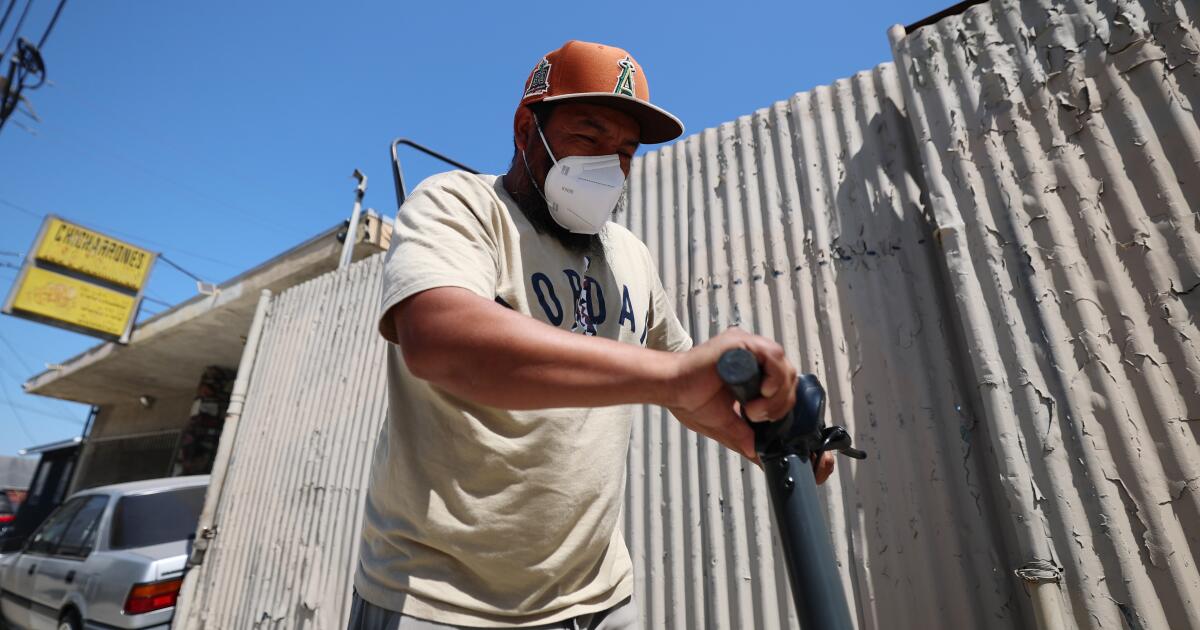
Street vendor Lupe Gonzalez pushes her cart away from a gutted warehouse in Boyle Heights.
(Allen J. Schaben / Los Angeles Times)
Chief Moore has faced criticism for his decision to advise residents to shelter indoors rather than to evacuate during the blaze. That stood in sharp contrast with Orange County fire officials, who evacuated tens of thousands of residents near an overheating chemical tank in Garden Grove in May.
On Tuesday, Moore told Padilla that the two incidents were very different. Moore said he had discussed the dilemma with TJ McGovern, the interim fire chief for the Orange County Fire Authority.
“He says everybody got mad at him because he evacuated everybody and nothing blew up,” Moore told Padilla. “But everybody’s mad at you because of the shelter-in-place [order] and it smells.”
Moore said that “there was nothing in the air that was hazardous” and that firefighters “never had a threat of an explosion.”
However, environmental experts said 14,000 pounds of flammable anhydrous ammonia were stored in tanks and used as refrigerant at the Lineage warehouse and posed a significant risk of explosion until it was removed days into the fire.
Environmental and community groups said L.A. fire officials also repeatedly emphasized the risks from ammonia in their radio communications. On the first day of the fire, a group of firefighters was hit by a plume of ammonia gas, and fire command quickly organized medical help.
“The majority of my division got exposed to ammonia gas. We’ll need to get them assessed.”
On Tuesday, Moore said no amount of ammonia was detected.
“When [firefighters] opened those doors, there was what looked like a big vapor cloud that came out,” Moore said. “That was the cold air mixing with the hot air that caused a vapor. It wasn’t ammonia.”
But residents remain skeptical.
Padilla’s visit follows a notice of violation that the South Coast Air Quality Management District issued to Lineage. The notice of violation was issued on July 12, after the agency received more than 40 public complaints of rotten, sour, garbage-type odors in the area. Inspectors confirmed the odors with community members and traced them back to cleanup operations at the facility, according to the air quality agency.
Boyle Heights residents are calling on Gov. Gavin Newsom to declare a mandatory evacuation of their community, saying the fire and the toxic aftermath are continuing to pose health risks. Without an evacuation order, they said, insurance companies won’t help residents who want to relocate with rent or mortgage relief.
“For nearly a month, a cold-storage warehouse fire has poisoned the air over the Eastside and Los Angeles County and City officials have refused to issue a mandatory evacuation,” read a statement from the community group Protect LA Now. “That refusal forces victims to pay their own way out, and leaves those who can’t afford to leave trapped in gases and toxins that no agency will name.”

Joe Lyou, president of the Coalition for Clean Air, explains how smell is affecting his health while talking to the media near a fire-gutted Lineage facility Tuesday.
(Allen J. Schaben / Los Angeles Times)
Tensions have been building in the community since the fire broke out on June 17 and burned for days.
At a contentious town meeting last week, Los Angeles Mayor Karen Bass struggled to open the meeting over the loud boos and yelling of community members, actions that were repeated as other elected officials took the microphone. The crowd grew even louder when Lineage Chief Operating Officer Jeff Rivera took to the stage and was met with shouts of “Liar!”
Air quality has been a constant concern for the community since the incident began. Beyond the health hazards of breathing in smoke from a building fire, there was a brief, temporary scare when an ammonia line that helped keep the building refrigerated was compromised, though Lineage has said the chemical was not detected in the air. Additionally, 85 million pounds of food thawed, burned and spoiled inside, creating a terrible smell that emanated from the property.
Nora Saenz, a resident of Bell, said she believed local leaders when they said there was no threat. During the fire, she took her niece and nephew to a community event in La Mirada, which was downwind of the fire.
Now Saenz fears what they might’ve breathed in.
“The day of the fire, we were told that the air was safe to breathe,” she recalled. “To this day, I don’t know what I exposed my niece and my nephew to.”
Times staff writers Salvador Hernandez, Clara Harter and Seamus Bozeman contributed to this report.
Video released by Chinese state media shows a state-owned aerospace company launching a rocket and recovering part of it on Friday. The successful launch of a reusable rocket was a major step for China toward challenging SpaceX’s satellite internet dominance.
-
Oregon2 minutes ago
Oregon Lottery Mega Millions, Pick 4 results for July 14
-

 Pennsylvania8 minutes ago
12-year-old boy on e-bike killed in crash with pickup truck in Pennsylvania
-
Rhode Island14 minutes ago
RI Lottery Mega Millions, Numbers Midday winning numbers for July 14, 2026
-

 South-Carolina20 minutes ago
Lindsey Graham’s sister sworn in as the South Carolina senator’s successor
-
South Dakota26 minutes ago
SD Lottery Mega Millions, Millionaire for Life winning numbers for July 14, 2026
-

 Tennessee32 minutes ago
Double rainbows spotted over Middle Tennessee — what causes them
-

 Texas38 minutes ago
Texas Makes Announcement Featuring Arch Manning
-

 Utah44 minutes ago
Legal outcomes difficult to track for hundreds of human-caused Utah wildfires

