Business
Sales Are Up. Celebrities Are In. Is Gap Officially Back?


At Gap’s headquarters in San Francisco, an archive dedicated to the apparel company’s 57-year history features nearly 6,000 boxes of memorabilia documenting the retailer’s brands, which also include Old Navy, Banana Republic and Athleta.
There are prints from photographers like Annie Leibovitz and material related to many celebrity ad campaigns, like Missy Elliott and Madonna for Gap and Cindy Crawford for Old Navy. Those dated back to the retailer’s heyday, when malls were full, celebrities wore the brand on red carpets and Gap stores were plot points in sitcoms like “Seinfeld.”
When Richard Dickson started as Gap’s chief executive nearly three years ago, he was awed by those archives and set out to change the conversation about the company.
Gap had spent years closing hundreds of stores across the United States, as sales flagged and profits were patchy. Its stock, which peaked in 2000, was languishing. The company took more than a year to fill the C.E.O. position.
Mr. Dickson, who spent nearly 20 years at Mattel, brought with him a playbook that had helped revitalize the toymaker’s brands like Hot Wheels and Barbie. He got Barbie to the big screen, with star power and a marketing machine that produced blockbuster financial results.
The native New Yorker speaks excitedly about the ways that fashion, entertainment and music are intertwined. He went to Coachella last month and has been to the Oscars in recent years. He often mentions how Gap’s first store, which opened in 1969 in San Francisco, sold records, tapes and jeans.
Mr. Dickson’s culture-focused strategy is taking root. For his creative director, he hired Zac Posen, who dressed Kendall Jenner in a Gap gown for the recent Met Gala. Gap has made toe-tapping ads featuring Katseye and Parker Posey. Mr. Dickson even hired another C.E.O. — a chief entertainment officer — to oversee the company’s push into content, licensing and Hollywood.
Gap’s comparable sales have risen for eight straight quarters, and its market value has increased to $8.5 billion, from $3.6 billion when Mr. Dickson started. Last year, Gap, Old Navy and Banana Republic posted sales increases, with only Athleta recording a decline. Gap’s namesake brand showed the strongest growth.
Mr. Dickson, 58, credits the turnaround to “being aware of pop culture, content, art, theater, music, entertainment.” If a brand makes sure that those themes come through, “you become more relevant,” he said.
This interview was edited and condensed.
As you try to bring Gap back into the cultural conversation, how are you managing your time? Are you spending more time in Hollywood?
As our business evolves, my allocated time also changes.
When I first got to the company, we were in “fix mode.” It’s no secret. My time was 100 percent spent on the operations, the financial rigor, setting up strategic priorities and editing a lot of the noise in the system that can be very distracting for a turnaround.
Over the course of three years, we’ve emerged a better company. Now we move into the next phase, which is to build momentum. My focus, while not taking my eye off the operational discipline, moves more into how to accelerate our growth.
I have a multitude of meetings and time spent with the entertainment community, which I’m very familiar with from previous roles.
When you were hired from Mattel, the chatter was that you would try to recreate the Barbie magic. Is that true, or is there a different strategy for Gap?
It’s actually the same playbook. It is not so much that the playbook is unique; it’s the methodology and the execution that’s unique.
The playbook is, first, identifying what’s our reason for being.
You could put me on any brand in the world. Why do you exist? What is our purpose? What’s our point of difference? Those simple questions have very complicated answers when you’re in a turnaround. If you can’t answer it in a sentence or two, or one or two words, you’ve got a problem.
Old Navy is different from Gap. Gap is different from Banana. Banana is different from Athleta.
So let’s focus on Gap. What makes it distinctive?
When I look at the history of every one of our brands — it wasn’t dissimilar to the Barbie conversation — what was it that broke through? What was that single thing that made it so incredibly relevant?
In our case, it was a store that was all-inclusive before inclusivity became a word, because we sold jeans for all races, all sizes, all sexes. We bridged the generation gap in the experience through music. Music was the connective tissue in the context of the store experience.
Let’s get back into that music narrative with great product storytelling and amplify it in a way that is relevant for today’s consumer. We started with Jungle with our linen campaign. We moved to Troye Sivan with a great music video around the baggy and loose trend. Then, of course, the blowout with Katseye.
These aren’t ads. Yes, you see the fleece because it looks incredible. But nobody’s saying, “Oh, my God, it’s a great deal with a great price.” They’re saying: “Did you see this? Did you feel this?” That is when you get emotional connection to a brand.
We had become more about price than product. More about stuff, not storytelling.
If you’re focusing on entertainment, how do you measure success?
We have dashboards everywhere. I think we just turned one off when you walked in because our business flashes on an hourly basis on my screens.
We have dashboards that measure brand love, people searching more for our brand and brand attributes that we test and roll out to see how consumers are feeling.
Does the focus on entertainment hedge against all of the uncertainty in the world?
To some extent, in the world that we live in, we should be that great distraction in some cases, that pleasant place that you love to go to. That ultimately makes a brand stronger, to essentially navigate more complex times. There’s always something that we have to worry about.
How worried are you about consumer spending? We’re in California right now. I passed a gas station where it was about $6 per gallon.
That was a good deal.
Most retailers say that consumers remain resilient, but are you prepared for spending levels to drop?
We have a fantastic portfolio that addresses all income cohorts.
We have quality products that should last, in some cases, for generations. You’re buying it for the long haul. But we do recognize that we need frequency: We need to stay fresh. We need to stay new.
There are a lot of businesses that will start to pull back on quality, right? We’re not.
You’re from New York City, right? Tell me about your upbringing.
My parents were both in retail, real estate and fashion. My mom was more on the creative side, and my dad was more on the financial and operations side.
My grandparents were also in fashion and retail. They were Holocaust survivors. My grandmother sewed and had her own line in department stores. My grandfather ran the factory, so they had a small business that did very well. I remember growing up and running around the factory floor.
What’s a piece of advice that you received that you still reflect on today?
Retail is detail. There’s not a single day where everything goes right, but at the end of that day you could still say that it was a great day.
Ultimately you’re firefighting on a minute-to-minute basis. You’re constantly in motion. That sense of detail orientation is probably an attribute that’s carried with me from my earliest days in the industry.
It’s time for the lightning round. What’s on heavy rotation on your music playlist right now?
Who I really like right now is Sombr. I saw him at Coachella.
What’s the last thing you asked A.I.?
To decipher an object that somebody sent me from a museum and I wanted to know which museum it was from.
How often do you check Gap’s stock price?
I probably check it twice a day. I do a morning check and at the end of the day.
When you need to feel most confident, what are you wearing?
I love our hoodies, and not only our fleece hoodies at Gap but Banana Republic’s cashmere hoodie. Depending on the vibe, I would go with a fleece or cashmere hoodie. Then I usually throw on a Banana Republic trucker jacket.
I wear all of our brands. I have worn a few sweatshirts from Athleta.
If you had to explain each of your brands in exactly one word, what would it be? Let’s start with Old Navy.
Family.
Gap?
Individuality.
Banana Republic?
Adventure.
Athleta?
I’m going to go with empowerment.



Netflix is going bite-sized. In a pivot toward the short-form content dominating TikTok and YouTube, the streaming giant announced it will start hosting three- to 20-minute videos from top digital publishers right on its homepage starting Aug. 3.
The streamer said U.S. customers will see “fan-favorite videos” from brands run by digital publishers, including BuzzFeed Studios, Condé Nast, Hearst Magazines, PMX (a subdivision of Penske Media), People Inc. and Tastemade. The videos will cover a variety of topics, including gardening tips, travel and celebrity profiles.
The rollout comes as Netflix competes for audience time from YouTube and social media platforms such as TikTok that have viral videos that can occupy users for hours. By bringing series such as BuzzFeed Celeb’s “30 Questions,” on which celebrities provide answers, or Vanity Fair’s “Lie Detector,” on which celebrities are hooked up to polygraph machines, Netflix users can learn more information about the people they already watch on the streamer, but in shorter videos.
“Members don’t just want to watch a show or film and move on. They want to keep exploring the stories and personalities they love long after the final credits roll,” said John Derderian, a Netflix vice president overseeing the initiative. “These partnerships help us deepen fandom and create more ways for members to carry those stories with them throughout their day.”
Netflix said it will offer licensed archival and ongoing series, including Harper’s Bazaar’s “Burning Questions,” Billboard’s “24 Hrs With” and People’s “My Life in Pictures” that provide an inside look at celebrities.
The videos from digital publishers will also be available to Netflix customers in Canada, the United Kingdom, Ireland, Australia and New Zealand on Aug. 3.
The Los Gatos, Calif., streamer over time has been expanding its library of content, adding games, live programming such as boxing matches and football games, alongside movies and TV shows.
Business
Commentary: While Trump declares that U.S. is enjoying ‘best economy ever,’ manufacturing jobs have been disappearing
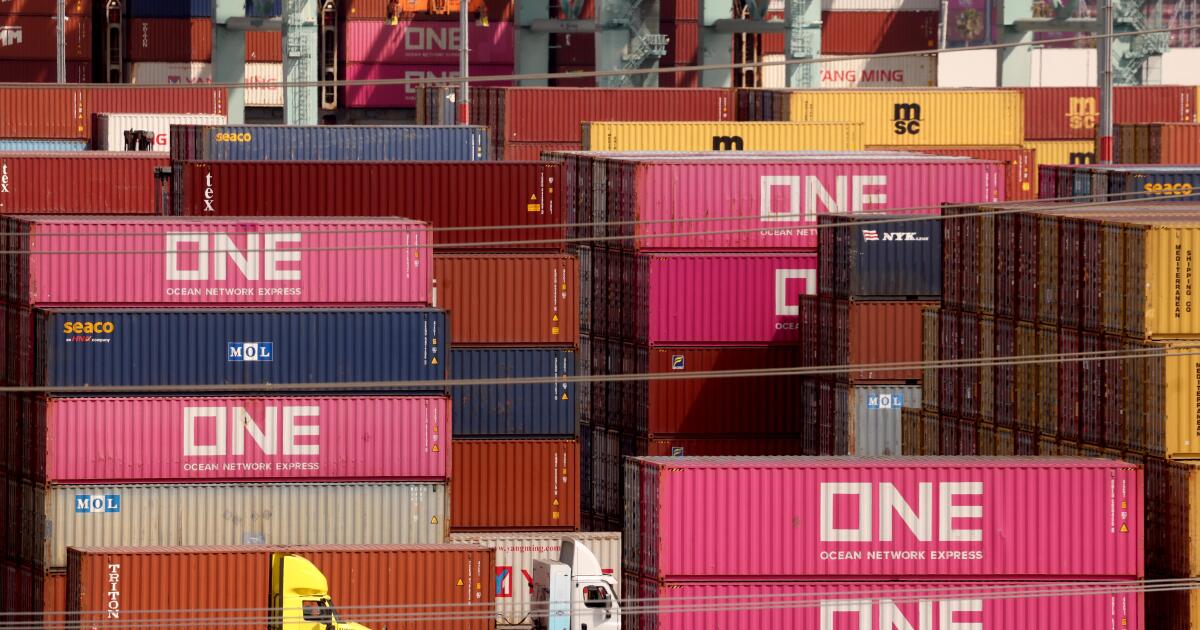
Based on the words of President Trump, America is well on the way to becoming a “global superpower in manufacturing” — indeed, as he declared in a Father’s Day social media post, we are already experiencing the “BEST ECONOMY EVER.” (Capitalization’s his.)
Here’s what the government’s own statistics tell us: Manufacturing investment has crashed during his watch, with construction spending in the manufacturing sector down 26.4% from Trump’s inauguration through May, to $174.8 billion. That’s the lowest figure since February 2023, when the economy was in the midst of a post-pandemic recovery.
White House spokesman Kush Desai told me by email that “the last two jobs reports” showed manufacturing job growth. The Bureau of Labor Statistics reported a seasonally-adjusted decline of 2,000 manufacturing workers in May and a gain of 3,000 in June. But the June 2026 figure was 38,000 jobs, or about 0.3% below the level in June 2025, and 75,000 or about 0.6% below the level in January 2025, when Trump took office.
Desai said that “thanks to President Trump’s proven agenda of tariffs, deregulation, and tax cuts, American manufacturing will continue to rebound.”
There’s little mystery about what has come between Trump’s ambition and the real world. To a large extent it’s Trump’s economic program, particularly his tariff policies and, more recently, his war with Iran. Those have injected a level of uncertainty for corporate managements pondering whether to spend money on expansion that they haven’t had to confront in years.
From where we’re standing, we are not seeing signs of a manufacturing renaissance in the U.S.
— Didi Caldwell, Global Location Strategies
The tariffs and the war have driven up manufacturers’ costs for raw materials and overseas shipping. The general economic atmosphere doesn’t help. U.S. gross domestic product growth came in at a 2.1% annualized rate in the first quarter of this year, but the Federal Reserve Bank of Atlanta expects it to have fallen to 1.3% in the second quarter ended June 30.
Meanwhile, the University of Michigan consumer confidence index reached 44.8 in May, its lowest level ever (though it improved to 49.5 in June). Wages have been rising modestly, according to the Bureau of Labor Statistics, but those gains have been eaten up by higher prices, especially for gasoline and food.
To put things another way, the actual figures show the U.S. economy to be sputtering, and the “vibe economy” as measured by consumer confidence is doing even worse.
Now that Trump’s second term is about to reach its 18-month mark, let’s unpack the factors causing the discrepancy between his ambitions and claims, and the reality.
Trump declared economic victory just as his term was starting. On March 20, 2025, he proclaimed a “manufacturing renaissance” in the U.S. That was based on what he said were “trillions of dollars in new investments” he had “already secured in tech-based manufacturing.”
A White House statement said “the list of manufacturing wins is endless.” The provided list was a roster of announcements, not groundbreakings, much less completed ventures.
Business executives quite properly have taken these pledges with mounds of salt. “Announcements are what people say they’re going to do, but dollars spent is what’s actually happening,” Didi Caldwell, chief executive of a firm that helps companies find factory sites, told the Financial Times. “From where we’re standing, we are not seeing signs of a manufacturing renaissance in the U.S.”
Indeed, at least some of these announcements have had the flavor of performative efforts to satisfy Trump’s amour propre and extract government concessions.
For example, Apple Chief Executive Tim Cook appeared with Trump at the White House in August to announce a $600-billion U.S. spending plan to take place over four years. That was a $100-billion increase over its previously-announced program.
More to the point, however, it incorporated spending with suppliers that Apple had been working with for years. Mentioned in the news announcement was a commitment to buy cover glass for iPhones from Corning. But Corning has been supplying that glass since the first iPhone appeared in 2007. In any case, the announcement appeared to secure a commitment from Trump to exempt Apple from tariffs imposed on imported chips.
Apple’s announcement Wednesday that it will spend $30 billion to buy chips from Broadcom was similarly ambiguous. The announcement didn’t provide details about the terms of the commitment or the timing of its expenditures. I asked Apple for details and whether the deal was related to a desire to remain in Trump’s favor, but didn’t hear back.
A similar phenomenon occurred during Trump’s first term; Trump had built much of his 2016 presidential campaign on a promise to increase manufacturing jobs in the United States. He blamed shrinkage in the manufacturing sector on trade agreements such as NAFTA and the policies of the Chinese, and took credit when an American manufacturer agreed to create or save jobs in the United States.
As I reported in 2019, many of those arrangements turned out to be exaggerated or bogus, or predated Trump’s claim. Some disappeared as soon as public attention turned elsewhere, or were outweighed by job cuts made elsewhere by the same companies.
Trump’s tariffs appear to have had a direct effect on manufacturing employment in the U.S. Since Trump’s inauguration, the manufacturing sector has shed about 75,000 jobs, or 0.6%. After April 2, 2025, when he announced global “liberation day” tariffs supposedly as a response to years of unfair treatment of American exports, the decline picked up pace, with a shrinkage of 68,000 manufacturing jobs.
The Supreme Court invalidated those tariffs in February, but others are still in place, including tariffs on imported steel and aluminum and on goods from China. Nor has he ceased threatening partners with trade wars. As recently as Tuesday, he said he would cut off all trade with Spain because of that country’s disagreement with him over its defense spending and its criticism of his Iran war.
As it happens, Spain is one of the few countries with which the U.S. has a trade surplus. That means that any cutoff, which trade experts think will be unlikely, would come at a cost to the U.S.
One might have hoped that Trump had learned a lesson from his first-term trade war with China. That conflict provoked a sharp contraction in the manufacturing economy, with the Institute for Supply Management’s purchasing managers index falling to 49.1 by mid-2019. (A reading below 50 signifies contraction.)
The ISM index began to recover toward the end of Trump’s term but fell again during the pandemic. Lately it has been falling again, to 53.3 in June from 54 in May.
The Iran war is another deadweight on domestic manufacturing. That’s partially the consequence of blockages of the Strait of Hormuz, the crucial thoroughfare not only for middle eastern oil, but also for such industrial inputs as fertilizer and aluminum. Cement, concrete, olive oil and spices are also among commodities produced in the region that use the strait as an outlet to reach the outside world.
Uncertainties in the region, tensions between the U.S. and China, and heightened concerns over the safety of shipping overall have driven up shipping costs between the far east and the U.S. The price of shipping a benchmark 40-foot container from China to the West Coast has nearly quadrupled to $6,687 now from about $1,700 just before the Iran war began, according to an index maintained by the cargo firm Freightos — even though shipping prices typically decline during this time of year.
There can be little doubt that the U.S. would benefit from an industrial policy — if it’s coherent. China supplanted America as the world’s leading exporter of manufactured goods in 2010, and the gap has only widened since then. China’s dominance may be hard to reverse, as it’s built on lower labor costs and transport infrastructure that enjoys focused government investment.
Tariffs could be a component of a new industrial policy, but Trump’s tariffs aren’t rationally geared to protecting domestic industries that need protection. They’re expressions of his whims, and as such they’re totally ineffective. If there are government investment policies targeting industries that need assistance, they’re not apparent to economists or industrialists.
Trump can talk as much as he likes about a golden age for U.S. manufacturing, but from his first term through this one, it’s nothing but talk. And talk, of course, is cheap.

Walt Disney Co.’s “Moana” lost its way at the box office this weekend as the company’s latest live-action remake opened to a sluggish $43 million in the U.S. and Canada.
The domestic haul for “Moana” underperformed studio expectations, which ranged from $60 million to $65 million. Globally, the film brought in a total of $95 million on a production budget of about $250 million.
Despite its lackluster debut, the film still came in first at the box office during a weekend where it had few new competitors in the family film space.
The “Moana” franchise has been a box-office and streaming juggernaut. The original 2016 animated movie brought in more than $643 million worldwide and is the most-watched movie on Disney+, while a 2024 sequel grossed more than $1 billion at the global box office. On the merchandise side, more than 22 million “Moana”-themed toys have been sold. “Moana” also appears in the Disney theme parks.
But the theatrical reception for the live-action film may signal that audiences think there’s been too much “Moana” in just 10 years. (The 2024 film sequel was originally set to be a streaming series before it was moved to Disney’s theatrical calendar.)
Most of Disney’s previous live-action remakes have come decades after the original animated movie, such as 2025’s “Lilo & Stitch,” which arrived 23 years after its animated predecessor and grossed more than $1 billion in worldwide box office receipts.
The theatrical haul for the latest “Moana” may also have suffered from poor reviews — the film got a 34% on aggregator Rotten Tomatoes, with several critics highlighting its nearly frame-by-frame similarity to the original film. The audience score on Rotten Tomatoes, however, was 90%.
Still, as the last of this summer’s major family films, “Moana” could see a longer tail in theaters, particularly with many children still on break from school. Disney’s live-action “Mufasa: The Lion King” opened in 2024 to a middling $35 million, but ended up grossing more than $722 million globally through the holiday season.
Universal Pictures and Illumination’s “Minions & Monsters” came in second at the domestic box office this weekend with $20.5 million. Disney and Pixar’s “Toy Story 5” continued its strong run with an $18.5-million haul, enough for third place and contributing to a total global gross of $879.1 million.
Warner Bros.’ “Evil Dead Burn” ($13.7 million) and Angel Studios’ “Young Washington” ($6.4 million) rounded out the top five.
Also notable this weekend: Lionsgate’s musical biopic “Michael” crossed $1 billion in worldwide box office revenue, the first time that the studio has reached that milestone and the second film this year after “The Super Mario Galaxy Movie” to hit that mark.
-

 Dallas, TX5 minutes ago
Top 10 Dallas Cowboys of 2026: Rashan Gary is Complete EDGE Dallas Needed
-

 Miami, FL11 minutes ago
Girl, 12, shot while sitting in parked car in northwest Miami-Dade, deputies say
-

 Boston, MA17 minutes ago
GBH Daily: Come sail away
-

 Denver, CO23 minutes ago
New ice cream shop with a ‘waffle theater’ bets big on downtown Denver
-

 Seattle, WA29 minutes ago
Seattle weather: Sunny skies and warmer temperatures Tuesday
-

 Milwaukee, WI41 minutes ago
Milwaukee cooling centers, heat advisory tips; what to know
-

 Atlanta, GA47 minutes ago
Warnock, Dickens talk about new housing legislation
-

 Indianapolis, IN59 minutes ago
Indiana heat index to hit 100 as hot, dry pattern holds | July 14, 2026

