
Louisiana
A crabbing trip to Rockefeller Refuge reels me into Louisiana life
When friends found out I’d never been crabbing in Louisiana, they were determined to set things right.
Getting to Pecan Island on a Friday afternoon required patience, but the hardest part of the whole adventure was finding a time that worked for all our schedules. The evening before we left, Adele Netterville messaged to say, “You’ll need to get a fishing license if you don’t have one.”
Getting a Louisiana fishing license was simple. Five minutes on Louisiana’s Department of Wildlife and Fisheries’ website, and I was officially licensed — and impressed.
Camps in Pecan Island, a ridge of high ground about 10 miles from the Gulf.
Fishing license in hand, my friends, including Adele’s husband Craig Netterville, picked me up at 4 p.m. Friday and off we went, headed to a camp in Pecan Island, a ridge of high ground about 10 miles from the Gulf.
We picked up Michelle Kallam in Lafayette, then hit the Best Stop in Scott for boudin and crackers. Eating hot boudin in the backseat of a truck on the way to a camp in Pecan Island felt like pure Louisiana.
After winding through Acadiana’s backroads with boudin in our laps, we arrived at the camp. Robert Kallam greeted us with a cooler full of crabs he had caught using traps. He had a giant boiler on the burner already bubbling.
Columnist Jan Risher saw many goats and a giant pig on the banks on her way to go crabbing at Rockefeller Refuge.
As the sun was setting, we took a quick boat ride into the marsh, floating past goats and a giant pig on the banks. The Kallams explained that their camp was not waterfront property when they bought it 20 years ago, but after Hurricane Rita, some water never left.
Back at the camp, we sat down to a crab feast outside. The mosquitoes nearly hauled us off. So we retreated indoors.
The crabs were the best I’d ever had. I believed I’d soon be a crabbing expert and wanted mine to taste just like that. Thankfully, Robert Kallam was generous to share his secret: Louisiana Fish Fry Crawfish, Shrimp and Crab Boil.
Adele Netterville, Michelle Kallam and Jan Risher in a boat at Pecan Island on May 30, 2025
After a full week of work, we hit the hay early. I got the bottom bunk in a room all my own. The crabbing experts said we had to leave by 6 a.m. to head to Rockefeller Refuge to get a spot.
They weren’t joking. When I went outside at 6:15 a.m. Saturday, a line of trucks were already barreling down La. 82 headed south.
Truth is, I’m not a 6-a.m.-Saturday-morning-up-and-at-’em kind of human. Last weekend was the exception.
The Rockefeller Wildlife Refuge is a large area of marshland in Cameron Parish and Vermilion Parish.
We pulled into Rockefeller Refuge minutes after the sun began to rise. Looking out the window onto the incredible morning sun hitting the Roseau reed felt like riding into a painting.
I grew up among a family of hunters and fishermen. I’ve remained baffled at why they got up at the crack of dawn day after day to head into the woods. But on Saturday, the glow on the reeds gave me insight into my brother, uncles and father.
After a string of busy weeks, quietly watching that kind of beauty was indeed enough to pull me back again, even at 6 a.m. — and we hadn’t even gone crabbing yet.
View out the window, with the truck in the shadows of the Roseau reed at Rockefeller Refuge on May 31, 2025.
My friends showed me that crabbing is easy. All you need is string, a net and some chicken legs or turkey necks. Tie the bait, drop it in. When the string moves, gently pull it in and scoop up the crab with the net.
For two hours, we couldn’t move from string to string fast enough. Granted, many were juveniles, which we released, but the catching was nonstop. It was a blast.
Then, all of a sudden, they just stopped biting. We sat on the pier for a while longer. We had made friends with the young family beside us from Holmwood. The two little boys, Maverick and Maddox Suire, were as helpful, kind and confident as they could be.
Jan Risher with her first crab catch at Rockefeller Refuge on May 31, 2025.
When we walked up, Maverick, the 5-year-old younger brother, exclaimed to his mom, “This is only my second time crabbing, and I’m already good at it.”
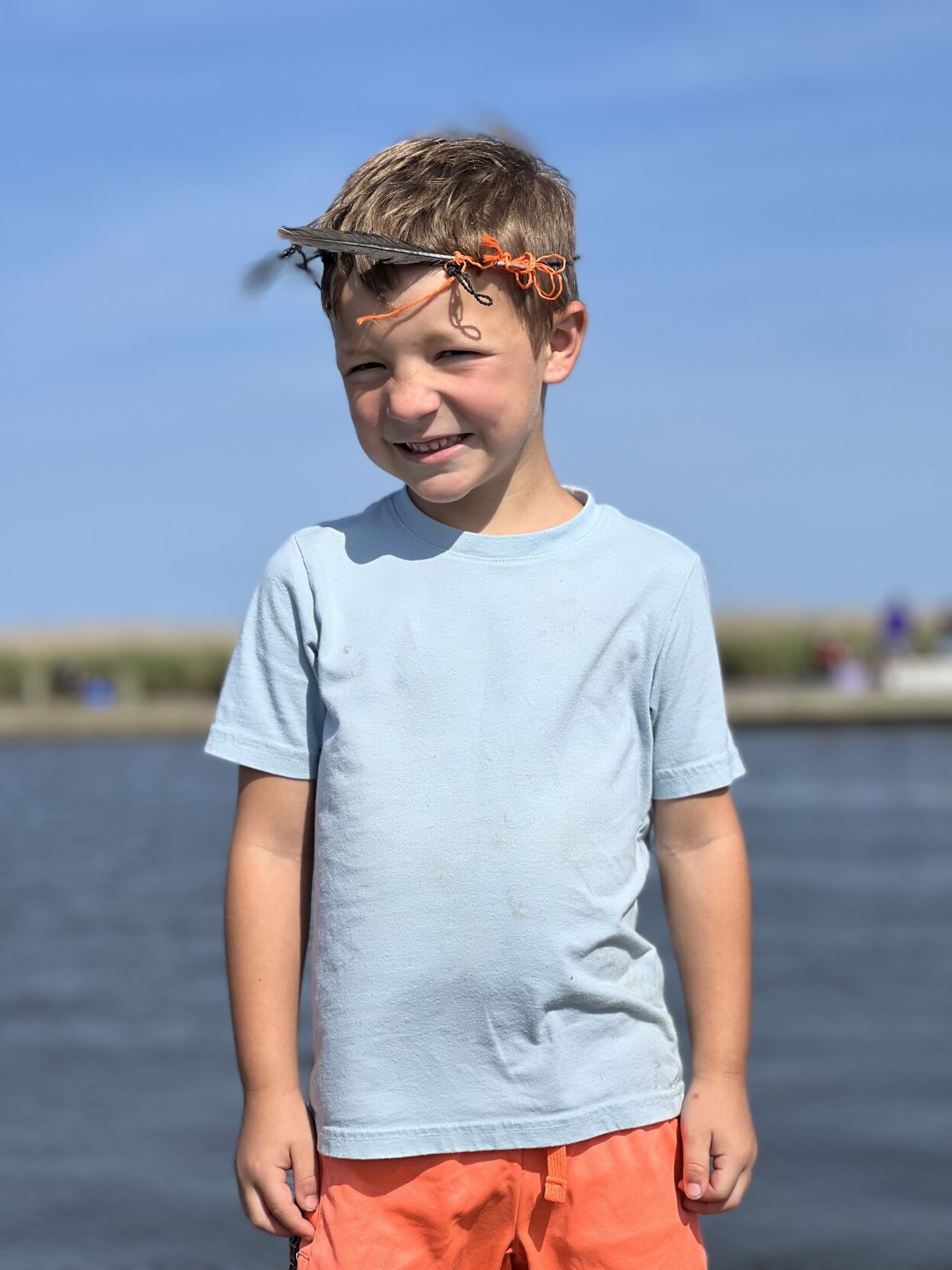
Maverick and I became fast friends. He found a bird’s feather and a piece of string. I told him if he could find another piece of string, I would make him a headdress. String is easy to find on a crabbing pier.
Maverick wore the makeshift headdress proudly for the rest of our time together, as happy as a child could be.
Maverick Suire of Holmwood, Louisiana, wearing his feather headdress at Rockefeller Refuge on May 31, 2025.
Since we had already eaten crabs the night before, we asked Maverick’s mom if she would like the ones we caught. She gladly accepted. The boys were pulling crab lines as we drove away.
Turns out, slow time with friends, a feather, a string and a 5-year-old on a crabbing pier go a long way in reminding us what joy looks like.
We stopped at Suire’s grocery south of Kaplan for lunch. It was like a little slice of heaven. I was glad my friends took it upon themselves to go crabbing.
Louisiana
Louisiana considers opening recreational alligator hunting season
Massive alligator causes chaos, attempts to avoid capture
Officers wrangled and released an alligator after it was spotted near a home in Livingston Parish, Louisiana.
Louisiana may expand its wild alligator harvesting opportunities to recreational hunters if the Legislature passes a bill that secured unanimous approval in a committee hearing March 11.
Franklin state Sen. Robert Allain’s Senate Bill 244 would authorize the Louisiana Wildlife Commission to create a recreational season that would be open to 5,000 hunters annually, each with a two-gator limit.
The state already has a commercial hunting season for alligators, which is chronicled in the popular “Swamp People” TV reality series.
“We think the time is right,” Louisiana Department of Wildlife and Fisheries Secretary Tyler Bosworth testified during the Senate Natural Resources Committee hearing. “We want to provide a recreational opportunity for the common folk of Louisiana.”
Louisiana’s alligator population has exploded in the past 50 years from fewer than 100,000 to more than 3 million today. Of those, about 2 million are wild with another 1 million farmed.
That’s at least twice the population in Florida, the state with the second most number of alligators.
And their Louisiana numbers have grown throughout the state where they can be commonly spotted from Lake Martin in Breaux Bridge to Caddo and Cross lakes in Shreveport to Caldwell Parish in northeastern Louisiana.
“This is a conservation success story on the highest level,” LDWF general counsel Garrett Cole said during the hearing. “This would create a true recreational opportunity outside our commercial season.”
Garrett said hunters would compete for hunting tags through a lottery will statewide opportunities. Recreational hunters would be limited to hook and line harvesting from land. No gators could be taken by boat as commercial hunters are allowed to do.
If approved, the first season could take place beginning Oct. 1.
Greg Hilburn covers state politics for the USA TODAY Network of Louisiana. Follow him on Twitter @GregHilburn1.
Louisiana
How a sinkhole caused a whirlpool and formed Louisiana’s deepest lake
Responsible Anglers United, LDWF release bass into Lake Bouef
Responsible Anglers United team up with Louisiana Department of Wildlife and Fisheries to release more than 3,000 Florida bass into Lake Bouef on Oct. 17.
While Louisiana’s largest lake, the Toledo Bend Reservoir, spans 1,200 miles of shoreline, the state’s deepest lake only spans 1,125 acres.
Lake Peigneur is the deepest lake in Louisiana, with a depth measuring approximately 200 feet.
Lake Peigneur is a brackish lake, meaning it contains saltwater but has less salinity than seawater, located in New Iberia Parish in South Louisiana.
How did Lake Peigneur become the deepest lake in Louisiana?
Lake Peigneur was not always considered the deepest lake in Louisiana, as it was only a 10-foot-deep freshwater lake 40 years ago.
On Nov. 20, 1980, an oil rig crew was attempting to free a 14-inch drill bit when they heard popping noises and the rig began to tilt. Shortly after the crew abandoned the rig and headed for shore, the crew watched the 150-foot oil rig disappear into the 10-foot-deep lake.
Soon, a whirlpool formed in place of the oil rig. The whirlpool grew rapidly until it was able to suck up nearby boats, barges, trees, a house and half an island.
At the same location of the oil drilling site, there was also a salt mine, and when the whirlpool formed after the oil rig collapsed, the mine began to fill with water. As the whirlpool grew, water was able to enter the mine at such a force that it caused a geyser to spew out of the mine’s opening for hours until the lake was drained.
After the lake was emptied, the Delcambre Canal began to flow backward, marking the only time in history that the Gulf of Mexico flowed into the continental U.S. This backflow continued until the entire mine and lake were filled with water, except now the lake was filled with saltwater, according to an article published on Louisiana Tech Digital Commons.
Can you swim in Lake Peigneur?
Before the oil rig and salt mine accident, Lake Peigneur was a popular spot for fishing and recreational activities. However, since the lake is almost entirely surrounded by private property, visitors will have to enter the nearby Rip Van Winkle Gardens in order to get a closer look, according to Atlas Obscura.
While there are no reports indicating the lake is unsafe, the lake is not exactly developed for public access. However, there are things to do around Lake Peigneur, like visiting Rip Van Winkle Gardens on Jefferson Island, or visiting Avery Island to tour the Tabasco Factory.
Presley Bo Tyler is a reporter for the Louisiana Deep South Connect Team for USA Today. Find her on X @PresleyTyler02 and email at PTyler@Gannett.com
Louisiana
Officials confirm Pensacola Beach residue is algae, not oil from Louisiana spill
PENSACOLA BEACH, Fla. — A local fisherman raised concerns about the substance now coating Opal Beach, citing a recent oil spill off the coast of Louisiana.
WEAR News went to officials with the Gulf Islands National Seashore and Escambia County to find out the cause.
They say it’s not related to an oil spill, but is in fact algae.
The Marine Resources Division says they can understand beachgoers’ concerns, and hope to raise awareness.
“You don’t even want to get near it because it’s so gooey and sticky,” local fisherman Larry Grossman said. “It was accumulating on my beach cart wheels yesterday, and it felt like an oil product.”
Grossman messaged WEAR News on Monday after noticing something brown and oozy in the sand. He says it started showing up by Fort Pickens and stretched down to Opal Beach.
Grossman said a park service employee told him it could be oil from a recent spill in Louisiana. So he took a message to social media, sparking some reactions and raising questions.
“it certainly didn’t seem like an algae bloom because I was in the water, I caught a fish and I put some water in the cooler to keep my fish cool and it almost looked like oil in it,” Grossman said. “I know some people think it’s an algae bloom, but it certainly smelled and felt and looked like oil.”
A Gulf Islands National Seashore spokesperson confirmed to WEAR News on Tuesday that the substance is algae.
WEAR News crews were at the beach as officials with the Escambia County Marines Resources Division came out take samples.
“What I found here washed up on the beach is some algae — filamentous algae, single celled algae — that washed ashore in some onshore winds,” said Robert Turpin, Escambia County Marines Resources Division manager. “This is the spring season, so with additional sunlight, our plants, they grow in warmer waters, with plenty of sunlight.”
Turpin says this algae is not harmful.
He also addressed the concerns that this could be oil, saying he’s familiar with what oil spills look like.
He says he appreciates when people like Grossman raise the concerns.
“The last thing in the world we want is something to gain traction on social media that is faults in nature that could harm our tourism,” Turpin said. “Our tourism is very important to our economy, and we want to give the right information out to the public so we all enjoy the beaches and enjoy them safely.”
Turpin says if you see something or suspect something may be harmful on the beach, avoid it and contact Escambia County Marine Resources.
-
Wisconsin1 week agoSetting sail on iceboats across a frozen lake in Wisconsin
-
Massachusetts1 week agoMassachusetts man awaits word from family in Iran after attacks
-
Detroit, MI6 days agoU.S. Postal Service could run out of money within a year
-
Pennsylvania6 days agoPa. man found guilty of raping teen girl who he took to Mexico
-
Miami, FL1 week agoCity of Miami celebrates reopening of Flagler Street as part of beautification project
-
Sports7 days agoKeith Olbermann under fire for calling Lou Holtz a ‘scumbag’ after legendary coach’s death
-
Michigan2 days agoOperation BBQ Relief helping with Southwest Michigan tornado recovery
-
Virginia1 week agoGiants will hold 2026 training camp in West Virginia
