News
Why cruise ship passengers with possible hantavirus exposure went to Nebraska


The National Quarantine Center is located at the University of Nebraska Medical Center in Omaha.
Nebraska Medicine
hide caption
toggle caption
Nebraska Medicine
Sixteen of the 18 passengers transferred to the U.S. from a cruise ship where there was an outbreak of hantavirus arrived in Omaha, Neb., on Monday for evaluation after disembarking the vessel in Spain’s Canary Islands over the weekend.

Of the 15 U.S. citizens and one dual U.S.-British citizen who arrived in Nebraska, all but one are currently being housed in the National Quarantine Unit. That patient tested positive for the virus and was being housed in the Nebraska Biocontainment Unit, officials said at a Monday news conference. The 15 people in the quarantine unit will continue to be monitored for signs of the illness.
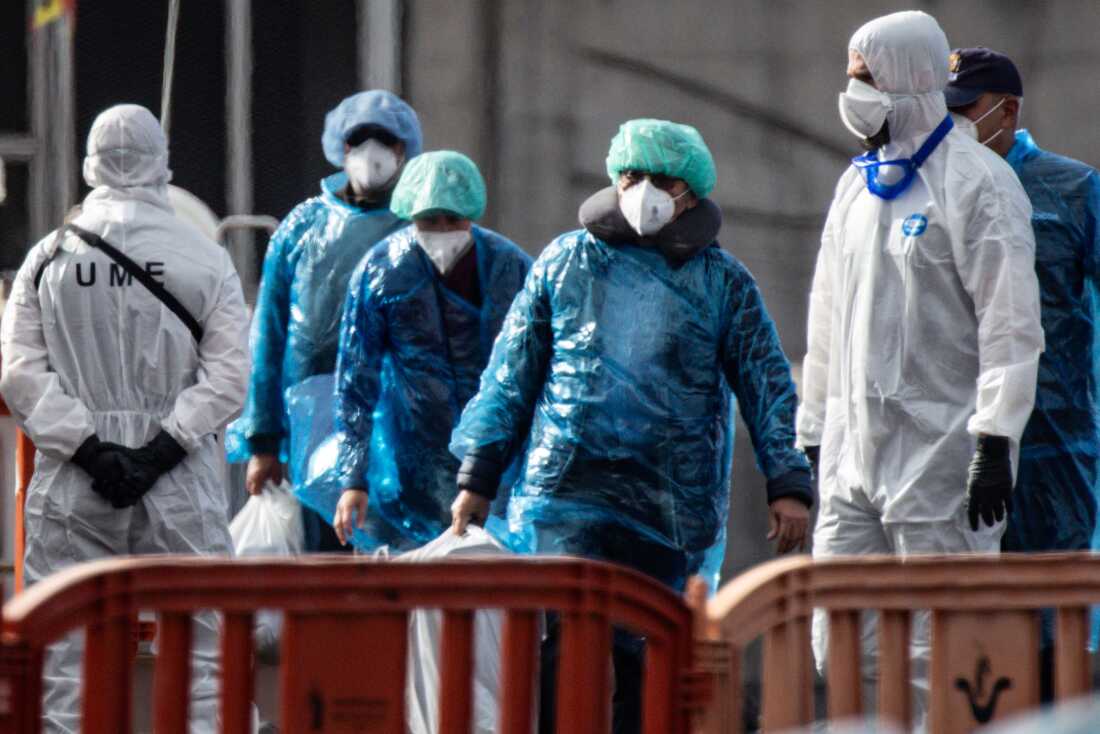
Passengers carry their belongings in plastic bags after being evacuated from the MV Hondius after docking in the Granadilla Port on Sunday in Tenerife, part of the Canary Islands, Spain.
Chris McGrath/Getty Images
hide caption
toggle caption
Chris McGrath/Getty Images
Nebraska may seem an unlikely location to process these individuals, but it is home to the National Quarantine Unit — the only federally funded quarantine unit in the U.S. — and the separate Nebraska Biocontainment Unit. They are highly specialized facilities located at the University of Nebraska Medical Center (UNMC) and widely considered among the best in the world.
The $1 million, five-room biocontainment unit was dedicated in 2005. It was a joint project with Nebraska Health and Human Services and the UNMC. It is set up to safely provide medical care for patients with highly hazardous and infectious diseases and was used in 2014 to treat two doctors infected with Ebola. The National Quarantine Unit was completed in late 2019. It cost nearly $20 million, according to the Associated Press. Both facilities were used during the COVID-19 epidemic.

“We are prepared for situations exactly like this,” Dr. Michael Ash, CEO of Nebraska Medicine, said in a statement. “Our teams have trained for decades alongside federal and state partners to make sure we can safely provide care while protecting our staff and the broader community. We are proud to support this national effort.”
Two additional U.S. passengers on the cruise ship — a couple, with one showing symptoms of hantavirus — were transferred for monitoring to Emory University Hospital, where another advanced biocontainment facility is located.
When the biocontainment unit was first dedicated more than 20 years ago, the biggest concerns were anthrax attacks and severe acute respiratory syndrome, more commonly known as SARS, Dr. Phil Smith, who spearheaded the efforts at Nebraska Medical Center to create the biocontainment unit, told the AP in 2020. Smith died last year.

A hallway leading to rooms at the Nebraska Biocontainment Unit at the University of Nebraska Medical Center.
Nebraska Medicine
hide caption
toggle caption
Nebraska Medicine
The quarantine unit features 20 negative-pressure rooms designed to keep potentially harmful particles from escaping by maintaining lower air pressure inside than outside the rooms. The single-occupancy rooms provide patients with attached bathrooms, exercise equipment and Wi-Fi, according to the medical center.
“We have protocols in the quarantine unit that provide for safe care of these of these persons, including just all the activities of daily living so that they can … have a comfortable stay but also have it in an area that’s protected and limits spread of the pathogen,” Dr. Michael Wadman, the medical director of the National Quarantine Unit, said at a Friday news conference.
The biocontainment unit, by contrast, is a patient-care space where people are able to receive medical treatment, Dr. Angela Hewlett, medical director of the biocontainment unit, told reporters Monday.
She emphasized that the facility — which has a 10-bed capacity — operates independently from the quarantine unit and has its own dedicated air-handling system. “We don’t share [it] with any of the rest of the facility,” she said, noting that the unit uses rooftop HEPA filtration and is designed “very differently” from what most people typically imagine in a hospital setting.

One of the rooms in the Nebraska Biocontainment Unit.
Nebraska Medicine
hide caption
toggle caption
Nebraska Medicine
Nebraska Gov. Jim Pillen, speaking at Monday’s news conference, welcomed the recently arrived patients, who are among nearly 150 people from 23 different countries who were aboard the MV Hondius when the illness most commonly transmitted to humans through contact with infected rodents broke out. As of Monday, the World Health Organization has reported at least nine cases of hantavirus, including three deaths.
“We’re glad that you’re here,” Pillen said. “We’re going to ensure that you have the best world-class care possible.”
Pillen also sought to reassure Nebraskans that the facilities are safe and secure: “We’re working diligently to ensure no one leaves the security in an unsecured way at an inappropriate time,” he said. “No one poses a risk to public health, just walking out the front door of the streets of Omaha.”

The hantavirus outbreak on the cruise ship has been identified as the Andes strain of the illness, one that can be spread, though rarely, from person-to-person, according to the Centers for Disease Control and Prevention. It can cause severe respiratory disease, with early flu-like symptoms.
“The Andes variant of this virus does not spread easily, and it requires prolonged, close contact with someone who is already symptomatic,” according to Adm. Brian Christine, the assistant secretary for health at the U.S. Department of Health and Human Services, who spoke at Monday’s news conference. “Even so, we have taken this situation very seriously from the very start.”
“The risk of hantavirus to the general public remains very, very low,” he said.
The full quarantine period for hantavirus is 42 days, Christine said, but he added that the patients would be allowed to go home if they remained asymptomatic.
“Right now, the passengers that are all in the assessment phase — they’re going to be here for at least a few days while we do assessments and the coordination on what happens next,” he said, adding that they had the option to remain in the quarantine facility for the full period, for “the safest and most effective option for them.”


UTAH COUNTY, Utah (ABC4) — Utah County has declared a state of emergency.
According to an announcement from the Utah County Commissioner Skyler Beltran, the county is in a dire position due to the extensive wildfires in the area and high fire risk.
The announcement states that declaring the State of Emergency will allow the county to access additional resources, and notes there is no imminent threat to Utah County residents.
“We have utilized a tremendous amount of our resources (very early in the traditional fire season schedule) responding to the Iron Fire and continue to face ongoing recovery concerns,” the statement read. “This was even before the Maple Peak and Cherry fires, which have now merged and are moving toward the Iron Fire.”
The Iron Fire, which started last week, has burned over 40,000 acres. Around 22,830 of those acres were in Utah County. Reportedly, the county has limited resources available to help those who are evacuating from Juab County, including the 600 residents in the Town of Eureka.
Due to the influx in evacuees, the Utah County Commission says that more resources are necessary to help the evacuation shelters in Elberta, Utah. Additionally, due to the Iron Fire and other wildfires, Utah County is facing immense repair needs to avoid future flooding, loss of homes, and disruption to local economies and ecosystems.
There is “imminent threat” to public safety due to the damage.
The commission also asks the public to be vigilant when handling heavy equipment, using campfires or barbecues, and discharging fireworks, to avoid preventing fires.
Their statement added, “Our firefighters are exhausted, our resources are stretched thin and we are in a very vulnerable position.”
News
A day after Alito’s testy response to Sotomayor’s dissent, court says it was a ‘misunderstanding’

The justices of the U.S. Supreme Court, with Justice Sonia Sotomayor (seated left) and Justice Samuel Alito (seated second from right).
Alex Wong/Getty Images
hide caption
toggle caption
Alex Wong/Getty Images
As the Supreme Court heads into the announcement of its final and hugely important opinions next week, there are reverberations from this week’s announcements, and Justice Samuel Alito’s public rebuke of his colleague Justice Sonia Sotomayor.
On Thursday, Justice Alito summarized from the bench three very big opinions he authored for the court’s six justice conservative majority. Alito, unlike most of his colleagues, doesn’t spend much time on these summaries. And it is rare that a justice has three big opinions to announce, but it is almost the end of the term, and there are a lot of big cases still outstanding.
The first case he announced came and went. Alito then moved on to a second case, this one tests whether migrants may apply for asylum in the U.S. by going to one of several ports of entry along the U.S.-Mexican border, and presenting themselves for admission. This entails presenting documents that persuade an asylum officer that applicants’ fear of persecution in their home country is credible enough to allow them to enter the U.S. while their asylum application is processed. Alito’s opinion ruled in favor of the Trump administration’s policy of refusing all such applicants by blocking them at the border. It was a policy also followed at one time by the Obama administration until it was blocked by the lower courts.
After Alito finished his summary of the opinion, he paused, at which point Justice Sotomayor read a summary of her contrary views in dissent. When she finished, however, Justice Alito did not move on to the announcement of his third opinion. Instead, he did something that nobody in the press corps ever remembers happening before. Looking much as if he had just bitten into a lemon, Alito said, “There is much that I would have added to my bench statement had I known there would be a dissent read.” And he then went on to a short extemporaneous rebuttal.
What caused the hissy fit? Did Sotomayor really fail to tell him she would have an oral dissent? That really would have been a breach of the court’s practices. A justice typically notifies the chief justice and the author of the majority opinion in writing if there is to be an oral dissent.
In response Friday to an inquiry from NPR came this terse statement from the court’s public information office.
“Justice Alito was notified in advance by Justice Sotomayor’s chambers that she would be reading a dissent from the bench. It was a misunderstanding on Justice Alito’s part.”
News
“It’s blood money”: Family of exonerated man in Texas yogurt shop murders speaks out after settlement

The widow and the daughter of Maurice Pierce, one of the four men wrongfully accused in the 1991 Texas yogurt shop murders, have confirmed they signed a multimillion-dollar settlement with the city of Austin.
Kimberli and Marisa Pierce spoke with correspondent Erin Moriarty in a new episode of the podcast “48 Hours: Case by Case.” Moriarty has reported on the yogurt shop murders for over 30 years.
Maurice Pierce’s widow Kimberli made clear that their priority has never been financial compensation. “It’s blood money for us. He died for this money,” Kimberli Pierce said. “It’s about the reform and the changes that need to happen, not only in Austin, but apparently across the country.”
They also went into great detail about what they believe happened when Maurice Pierce was shot and killed by police in 2010.
Maurice Pierce was one of four men, along with Michael Scott, Robert Springsteen and Forrest Welborn, who were wrongfully accused in the murders of four teenage girls in Austin on Dec. 6, 1991. Eliza Thomas, Amy Ayers, and sisters Jennifer and Sarah Harbison were tied up, shot and left inside the yogurt shop as it was set ablaze.
The four men were exonerated in February after investigators linked another man, Robert Eugene Brashers, to the killings. The city of Austin subsequently offered a $35 million settlement. Because Maurice Pierce died in 2010, his share of $10 million will go to Kimberli and Marisa Pierce.
Eight days after the killings, 16-year-old Maurice Pierce was arrested at a mall, carrying a .22, the same caliber handgun connected to the crime. Kimberli Pierce said police told Maurice Pierce that his gun was the murder weapon. He responded by mentioning his friend Forrest Welborn. Maurice Pierce was then wired up and sent to speak with Welborn, but investigators ultimately determined that Welborn and the others knew nothing about the murders, and no charges were filed at that time.
Marisa Pierce has said there was no evidence when her father was questioned, “only a detective and a narrative, a narrative so completely false. It feels evil.”
Nearly eight years later, in 1999, all four men were arrested after Scott and Springsteen confessed to the murders. They later recanted, saying they had been coerced. Springsteen and Scott were tried and convicted, but later those convictions were overturned on constitutional grounds. A subsequent DNA test excluded all four men. Maurice Pierce was never convicted but spent three years in jail before his release in 2003.
Kimberli Pierce said her husband came home a hardened man. She believes police continued to harass Maurice and their family after his release. In 2010, Maurice Pierce was stopped for a routine traffic stop, fled on foot, and was shot and killed by an Austin police officer who said Pierce had stabbed him with a knife.
Marisa and Kimberli Pierce told “48 Hours” that they intend to review the circumstances surrounding the night of Maurice Pierce’s death. Marisa Pierce revealed in new, emotional detail that she was on the phone with her father at the time. She believes he panicked and was only trying to get away, not to hurt anyone. She described her father’s last breaths: “And in those last moments, he had just said I’m sorry, I don’t think you’re gonna see me again, and I love you.”
“48 Hours” reached out to the Austin Police Department about the Pierces’ allegations of harassment and their questions about Maurice Pierce’s death in 2010. The police department said they had no additional comment.
For the Pierce family, the settlement is a starting point, not an end point. They have put forward seven proposed reforms they hope the city of Austin will approve, including appointing a child advocate whenever a minor is questioned, prohibiting deceptive interrogation tactics, educating juveniles about their rights and establishing accountability measures to address tunnel vision in police investigations.
In a statement shared with “48 Hours,” the Pierces wrote: “Real justice is not only about acknowledging harm after the fact but about creating safeguards that prevent future families from enduring the same pain.”
-

 North Dakota5 minutes ago
Column: A possible bear season in North Dakota?
-

 Ohio8 minutes ago
Oregon Misses Out On Four-Star Offensive Lineman to Ryan Day, Ohio State
-

 Oklahoma13 minutes ago
Flooded roads prompt travel warnings across Northeast Oklahoma
-

 Oregon20 minutes ago
Public asked to help find missing 2-year-old Armani Andrews in Portland
-

 Pennsylvania23 minutes ago
Trump admin rule puts reproductive health care for 160K Pa. patients at risk, lawsuit says
-

 Rhode Island28 minutes ago
When will RI see promised Time-Varying Rates on electric bills? | Opinion
-

 South-Carolina35 minutes ago
Myrtle Beach is a hotspot for sharks and the potential to be bit
-

 South Dakota38 minutes ago
Work, housing and staffing: How South Dakota’s corrections chief aims to keep inmates from returning

