Business
China Increasingly Views Trump’s America as an Empire in Decline


When President Trump visited China in late 2017, Xi Jinping welcomed him with a grand display of Chinese history and culture: a four-hour private tour of the Forbidden City culminating in a performance by the Peking Opera.
Eight years, a pandemic and two trade wars later, Mr. Trump is returning to Beijing, where the theme of future dominance, not ancient majesty, has filled domestic and international headlines with articles about dancing robots, drone swarms and the quiet hum of electric vehicles.
China increasingly casts itself not as a fading civilization trying to catch up to the West but as a superpower poised to surpass it. Chinese nationalists and state-linked commentators say they have Mr. Trump to thank. America under his rule, they say, validates Mr. Xi’s worldview centered on “the rise of the East and decline of the West.”
For decades, many Chinese viewed the United States with a mix of admiration, envy and resentment. America represented wealth, technological sophistication and institutional confidence. Even critics of Washington who reviled the American system often assumed that it worked.
Mr. Trump’s ascent and his volatile second term shattered that image.
In January, a nationalistic Beijing think tank affiliated with Renmin University published a triumphant report about Mr. Trump’s first year back in office. The report argued that his tariffs, attacks on allies, anti-immigration policies and assaults on the American political establishment had inadvertently strengthened China while weakening the United States. Its title: “Thank Trump.”
The report called Mr. Trump an “accelerator of American political decay,” with the United States sliding toward polarization, institutional dysfunction and even “Latin American-style instability.” His hostility toward China, the authors argued, was a “reverse booster” that unified the country and helped bring about its strategic self-reliance.
“At this turning point in history,” the authors wrote, “what we hear is the heavy and haunting toll of an empire’s evening bell.”
Such language, once confined largely to nationalist corners of the Chinese internet, has increasingly entered mainstream political discourse.
Evidence of this shift is measurable: The use of terms related to “American decline” in official Chinese sources nearly doubled in 2025, according to a study by two Brookings Institution researchers.
The narrative of American decline did not begin with Mr. Trump. For years, Chinese state media and nationalist pundits have highlighted mass shootings, homelessness, political polarization and economic inequality in the United States as evidence of the failures of Western democracy. More recently, official outlets embraced the viral phrase “kill line,” borrowed from video game culture, to describe what they portrayed as the irreversible downward spiral facing America’s working poor. It’s a familiar tactic of the Communist Party to distract the Chinese public from the country’s own issues.
But Mr. Trump’s return to office and his administration’s erratic decision-making in both domestic and foreign policy have supplied the propaganda machine with plentiful fresh material. Images of immigration raids, the Minneapolis shootings and bitter political infighting circulate widely on Chinese social media alongside triumphant commentary about American dysfunction. What once sounded to many educated Chinese like exaggerated propaganda increasingly feels, to some, observational.
A 31-year-old education consultant in northern China who advises families on overseas study told me that parents who had once aspired to Ivy League degrees for their children now saw America as “too chaotic.” A decade ago, more than 80 percent of his students considered the United States for study abroad, said the consultant, who asked me to use only his family name, Wang, for fear of government retribution. Now, he estimated, the figure has fallen to 45 percent.
Mr. Wang described watching footage of the Jan. 6, 2021, attack on the U.S. Capitol and finding himself thinking of the Red Guards that Mao Zedong dispatched to tear apart China’s institutions during the Cultural Revolution. That feeling returned more insistently with the immigration raids and the targeting of perceived enemies during Mr. Trump’s second term.
“The America that represented wealth, freedom and institutional confidence feels like it belonged to a different era,” Mr. Wang said.
Among China’s foreign policy analysts, the conversation has turned to what Beijing can gain from the bilateral relationship, which has become more transactional under Mr. Trump than under President Joseph R. Biden Jr.
“Only China can save Trump,” said Huang Jing, a professor at Shanghai International Studies University, during a media event that was livestreamed in late 2025. With the U.S. midterm elections approaching, he argued, Mr. Trump needed visible wins such as Chinese purchases of American soybeans, corn and natural gas that could play well in swing states.
“Since Trump,” Mr. Huang said at the event, “the United States has become increasingly prone to compromise.”
Wu Xinbo, a leading American studies scholar at Fudan University, offered a similar assessment. If Republicans lose control of the House this fall, he said at the same event, Mr. Trump is likely to pivot toward his foreign policy legacy, creating space for a larger accommodation with Beijing.
China, he said, “should make good use of this opportunity.”
The war in Iran has reinforced the view that China has the upper hand with Mr. Trump. At a conference in late April, Mr. Wu argued that the war reduced Washington’s leverage against China while increasing Beijing’s by consuming American military and diplomatic attention in the Middle East.
The logic helps explain why China’s official language regarding Mr. Trump has often been less hostile than it was regarding Mr. Biden. According to a project by the Tracking People’s Daily newsletter, which used artificial intelligence to analyze nearly 7,000 Chinese official statements since 2021, Mr. Biden was presented as a more systemic threat — so serious that Mr. Xi accused Washington of “encirclement and suppression,” unusually confrontational language for a Chinese leader.
By contrast, the study noted, “Trump’s transactionalism is something Beijing understands and can work with.”
Yet belief in U.S. decline has not translated into aggressive Chinese foreign policy, at least not the kind of overt geopolitical gamble that Russia made before invading Ukraine.
China has become more assertive, pressuring U.S. allies, expanding military activity around Taiwan and restricting rare-earth exports in response to Mr. Trump’s tariffs. But even as Beijing advances the idea of the decline of American power, it appears wary of directly confronting what many Chinese analysts describe as a still dangerous superpower.
Two factors play into this circumspection. First, many Chinese strategists believe Beijing can do better by sitting back while the Trump administration fumbles. Second, an unstable and distracted United States may also be a more unpredictable one.
Beijing’s export-dependent economy needs a stable international order to function. An erratic United States threatens that stability in ways a confident, predictable America never did, Zongyuan Zoe Liu, an economist at the Council for Foreign Relations, told me.
Mr. Xi “is getting the United States he always wanted,” she said, “and the America he most feared at the same time.”



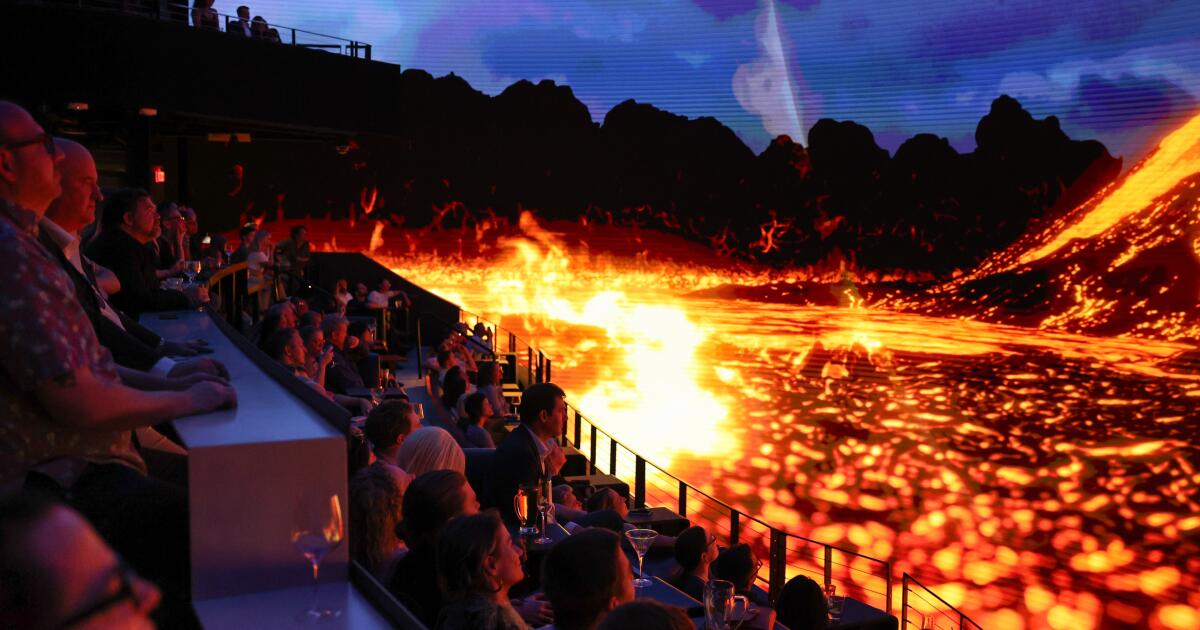
Sony Pictures will invest $100 million and take a minority stake in virtual reality venue operator Cosm, as the studio continues to build a business in communal experiences.
As part of the investment, Sony Pictures Chief Executive Ravi Ahuja will also join Cosm’s board of directors, the studio said Wednesday. The size of Sony’s minority stake was not disclosed.
The El Segundo-based Cosm currently operates three venues — one at Hollywood Park in Inglewood, and the others in Dallas and Atlanta. The company plans to open additional venues in Detroit and Cleveland.
Cosm bills itself as a “shared reality venue,” and its facilities center around a massive, wraparound screen that is intended to envelop viewers with additional digital effects. The company has largely focused on sports, though it has also shown Cirque du Soleil shows and done several collaborations with Warner Bros., including recent screenings of 2001’s “Harry Potter and the Sorcerer’s Stone” in honor of the film’s 25th anniversary.
“Cosm sits at the intersection of several trends shaping the future of entertainment,” Ahuja said in a statement. “We’ve followed Cosm since before launch and have been impressed with the quality of the experience and the enthusiasm it’s generating with audiences.”
The investment is Sony’s latest venture into experiential entertainment. In 2024, the Culver City-based studio acquired dine-in theater chain Alamo Drafthouse Cinema.

The Los Angeles City Council on Tuesday unanimously advanced an ordinance to halt new oil and gas drilling and phase out all existing production over the next 20 years. L.A. is home to more than 2,000 active oil wells.
The measure revives a similar ban passed in 2022, which was struck down by a judge following legal challenges from the oil and gas industry.
It must pass a second vote before final adoption later this summer, and would make L.A. the largest city in the United States to phase out existing oil wells.
“Today, Los Angeles is making a decision that aligns with our need to turn the page on urban oil drilling,” Councilmember Katy Yaroslavsky said during Tuesday’s council meeting. “The absence of an enforceable oil ordinance has had real consequences for our communities.”
The ban in 2022 was seen as a historic move for a region built on the petroleum industry.
But in 2024, a Los Angeles County Superior Court judge invalidated the law, ruling that the state, not the city, has jurisdiction over petroleum production. The legal challenge was brought by oil companies including Warren Resources, which operates a large oil field in Wilmington. Much of the field is beneath the city of Long Beach, but it also extends under Los Angeles.
Shortly after that, state legislators advanced Assembly Bill 3233, which reaffirmed city and county authority to regulate oil and gas activity. It was largely seen as the missing piece that made the original ordinance vulnerable.
“It’s now unequivocal that cities have the authority to regulate, limit and prohibit oil and gas operations within our jurisdiction,” Yaroslavsky said.
The new ordinance, written by the Department of City Planning, prohibits new oil and gas extraction, including drilling, redrilling or deepening existing oil wells for the purposes of production. It also designates all existing and active idle wells as “nonconforming uses,” meaning they may only operate during the phaseout period and are no longer compliant with current zoning.
Warren Resources, which led the lawsuit against the previous ban, did not immediately respond to a request for comment. The company previously argued that the 2022 ban was rushed and would lead to more oil imports to the area, causing increased emissions from tankers and trucks and other environmental consequences.
Many wells in the city operate near schools, homes and parks. Most are concentrated in low-income areas and communities of color, such as Wilmington and the harbor district, West L.A. and South L.A., where residents have long reported respiratory issues, headaches, throat irritation and other health problems. Studies have found oil wells can emit carcinogens and are linked to adverse health effects.
“This ordinance is such an important step toward giving every frontline community in Los Angeles access to clean air,” Silvia Esparza, a South L.A. resident and member of environmental justice group Stand-L.A., said in a news conference ahead of Tuesday’s vote.
Ashley Hernandez, a Wilmington resident and organizer with the nonprofit Communities for a Better Environment, said bloody noses and noxious fumes were a regular part of life in the neighborhood growing up.
She noted that in addition to oil drilling, L.A. residents continue to face other environmental hazards, such as the recent oil pipeline rupture that sent crude into the L.A. River or the ongoing cold storage warehouse fire in Boyle Heights that is spewing toxic smoke.
“I’m here to remind L.A. city and these toxic neighbors that Wilmington residents are more important than any ‘black gold’ under their homes,” Hernandez said. “We need our city to protect our families now and to stop the oil industry’s reign of power in our city. A passage of the oil phaseout ordinance today gives the city a chance to correct this wrong.”
Times staff writer Dakota Smith contributed to this report.

Shares in Elon Musk’s rocket company SpaceX halted their three-day slide that had erased roughly $600 billion off its market value.
SpaceX shares closed at $156.11 with a nearly 1% gain on Tuesday, a slight recovery from a 16% fall on Monday.
That loss dropped the stock below $160.95, where it ended the day June 12 after a 19% surge during its record initial public offering. The IPO gave it a market cap of $2.2 trillion, making SpaceX one of the world’s most valuable public companies.
It also turned Musk into the world’s first trillionaire, a status he retains despite the sell-off.
The downturn probably reflects investor unease over the company’s spending plans and potential debt load, analysts say.
SpaceX raised a total of $86 billion after underwriters exercised their right to sell additional shares, on top of the $75 billion initially raised. It was the largest IPO in history.
A little more than half a billion shares were distributed to institutional and retail investors at a price of $135, with the stock opening at $150 as some holders immediately flipped shares for a profit.
Shares rose as high as $176.52 during the IPO before settling at the $160.95 price. In the weeks since, shares reached a high of $225.64, meaning that some investors lost money or are underwater with paper losses.
Since the IPO, SpaceX has dropped some big bucks.
It announced last week that it was acquiring AI coding startup Cursor for $60 billion in a deal expected to close in the third quarter. The San Francisco company, founded in 2022, enables engineers to instruct software in English to run coding tasks autonomously.
It also sold $25 billion in bonds on Tuesday , unusual for a company that just went public, much less for one that just raised a record sum.
The IPO surpassed the 2019 offering by Saudi Aramco, Saudi Arabia’s state-owned oil giant, which raised $29.4 billion, the prior record holder.
S&P Global issued a report last week that assigned SpaceX a “BBB” credit rating, the lowest possible rating to qualify as an investment grade credit risk. It noted the company will have “elevated capital expenditure” through 2029.
SpaceX rivals OpenAi and Anthropic filed this month for initial public offerings that, while not expected to be as large as Musk’s company, will be large in their own right.
Wedbush analyst Dan Ives, who has been bullish on SpaceX stock, said the market is digesting “massive debt and equity raises from Big Tech players” in the coming years.
“This is part of an industry wave of debt offerings on Wall Street, like Alphabet and SpaceX among others,” he wrote in an email.
With the stock already giving up gains since the IPO, it will be further tested when tranches of locked-up shares held by current and former employees are released.
At least 20% of the shares will be released after second-quarter results are disclosed sometime in the coming months, with all the lockups expiring in December.
SpaceX, based in Texas, is the leading launch services company in the world, with its Falcon 9 rocket accounting last year for the vast majority of satellites sent into space.
It is also the leading satellite-based broadband provider with its Starlink service. But the extraordinary interest in the IPO was driven by Musk’s plans to make the company an AI leader — including plans to launch orbiting satellite data centers powered by the sun that crunch AI data.
He merged his xAI artificial intelligence company into SpaceX this year, with the combined entity recently announcing it was leasing computer power to rivals Anthropic and Google at two terrestrial data centers it has constructed.
Musk moved the company’s headquarters from Hawthorne to Texas in 2024, but it retains large operations in the South Bay city and blasts off regularly from Vandenberg Space Force Base in Santa Barbara County.
Investment research firm Morningstar placed a $780-billion valuation on SpaceX, focusing on its core rocket and Starlink broadband satellite businesses. It suggested investors wait a few months for the stock to settle before buying in.
“I think the day-to-day stock price movements are usually based on market sentiment,” said report co-author Nicolas Owens, an equity analyst at Morningstar. “So I was not surprised when it went way up right after the IPO — and I’m not surprised it [came down]. Not much has really changed in the fundamentals.”
Mike Alves, founder of Pasadena’s Vida Vision Fund, has a stake in SpaceX that accounts for 46% of his AI and robotics fund.
He said he was not perturbed by the stock drop, noting that Facebook fell under $18 a share just months after its May 2012 IPO closed at $38 a share. It has since risen more than 1,000% above its offering price.
“The volatility doesn’t really matter because you’re going to multiply your best investment many times, so I’m not so worried about it,” he said, adding that investors seeking shares could now “scoop them up at a good deal.”
-
 News16 minutes ago
With a Round of 32 spot already clinched, the U.S. takes on Turkey in the World Cup
-

 Los Angeles, Ca2 hours ago
Hospital needs help identifying man found unconscious in downtown Los Angeles
-

 Detroit, MI2 hours ago
Large police presence for an investigation on Detroit’s west side
-

 San Francisco, CA2 hours ago
No tolerance for hate or crime at SF Pride this weekend, officials say
-

 Dallas, TX2 hours ago
Alanna Smith injury update: Dallas Wings player in concussion protocol
-

 Boston, MA2 hours ago
Boy, 13, hospitalized after being found unresponsive in swimming pool at Beverly home
-

 Denver, CO2 hours ago
Denver Nuggets draft Trevon Brazile in the second round of the NBA Draft – Denver Stiffs
-

 Seattle, WA3 hours ago
Council eyes street barricades in fight against violence, sex trafficking in north Seattle

