Northeast
Trump trial: Why can't Americans see or hear what is going on inside the courtroom?

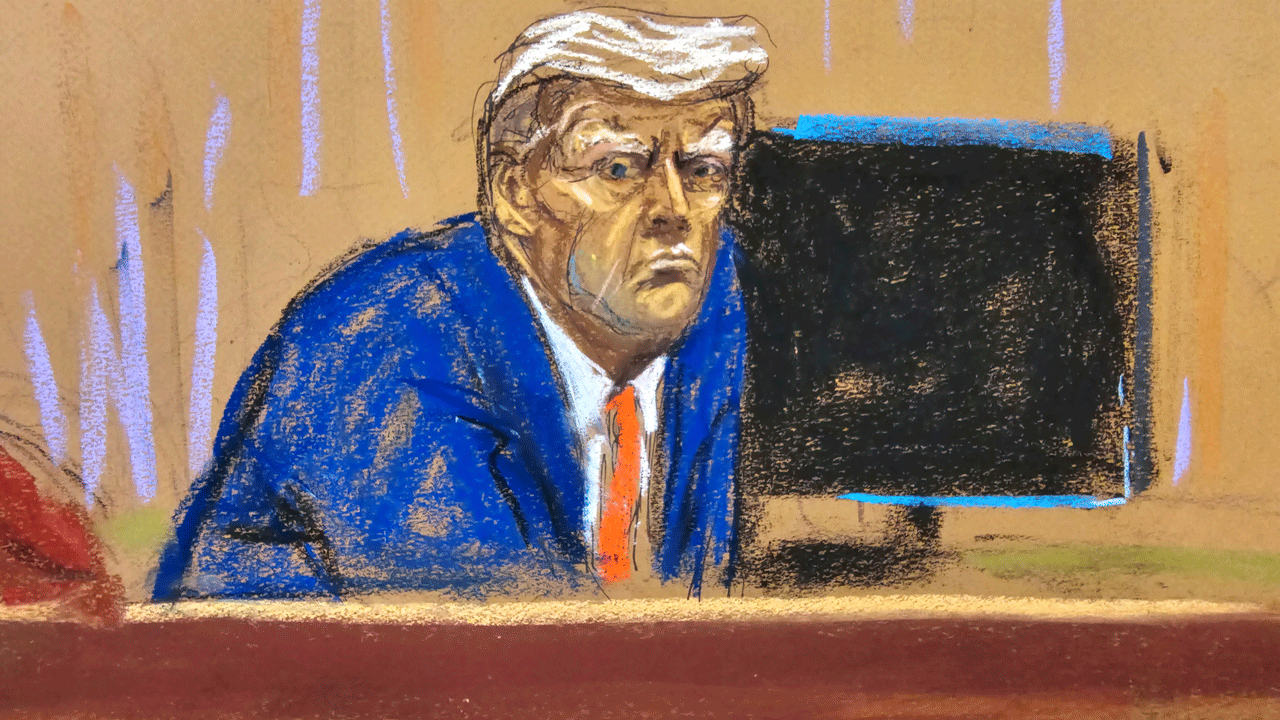
- Former President Donald Trump is the first U.S. president to face criminal charges in an American courtroom, but most of the country is getting news of the trial secondhand.
- New York law regarding media coverage in court proceedings is one of ‘the most restrictive’ in the nation.
- A limited number of cameras and reporters are positioned in a hallway outside the courtroom to capture remarks of those in the trial who want to address the outside world.
NEW YORK (AP) — It’s a moment in history — the first U.S. president facing criminal charges in an American courtroom. Yet only a handful of observers are able to see or even hear what is going on.
Instead, most of the nation is getting news of former President Donald Trump’s hush money trial secondhand. Starting with preliminary motions and jury selection Monday, reporters in a Manhattan courtroom must convey what is being said to the outside world after the fact.
TRUMP TRIAL: JURY SELECTION TO RESUME AFTER POSSIBLE JURORS EXCUSED FOR SAYING THEY COULD NOT BE IMPARTIAL
That’s all because New York state law regarding media coverage of court proceedings is one of the most restrictive in the country. Last week’s death of O.J. Simpson, whose murder trial beamed live from a California courtroom captivated a nation three decades ago, was a telling reminder of how New York is behind the times — or, at least, a holdout.
WHY WON’T NEW YORK LET ME SEE IT?
Regulations limiting media coverage in courtrooms date back nearly a century, when the spectacle of bright flashbulbs and camera operators standing on witness tables during the 1935 trial of the man accused of kidnapping and killing Charles Lindbergh’s baby son horrified the legal community, according to a 2022 report by the New York-based Fund for Modern Courts.
Rules to enforce decorum spread nationally, amended to account for the invention of television, as defense lawyers worried that video coverage would harm their cases, the report said.
Yet an interest in open government chipped away at these laws and — slowly, carefully — video cameras began to be permitted in courts across the country, often at the discretion of judges presiding in individual cases.
New York allowed them, too, on an experimental basis between 1987 and 1997, but they were shut down. Lobbyists for defense lawyers remain strong in New York and hold particular sway among lawyers in the state Assembly, said Victor Kovner, a former New York City corporation counsel who advocates for open courtrooms.
New York and Louisiana are the only states remaining that completely restrict video coverage, the Fund for Modern Courts said.
In this courtroom sketch, former President Donald Trump turns to face the audience at the beginning of his trial over charges that he falsified business records to conceal money paid to silence porn star Stormy Daniels in 2016, in Manhattan state court in New York, Monday, April 15, 2024. (Jane Rosenberg/Pool Photo via AP)
To Kovner and others, that’s outrageous.
“We’re the media capital of the world, we like to think, and the fact that cameras aren’t permitted in one of our three branches of government is unacceptable,” said New York State Sen. Brad Hoylman-Sigal, who has sponsored a bill to try to change that.
“It’s one of the most consequential trials of our modern age,” the senator said. “I think the public has a right to see exactly what happens in that courtroom.”
On the trial’s first day, some reporters suggested that it appeared there were times that Trump drifted off to sleep while watching the proceedings. The former president’s campaign disputed that. With no video camera in place and trained on him, there’s no way of knowing for sure.
WAIT — I SAW A PICTURE OF TRUMP IN COURT AT THE TRIAL’S START
That’s because the presiding judge, Juan M. Merchan, permitted a handful of still photographers to shoot photos of Trump before the day’s proceedings started. Once court was called into session, courtroom sketch artists — a dying communications form — hold sway.
There is actually some video coverage of the trial, available on monitors in an overflow room adjacent to the main courtroom. It was packed Monday with reporters, court officers and a few members of the public, including Ron Sinibaldi, a former accountant from Long Island who lined up outside the courthouse before midnight for a seat.
“I read presidential biographies,” Sinibaldi said. “I go to presidential libraries. I’m here for the history.”
HOW CAN THOSE INVOLVED GET AROUND THE RESTRICTIONS?
In a hallway outside of the courtroom, a limited number of cameras and a small pool of reporters are positioned to capture remarks of anyone involved in the trial who want to address the outside world. That included Trump, even before the proceedings started.
Absent live coverage of the trial, how often the former president chooses to take advantage of those cameras and whether news organizations carry his remarks either live, taped or not at all will play a big role in how the case is perceived publicly.
MSNBC carried his remarks live on Monday morning. “They’re trying to grab the narrative regardless of the outcome,” CNN reporter Phil Mattingly said of the Trump defense team.
HOW ARE JOURNALISTS COVERING THE TRIAL HANDLING IT?
With some difficulty. CNN stationed a team on the streets of Manhattan outside the courtroom, where a truck festooned with pro-Trump flags frequently drove by, blaring horns and music from loudspeakers. Reporters sometimes struggled to be heard. “It is kind of a circus down here,” CNN’s Kaitlan Collins said.
Commentators and experts, many of them with experience in jury selection, offered opinions from outside the courtroom or from studios. Fox News analyst Jonathan Turley said “most cities, at least those outside of New York,” will see the case as a weaponization of criminal justice.
With estimates that jury selection could take two weeks, and no way of showing it, journalists will have a lot of time to fill unless they turn their attention elsewhere.
WILL OTHER TRUMP CASES BE TELEVISED?
Georgia, where Trump faces charges of election meddling, gives judges discretion over whether to allow television cameras. Superior Court of Fulton County Judge Scott McAfee has said he will make all hearings and trials in that case available for broadcast. That has already included hearings on whether Fulton County District Attorney Fani Willis would be allowed to argue the case.
Federal courts do not allow cameras in criminal cases. Trump is facing separate federal cases for election interference and mishandling classified documents, although it is not clear when, or if, trials will take place.
The feds offer one glimmer of hope: The U.S. Supreme Court permits audio of oral arguments to be broadcast outside of the courtroom. But there’s no indication that this would apply to Trump’s case. New York’s law does not allow audio coverage of his hush money trial.
Proponents of legislation to open up New York courts to electronic media coverage are hoping the attention paid to the Trump case may boost their proposals. The idea is being considered as part of current negotiations over the New York state budget so, theoretically, a new law could even affect the Trump trial if it is passed and goes into effect immediately.
Given New York state’s history, it’s best not to count on it.
Read the full article from Here


What are the Red Sox going to do with Patrick Sandoval?
The veteran left-hander has yet to appear in a big league game for the Red Sox, having missed his first season and a half with the organization while working his way back from Tommy John surgery. But after a deliberate ramp up throughout the spring and then an April setback Sandoval is now nearing a return to the big league roster.
Sandoval made the fifth start of his current rehab assignment Sunday for the WooSox, allowing one run over four innings on three hits, a walk and three strikeouts. He threw 60 pitches, a slight uptick from the 53 he threw over 3 1/3 innings his last time out on Tuesday.
Under MLB rules rehab assignments for a pitcher can last up to 30 days, which means there’s only enough time for Sandoval to make one more start before the Red Sox would have to either activate him or designate him for assignment. Red Sox interim manager Chad Tracy said Sandoval might make one more start in the minors, but he acknowledged a decision will have to be made soon.
“There’s still room to get the count built up some more,” Tracy said. “He got to 60 today and there’s probably room for another one to get it further and then we have to have a conversation after that.”
The Red Sox likely won’t want to lose Sandoval, but how he fits in roster-wise is tricky. The Red Sox starting rotation has been on a roll recently, and the most likely candidate to be optioned is rookie left-hander Jake Bennett, who has pitched brilliantly since coming up to fill Brayan Bello’s spot.
Boston could also insert Sandoval into the bullpen, but the Red Sox are likely about to get fellow left-hander Jovani Moran back off the injured list, and long reliever Ryan Watson can’t be optioned as a Rule 5 pick without being DFA’d himself.
Tracy said those will be issues the Red Sox will have to sort out, but noted that these sorts of logjams often have a way of working themselves out.
“Having depth is a good thing and it’s been tested for us, we had depth when Brayan went down and you know he’s down there and he’s got a specific purpose and mind of trying to get it right, well we’re kind of out of starting depth,” Tracy said. “So getting Sandy helps us in that way, but what we’re going to do yet we haven’t gotten that deep into it but obviously it’s looming.”
Extra innings
Left-hander Jovani Moran (left elbow inflammation) made his second rehab appearance for the WooSox on Sunday, retiring all six batters he faced on just 14 pitches over two perfect innings. Tracy said the club hasn’t decided if Moran will need another rehab outing before he’s activated. … Tracy said shortstop Trevor Story (sports hernia) is continuing to make progress but likely won’t start a rehab assignment before the All-Star break. … Right-hander Kutter Crawford (right wrist surgery recovery) is in the early stages of his throwing program in Fort Myers but remains a long way off from a return.

The Cincinnati Reds are in a rain delay for the second consecutive day. Saturday’s rain delay came before the game even started. Sunday’s rain delay occurred in the bottom of the 8th inning.
“The tarp is on the field, and we are in a delay here at PNC,” the Pirates official account posted on X. “We’ll update when we have info.”
Update: The grounds crew is taking the tarp off the field and the game is expected to resume around 5:20 ET.
The Pittsburgh Pirates lead the Reds 5-4 in the 8th.
Let’s take a look at how we got there.
Game Recap
In the second inning, Esmerlyn Valdez hit a ground-rule double off Reds starting pitcher Brady Singer that scored Nick Gonzalez, giving the Pirates an early 1-0 lead.
Later in the inning, former Red Tyler Callihan hit his third home run of the year, giving Pittsburgh a 4-0 lead.
However, in the fourth, the Reds would battle back. After Elly De La Cruz reached on an error and Sal Stewart singled, JJ Bleday added a single of his own that would score both, making it a 4-2 Pittsburgh advantage.
The Reds continued to rally in the fifth. After Noelvi Marte walked, Tyler Stephenson stayed hot with an RBI double to left field, getting the Reds back within a run.
Edwin Arroyo followed with an RBI single of his own that tied the game at 4.
The Pirates got a run back in the bottom half of the fifth when Ryan O’Hearn hit his 12th home run of the season. That would be it for Singer, who gave up five runs on nine hits in 4 1/3 innings. He struck out six and did not walk a batter.
The Pirates had a big opportunity to break the game wide open in the seventh when Zach McCambley walked the bases loaded. Reds manager Terry Francona brought in Brock Burke, who was miraculously able to get out of the jam with a pop-up and an inning-ending double play.
The Reds had a big chance to tie the game in the 8th when they had runners on first and second with nobody out. However, Nathaniel Lowe popped out, Spencer Steer flew out, and Noelvi Marte grounded out to end the threat.
Pierce Johnson was set to come in the game for the Reds when the game entered a rain delay.
We will provide an update as we know more.
Sign Up For Our DAILY Newsletter for More Free Coverage of the Cincinnati Reds Delivered to YOU Directly
Follow me on X at @RedsDaily4 for more.
Make sure you bookmark Cincinnati Reds Talk for the latest news, exclusive interviews, and daily coverage of the Cincinnati Reds! Follow Cincinnati Reds OnSI on Twitter/X: @RedsTalkSI. Like Our Cincinnati Reds On SI Facebook Page. Follow Cincinnati Reds On SI on Instagram.
 Add us as a preferred source on Google
Follow

WALLINGFORD, Conn. (WFSB) – The Connecticut Department of Transportation is marking two years since the death of Andrew DiDomenico, a DOT worker killed in a work zone crash on June 28, 2024, in Wallingford.
DiDomenico, 26, of Meriden, was struck and killed while working along the shoulder of the Wharton Brook Connector of Interstate 91.
Denise Lucibello, 55, of East Haven, was driving under the influence when her vehicle left the roadway and struck him, according to the state’s attorney’s office.
Lucibello was sentenced to 10 years in prison, execution suspended after five years served, followed by five years of probation. She pleaded guilty to second-degree manslaughter and operating a motor vehicle under the influence.
“The defendant chose to drive under the influence and because of that choice, a young life full of promise was senselessly taken,” State’s Attorney John P. Doyle Jr. said.
DiDomenico’s family started the Andrew DiDomenico Memorial Foundation to honor his legacy and provide scholarships and donations in his name.
CT DOT continues to remind drivers to keep others in mind on the road and themselves.
“Roadside workers put themselves at risk every time they step onto a job site, and it’s on all of us to keep them safe. Drive sober, put the phone away, and slow down and move over in work zones. Lives depend on it.”
Copyright 2026 WFSB. All rights reserved.
-

 News9 minutes ago
Can the so-called nanobubbler save the Reflecting Pool? | CNN Politics
-

 Los Angeles, Ca2 hours ago
Climbers rescued from Tahquitz Rock in San Bernardino National Forest
-

 Detroit, MI2 hours ago
Report: Pistons Targeting 7-Time All-Star Wing to Pair With Cade Cunningham
-

 San Francisco, CA2 hours ago
6/28 Gamethread: Giants vs. Braves
-

 Dallas, TX2 hours ago
Dallas community gathers donations for Venezuela
-

 Miami, FL2 hours ago
Miami Heat Could Reunite With Playoff Hero This Offseason
-

 Boston, MA2 hours ago
Red Sox lefty makes latest rehab start, close to forcing tough decision
-

 Denver, CO2 hours ago
Firefighters say car crash caused large fire north of Denver International Airport

