Northeast
Trump pokes fun at his own hair during Michigan rally: ‘It looks OK from the other side’


Former President Trump stopped his speech to make fun of his hair during a rally in Grand Rapids, Michigan, Saturday.
“I have to just interject, if you would turn off those cameras… see the screen up there of me? That’s very severe, that comb over that’s a severe sucker,” Trump quipped while looking at a screen showing his remarks. “It looks OK from the other side, but that is very severe. I apologize. Man, I looked up there, I said, ‘Whoa, look at that.’ Wow. That’s like a work of art.”
The remarks came at Trump’s first rally since the Republican National Convention in Milwaukee, where he officially accepted the party’s nomination for president for the third time. It was also the first rally since the former president survived an assassination attempt, coming exactly one week after his brush with death at a rally in Butler, Pennsylvania.
TRUMP SAYS HE ‘TOOK A BULLET FOR DEMOCRACY’ AT MASSIVE BATTLEGROUND STATE RALLY ALONGSIDE RUNNING MATE VANCE
Former President Trump speaks at a campaign rally, Saturday, July 20, 2024, in Grand Rapids, Michigan. (AP Photo/Evan Vucci)
Since the experience, Trump’s campaign has promised to focus more on unifying the country, with the hair joke being the latest example of the former president showing a bit of a softer side.
Voters in Grand Rapids were also the first to see Ohio Sen. JD Vance at a rally since being nominated to join Trump on the ticket, with Vance continuing to make the pitch that Trump will fight for blue-collar workers in states such as Michigan.
Sen. JD Vance arrives at a campaign rally at the Van Andel Arena on July 20, 2024, in Grand Rapids, Michigan. (Anna Moneymaker/Getty Images)
RNC DELEGATES, GUESTS MAKE PREDICTIONS ABOUT BIDEN’S POLITICAL FUTURE AMID REPORTS HE MIGHT EXIT 2024 RACE
Trump also hit that theme in his speech Saturday before bringing the conversation back to his hair, touting his proposal to eliminate taxes on tips while noting all the different types of workers that receive them.
More than 12,000 people piled into Van Andel Arena in Grand Rapids, Michigan, on July 20, 2024, to see former President Trump and vice presidential nominee JD Vance. (Fox News Digital/Brandon Gillespie)
“Barbers get tips. I don’t give mine a big tip because I don’t think they do a very good job,” Trump joked to laughs from the audience.
Read the full article from Here


A new study showing deaths from rectal cancer are rising sharply among younger adults in their 30s and 40s — a troubling trend that researchers in a recent study say is not fully understood — is an important reminder for New Hampshire to include screening in their regular checkups.
The study, published March 2 in the American Cancer Society journal, found colorectal cancers — once more common in older adults — are increasingly diagnosed in younger people and are often more advanced at detection.
Colorectal cancer includes both colon and rectal cancer. In New Hampshire, 31.9 in 100,000 people were diagnosed from 2018 to 2022, according to the researchers’ analysis of federal health data. Death rates from 2019 to 2023 were 10.9 in 100,000 people.
Researchers said rectal cancer deaths could surpass colon cancer deaths by 2035 if current trends continue. Colorectal cancer is already the leading cause of cancer death among Americans under 50, with mortality in that group rising about 1% per year even as death rates decline among older adults, particularly those 65 and older.
Rectal tumors now account for about one-third of all colorectal cancer diagnoses, up from roughly one-quarter in earlier decades, indicating a growing share of the overall burden. Overall incidence has declined slightly, driven by a roughly 2.5% annual drop among adults 65 and older, but it is rising in younger groups—about 3% per year among those ages 20 to 49 and 0.4% annually among those 50 to 64. As a result, nearly half of new cases now occur in people under 65, up from about a quarter in the mid-1990s.
See also: AG: ‘Certain Issues…Warrant Further Review’ Of North Country Healthcare
Researchers estimate 158,850 new colorectal cancer cases and 55,230 deaths nationwide in 2026, with about 45% of diagnoses and nearly one-third of deaths expected in people younger than 65.
The reasons for the rise in younger adults remain unclear. Researchers point to possible links to diet, obesity, environmental exposures and other lifestyle factors, as well as changes in the gut microbiome.
See also: Botulism Risk On Certain Lots Of ByHeart Whole Nutrition Infant Formula, NH DHHS Says
As these generations age, the burden of rectal cancer “will continue to swell like a tsunami moving through time, underscoring an urgent need for etiologic research to discover the cause of rising incidence,” the researchers said.

Two private contractors have been hospitalized following, what police called, an “advanced life support emergency,” after they were likely electrocuted while working at a property in Ocean City, New Jersey early Monday.
According to police, the incident happened at about 8:57 a.m., when first responders were called to a property along the 100 block of Somerset Lane in Ocean City, New Jersey, after two men were possibly electrocuted.
Officials said the incident happened when one of the workers contacted electrical supply lines with a metal ladder while working on the exterior of a property.
The initial worker was injured when they were likely electrocuted and fell from a ladder police said.
A second worker was likely electrocuted as well when, officials said, they grabbed the ladder in an effort to help the first worker.
Police said fire department personnel at the scene administered trauma assessment and initial treatment while paramedics administered advanced life support care for the pair of workers before they were taken to a nearby hospital by helicopter.
Officials did not immediately provide information on the victims’ conditions upon being admitted to the hospital.
An investigation into this incident, officials said, remains ongoing.
Pennsylvania
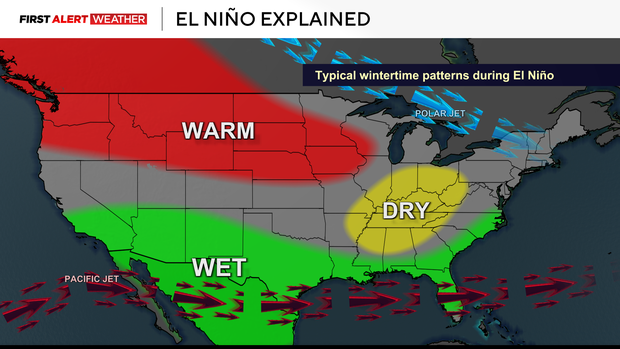
El Niño is likely to form this summer. Here’s what it could mean for western Pennsylvania.

You may have heard about the upcoming El Niño that is supposed to take shape this summer and potentially become very powerful by this fall into winter. Let’s dive into what this means, how it forms, and how it may potentially impact the weather pattern in western Pennsylvania for this summer and beyond.
What is ENSO?
El Niño is just a phase or part of ENSO, the El Niño-Southern Oscillation. It is an interannual mode of climate variability with three phases: neutral, warm (El Niño), or cool (La Niña). By far, ENSO has the greatest influence on weather patterns across the globe.
ENSO is a natural part of Earth’s climate system that exhibits variability over the span of a few years. To determine the current phase of ENSO and how that phase may or may not change, we look at sea surface temperature anomalies over the Equatorial Pacific Ocean and what is occurring underneath the surface by up to several hundred meters.
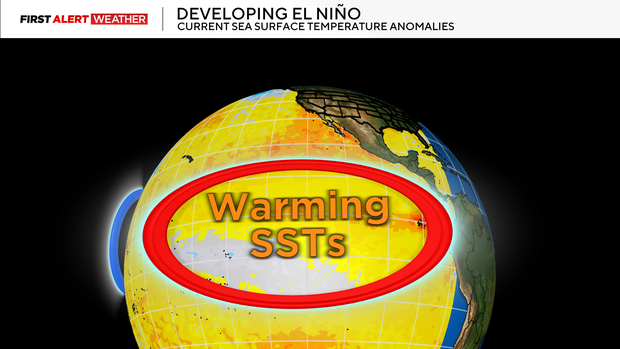
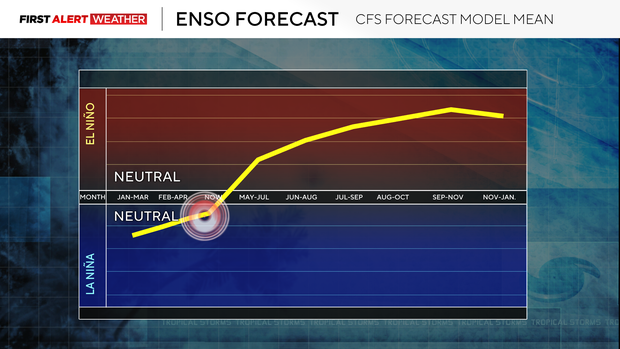
Right now, we are currently in the neutral phase of ENSO and are projected to head toward a strong warm phase or El Niño by mid-late summer that will last into the fall and upcoming winter.
What initiates and causes the shift?
Let’s start with the Walker Circulation, which is the physical mechanism that initiates and influences where warmer and cooler than normal seawater resides near the Equatorial Pacific Ocean.
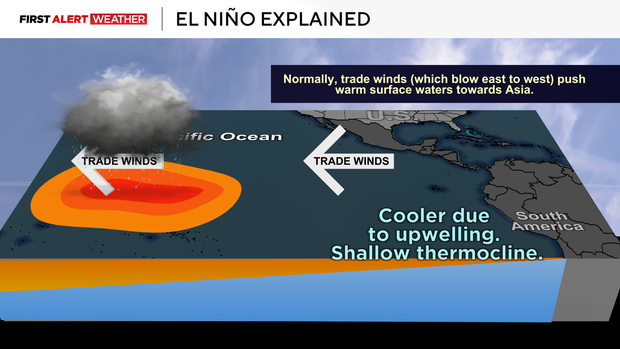
In the neutral phase of ENSO, the warmer sea surface temperatures are west of the International Date Line near Indonesia while cooler sea surface temperatures are positioned west of coastal South America. Above the warmer waters, we see enhanced rising motion leading to increased thunderstorms in the western Equatorial Pacific Ocean. While air rises and diverges in the upper atmosphere over the western Equatorial Pacific Ocean, it then converges and sinks over the eastern Equatorial Pacific Ocean. This sinking motion diverges at the ocean surface and helps enhance the trade winds which blow from east to west.
The east-to-west trade winds are responsible for upwelling and maintaining the cooler waters near the Equatorial East Pacific Ocean. When these trade winds are enhanced, we see a stronger upwelling of cooler water in the Equatorial East Pacific and a piling up of warmer waters and enhanced thunderstorms in the equatorial West Pacific. This is called La Niña.
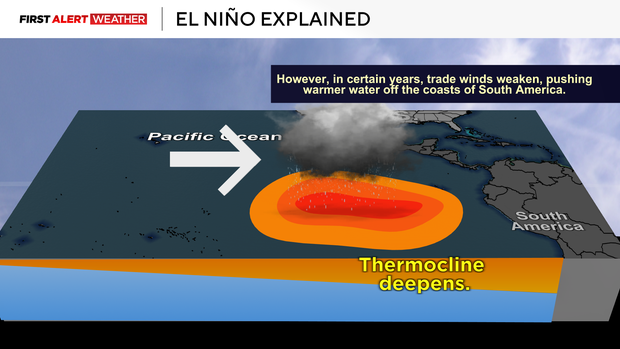
However, when those trade winds weaken, this slows the upwelling process and the warmer sea surface temperatures from the western Pacific Ocean migrate east through enhanced low-level westerly wind bursts. Once the waters in the relative Niño3.4 region— the area monitored in the Equatorial Pacific Ocean to assign the ENSO index — warm to a certain threshold above normal (greater than or equal to +0.5 degrees Celsius) for at least five consecutive overlapping three-month periods, then an El Niño can be declared.
What are the latest trends and projections with this El Niño?
According to NOAA’s Climate Prediction Center, El Niño is likely to emerge between June to August 2026 and persist through the end of the year. El Niño is pretty much expected by the end of year, and it’s likely that we’ll be dealing with a strong or very strong El Niño. The stronger the El Niño or La Niña, the more influence it has on the global weather patterns.
What El Niño means for western Pennsylvania
So how can this year’s setup influence summer patterns, and what does it mean for western Pennsylvania if El Niño persists into the winter?
When answering this question, it is extremely important to note a few things: no two El Niño or La Niña events are exactly alike. There are other factors that influence global weather patterns outside of ENSO, and planetary warming induced by human-caused climate change may cause modern-day El Niño, La Niña, and neutral episodes to behave differently compared to a past climate. We can still look at previous years with similar conditions to get a proxy and make an inference of how the upcoming year may trend.
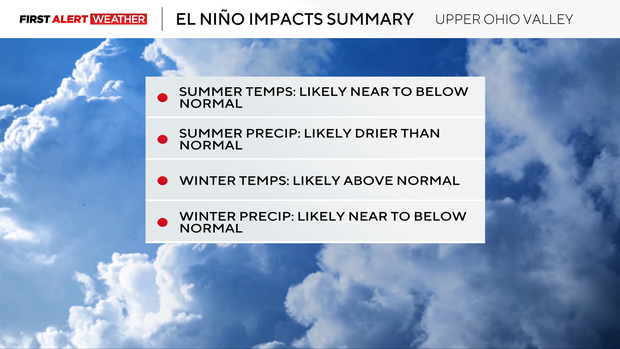
For this year, 2023 is the closest modern-day match under this climate regime to how this El Niño is likely to evolve this summer. For western Pennsylvania, that summer featured near to slightly below normal temperatures and near normal summer precipitation. The following winter featured well above normal temps and slightly above normal precipitation.
1976 is next on my analog years list. This featured a weak to moderate La Niña early in the year, but El Niño emerged more slowly (like 2026 projections) and became very strong by late year. Summer temperatures were below normal with below normal precipitation. That following winter was much drier than normal.
1982 is my third analog year. Unlike 2026, 2023 and 1982, there was no winter to early spring La Niña, but El Niño emerged more slowly (like 2026 projections) and became very strong by late year. During the summer, below normal temperatures were dominant with below normal precipitation. The following winter featured slightly above normal temperatures and below normal precipitation.
1991 and 1997 are also two years on my analog lists. The two commonalities among these years were below normal precipitation during the summer and a drier and warmer than normal following winter as El Niño peaked in intensity.
-

 New Hampshire39 seconds ago
This Cancer Rising Sharply Among NH Young People
-

 New Jersey7 minutes ago
2 workers airlifted after likely being electrocuted in Ocean City, NJ
-

 New Mexico13 minutes ago
Gila National Forest Hummingbird Fire Update – 4/27/2026
-

 North Carolina19 minutes ago
Projecting North Carolina’s Ceiling in 2026
-

 North Dakota24 minutes ago
ND state representative Liz Conmy dies in Minnesota plane crash
-

 Ohio31 minutes ago
Dr. Katelyn M. Williams, Negley, Ohio
-

 Oklahoma37 minutes ago
Oklahoma judge rules in favor of cannabis farm, lifts suspension
-

 Oregon43 minutes ago
Transfer Guard Jerry Easter II’s Fit in the Oregon Ducks Backcourt