Pennsylvania
El Niño is likely to form this summer. Here’s what it could mean for western Pennsylvania.


You may have heard about the upcoming El Niño that is supposed to take shape this summer and potentially become very powerful by this fall into winter. Let’s dive into what this means, how it forms, and how it may potentially impact the weather pattern in western Pennsylvania for this summer and beyond.
What is ENSO?
El Niño is just a phase or part of ENSO, the El Niño-Southern Oscillation. It is an interannual mode of climate variability with three phases: neutral, warm (El Niño), or cool (La Niña). By far, ENSO has the greatest influence on weather patterns across the globe.
ENSO is a natural part of Earth’s climate system that exhibits variability over the span of a few years. To determine the current phase of ENSO and how that phase may or may not change, we look at sea surface temperature anomalies over the Equatorial Pacific Ocean and what is occurring underneath the surface by up to several hundred meters.
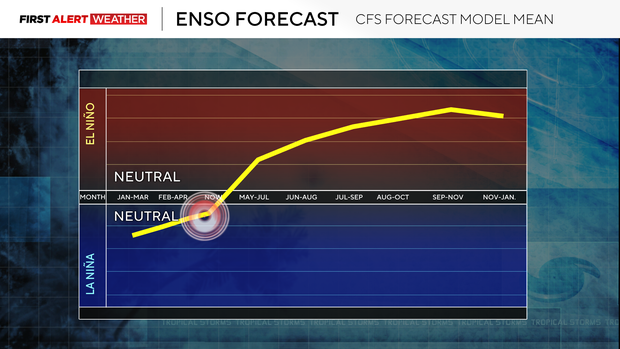
Right now, we are currently in the neutral phase of ENSO and are projected to head toward a strong warm phase or El Niño by mid-late summer that will last into the fall and upcoming winter.

What initiates and causes the shift?
Let’s start with the Walker Circulation, which is the physical mechanism that initiates and influences where warmer and cooler than normal seawater resides near the Equatorial Pacific Ocean.
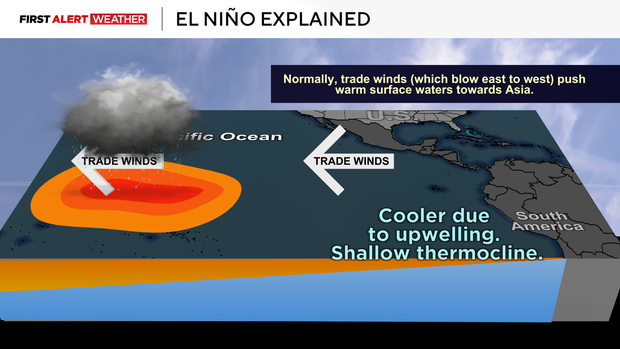
In the neutral phase of ENSO, the warmer sea surface temperatures are west of the International Date Line near Indonesia while cooler sea surface temperatures are positioned west of coastal South America. Above the warmer waters, we see enhanced rising motion leading to increased thunderstorms in the western Equatorial Pacific Ocean. While air rises and diverges in the upper atmosphere over the western Equatorial Pacific Ocean, it then converges and sinks over the eastern Equatorial Pacific Ocean. This sinking motion diverges at the ocean surface and helps enhance the trade winds which blow from east to west.
The east-to-west trade winds are responsible for upwelling and maintaining the cooler waters near the Equatorial East Pacific Ocean. When these trade winds are enhanced, we see a stronger upwelling of cooler water in the Equatorial East Pacific and a piling up of warmer waters and enhanced thunderstorms in the equatorial West Pacific. This is called La Niña.
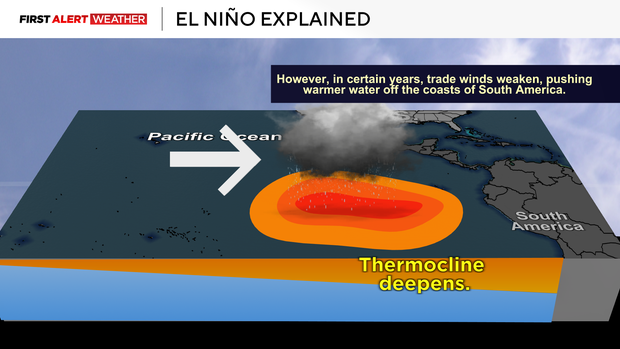
However, when those trade winds weaken, this slows the upwelling process and the warmer sea surface temperatures from the western Pacific Ocean migrate east through enhanced low-level westerly wind bursts. Once the waters in the relative Niño3.4 region— the area monitored in the Equatorial Pacific Ocean to assign the ENSO index — warm to a certain threshold above normal (greater than or equal to +0.5 degrees Celsius) for at least five consecutive overlapping three-month periods, then an El Niño can be declared.
What are the latest trends and projections with this El Niño?
According to NOAA’s Climate Prediction Center, El Niño is likely to emerge between June to August 2026 and persist through the end of the year. El Niño is pretty much expected by the end of year, and it’s likely that we’ll be dealing with a strong or very strong El Niño. The stronger the El Niño or La Niña, the more influence it has on the global weather patterns.
What El Niño means for western Pennsylvania
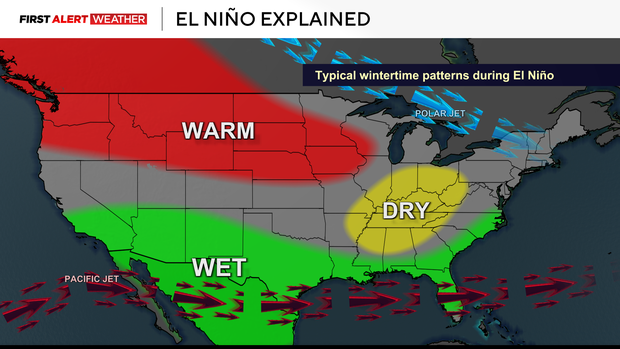
So how can this year’s setup influence summer patterns, and what does it mean for western Pennsylvania if El Niño persists into the winter?
When answering this question, it is extremely important to note a few things: no two El Niño or La Niña events are exactly alike. There are other factors that influence global weather patterns outside of ENSO, and planetary warming induced by human-caused climate change may cause modern-day El Niño, La Niña, and neutral episodes to behave differently compared to a past climate. We can still look at previous years with similar conditions to get a proxy and make an inference of how the upcoming year may trend.
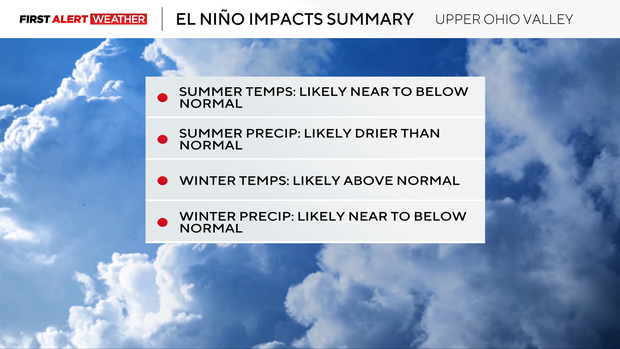
For this year, 2023 is the closest modern-day match under this climate regime to how this El Niño is likely to evolve this summer. For western Pennsylvania, that summer featured near to slightly below normal temperatures and near normal summer precipitation. The following winter featured well above normal temps and slightly above normal precipitation.
1976 is next on my analog years list. This featured a weak to moderate La Niña early in the year, but El Niño emerged more slowly (like 2026 projections) and became very strong by late year. Summer temperatures were below normal with below normal precipitation. That following winter was much drier than normal.
1982 is my third analog year. Unlike 2026, 2023 and 1982, there was no winter to early spring La Niña, but El Niño emerged more slowly (like 2026 projections) and became very strong by late year. During the summer, below normal temperatures were dominant with below normal precipitation. The following winter featured slightly above normal temperatures and below normal precipitation.
1991 and 1997 are also two years on my analog lists. The two commonalities among these years were below normal precipitation during the summer and a drier and warmer than normal following winter as El Niño peaked in intensity.



Michigan State basketball has extended an offer to a high-end four-star big man from Pennsylvania.
Jayden Jenkins of Warminster, Pa. announced on Sunday that he’s received an offer from the Spartans. He made the offer from Michigan State known by posting on his social media X account on Sunday.
Jenkins is listed as a four-star prospect, with a recruiting rating of 98.46 in 247Sports’ composite system. He ranks as the No. 7 center and No. 1 player from Pennsylvania in the 2027 class. He’s also ranked as the No. 39 overall prospect in the class.
Michigan State joins a list of nearly 20 schools that have offered Jenkins, according to 247Sports. Notable programs to offer him includes Georgia, Oklahoma State, Mississippi State, Penn State, Pittsburgh, West Virginia, Virginia Tech, East Carolina, Villanova, Seton Hall and St. Bonaventure.
It’s notable anytime Michigan State basketball hands out an offer to a prospect since they typically only do so to players that are key priorities for them. So this announcement of an offer shows that Michigan State is clearly focused on Jenkins in the 2027 class.
Contact/Follow us @The SpartansWire on X (formerly Twitter) and like our page on Facebook to follow ongoing coverage of Michigan State news, notes and opinion. You can also follow Robert Bondy on X @RobertBondy5.

Small-town Pennsylvania makes the right summer trip when the itinerary calls for peace and quiet. In the ten sweet spots highlighted below, you’ll find attractions secretly worthy of a larger crowd, but happily flying under the radar. Lititz invites visitors to tour America’s first commercial pretzel bakery and commune with wolves. New Hope pairs riverside charm with live performances at the historic Bucks County Playhouse. In Jim Thorpe, scenic train rides through the Lehigh Gorge compete for attention with concerts overlooking the Pocono Mountains. It’s all here in Pennsylvania if you know where to look.
Jim Thorpe
Named for a famed Olympic athlete despite the fact that he never lived there, Jim Thorpe stands as a jewel of the Poconos and a quiet destination for a summer adventure. The natural beauty of the area is on full display during a ride on the Lehigh Gorge Scenic Railway. This train will take you through nearby forests and give you a real appreciation of the expansive views of the Poconos from the comfort of a train car. In town, there’s plenty to do in the summer, especially if you enjoy the arts. The Mauch Chunk Opera House pays homage to the town’s original name and frequently hosts live music from local performers. And when the weather is nice, there’s few better venues for a concert than Penn’s Peak. In this beautiful outdoor setting, you’ll have a chance to enjoy the quality of entertainment you’d expect in a city like Philadelphia without the crowds.
Lititz

In the heart of Amish country, Lititz feels like a time capsule. The town has a rustic feel, with buildings that have stood for more than 100 years. The first stop during any trip should be the Julius Sturgis Pretzel Bakery. This local landmark has been making pretzels by hand since 1861, and you can schedule a tour during off-peak hours to avoid the crowds and even make your own. For a unique experience, check out the Wolf Sanctuary of PA, where you can take a tour and see the resident wolves up close. Come during a full moon for their special events. Summer festivities heat up at Lititz Springs Park during the Fourth of July for its annual celebration of the nation’s birthday with vendors and attractions.
Zelienople
Zelienople (or Zelie, as many locals call it) is about 30 miles north of Pittsburgh and offers a quiet alternative to the big city for a summer trip. The Strand Theater has been a popular destination in the town since it opened in 1914. In its new restored state, it frequently shows classic movies, hosts concerts, or puts on live shows. The Passavant House was the first house built in Zelienople. It now hosts a museum with period furniture and unique pieces, such as wreaths made from human hair. And if you’re hungry, Zelienople has plenty to offer. ShuBrew is a popular brewpub right by the Strand Theater that features craft beers and artisanal pizzas that will be a hit with your entire party.
Renovo
If your ideal summer getaway involves peaceful exploration of trails in forests near the Susquehanna River, Renovo should be your top destination. Staying in Renovo puts you right next to Hyner View State Park, featuring a hilltop that gives you a wide view of the river valley. And if you’re the adventurous sort, you can even hang glide off the hill. Closer to town is Bucktail State Park Natural Area. There, you’ll have a chance to see local wildlife, fish, and snap pictures of the river without seeing a soul. Back in town, you can enjoy a casual meal at Socky’s, a laid-back diner with delicious pizzas and breakfasts, or bring the kids to the 16th Street Park to play on the playground or shoot hoops at the basketball court.
Wellsboro
Wellsboro is the ideal vacation spot for art lovers, as this tiny town near the Grand Canyon of Pennsylvania offers several unique opportunities to appreciate the arts. The Arcadia Theater on Main Street has been entertaining residents and visitors since 1920. Inside, you’ll find four screens, and frequent live shows and musical productions. For a different vibe, check out the Deane Center for the Performing Arts further down Main Street, with community productions of everything from plays to musicals. And come in June to experience the unforgettable Pennsylvania State Laurel Festival. During the festival, you’ll have a chance to see local art, concerts, and much more for an entire week.
Ohiopyle
With a population well below 100, Ohiopyle is one of the smallest towns in Pennsylvania. When you want a crowd-free summer, it’s hard to get quieter than that. It serves as the gateway to Ohiopyle State Park, which surrounds the town and boasts over 20,000 acres of beautiful forest in the Laurel Highlands, with trails, rivers for fishing, and kayaking. For the best whitewater rafting experience, book a guided trip at Ohiopyle Trading Post. In town, accommodations include vacation rentals and well-appointed cabins at Ohiopyle Suites. If you don’t mind a slightly bigger crowd, the annual Beer and Gear Festival in the summer gives you a chance to enjoy live music and craft beers while you gear up with equipment for a trip to the state park in a fun, community-led event.
New Hope
New Hope is a youthful, artistic community on the banks of the Delaware River. The highlight of this town’s creative spirit is the Bucks County Playhouse, a former gristmill that now hosts live music, plays, and more. No matter when you make your trip to New Hope in the summer, you’ll likely find a show worth attending, right in the heart of town. Down South Main Street, you’ll find Gallery Piquel. It hosts a variety of artwork from local artists, and the owners are always happy to answer any questions you have about the pieces on display. For a scenic feel, book a ticket on the New Hope Railroad to enjoy riding in luxury along its scenic track. The railroad also offers many themed excursions for adventurous travelers.
State College
Home to Penn State University, State College is a bustling city during the academic year when students are in attendance. However, it becomes much quieter in the summer, making this the perfect time to visit one of America’s most beautiful campuses. The Arboretum at Penn State hosts a diverse selection of trees and flowers from around the world, and everything is in full bloom in the summer. Right next door is the Palmer Museum of Art, with rotating exhibits that feature artwork from the Americas, Europe, Asia, and Africa. After a day spent exploring, you can treat yourself to some of the best ice cream in the world at the Penn State Berkey Creamery.
Somerset
Somerset is a quiet Pennsylvania town that has seen its fair share of history. In 1794, it was the site of the Whiskey Rebellion and the home of several leaders. More than 200 years later, the town would again be in the news when United Airlines Flight 93 crashed in a nearby field during the attacks on September 11th. This is where you’ll find the Flight 93 National Memorial honoring the lives and bravery of the victims. You can also learn more about the impressive operation to save trapped miners at the Quecreek Mine Rescue Site in town. Despite these important events, Somerset stands as a quiet town that’s perfect for a summer getaway, particularly if you’re a nature lover, as Laurel Hill State Park sits right by the town, with over 4,000 acres for camping, swimming, and hiking.
Clarion
Clarion is a quiet town in Western Pennsylvania that sees most of its visitors during the fall for an annual festival. In summer, the town is relatively quiet, but there’s still plenty to do that makes it worth the trip. The town is home to several delicious places to get a bite to eat or enjoy the local brew. Toby Hill Bar & Grill is a local spot with classic bar food and frequent live shows on weekends. And to get a true taste of Clarion, take a trip to Mechanistic Brewing Co. with beer and mixed drinks you won’t find anywhere else in Pennsylvania. For nature lovers, Clarion is a can’t-miss summer destination. It sits right by Cook Forest State Park, one of the best in the state, with 29 miles of trails, ample fishing and camping opportunities, and a beautiful pine and hemlock forest.
Unforgettable Summer Trips in Pennsylvania Without the Crowds
From rafting the Youghiogheny River in Ohiopyle and taking in the views from Hyner View State Park near Renovo to exploring theaters in Wellsboro and galleries in New Hope, Pennsylvania’s small towns offer a wide variety of summer experiences. History buffs can reflect at Somerset’s Flight 93 National Memorial, food lovers can sample handcrafted pretzels in Lititz and local brews in Clarion, while outdoor enthusiasts will find endless opportunities in the state’s forests, rivers, and parks. Whether you’re drawn to arts and culture, scenic landscapes, or fascinating local history, these destinations showcase a quieter side of Pennsylvania that is every bit as memorable as its better-known attractions.
Pennsylvania
America250 history trail: Visit Pennsylvania’s overlooked sites that helped win the American Revolution

As the nation marks its 250th anniversary, Pennsylvania’s role in the American story extends far beyond the iconic landmarks of Independence Hall and Valley Forge.
From Reading, where George Washington’s mobile headquarters tent — known today as the “First Oval Office” — was crafted, to a little-known Montgomery County encampment where exhausted Continental soldiers regrouped before becoming the formidable Grand American Army, local history reveals the people and places that quietly altered the course of the Revolution. Berks County riflemen armed with the Pennsylvania long rifle earned Washington’s praise, while southeastern Pennsylvania iron furnaces overcame early failures to forge the cannons needed to defend the fledgling nation.
Here is how you can step back in time to explore the remarkable stories of ingenuity, sacrifice and perseverance that helped secure American independence and continue to shape the nation’s identity 250 years later.
The First Oval Office: Reading
In early 1778, as Gen. George Washington endured the brutal Valley Forge winter, a new field headquarters tent — his mobile command center for the remainder of the Revolutionary War — was crafted in Reading.
Long overshadowed by the larger drama of the encampment, the tent’s origins in Reading reveal a local contribution to the nation’s founding that has only recently received the recognition it deserves, historians say.
“Washington’s tent was his command center during the Revolutionary War, and tells the story of his inspiring leadership, unyielding determination, and steadfast devotion to his troops,” Michael Quinn, then-president and CEO of the Museum of the American Revolution, said during the 2017 opening of the museum in Philadelphia. “It is a powerful symbol of American freedom, and one that we are thrilled to be able to preserve for future generations.”
The 23-by-14-foot tent, made of linen canvas, served as Washington’s office, sleeping quarters, and strategic hub from 1778 to 1783. It traveled with him through the war’s most consequential moments. The structure was a sophisticated, multichambered canvas marquee divided into an office, Washington’s sleeping area, and a space for his enslaved valet, William Lee. Inside these linen walls, Washington drafted dispatches, met with aides such as Alexander Hamilton, and shaped the military decisions that would ultimately secure American independence.
Today, Washington’s tent is the signature artifact of the Museum of the American Revolution. Installed after a years-long conservation effort, the tent is displayed in a dedicated 100-seat theater as part of a 10-minute presentation. More than 1 million visitors have viewed it since its installation.
(COURTESY OF MUSEUM OF THE AMERICAN REVOLUTION)
The battlefield tent Gen. George Washington featurd three rooms and was made in Reading and delivered to the Continental Army campment at Valley Forge in 1778, according to the Museum of hte American Revolution where the restored tent has served as the featured exhibit since it opened in 2017. (COURTESY OF MUSEUM OF THE AMERICAN REVOLUTION)
Plan your visit: The First Oval Office
Location: Museum of the American Revolution, 101 South Third Street, Philadelphia
The vibe: An intimate look at the mobile command center where George Washington strategized the war and secured American independence.
Must-see: The 23-by-14-foot tent, originally crafted in Reading, displayed in a dedicated 100-seat theater.
Tip: The tent presentation is a popular 10-minute immersive theater experience. Be sure to check the museum’s daily schedule upon arrival to secure your spot.

The Grand American Army Encampment: Towamencin Twp.
Montgomery County’s place in the nation’s founding is well documented in Revolutionary War history, from the winter at Valley Forge to nearby battles at Whitemarsh, Paoli, and Brandywine.
What is lesser known is an encampment by Washington and his troops in the hills and woods of Towamencin Twp. that transformed his army into the Grand American Army of 11,000 soldiers.
“They walked in as the Continental Army, and they walked out as the Grand American Army,” said historian Victor Verbeke, describing the Colonial soldiers’ encampment located between what are now the boroughs of Lansdale and Souderton.
Several Revolutionary War veterans are buried in Tennis-Lukens Cemetery in the township, and the township’s Morgan Log House dates back to the early 1700s. But there is not yet a marker that notes the site of the army’s encampment that “refreshed” their abilities, according to historians.
Last summer, two local historians made a request to the state’s Historic Preservation Office for a marker to indicate the location that proved so key to the young nation in the fall of 1777.
“General Washington and 11,000 Continental soldiers spent eight whole days here, from October 8 to October 16 of 1777,” Verbeke said. “There were no battles fought here, but there were some significant events that this township can be proud of. The residents, back in the day, on both sides of the Skippack Creek, welcomed these soldiers, most importantly fed these soldiers, and provided them with what General Washington specifically told John Hancock: ‘Rest and refresh my men.’”

shillings and six pence for the inconvenience of his house used as military headquarters. (Image courtesy of Brian Hagey, original document via U.S. Library of Congress)
Plan your visit: The Grand American Army Encampment
Location: Detwiler Road near Delp Drive in Towamencin Township (Montgomery County)
The vibe: A quiet, historically rich exploration of the grounds where 11,000 Continental soldiers rested and reformed after brutal campaigns.
Must-see: The historic Morgan Log House dating back to the early 1700s, and the Tennis-Lukens Cemetery, the final resting place of several Revolutionary War veterans.
Tip: Keep an eye out for future historical markers. Local historians are actively petitioning the state to officially recognize the exact locations of the encampment.

The Pennsylvania Long Rifle: Berks and Lancaster Counties
What most distinguished Revolutionary War soldiers from Berks County and Pennsylvania was their weapon of choice: the Pennsylvania long rifle.
That weapon played a decisive role in the regions included in Congress’ call to form an army, said Gregory Kreitz, a former Reading Eagle reporter and local history buff. Thompson’s Rifle Battalion drew recruits from counties including Bedford, Cumberland, York, Northumberland, Northampton, Lancaster, and Berks.
After the battles at Lexington and Concord in 1775, Kreitz noted it’s likely America’s founders were wishing for some kind of silver bullet. That silver bullet was a lead ball shot from a Pennsylvania long rifle with deadly accuracy up to 300 yards.
The rifle was first made in the early to mid-1700s by German immigrant gunsmiths in Lancaster and along the Wyomissing Creek in Berks County. Its greater range came from patched balls and spiral grooves inside a lengthy barrel, which spun the balls as they shot.
The congressional war resolution on June 14, 1775, was the first time an army was officially drafted — and it was solely riflemen. The resolution called for riflemen from Pennsylvania, Maryland, and Virginia, all areas along the Great Wagon Road — running from Philadelphia to the Shenandoah Valley — where long rifle gunsmiths had settled and sold their wares.
After major victories at Trenton, Assunpink Creek, and Princeton, Washington moved all his riflemen into one corps, commanded by Col. Daniel Morgan.

Plan your visit: The Pennsylvania Long Rifle
Location: Landis Valley Village & Farm Museum, 2451 Kissel Hill Road, Lancaster, and Berks History Center, 940 Centre Ave, Reading
The vibe: An authentic look into the meticulous craftsmanship of the 18th-century German immigrant gunsmiths who forged the frontier’s most decisive weapon.
Must-see: The collections of beautifully preserved, original Pennsylvania long rifles. Look closely for the intricate woodwork and imagine the spiral grooves inside the lengthy barrels that gave the weapon its deadly 300-yard accuracy.
Tip: Landis Valley is a living history museum that frequently hosts historical demonstrations. Check their seasonal schedule before you go to see if you can catch a glimpse of early blacksmithing and gunsmithing techniques in action.

The Revolutionary Iron Furnaces: Berks, Lebanon, and Chester Counties
After the battles at Lexington and Concord kicked off the war, Pennsylvania leaders decided they needed to protect Philadelphia’s port. To defend the waterways leading into the city, they devised a plan to create a navy and line the shores with cannons.
A cannon committee organized by Benjamin Franklin was tasked with answering a crucial question: Were the people and facilities needed to make cannons available locally? The answer was yes, historian Dan Graham said. Southeastern Pennsylvania had several working iron furnaces, including Hopewell in Berks County, Cornwall in Lebanon County, and Warwick and Reading in Chester County.
The forge operators got to work in the spring of 1776, but there was a catch: They had never made cannons before. Their early efforts were a mess, Graham noted.
Eventually, an expert was brought in to help the locals figure out the pervasive kinks. For about 18 months, local furnaces successfully produced working weapons — 12-pound cannons at Hopewell and Cornwall, and 18-pound cannons at Warwick and Reading.
Once France entered the war effort in late 1777 and began providing weapons, local cannon production fell by the wayside. However, remnants of this early weapon manufacturing era remain. Graham said half of a cannon is still on display at Hopewell, while a fully preserved cannon can be found at Cornwall.
Plan your visit: The Revolutionary Iron Furnaces
Location: Hopewell Furnace, 2 Mark Bird Lane in Elverson (Berks County), and Cornwall Iron Furnace, 94 Rexmont Rd, Cornwall (Lebanon County)
The vibe: Early American industrial ingenuity on display, highlighting the local forges that scrambled to build the cannons needed to defend Philadelphia’s port.
Must-see: A fully preserved cannon from the era at Cornwall, and the historic half-cannon remaining at Hopewell.
Tip: Because the sites are spread across two counties, plan a scenic drive to see how the local landscape supported these vital early ironworks.
-
Politics2 minutes ago
Gun owners may carry a weapon into stores, Supreme Court rules, rejecting a California law
-
 Sports17 minutes ago
Commentary: World Cup shows MLS still needs to achieve major goals to grow the game
-

 World25 minutes ago
‘A concession to Zelenskyy’s ultimatum’: Ukraine’s triumph over Belarus
-
 News47 minutes ago
Native Americans celebrate victory at the Battle of Little Bighorn, 150 years later
-

 New York2 hours ago
How a Global Researcher Lives on $110,000 in Long Island City
-

 Los Angeles, Ca2 hours ago
Mass shooting at L.A. street takeover leaves 1 dead, 6 injured
-

 Detroit, MI2 hours ago
On the front lines of chronic absenteeism: What Detroit’s Health Hubs do to get kids to school
-

 San Francisco, CA3 hours ago
S.F. police arrest 20 at 300-person SoMa block party during Pride


