Northeast
Private college students in ‘To Catch a Predator’ TikTok trend targeting Army soldier plead not guilty

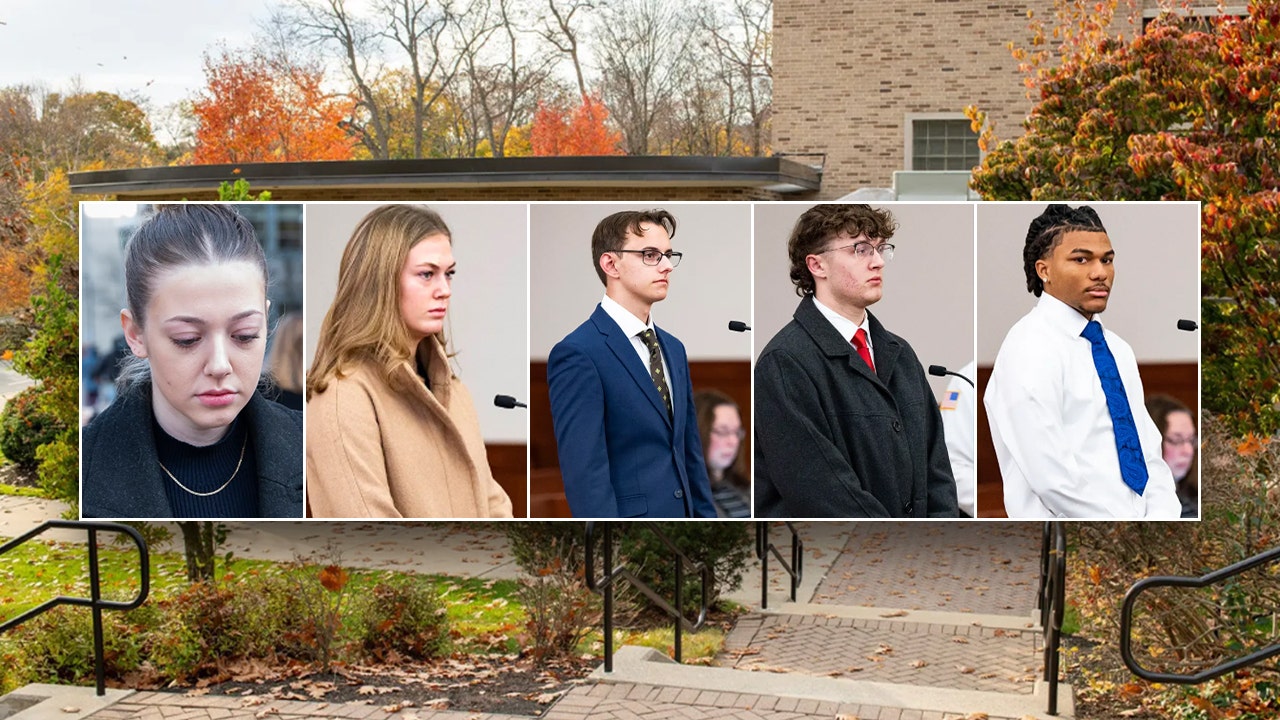
Five students at a Massachusetts Christian college made their first court appearances on Thursday, accused of luring an Army soldier onto their campus using a dating app and attacking him in a “To Catch a Predator” TikTok trend.
The Assumption University students were arraigned on conspiracy and kidnapping charges in Worcester District Court on Thursday. Automatic not-guilty pleas were entered for Easton Randall, 19; Kevin Carroll, 18; Isabella Trudeau, 18; Joaquin Smith, 18; and 18-year-old Kelsy Brainard, whose Tinder account was used to lure the 22-year-old Army soldier.
They are scheduled to appear again on March 28, according to online court records. A sixth student, a juvenile, has also been charged.
A relative of the victim told Fox News Digital that the 22-year-old deployed to the Middle East soon after the harrowing incident.
COLLEGE STUDENTS CHARGED WITH AMBUSHING US SOLDIER IN ‘TO CATCH A PREDATOR’ TIKTOK SCHEME: POLICE
Kelsy Brainard departs the courthouse after being arraigned in Worcester District Court in Massachusetts on Thursday, January 16, 2025. Brainard is one of six Assumption University students arrested in connection with ambushing a U.S. soldier as part of a “Catch a Predator” online trend. (David McGlynn for Fox News Digital)
The unassuming man was in Worcester attending his grandmother’s funeral on Oct. 1 before he agreed to meet with Brainard on Tinder that evening, he told police. The soldier later told Assumption University police that they “were going to try to hook up,” and that he “just wanted to be around people that were happy” after the burial service.
Based on the messages he exchanged with Brainard on the app and shared with police and Brainard’s profile, which indicated that she was 18, there was “absolutely no evidence presented to indicate that [the victim] was seeking sexual relationships with underage girls” and was “using Tinder as it was originally designed … to initiate a hookup,” police wrote in charging documents obtained by Fox News Digital.
A “mass” of 25 to 30 people emerged just minutes after the victim met Brainard, calling him a “pedophile” who “liked having sex with 17-year-old girls.” Before he was surrounded, the victim was sitting beside Brainard watching a game in a student lounge, and surveillance footage showed that they had “ample personal space between them,” and Brainard was “laughing and smiling.”
ILLEGAL IMMIGRANT HONDURAN GANG MEMBER KIDNAPPED US WOMAN, ‘GIGGLED’ AFTER THREATENING TO SELL ORGANS: REPORT
Isabella Trudeau is arraigned in Worcester District Court in Massachusetts on Thursday, January 16, 2025. Trudeau is one of six Assumption University students arrested in connection with ambushing a U.S. soldier as part of a “Catch a Predator” online trend. (David McGlynn for Fox News Digital)
Surveillance footage showed the group encircling the victim and preventing him from leaving around 10:30 p.m., police wrote. The victim was able to break free, but he was chased by the “crowd that can clearly be seen using their phones to record the pursuit.”
Police said the soldier was punched in the back of the head by a juvenile student who was not named in court documents, due to his age. Then Carroll slammed the victim’s head in his car door, according to court documents, and students kicked the victim’s vehicle as he rushed out of the parking lot.
Carroll is facing an additional charge of assault and battery with a dangerous weapon, according to court documents.
WASHINGTON INMATE ACCUSED OF MOLESTING CELLMATE AFTER CHANGING GENDER, TRANSFER TO WOMEN’S PRISON
Joaquin Smith departs the courthouse after being arraigned in Worcester District Court in Massachusetts on Thursday, January 16, 2025. Smith is one of six Assumption University students arrested in connection with ambushing a U.S. soldier as part of a “Catch a Predator” online trend. (David McGlynn for Fox News Digital)
A few minutes later, the group can be seen on surveillance footage re-entering the building while laughing and “high-fiving” each other, police wrote.
Campus police became aware of the incident after Brainard reported “that a creepy guy came to campus looking to meet an underage girl.” She said that she had texted Randall, who “came down [into the lounge] to help [her] with a sexual predator.”
La Maison Francaise on the campus of Assumption University, where a 22-year-old soldier was allegedly lured via Tinder and attacked by students on Oct. 1. (Rick Cinclair/Telegram & Gazette / USA Today Network via Imagn Images)
Although she said she met the “creepy” man on Tinder, she claimed that he “came [to campus] uninvited.”
Campus police were unable to find the alleged predator on campus, but they began reviewing security footage and interviewing students after they were contacted by Worcester Police about a man reporting an assault that took place at Assumption University.
BLUE STATE VIOLENT CRIME VICTIMS ORDERED TO ADDRESS ‘TRANS’ CAREER CRIMINAL BY PREFERRED PRONOUNS
Kevin Carroll is arraigned in Worcester District Court in Massachusetts on Thursday, January 16, 2025. Carroll is one of six Assumption University students arrested in connection with ambushing a U.S. soldier as part of a “Catch a Predator” online trend. He faces an additional charge for allegedly slamming the victim’s head in his car door. (David McGlynn for Fox News Digital)
Further investigation revealed that “a small subset of the larger group” – the students now facing criminal charges – allegedly “conspired with each other to lure the victim to the property and solicited assistance ‘to catch a predator’ via group texts.”
“The goal of the Tinder invite was to simulate the TikTok fad of luring a sexual predator to a location and subsequently physically assaulting him or calling police,” according to court documents.
The accused students were all sitting together when Brainard was sending Tinder messages back and forth with the victim “when the idea of Catch a Predator came to mind,” Randall later told police.
Easton Randall is arraigned in Worcester District Court in Massachusetts on Thursday, January 16, 2025. Randall is one of six Assumption University students arrested in connection with ambushing a U.S. soldier as part of a “Catch a Predator” online trend. (David McGlynn for Fox News Digital)
“They all made suggestions and agreed what was texted to [the victim] and … the others joined the conspiracy knowing of the unlawful plan.”
Randall told campus police that “Catch a Predator was a big thing on TikTok currently, but that this got out of hand and went bad,” police wrote.
Joaquin Smith is arraigned in Worcester District Court in Massachusetts on Thursday, January 16, 2025. Smith is one of six Assumption University students arrested in connection with ambushing a U.S. soldier as part of a “Catch a Predator” online trend. (David McGlynn for Fox News Digital)
When the victim came to campus, one of the men simply texted the group chat that they “[had] to come down here” because they were “catching a predator,” which provoked a “rabid” response from the students, according to court records.
Assumption University in Worcester, Massachusetts. (Christine Peterson/Worcester Telegram & Gazette via USA Today Network)
Brainard diminished her responsibility, records show, telling campus police that she “didn’t know what was going to happen” when confronted about the falsification. But police wrote that she was seen laughing and smiling on surveillance footage as the male students descended upon her Tinder match.
Attorneys representing the six students did not return Fox News Digital’s requests for comment.
Read the full article from Here


A broken elevator has left some residents of a Boston apartment building unable to leave, but a new stairlift has brought temporary relief.
When 80-year-old Silke Evans, who lives at the Villa Michelangelo Apartments in the North End, spoke with NBC10 Boston last Wednesday, she had been stuck inside for weeks.
“I feel imprisoned. That’s it,” she said at the time. “I feel like I’m in prison.”
Silke Evans, an 80-year-old woman living at the Villa Michelangelo Apartments in the North End, has been unable to use the elevator at her building for three weeks.
“She was stuck up on the third floor for a total of three-and-a-half weeks,” her daughter, Katharine Clark, said Thursday.
Thursday, Metro Management, which runs the building, installed the stairlift as a temporary solution while waiting for elevator repairs.
It allowed Evans to leave for the first time in nearly a month.
“They had food, and got to eat out, and just feel like a normal person,” Clark said. “She’s been looking kind of sad for weeks, so it’s the first time I saw some pictures where she was genuinely smiling.”
The fix brought major joy to Evans, with hopes of a long-term solution in the future.
“We’re not out of the woods. We still have a broken elevator. Hopefully, it’s not too many months with just a chairlift,” Clark said.
Jeff Buono, director of property management, told NBC10 Boston last week that the process to repair the elevator has been difficult.
“They’re estimating four to five weeks to get the parts and then four to five weeks for the install,” Buono said in a phone interview. “It’s tough to get parts in general. It takes longer to get them than it ever has before. So the systems now just need to be modernized. I mean, it does take a toll on our elderly population — it really does. And we do feel for them. They’re likely family to us.”
NBC10 Boston reached out to the management company for further comment Thursday, but staff had already left for the holiday weekend.
Pittsburg, PA
Pittsburgh is promising its biggest fireworks show ever. Here’s what the setup looks like.

We are just two days away from the Fourth of July, and that means fireworks. The final preparations are underway for the City of Pittsburgh’s show, which is promised to be the largest in history. In all, five barges full of fireworks will be set off for this show.
Under the blistering sun, the true heat is packed on the barges along the Ohio River. Thousands upon thousands of fireworks will go off during the 25-minute show Saturday night, done by Starfire Corporation.
“Being down here, for our family to be able to perform for Pittsburgh is such an honor,” Starfire Corporation vice president Vince Terrizzi Jr. said.
Planning started back in February for this event. The barges will go on the Mon, Allegheny and right near The Point, creating a triangle effect around the Golden Triangle.
“We have one rooftop location that will surprise people and come in and out during the show,” Terrizzi said.
In all, nine truckloads of fireworks were brought in to be part of the show. Inspectors with the Pittsburgh Bureau of Fire inspected and will do a final inspection before the show. For the inspector, it’s her last show as she plans to retire in a few months.
“Going out with literally the biggest bang the city has ever seen,” Lisa Epps-Cuda said with a laugh.
Starfire has done the about a half dozen of the city’s shows over the years, and it never gets old for them.
“Listening to the crowd’s response, boats cheering, those kind of things make it worth its while,” Terrizzi said.
As for the weather, the big concern will be lightning; the fireworks can still be fired off in the rain. The show is set to go off at 9:35 on Saturday night.

In order to get to the truth, it’s important to define your terms.
For example, what precisely do you mean by the word Connecticut? Or is it Quinnehtukqut, in the Algonquin language?
It’s also important how you frame your story.
That is, what do we miss if we only start Connecticut’s story in 1776? What about the long, century-and-a-half colonial/religious run-up beginning in 1638? What about the 10,000 years before that, of indigenous habitation along our state’s long and short rivers? And what of all Long Island Sound?
Depending on where you start, you might have a geography story, a political story, a theological struggle.
You also need to include not only 50 or 60 founding fathers, but a full range of voices — you must try to expand the historical house, and also tell a whole story, not a partial.
For example, even in a copiously told tale of the Elm City Signer-in-Chief Roger Sherman, if you stopped his story at the mere signing of the Declaration of Independence, he’d still be a guy in a homespun suit among many in the founders’ chorus.
Although John Hancock appointed Sherman to the committee — along with Jefferson, Franklin, and Adams, to write the document we are all celebrating this year — it’s clear he wasn’t much of a writer, or editor, or speller. John Adams, when he recollected those days, couldn’t even remember Sherman in the room of the writing of the document that changed the world. Apparently only Franklin and Adams dared to edit the brilliant Jefferson’s prose.
However, continue the story to 1787, and Roger Sherman’s political and personal skills help lead the way to the bicameral compromise — a Congress with one legislative house based on population side by side with another house of equal number of senators from each state.
Without this deal — known as the Connecticut Compromise — there would have been two-and-a-half strikes against the possibility of ever passing a Constitution; and as a consequence, perhaps no United States. That makes Sherman a profound hero of the democratic story, and, of course, earns our sobriquet as the Constitution State.
All this fascinating, perspective-altering stuff was at the heart of a by-turns erudite and entertaining lecture — call it a sermon on history– entitled “Why Connecticut 250 Matters,” delivered by Connecticut State Historian Andy Horowitz.
Receiving it Wednesday night was a standing-room-only crowd of some 200 New Haven history glitterati gathered at the New Haven Museum.
Horowitz’s lecture was the companion piece to a gala evening marking the opening of the New Haven Museum’s new exhibition, “New Haven’s Unfinished Revolutions.”
With opening remarks by City Historian Michael Morand and exhibition director Joanna Steinberg and designers David Jon Walker and John Kudos, attendees also took in the spiffy photo and large, wall-text-festooned new space — the gallery to the left as you enter the museum’s first floor.
The exhibition is designed to include all those voices that Horowitz talked about — the centerpiece being a kind of grand kiosk or large table where you can put “tablets” of, so far, largely 18th century documents into a “cradle,” and then the docs come alive.
You hear, for example, a selection of the deposition by Sarah Townsend of the British invasion of New Haven in 1779. It’s a rare document in the NHM’s collection, but how many have had a chance to read it?
Enter the new exhibition, and the text appears on a screen in front of you — in both the original handwriting and an easy-to-read print version, as her voice speaks in the voice of local actors from New Haven who have done the recordings.
It’s immersive and the whole packed space — 900 square feet, which is not much bigger than a comfortable one-bedroom Elm City apartment — is trying to tell a Big Story, much of it under-told or never-told. It’s also designed for classes and groups and to be a kind of teaching house, said Steinberg.
The “table” is its centerpiece, a kind of hearth — designer John Kudos agreed to this reporter’s characterization — is where an individual, a family, or a group of school kids gather round to warm to the sounds and evocations of long ago and also to not-so-long-ago overlooked voices.
And the design is such that new documents can be added, indeed, are being added from the museum’s collection, along with contemporary documents/voices as they emerge in the living history of the city.
“The soul of New Haven is on display,” said Walker, one of the designers, via video hook up.
By that he meant, in part, under-told stories such as that of the Winchester Repeating Arms Company and those many African American immigrants from a racist South who labored on its factory floors and built new lives and institutions in the Elm City; the Model City era of the late 1960s; May Day of 1970, with the mutual aid groups such as the Hill Parents Association and the local Black Panthers who organized in the run-up; and New Haven’s important labor history as captured in the watershed 1975 teachers strike. The exhibition ends with material from the environmental movement of the 1980s.
In addition to Roger Sherman, the two other “souls” from New Haven’s 1776-era history whom Horowitz summoned and evoked to structure his tale were Hannah Mamanash, an indigenous woman of the Wangunk tribe (related to the Quinnipiacs and Mohegans); and Cuff Wells (also known as Cuffee Saunders), kidnapped as a child from Guiana, in South America, and enslaved in Colchester, Connecticut.
Known mostly through land deeds and an extensive petition for Revolutionary War pensions, Mamanash saw four of her sons enlist in George Washington’s forces. Three, perhaps all four, were killed in the Revolutionary War fighting.
“It’s hard to believe,” said Horowitz, “that anyone made a larger sacrifice to the American Revolution than Hannah Mamanash.”
But Horowitz deepend the story: Mamanash also had a daughter, who married a Samson Occam, a Mohegan who was Christianized, became a minister, and was the first Native American to publish a book. In another document, from 1775, a letter to the Oneida tribe, Mamanash’s son-in-law Occam tried to explain and advise which side that tribe should take in the fast-arriving rupture with Great Britain.
He basically took a neutral position, citing Jesus as a template for being peace-makers, not side-takers, although he did characterize the English as the oppressors and the patriots as the oppressed.
Yet Horowitz’s point is that there was no inherent, clear, obvious reason for Mamanash and her sons to make the choices they made, and the sacrifices they gave. Their history goes back much farther, sometimes siding with the English, sometimes the French, often with no one. You widen the story, and it gets deeper, more complex.
Wells’s enslaver was an apothecary and with that skill, which he learned, Wells enlisted in the Continental Army tending the sick and likely saving lives at the army hospital in Danbury, and later at Valley Forge.
And yet, Horowitz taught, it’s important to know that at the start of the Revolution neither Washington nor the creators of the Declaration wanted Blacks to enlist at all, whether they were apothecaries or not. Like the British they were afraid of what enslaved people might do if given firearms.
In fact, the phrase, among the list of colonists’ grievances in the Declaration itself, is the tell in this context: “Exciting domestic insurrections amongst us” primarily refers to British inducements to enslaved African Americans to flee their American masters and to fight for the king in exchange for offers of freedom.
And still Wells enlisted and deployed his skills, survived the war, received a pension, bought three acres of land in Lebanon, and sired a son, Prince, who went on to graduate from Dartmouth College.
If that isn’t a little-known American story that should be better known, I don’t know what is.
Horowitz was at pains to point out, also, that Wells is known, in the extensive 127-page pension file, the key source of his biography, also as Cuff Saunders.
“He changed his name,” Horowitz surmised, “because he did not want Wells, his enslaver’s name.”
“And such stories are not that unusual,” Horowitz added, “among Black soldiers, who gave themselves names like Caesar, Liberty, Beman. Every description is a form of argument.”
“So what to make of these stories?” Horowtiz drew towards his conclusion and, of course, the relation of the past to the present.
He said the kind of historical research, the poring over documents in archives, that yielded these stories is precisely the kind that is being threatened today, along with, of course, doing the opposite of expanding the historical frame, which is the policy direction of the current administration.
He didn’t mention the name of President Trump, but the narrowing of history, the bee in the bonnet of the current administration, was clearly the elephant in the room, to mix the zoological metaphors.
“When I began, there were three people in the office of state historian. Now I’m the only one. Seventy percent of professors teaching history are un-tenured. History departments are closing down. As a tenured historian I’m like a typewriter repairman, the last of my kind.”
And if there were a single theme to this wide-ranging yet also deep dive into Connecticut’s 1776, it was this: “A narrow sense of history yields a narrow sense of the future.”
Which is why Morand had concluded his remarks, in the new exhibition space of “New Haven’s Unfinished Revolutions,” singing from the same hymnal, with similar congratulatory, if minatory, praise:
“This is a major addition to understanding what New Haven has been and what it has become and to what they and we can do to affect the future. . . Our history is not about the past, it’s made active, it’s story upon story, not punctuated by a period, but an ellipsis. This show is really about America 251, 252, 253 . . . ”
 100vw, 1024px”/><figcaption class=) State Rep. Pat Dillon and local historian Aaron Goode discuss democracy and what to do with the U.S, Supreme Court!
State Rep. Pat Dillon and local historian Aaron Goode discuss democracy and what to do with the U.S, Supreme Court!
 100vw, 1024px”/><figcaption class=) Former teachers union President Frank Carrano, listening to what he said about the 1975 strike.
Former teachers union President Frank Carrano, listening to what he said about the 1975 strike.
Related
-

 Dallas, TX1 minute ago
Paige Bueckers, Azzi Fudd do the usual in Hartford, win. This time with Dallas Wings
-

 Miami, FL4 minutes ago
World Cup-inspired art exhibit transforms Miami’s Wynwood with interactive soccer experience
-

 Boston, MA9 minutes ago
Stairlift brings relief to residents stuck in building with broken elevator
-

 Denver, CO16 minutes ago
Free agent point guard Tyus Jones re-signs with the Denver Nuggets – Denver Stiffs
-

 Seattle, WA19 minutes ago
Husky Recruit To Move From Seattle to Florida For High School Ball
-

 San Diego, CA24 minutes ago
CDCR Seeking Incarcerated Person Who Walked Away from Male Community Reentry Program in San Diego – News Releases
-
 Milwaukee, WI31 minutes ago
Do federal agents have to follow Milwaukee’s face-covering and park ordinances?
-

 Atlanta, GA34 minutes ago
Decatur Square businesses thrive during 2026 FIFA Men’s World Cup and WatchFest: “…beyond our wildest imagination”

