Lifestyle
She’s rich, self-made and wants women to boldly talk about money (and make more)

The world can be a difficult place for women, people of color and poor people, says UK-born mogul Emma Grede — and she’s been all of those things, so she knows.
Today, Grede is best known as a serial entrepreneur whom “Forbes” named one of “America’s Richest Self-Made Women” in 2025. She’s the chief executive and co-founder (with Khloé Kardashian) of the size-inclusive denim brand Good American, the founding partner of loungewear-shapewear company Skims and host of the podcast “Aspire with Emma Grede” — among other business roles. But growing up in the rough East London neighborhood of Plaistow, Grede was broke, the daughter of a struggling single mother. She battled dyslexia and dropped out of high school and then the London College of Fashion before immersing herself in the working world of fashion.
In her new book, “Start With Yourself: A New Vision for Work & Life,” Grede chronicles her rags to riches journey while harnessing the lessons she learned along the way to help others achieve what they want in business and in life. The book is part memoir, shot through with personal stories featuring a cast of characters, as Grede puts it, “straight out of a Guy Ritchie movie.” And it’s part self-help book offering a new mindset for success, one that encourages managing our emotions, clarifying what we want for ourselves and changing the way we think about what’s possible.
This interview has been edited for length and clarity.
Emma Grede.
(Jamie Girdler)
You say having a clear vision for the future is key for achieving success. What’s your unique process for “grounding your vision,” as you call it?
I really think deeply about, what do I want and what is important to me? And I really make sure that what I’m using my energy for is about what I want and what’s important to me. What type of life do I want to live, how do I want to spend my time? The process takes me weeks and months. I write things down. I started this process in my 20s. So I had a plan for my 30s, I had a plan for my 40s, and now I’m working on the plan for my 50s. It starts with a headline: Like: “It’s the X Y Z decade.” I’ll name it. And then I break it down by the years. Then I break it down even further into quarters, and I keep it on a note, in the notes section of my phone, and then every Sunday I revisit it so I can really ground myself in my goals. And the important part of it is that I say no to everything that isn’t getting me closer to my goals.
On your podcast, you interview successful people about their habits. What are some of your lifestyle habits that set you up for success?
I’m really a very routined person, meaning that I have the same routine almost every day and I’m really militant about policing it. I get up very early in the morning, just before 5 a.m. I work out at 5:30. I do a mix of strength training, so I’m lifting weights three days a week and the other two days a week I do reformer Pilates with a trainer, which I really love. I have to do it in the morning because I just will never work out otherwise. The rest of my day, I help get my kids ready, get them out the door, and then I’m in the office. The rest of my wellness routine really evolves around some regular appointments. I do think about recovery and take recovery quite seriously, so I’ll do a weekly massage, where I do cupping. I love a lymphatic drainage massage too, that’s like one of my favorite treats to myself. I love skincare, that’s one of my little indulgences. I love all of the red light masks and any kind of red light therapy, I’m really into that. I make a lot of time for self-care and for looking after myself.
You say that women are generally reluctant to talk about money. Why do you think that is? The honest truth is, we’re not always raised to talk about money. I’ve done a lot of work on this; not just around the book, but as a leader of a lot of female employees. I’ve really had to sit down and say: Why aren’t my female employees coming to me for pay raises at the same rate as men? Why aren’t they as comfortable stating what it is that they should be paid or what they think they’re worth? I think a lot of it is cultural conditioning. That’s why I wrote this book — it’s not about blaming women, but [meant] to expose the conditioning that keeps women small, that keeps women in a place where we believe that perhaps that’s not for us, that nice girls don’t talk about money. I think it’s really important for women to understand that you can still do really deeply meaningful and impactful work and care about money.
How is managing emotions, particularly for women, a key strategy for success in business?
I don’t make decisions from an emotional place. I haven’t allowed the things that happen in my head — whether it’s fear or anger or guilt — to get in the way of a good decision or an opportunity for me. I do think that women are more, perhaps, emotional, relational, we’re allowed to be much more so in culture and in the world. But we have to make sure that doesn’t stand in the way of our making progress. We’ve been socially conditioned to avoid the exact behaviors that would create wealth and visibility and leadership and opportunity. And so we literally have to dismantle the lies that we’ve been sold about all of those things so that we can just get on with it.
What are those behaviors, exactly?
Having audacity. Maybe sitting in discomfort. Ambition requires you to be uncomfortable. If you think that you’ve got to be comfortable all the time, or that you have to make other people around you comfortable and that pleasing people is higher up on your list of things to do than pleasing yourself, that’s a problem. That’s going to stop you getting where you want.

You grew up in a hardscrabble neighborhood in East London. What role did that play in shaping the businesswoman you are today?
You know, it wasn’t until I wrote the book that I understood that implicitly. I thought that was my personality, that I had a higher moral baseline and that I was just a person of their word, a person who didn’t suffer fools, a person who doesn’t take much s—, but a person that’s really firm and fair. And what I’ve come to understand is: So much of that is from that place. Because in East London, you learn that there is a moral baseline, that there is a right way of behaving, and you’re taught to respect your elders and to sort of look after everyone. All the kids would play out in the street every day, you could walk into any neighbor’s house and they would feed you or you could get a packet of crisps. It really set me up as somebody who understood what was important in life. That you should tell people the truth. And if you say you’re gonna do something, you should do it. That has really seeped into the way that I do business.
You’re very clear that there is no such thing as “work–life balance.” That said, how do you parent four kids as a successful serial entrepreneur? What gives?!
Well, that’s the exact answer to the question — what gives? I do speak a lot about the trade-offs and what has to happen if you’re going to be successful in your business and successful in your life. I think that Oprah said it best: “You can have it all, but maybe not all at once,” and I’ve really understood that my life has seasons. There are moments when I am all work and 110%, and there are other moments, like after you have a baby, where you need to take it slowly and have other priorities in your life. I think the best news is that life is really long, and there’s times for both. The hard thing is having a level of acceptance for the moments and making sure that you are deciding the trade-offs. And I think the best thing to do is to really think deeply about your vision and what’s important to you and make sure that your trade-offs line up with that.
See Emma Grede live, in conversation with Deborah Vankin, at the L.A. Times Festival of Books at USC on April 19 at 4 p.m., on the Los Angeles Times Stage. Free.


Sunday Puzzle
NPR
hide caption
toggle caption
NPR

On-air challenge
I’m going to give you two words starting with the letter B. You give me another word starting with B that can follow my first one and precede my second one, in each case to complete a compound word for a familiar two-word phrase.
Ex. Boot Box –> BLACK (bootblack, black box)
1. Beer Button
2. Blue Binder
3. Bounce Burner
4. Billiard Bearing
5. Busy Builder
6. Bar Bottoms
7. Baby Brothers
8. Bird Buster
9. Brick Boy
Last week’s challenge
Last week’s challenge came from listener Michael Pickard. Name something in 10 letters that’s found in a kitchen. Drop its sixth letter to name something on a keyboard. Then drop the new word’s fifth letter to name something no one wants to get. What words are these?
Answer: Backsplash –> backslash –> backlash
Winner
John Blakelock of Yellow Springs, Ohio
This week’s challenge
This week’s challenge comes from Evan Kalish, of Bayside, N.Y. Take the name of a nocturnal creature, in two words. The first word is a spooky sound. Move the last letter of the first word to the start of the second word and you’ll get another spooky, nocturnal sound. What is the creature and what are the sounds?
If you know the answer to the challenge, submit it here by Thursday, June 25 at 3 p.m. ET. Listeners whose answers are selected win a chance to play the on-air puzzle. Important: include a phone number where we can reach you.
Lifestyle
Exclusive | Paul Kueker ID’d as beloved dad of 2 who tragically plunged to death at Madison Square Garden concert

The 51-year-old rock fan who fell to his death during a weekend Goose concert at Madison Square Garden was a beloved married dad of two from Connecticut, his weeping mom told The Post on Sunday.
Paul Kueker fatally plunged 150 feet from the Chase Bridge in the World’s Most Famous Arena while the event was in full swing shortly before 10 p.m. Saturday — the day before Father’s Day.
“He was the greatest kid in the whole wide world,” Kueker’s mother, Patricia Finelli, said through tears. “He’d give you the shirt off his back.
“He has two children, a beautiful wife, and he took care of me like I was a piece of gold.”
Kueker was with his wife at the time, according to Fox News.
The Niantic man was rushed to Bellevue Hospital after the fall, where he was later pronounced dead, police said.
He was on the Chase Bridge, an elevated seating section that was added to the arena in 2013, when he fell, Fox said.
Goose, a Connecticut-based jam band, was booked for a two-night gig at MSG as part of their summer tour and on their second night there when the tragedy struck.
They completed their full 16-song set around midnight Saturday, after the fall.
“We are deeply saddened and heartbroken to learn of the tragic event that occurred at tonight’s show,” the band later said in a statement.
“We extend our deepest sympathies to everyone affected. Thank you to the emergency personnel and venue staff who stepped in with care and support.”
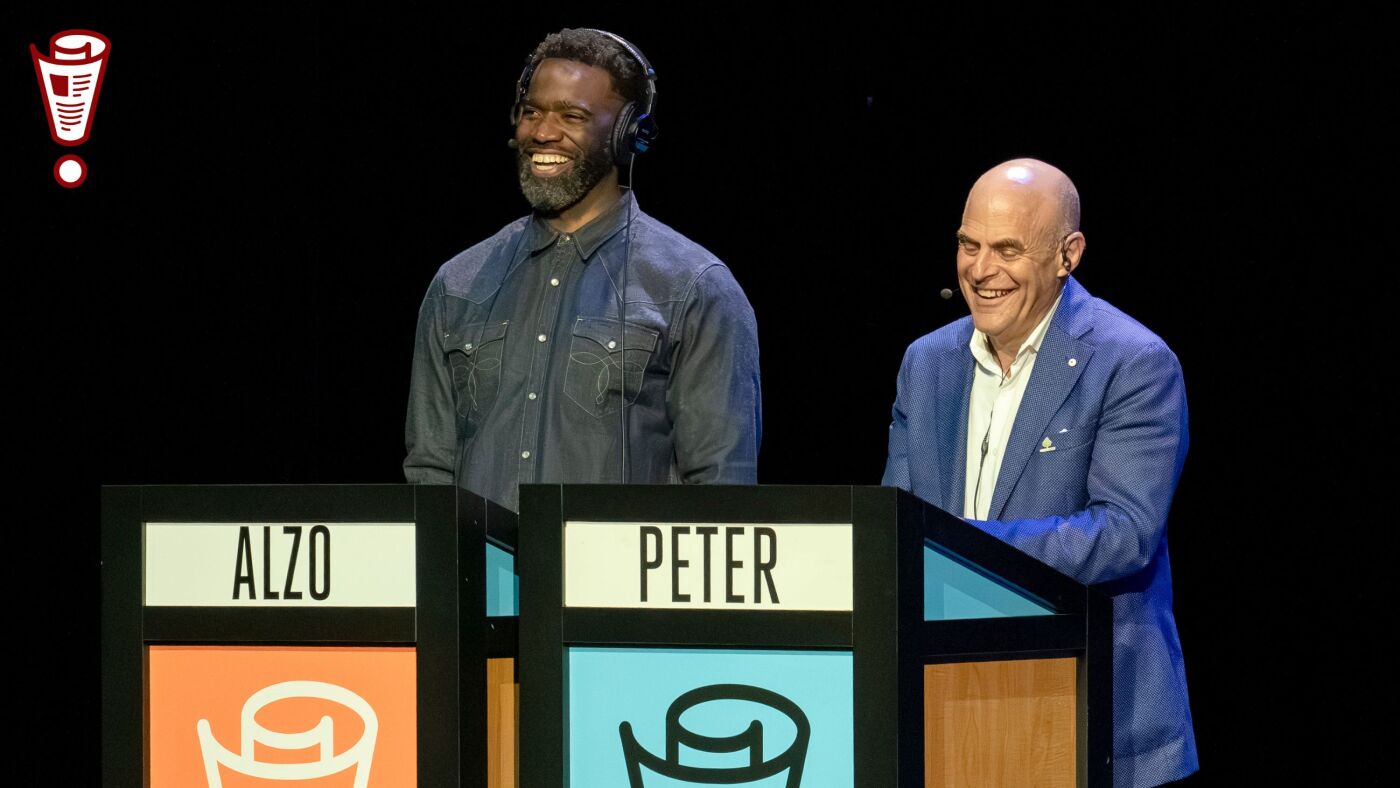
Alzo Slade and Peter Sagal on stage at the Studebaker Theater in Chicago
Jenn Udoni/NPR
hide caption
toggle caption
Jenn Udoni/NPR
This week’s show was recorded in Chicago with host Peter Sagal, judge and scorekeeper Alzo Slade, Not My Job guest Caro Claire Burke and panelists Karen Chee, Peter Grosz, and Shane O’Neill. Click the audio link above to hear the whole show.
Who’s Alzo This Time
Tourists Embrace The USA; The Wedding of the Century; Advances in Parenting
Panel Questions
Stolen Flavor
Bluff The Listener
Our panelists tell three stories about 80’s band A-ha making the news this week, only one of which is true
Not My Job: Caro Claire Burke, the author of Yesteryear, joins us to answer questions about yearbooks
This week, Caro Claire Burke, author of the book of the summer, Yesteryear, joins us to play a game called, “Yesteryear, meet Yearbook.” Three questions about yearbooks.
Panel Questions
Bookmarks and Beaches; One Man’s Trash
Limericks
Alzo Slade reads three news-related limericks: Jurassic Purse; Viper Visions; Humanity’s Tilt
Lightning Fill In The Blank
All the news we couldn’t fit anywhere else
Predictions
Our panelists predict, what would be the big surprise at Taylor Swift’s wedding
-

 Health5 minutes ago
7 Celebrity Weight Loss Success Stories—From Adele to the Pioneer Woman
-

 Lifestyle20 minutes ago
Sunday Puzzle: B to the B to the B
-

 Technology28 minutes ago
Bose thinks it can be a media company for some reason
-

 World35 minutes ago
Meloni’s spat with Trump is calculated strategy to boost her approval ratings: expert
-

 Politics38 minutes ago
Trump’s Iran gamble divides GOP hawks and ‘America First’ conservatives over what victory looks like
-

 Health43 minutes ago
This one question may reveal whether your body is getting the rest it needs, study finds
-

 Sports50 minutes ago
Teenage golfer Miles Russell delivers his dad an all-time Father’s Day experience during US Open final round
-

 Technology53 minutes ago
Fake AAA email scam targets drivers

