Maine
These Maine students are sinking to the bottom

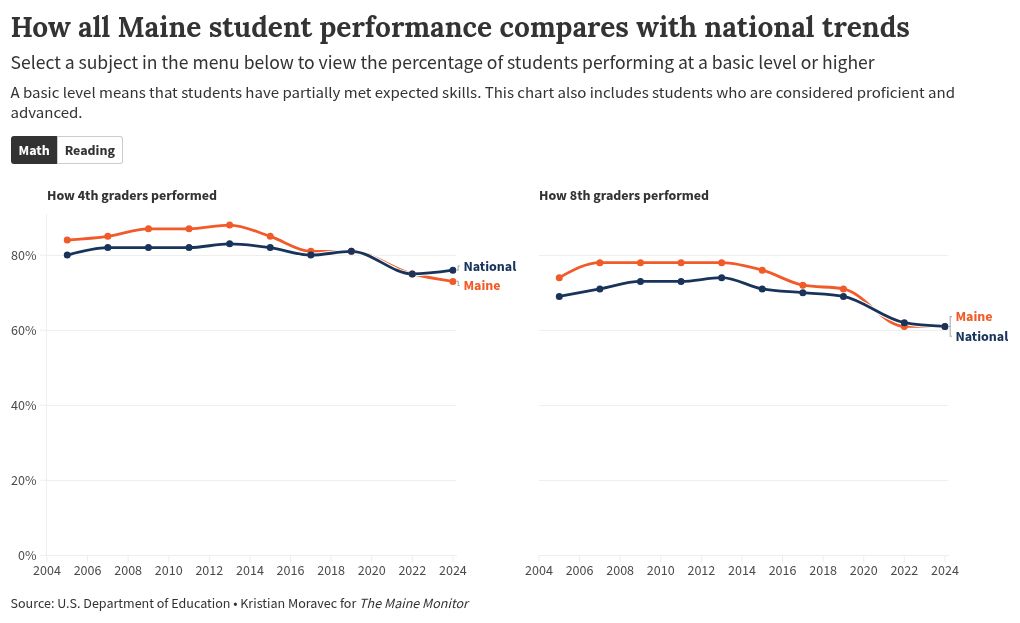
Maine, once a national competitor in student achievement, now sits at or below the national average for standardized test performance.
While scores nationwide have dropped since the COVID-19 pandemic, Maine student performance has been sliding for more than a decade.
And a Maine Monitor analysis of 20 years of student test scores on the National Assessment of Educational Progress, or NAEP, showed that some students are sinking to the bottom faster than others. Low-income students and children with disabilities saw peak test scores on the NAEP starting around 2007. Then these students started to see huge losses.
Between 2007 and 2024, the portion of all Maine students reaching at least a partial, basic level of understanding of reading and math fell more than 14 percent.
But the percentage of students with disabilities reaching the same, bare-minimum performance level or higher fell more than 32 percent — in some subjects more than 40 percent. The group of low-income students meeting that level, meanwhile, fell more than 23 percent.
The percentage of Maine test takers performing at a basic level or more is lower than the national average. (The NAEP results are only presented as percentages, not total numbers, and the exact loss in performance depends on the subject and grade level.)
The Maine Monitor ran the data by two education researchers to confirm that children with disabilities and from low-income households were sliding significantly.
Students with disabilities have plans that provide accommodations for learning; they may have autism, dyslexia and more.
Economically disadvantaged students include children who come from low-income households, are homeless, or may qualify for programs such as free and reduced lunch.
Other groups of students have been struggling as well. Black students saw significant losses in test scores, as did English language learning students, though data collection for both of these groups has been inconsistent over the years given their small numbers.
On the NAEP test, students can score at four levels. If they meet the basic level, it means they showed some, but not a complete, understanding of the fundamental things kids usually know at their grade level.
For instance, in reading, fourth graders meet the basic level if they can at least make simple inferences from text, and eighth graders meet it if they can answer specific questions about the text.
At the proficient level, or the level that the National Assessment Governing Board describes as the goal for all student performance, children show a solid understanding of challenging math and reading skills. The percentage of students performing at the proficient level in Maine started to decline between 2013 and 2017 across grade levels and subjects.
Advanced-level students, meanwhile, have mastered math and reading skills. As a whole, between 2 and 10 percent of Maine students perform at an advanced level across grade levels and subjects. This range for the top tier of performance has stayed fairly consistent over time.
Students fall into a fourth category of performance, called “below basic,” when they cannot demonstrate even fundamental knowledge in reading or math.
The Monitor analysis showed that the percentage of students performing at this lowest level has grown since 2007. For instance, about 59 percent of fourth graders with disabilities tested below the basic level on reading in 2007. By 2024, about 78 percent of these students did.
In the same subject in 2007, 41 percent of low-income fourth graders tested at the below basic level. In 2024, 59 percent of these students did.
This story was originally published by The Maine Monitor, a nonprofit civic news organization. To get regular coverage from The Monitor, sign up for a free Monitor newsletter here.




Tennessee forward J.P. Estrella, a Scarborough native and former South Portland standout, announced earlier today that he is entering the transfer portal.
Estrella shared the news in a social media post, writing that his time at Tennessee “means more to me than I can put into words” and that he’ll “cherish the time I spent there.”

This iconic spot is a “road-trip-worthy” Maine destination, but can you handle their newest addition?
Spring has sprung, which means plenty of people will take a well-deserved break from the daily grind and hit the open road. If you’re heading out to explore some cool Maine traditions—and you love lobster rolls—we’ve found the perfect stop.
The Taste of Maine restaurant has been serving up delicious seafood since 1978. They’re famous for a few things: a giant inflatable lobster that covers about 75% of the roof, and their claim to fame—the “World’s Largest Lobster Roll.”
These legendary lobster rolls are 22 inches long, and over the years, many customers have taken on the dare of finishing one. If you succeed, you earn membership in the “Clean Plate Club”—no easy feat given the size of this lobster roll.
But this year, Taste of Maine has gone even bigger. Introducing the “Monster” Lobster Roll: 3 feet long, packed with 2½ pounds of fresh Maine lobster meat—tail, claw, and knuckle—all on a 6-inch roll. This colossal creation carries a price tag of $259.99.
Read More: Maine Amusement Park Reveals New Family Attraction For 2026
Located at 161 Main Street in Woolwich, Maine, Taste of Maine is now open for its 48th season.
One of the best things about Taste of Maine is watching people take on these enormous lobster rolls. Guests love filming themselves attempting to finish them, including a Guinness World Records titleholder for “World’s Largest Mouth Gape.”
Spring Hours:
Monday: Closed
Tuesday: Closed
Wednesday: 11:30 AM – 8:00 PM
Thursday: 11:30 AM – 8:00 PM
Friday: 11:30 AM – 8:00 PM
Saturday: 11:30 AM – 8:00 PM
Sunday: 11:30 AM – 8:00 PM
To see just how long Taste of Maine has been a local favorite, check out this classic TV commercial from the 1980s!
New Arcade in Brewer, Maine Opens This Month
Game on, Brewer! The arcade of your dreams is almost here. Get ready to press start!
Gallery Credit: Arlen Jameson
12 New Restaurants That Opened in Maine in February 2026
Gallery Credit: Sean McKenna

LettersToTheEditor-640×400
To the Editor;
Access to affordable child care plays a direct role in whether Maine families can work, pursue education, and maintain stability. The Child Care Affordability Program helps keep child care costs within reach for working families.
To the Editor;
Access to affordable child care plays a direct role in whether Maine families can work, pursue education, and maintain stability. The Child Care Affordability Program helps keep child care costs within reach for working families. At Penquis, we serve 270 children from 266 families across dozens of communities through our child development programs, including Head Start, Early Head Start, and child care. We see firsthand how access to child care determines whether parents can work, pursue education and build long-term stability for their families, particularly in communities facing workforce shortages and rising cost of living.
Child care availability alone is not enough. We can have programs and facilities in place, but if care is not affordable, it remains out of reach for families who are already struggling.
Without it, the cost of child care places an unsustainable burden on Maine families, consuming as much as 29% to 39% of income for single-parent households and 10% to 13% for two-parent families. CCAP is one of the few tools that effectively addresses this challenge by ensuring child care costs are affordable, capping costs at 7% of income for those with the lowest incomes, and expanding access for many more families.
Investing in CCAP supports children’s healthy development, enables parents to participate in the workforce, and strengthens Maine’s economy. We urge state leaders to prioritize this $15 million investment in the supplemental budget and ensure that affordable child care is accessible to the families who need it most.
Kara Hay Penquis
Bangor
president and chief executive officer
Thank you for reading your4 free articles this month. To continue
reading, and support local, rural journalism, please subscribe.

NHL roundup: Zach Werenski says slumping Blue Jackets ‘still in it’

How to watch San Francisco Giants vs. Philadelphia Phillies

After deadly crash, loved one questions suspect’s actions at scene

Unlicensed contractor arrested after allegedly scamming Miami Catholic school out of $220,000

Boston University OT Program Ranks Top in Its Class for Fifth Straight Year by U.S. News & World Report

Florida High School Football Rankings: Top 25 teams – Oct. 21

How old is Bo Nix? What to know about Oregon quarterback ahead of 2024 NFL Draft

Cleary's 21 help Le Moyne down Central Connecticut State 69-64 in OT

99th annual Pony Swim held in Virginia

Indiana Members Credit Union announced as new anchor tenant at Bottleworks District

Map: Minor Earthquake Strikes Near San Diego

Trump claims he’d win as the president of Venezuela — just needs to ‘quickly’ learn Spanish

US Supreme Court clears path for Steve Bannon criminal case dismissal

Trump reiterates threats to bomb Iran’s power plants and bridges

Trump threatens Iranian infrastructure over Strait of Hormuz | BBC News
-

 Atlanta, GA2 days ago
1 teenage girl killed, another injured in shooting at Piedmont Park, police say
-

 South-Carolina1 week ago
South Carolina vs TCU predictions for Elite Eight game in March Madness
-

 Movie Reviews5 days ago
Vaazha 2 first half review: Hashir anchors a lively, chaos-filled teen tale
-

 Vermont1 week ago
Skier dies after fall at Sugarbush Resort
-

 Politics1 week ago
Trump’s Ballroom Design Has Barely Been Scrutinized
-

 Politics1 week ago
JD Vance says he was ‘obsessed’ with UFOs, believes aliens are actually ‘demons’
-
 Entertainment5 days ago
Inside Ye’s first comeback show at SoFi Stadium
-

 Atlanta, GA1 week ago
Fetishist ‘No Kings’ protester in mask drags ‘Trump’ and ‘JD Vance’ behind her wheelchair