Science
Next to Joshua Tree National Park, a mining company is staking its claim for rare earth minerals


An Australian company has launched a rare earths mining project just outside Joshua Tree National Park in critical desert tortoise habitat, an area the company’s director refers to as an “emerging heavy rare earth district.”
The company, Dateline Resources Ltd., says that historical sampling of the area in the Pinto Mountains south of Twentynine Palms found enrichment in elements key to powering electric vehicles, wind turbines and defense systems.
The United States depends heavily on China for its supply of these critical minerals, a major national security vulnerability the Trump administration has sought to address through a series of regulatory changes and financial incentives aimed at shoring up domestic production.
The desert tortoise, as seen in Music Valley in the Pinto Mountains, is listed as threatened under the Endangered Species Act due to habitat loss and predation.
(Gary Coronado / For The Times)
The project is in its early stages, and it’s unclear whether further testing will confirm the presence of rare earth elements across a broad enough area to warrant extracting them. The site is roughly 100 miles southwest of the nation’s only fully functional rare earths mine — Mountain Pass operated by MP Materials, in which the U.S. Department of Defense holds a 15% stake.

It’s also steps from Joshua Tree National Park, one of the nation’s most beloved desert getaways where about 3 million people visit annually. The 1,200-square-mile park and the public lands that surround it are home to sensitive plants and wildlife that environmentalists say would be harmed by a major mining project that could deplete water supplies, draw traffic and generate toxic waste.
“This is truly one of the most iconic landscapes in America,” said Chance Wilcox, California desert program manager for the National Parks Conservation Assn., as he stood atop a rocky slope within the project footprint on Friday.
Beside him, a wooden stake marked the corner of a mining claim. About 100 feet away, a metal post denoted the park’s boundary. In the valley below sat the fee booth for the east entrance.
If mining were to go ahead here, visitors would likely be able to see the activity while driving into the park, Wilcox pointed out. “It just emphasizes this company’s blatant disregard for our nation’s crown jewels,” he said.
Dateline did not return messages seeking comment on the project. The company also operates the Colosseum Mine in the nearby Mojave National Preserve, which the Trump administration has touted as pivotal to its efforts to develop a homegrown critical minerals supply chain.
Dateline first announced the venture — the Music Valley heavy rare earths project — late last month, saying it had acquired 57 claims totaling 1,140 acres and had also invested $1 million in Fermi Critical Minerals Inc., an American company that holds uranium and rare-earths projects in multiple western states. Dateline later broadened the footprint by staking an additional 969 claims covering 19,380 acres, a subsequent release states.

Twentynine Palms Highway looking west runs through downtown on Friday in Twentynine Palms, Calif.
(Gary Coronado / For The Times)
The company now holds claims over a roughly 32-square-mile area, the vast majority within the Bureau of Land Management’s jurisdiction.
U.S. Geological Survey geologists first identified rare earth mineralization in the Music Valley area in 1954, with sampling reporting enrichment in dysprosium, terbium, yttrium and ytterbium, Dateline Resources said in a press release. The company is now training modern exploration techniques on outcroppings of a 1.8-billion-year-old type of metamorphic rock called Pinto gneiss.
While rare earths will be the primary focus, exploration will also assess the potential for gold mining — the area is dotted with old, small-scale adits and shafts.
The project is located in what’s known as an area of critical environmental concern. The U.S. Fish and Wildlife Service has deemed the sweeping landscape to be crucial to the survival of the Mojave desert tortoise, which is endangered in California thanks to a stew of threats including development, disease, raven predation and climate change.
The land abutting the Pinto Mountains Wilderness is also home to badgers, bighorn sheep and Mojave fringe-toed lizards. Massive yuccas and barrel cacti stud its steep slopes.

A chuckwalla lizard suns itself on a rock in the Pinto Mountains.
(Gary Coronado/For The Times)
On Friday, desert iguanas and whiptails scampered across an access road, portions of which wind through the national park. A chuckwalla sunned itself on a boulder. Nearby, a desert tortoise had emerged from its burrow to munch on some grass — a rare sight that elicited a whoop of joy from Wilcox. “This is a really special place,” he said.
If the area proves to be a valuable source of heavy rare earth elements, it would be significant as the U.S. has none, said Daniel O’Connor, co-founder and chief executive of Rare Earth Exchanges, a website that covers the global rare earths market. Mountain Pass primarily produces light rare earth elements, which are typically more abundant.
“Our entire war machinery — missiles, radar, fighter jets — all need these heavy rare earths,” O’Connor said.
Still, he said, even if the U.S. were to start producing heavy rare earths, the country would likely remain reliant on China to process them — a complex, multi-stage undertaking that involves chemically separating the elements from ore. Companies controlled by the Chinese treasury currently separate and refine an estimated 90% of the world’s supply of rare earth elements, and about 90% of the specialized magnets they are used to create are also manufactured in China, he said.

A mural illustrating miners in the Dirty Sock Camp is painted on a wall in downtown Twentynine Palms, Calif.
(Gary Coronado / For The Times)
O’Connor described the Music Valley project as early-stage and speculative, pointing to a mining tradition dating back to the Wild West in which prospectors tout samples that show heavy concentrations of minerals in a bid to loosen investors’ wallets. There’s no way to know how widespread or systematic those concentrations are without technical reports disclosing a project’s mineral contents and quality, he said. Dateline does not yet appear to have released any such report, which are industry standard, he said.
Rare earths mining typically involves pulling out ore with jackhammers or dynamite and grinding it down before chemically treating it — processes that consume a lot of energy, generate toxic waste and can unleash radiation that’s often present in the ore, he said.
“It’s hard to think of a worse place for a massive industrial project than sensitive desert tortoise habitat on the very edge of Joshua Tree National Park,” wrote Brendan Cummings, conservation director for the Center for Biological Diversity, in an email.
A buildout of the claims could end public access to the area and permanently scar the landscape, drawing traffic and light pollution and harming springs and groundwater stores, he said. Given those potential impacts, he is skeptical that the developers could lawfully be granted the necessary federal, state, and local approvals to proceed.
Conservationists also point to Dateline’s history operating the Colosseum Mine as a source of concern, saying the company flouted National Park Service rules and damaged the surrounding landscape.
“They don’t respect public lands, national parks or the law, so there’s every reason to be deeply concerned about this proposal,” said Rep. Jared Huffman (D-San Rafael), the ranking member on the House natural resource committee who said the project “has red flags waving in every way.”
“We do need domestic and critical minerals sourced from friendly countries and responsible actors,” he added, “but it doesn’t mean we need them everywhere or at any cost.”

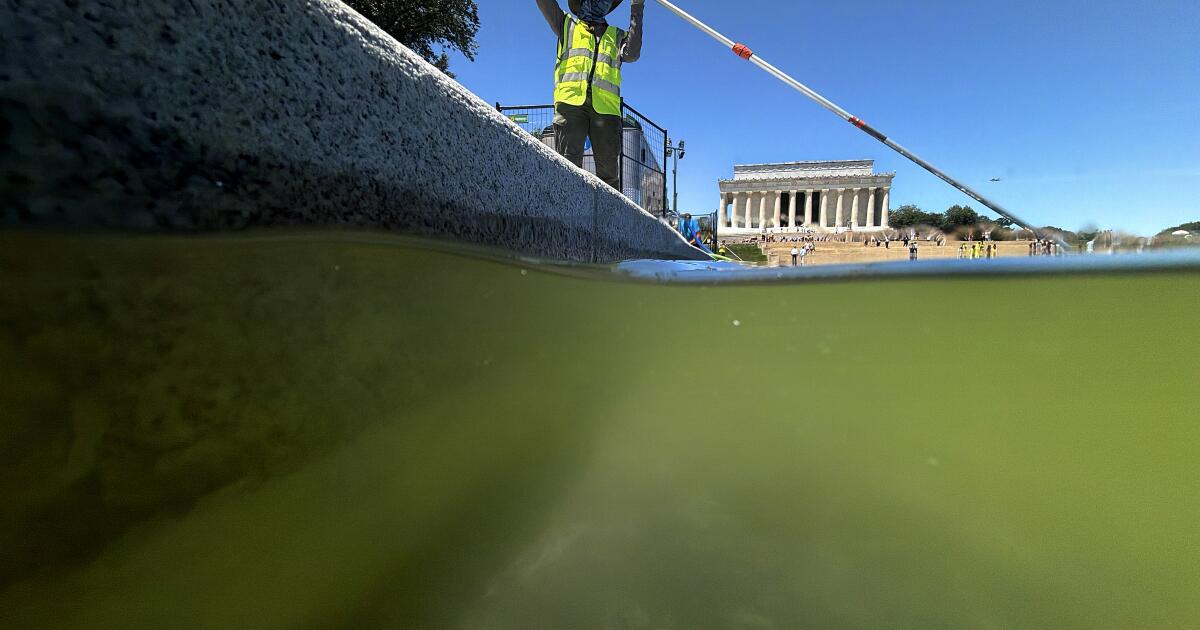
Just days after the Trump administration completed millions of dollars in renovations on the Lincoln Memorial Reflecting Pool to make it American flag-blue, residents and online users noted it had turned a phosphorescent green.
Here’s why:
The calm, still waters of the Reflecting Pool make it an ideal nursery for algae growth. Algae need nitrogen and phosphorus to grow, and the Reflecting Pool is primarily fed by the Potomac River, which gets heavy doses of those nutrients from nearby urban and agricultural lands.
The Potomac also absorbed one of the largest sewage spills in U.S. history earlier this year when a pipe burst five miles upstream of Washington, although that event probably happened too long ago to contribute to the algal bloom today.
Untreated sewage is high in nitrogen and phosphorus. When nutrient levels are high, feasting algae can quickly reproduce.
The Department of the Interior said when the algae first appeared that it was “residual,” from the supply lines to the pool.
Experts also speculate that the darker blue color may be helping the Reflecting Pool absorb more heat. The higher temperatures promote algae growth by allowing their metabolisms to shift into overdrive.
Summer temperatures in D.C. aren’t helping. This week, temperatures are as high as 95 degrees in the city, prompting a heat alert.
The combination probably explains the excessive growth, turning the water surface an opaque green and preventing onlookers from seeing the new blue hue of the concrete basin.
Algae are important and beneficial organisms when the ecosystem is in balance. They’re the base of the aquatic food chain, fed on by herbivores of all shapes and sizes, including shrimp and juvenile fish, which in turn feed organisms higher up the food chain. The single-celled organisms use the power of the sun to produce energy through photosynthesis, similar to houseplants on your balcony.
In an effort combat the algae in the Reflecting Pool, employees of the National Park Service were seen pouring in gallons of hydrogen peroxide, a chemical commonly used in pool maintenance.
The Department of the Interior also is employing a “high-tech nanobubble ozone technology” to destroy the cells of the algae.
Ozone — yes, the same irritant that is in smog — is a gas composed of three oxygen molecules, and the small size of the bubbles allow the most gas transfer into the water, where it can damage algal cells, similar to how it irritates our lungs.
This only treats the symptoms, however. Generally, ozone nanobubbling is effective as a temporary solution for algae blooms. Longer-term fixes would have to address what makes the Reflecting Pool so ideal for algae, such as its depth, darker color and inflow of nitrogen and phosphorus.
In California, ozone nanobubbles also have been used in a project to improve water quality in the Tijuana River. The 120-mile river that runs near the border in northern Mexico and Southern California was the site of a pilot study in 2025. The U.S. section of the International Boundary and Water Commission reported that the nanobubbling reduced “odors and bacteria,” but the project concluded prematurely after a flood swept some of the instrumentation into the river.

A plant extract that’s gaining popularity as a pain cure-all and has been associated with multiple California deaths in its concentrated, synthetic form has been approved for research as a treatment for opioid addiction by the federal government.
Kratom is derived from the leaves of Mitragyna speciosa, a tree native to Southeast Asia, and is commonly made into a powder or pill.
Researchers say people in the U.S. are using kratom to alleviate anxiety, treat chronic pain or as a remedy for the symptoms associated with quitting opioids, due to its ability to bind with opioid receptors in the body. But recently, public health officials have raised alarms about a component of the leaf called 7-hydroxymitragynine, also known as 7-OH, an alkaloid that has the potential for abuse and addiction in high doses.
Last year, the Los Angeles County Public Health Department linked the deaths of six county residents to the use of 7-OH mixed with other substances. The toxicology screens for some of the deceased revealed both kratom and 7-OH, leading to a countywide crackdown of products with either compound because they’re unregulated.
Although there is no scientific consensus on whether kratom has therapeutic value, the Food and Drug Administration has recommended that its potent 7-OH form be classified as a controlled substance. Consumers who use 7-OH as a pain reliever expecting an experience similar to consuming kratom are at risk, said Dr. Mason Turner, president-elect of the California Society of Addiction Medicine.
“I have a couple of patients that I work with who use 7-OH for chronic pain management, not realizing the potential of the medication, and then developed an opioid use disorder,” Turner said. “I think in that case it was very clear they were seeking it for the chronic pain, not to get high, not to have some kind of experience, but really to reduce their pain.”
About two decades ago, Turner said, the healthcare industry started acknowledging the limits and risks of prescribing opioids for chronic pain. Some doctors pulled back on prescriptions, recognizing the potential for abuse.
That led some patients to find alternative solutions, he said.
“Maybe they don’t get a good benefit, or maybe the benefit from some of the other treatments is not as robust as what they got from opioids,” Turner said. “So they seek out some of these illicit products … or they look for kratom or 7-OH to be able to mitigate the pain.”
Turner said he supports further research into kratom and regulation because “it could be worth exploring as a treatment for chronic pain.”
On June 1, the National Institutes of Health announced that researchers from the University of Florida would begin the first phase of clinical trials on kratom to evaluate it as a potential treatment for opioid addiction. The research would be done with the FDA’s approval, according to officials.
“This … is a major step toward expanding treatment options for the millions of Americans struggling with opioid use disorder, which has contributed to historically high overdose mortality rates,” said Dr. Nora Volkow, director of NIH’s National Institute on Drug Abuse, in a statement.
Interest in kratom surged in the last couple of years as users have reported consuming the compound in the form of a pill, powder or tea to treat various ailments. A John Hopkins survey conducted in 2020 reported that 91% of respondents used kratom to treat chronic pain, 67% to treat anxiety, 64% for depression and 41% to treat opioid dependence.
A more recent study by the University of Michigan and Texas State University found that more than 5 million people in the U.S., including more than 100,000 children ages 12 to 17, have used kratom, the compound experts say is growing in popularity with young adults.
In the study, which analyzed data from the National Survey on Drug Use and Health collected between 2021 and 2024, researchers say that despite numerous state-level bans on kratom across the nation, its use is at an all-time high and is increasing.
People between the ages of 21 and 34 said they used kratom at least once and 1% said they used it in the last year. The share of children ages 12 and older who said they had used kratom increased from 1.6% in 2021 to 1.9% in 2024.
The FDA has stated that neither kratom nor 7-OH are approved as drug products, dietary supplements or food additives, but that hasn’t stopped storefronts and companies from selling them as such.
Up until November you could find kratom and 7-OH products in smoke shops and specialty stores in California, but that has stopped.
“Until kratom and its pharmacologically active key ingredients mitragynine and 7-OH are approved for use, they will remain classified as adulterants in drugs, dietary supplements and foods,” the California Department of Public Health told The Times via email.
Kratom “Feel Free Classic” liquid products are displayed at a smoke shop in Los Angeles in 2024 before they were banned.
(Michael Blackshire / Los Angeles Times)
In May, the California Department of Public Health and Atty. Gen. Rob Bonta filed a complaint against Ashlynn Marketing Group Inc., accusing the company of repeatedly flouting the state’s regulations on kratom products.
The filing, submitted in the San Diego County Superior Court, seeks a judge’s order to condemn and destroy the embargoed kratom products, halt ongoing unlawful manufacturing and impose civil penalties.
The California Department of Public Health “is pursuing legal action because Ashlynn’s continued manufacture and sale of these products pose a clear and preventable public‑health risk and violates state and federal law,” said Dr. Erica Pan, the department’s director and state public health officer. “7-OH and kratom-derived products have been associated with addiction, serious health harms, overdose and death.”
The state is alleging its inspectors visited Ashlynn Marketing Group’s facility in Santee in May 2025 and found kratom powders, capsules, liquids and chewable tablets being manufactured and held for sale.
During the visit, inspectors issued an embargo to prohibit the sale and distribution of all kratom-related materials on-site, according to the complaint.
Public health inspectors conducted follow-up visits at the facility in October and April, “collecting evidence at both inspections that indicated embargoed kratom products had been moved, tampered with and repackaged,” according to public health officials.
“In addition, investigators observed evidence of continued manufacturing and distribution of kratom materials,” officials said. “The firm’s owner continues to manufacture kratom products and ships orders weekly.”
To date, the California Department of Public Health has seized more than $5 million worth of kratom and 7-OH products, a spokesperson for the department told The Times.
California and Los Angeles County are considering whether to tighten regulations or ban the compounds altogether.

NEW YORK — Scientists have unearthed communities of marine life — including jellyfish, tubeworms and brittle stars — thriving on a whale graveyard that is millions of years old.
These graveyards form when whale carcasses fall to the sea floor, becoming a sustaining snack for nearby critters. This one, located up to 23,000 feet below the surface of the southeastern Indian Ocean, spans the largest area and is so far the deepest and oldest found.
A whale’s sheer size and the unique chemistry of its bones are the keys to forming these unique underwater neighborhoods, said Xikun Song, a biologist with the Chinese Academy of Sciences’ Institute of Deep-sea Science and Engineering.
“At the same time, the very nature of the deep ocean makes these sites exceptionally difficult for scientists to locate,” Song, who was involved with the latest find, wrote in an email.
Researchers explored the remains during multiple deep-sea submersible trips in 2023, collecting samples and mapping the extent of the necropolis. They found five carcass sites and fossils, including skulls belonging to beaked and baleen whales. The oldest bones date back 5.3 million years.
Feeding and living on the carcasses were myriad creatures, large and small, including sea cucumbers, squat lobsters and saltwater clams. Many of them are likely species that have never been documented, according to findings published Wednesday in the journal Nature.
“The potential number of specimens is just astounding,” said paleontologist Stephen Godfrey with the Calvert Marine Museum in Maryland, who wasn’t involved in the research.
Many factors likely conspired to preserve the bones for millions of years, according to the study authors. They’re dense enough to outlast attacks from bone-eating worms, and located deep enough in the ocean to avoid getting buried by dust and loose particles. The bones also were coated with a light layer of minerals from the surrounding seawater, which may have prevented them from degrading.
Why did so many whales die here? Maybe they were already living in the area and died of natural causes. A few could have perished from exhaustion or illness caused by deep-sea diving. The area’s shape, akin to the letter V, could also have funneled the remains to their resting spot, the authors wrote.
Such discoveries are important because they clue scientists into the vibrant communities that find a way to live even in remote, hard-to-reach environments.
Studying the whale graveyards “is important for understanding how life can adapt to such extreme conditions, not only due to the lack of light and oxygen but also to the incredibly high pressure,” said study co-author and paleontologist Giovanni Bianucci with the University of Pisa in Italy in an email.
Ramakrishnan writes for The Associated Press.
The Associated Press Health and Science Department receives support from the Howard Hughes Medical Institute’s Department of Science Education and the Robert Wood Johnson Foundation.
-

 Oregon50 seconds ago
11 Best Small Towns In Oregon For A Crowd-Free Summer
-

 Pennsylvania6 minutes ago
Thousands flock downtown for Juneteenth parade celebrating racial progress and end of slavery
-

 Rhode Island13 minutes ago
Providence holds 50th Annual PrideFest
-

 South-Carolina16 minutes ago
South Carolina Lottery Powerball, Pick 3 results for June 20, 2026
-
South Dakota21 minutes ago
SD Lottery Powerball, Lotto America winning numbers for June 20, 2026
-

 Tennessee28 minutes ago
Strong storms possible Sunday night into Monday morning for Middle Tennessee
-

 Texas31 minutes ago
Video captures aftermath of a fatal stabbing at Texas track meet
-

 Utah36 minutes ago
Wildfire burns in Salt Lake City foothills behind University of Utah

