Business
Downtown L.A.’s cratering real estate market is changing — rich renters are buying their buildings

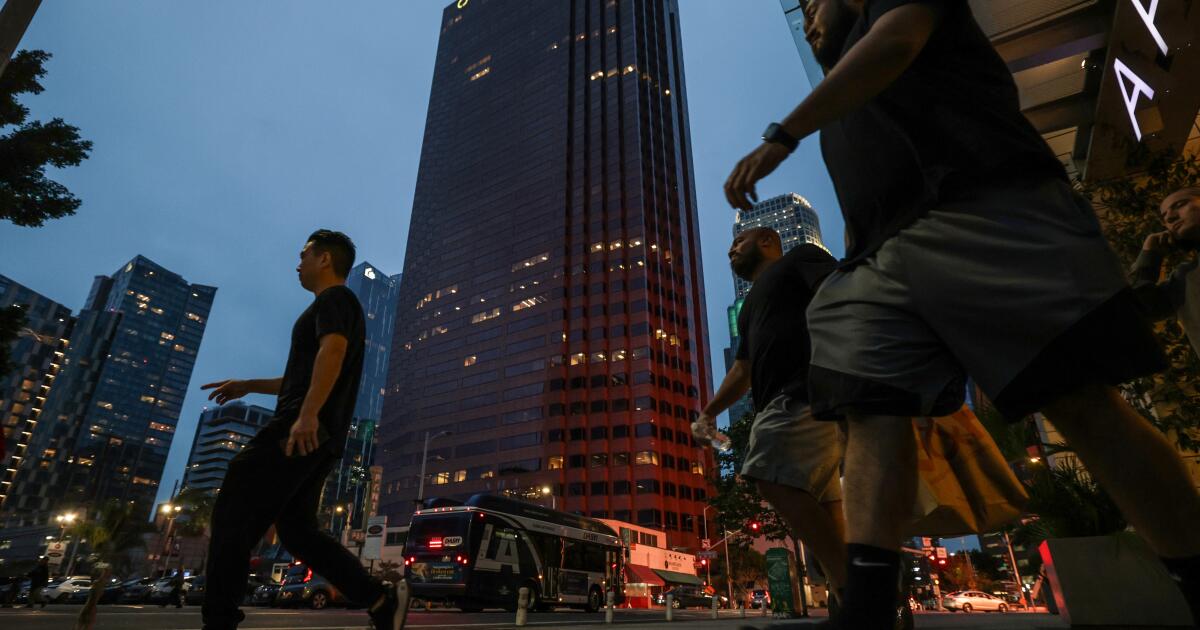
As the office market bottoms out after a long fall, renters are swooping in to buy their own buildings.
Occupant businesses are seizing the opportunity to become owners, especially in downtown Los Angeles, where glittering high-rises have plummeted in value since occupancy dropped during the pandemic. It has never fully recovered, but investors believe the market has at least stabilized.
Among the latest to snag a skyscraper is fund manager Capital Group, which has agreed to pay about $210 million for the 55-story Bank of America Plaza atop Bunker Hill, where it has offices. Others choosing to buy over rent include Riot Games and the Los Angeles Department of Water and Power.
“We knew the best landlord we could possibly have would be ourselves,” Capital Group Chief Executive Mike Gitlin said.
There are some good reasons tenants want to become landlords right now, Newmark property broker Kevin Shannon said, starting with timing.
“Everyone knows we’re near the bottom of this cycle, and it’s always good to buy near the bottom,” he said.
Downtown has suffered from an oversupply of office space since a building spree in the 1980s and early 1990s. The lack of rent-paying tenants that has driven down office values has become more acute since the pandemic. Nearly 40% of the office space in the financial district was available at the end of last year, according to CBRE. Overall vacancy downtown has climbed from 14% in 2019 to 34%.
Investors are finding deals to be had that include trophy properties such as San Francisco’s Transamerica Pyramid, a 48-story tower that has served as a symbol of the city since its completion in the 1970s. A European investment firm, Yoda PLC, recently paid around $690 million for the building, reflecting a deep loss for the previous owner, who had invested about $1 billion to buy and improve the famous skyscraper, according to CoStar.
A sign of the bottom of falling values is that office leasing levels seem to have stabilized, Shannon said.
“We’re far enough past COVID that office users are comfortable” and know how much space they’ll need going forward, he said.
Recent changes in federal tax laws regarding property depreciation benefits have added incentive, he said, and with office leasing improving around the country, lenders are looking more favorably on backing office purchases.
By owning their own buildings, white-shoe firms can maintain their properties in their own image.
Capital Group is already an anchor tenant in Bank of America Plaza, and it will consolidate other offices there after the sale closes.
Renters are taking advantage of the depressed office market and buying their own building, including Bank of America Plaza at 333 S. Hope St. which was just purchased by investment firm Capital Group.
(Robert Gauthier / Los Angeles Times)
“The best way to ensure a great environment in downtown L.A. is to create what we’re calling a vertical campus,” Gitlin said. “It was just this unique opportunity where the price was much lower than it had been historically, and it was for sale.”
Capital Group declined to confirm the reported $210-million sale price, but the building was last appraised in late 2024 at $212.5 million, down from $605 million 10 years earlier, according to Bloomberg.
Shannon said Capital Group paid about $150 per square foot for a property that would cost as much as $800 a foot to build at current costs. It will end up occupying the majority of the 1.4-million-square-foot building with 2,100 employees.
Owner-users have surged as key players in L.A.’s office market, now accounting for nearly half of all deals, real estate data provider CoStar said, while institutional investors’ share of purchases has fallen from 45% to 26%.
Office users from the public sector are among the buyers. The city of Los Angeles plans to buy a 35-story tower downtown for use by the Department of Water and Power.
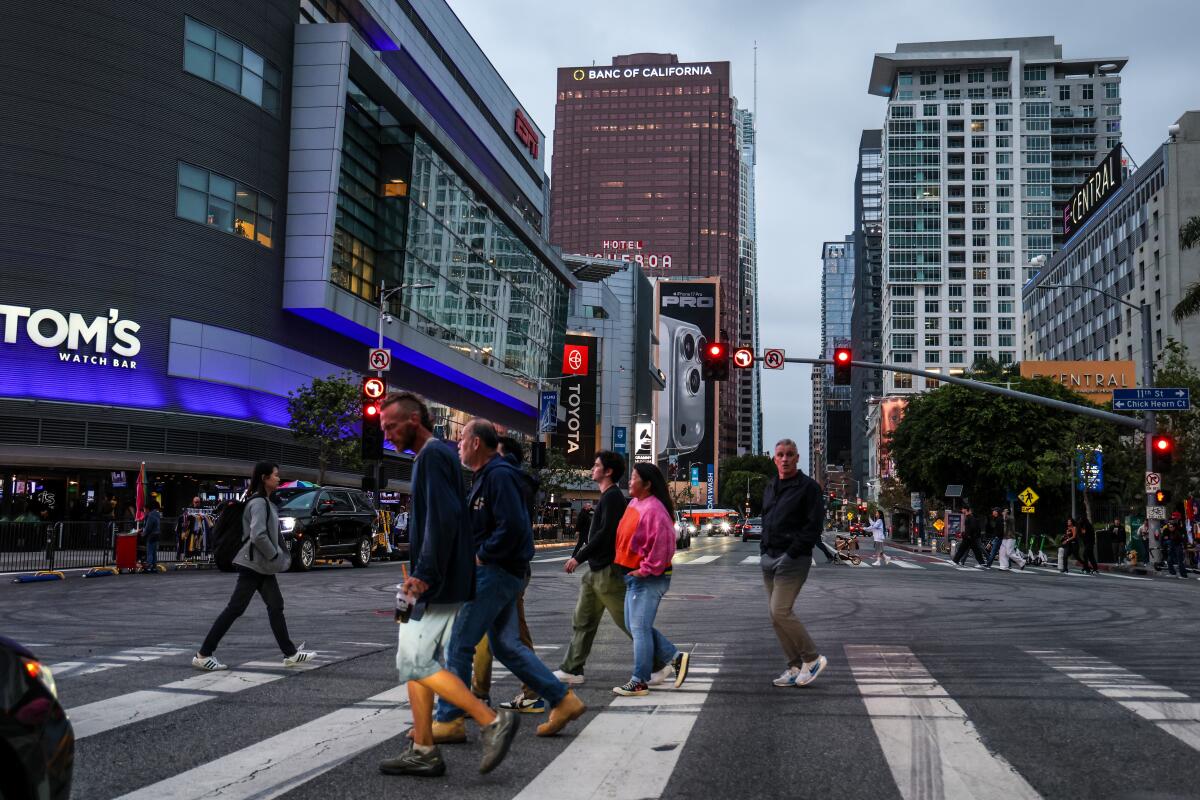
The depressed office market in downtown Los Angeles has some renters looking to buy their own buildings.
(Robert Gauthier / Los Angeles Times)
Manulife U.S. Real Estate Investment Trust said this week that it would sell its high-rise at 865 S. Figueroa St. for $92.5 million pending approval from Los Angeles officials. It has an assessed value of $248 million.
The DWP confirmed in a statement that its negotiators will bring a proposal to the Board of Water and Power Commissioners next month to buy the Figueroa Street property. The polished red granite-clad building north of L.A. Live has been a prestigious corporate address since its completion in 1990.
“If approved, this acquisition would provide needed office space to support the expansion of LADWP’s workforce, consolidate operations and maintain the reliable delivery of water and power to the city of Los Angeles,” spokeswoman Renee A. Vazquez said.
Another major public buyer of a downtown office building was Los Angeles County, which in 2024 bought Gas Co. Tower for $200 million, a steep drop from its $632-million valuation in 2020. County officials said at the time that the foreclosure sale was too good a deal to pass up.
The county is gradually moving workers into the 55-story skyscraper at the base of Bunker Hill that was widely considered one of the city’s most desirable office buildings when it was completed in 1991.
A major renter takeover on the Westside happened in December, when video game giant Riot Games bought its five-building headquarters campus in the Sawtelle neighborhood for $150 million, one of the priciest Los Angeles office sales of the year.
The campus is home to a movie-studio-like environment that includes theaters and one of the largest commercial kitchens on the Westside, serving a wide range of fare that changes daily and is provided free to the company’s employees. Among the company’s well-known products is “League of Legends,” a multiplayer online battle arena video game played daily by millions of people around the world.
The colorful campus “unlocks the creative heart and spirit of Riot,” Chief Executive Dylan Jadeja said. “When the opportunity came up to own the property, we knew it made sense to invest for the long term. This allows us to continue cultivating an environment that reflects our mission and enables Rioters to do their life’s best work.”
The Sawtelle complex has been Riot Games’ global headquarters since 2015.
“It’s become far more than just an office for us,” Jadeja said. “This is where Rioters have pushed the boundaries of game development in service of delivering incredible games and experiences to players around the world.”


A big rig crossed the center divider on the 210 Freeway in Irwindale on Saturday morning, killing one and injuring 30, authorities said.
The mass accident took place before 9 a.m. west of Irwindale Avenue, where emergency personnel arrived to find the truck had collided with several vehicles, the Los Angeles County Fire Department said in a social media post.
One person was pronounced dead at the scene and two were critically injured. Eight minors were taken to the hospital and 22 other crash victims declined treatment, the department said.
The California Highway Patrol temporarily shut down all westbound lanes of the freeway, diverting traffic onto Irwindale Avenue, before opening up one lane.
The CHP issued a SigAlert warning of traffic delays on the westbound lanes, with two lanes on the eastbound side of the freeway also temporarily closed.
The cause of the crash is under investigation.

Ford Motor Co. is suing a prominent Los Angeles lemon law firm for allegedly inflating their fees by as much as 7,000%, the company’s latest attempt to crack down on California attorneys who it says are exploiting the state’s unique law to protect consumers from defective cars.
Quill & Arrow, a personal injury firm that represents drivers suing over so-called “lemons” — vehicles with significant, unfixable manufacturing flaws — has long been a thorn in the side of Ford. Since 2021, Ford said its has paid them more than $100 million, roughly half in attorney fees.
That profit, Ford alleges in a federal lawsuit filed Thursday, came from billing records that were “utter fabrications.”
Quill & Arrow used an overseas “army” of low-paid, non-lawyers to help file thousands of lemon lawsuits and then pretended the work was done by California attorneys, who billed as much as $950 per hour, Ford alleged in its complaint.
Ford claims that the bulk of the work was actually done by non-lawyers in countries such as Mexico and the Philippines, who got paid as little as $13 per hour.
Quill & Arrow was founded in 2019 by attorneys Kevin Jacobson and Jonathan Shirian, according to the firm’s website, which touts recovering $500 million in lemon law payouts. The partners called Ford’s lawsuit “nothing more than an attempt to silence firms who would dare to hold them responsible and seek justice for consumers.”
“It grossly mischaracterizes the facts and the claim that Quill & Arrow created fabricated attorney billing records is absurd,” the firm said in a statement.
California’s lemon law, considered one of the strongest consumer protections in the nation, allows drivers to get a refund or replacement of a broken car if the manufacturer can’t fix it. If the driver is not satisfied, they can sue.
If the driver wins, the law allows attorneys to collect their fees from the car maker — rather than take a percentage of the client’s winnings, as is common in personal injury cases. This fee structure, Ford argues, has turned the law into a bonanza for plaintiff attorneys. The longer the case drags on, the company argues, the more the law firm can reap in profit.
Ford alleges the firm intentionally slowed down its clients’ cases to drive up their billable hours, instructing drivers not to communicate with Ford and pushing them toward filing a lawsuit.
“California’s Lemon Laws are in need of reform and the courts need to exercise more oversight, given the fraud we continue to expose,” said Doug Lampe, counsel at Ford, in a statement. The law is “being blatantly abused by the lemon law plaintiffs lawyers, the bar is not policing its own and the courts need to monitor fee awards with far more skepticism and scrutiny.”
The cases, he said, “have become about the lawyers for the lawyers.”
Lemon law cases have exploded in California in the last decade from about 4,500 cases in 2015 to roughly 30,000 in 2024, according to an analysis from the Assembly Judiciary. These cases, officials warned, “are poised to cripple the entirety of California’s civil justice system.”
In 2024, the legislature tightened the state’s lemon law, requiring additional steps before a driver could sue. The bill seems to have put little dent in the caseload: Lemon lawsuits surged to record levels the following year.
Ford’s lawsuit marks the second attempt by one of America’s largest car manufacturers to go on the offense against lemon law attorneys in Southern California.
Ford sued a cohort of local lemon law firms in May 2025, accusing attorneys of collecting at least $100 million in “phantom legal fees” by billing for hours they never worked. The case, which was brought under the Racketeer Influenced and Corrupt Organizations Act, or RICO, alleged lawyers worked together to file a flurry of fraudulent cases with billable hours that defied logic.
A partner at Knight Law Group, an L.A.-based lemon law firm, once billed an “ostensibly heroic but physically impossible” 57.5-hour workday, Ford alleged.
Knight Law Group denied inflating their billing, calling the suit a “thinly veiled attempt to silence firms who would dare to hold them responsible and seek justice for consumers.”
A judge threw out the suit in March on the grounds that lawyers were protected under the 1st Amendment from being sued for the content of their lawsuits unless the case was proved fraudulent. Ford says it plans to appeal.
After Quill found about the Knight Law Group case, Ford alleged, Quill dedicated a team to “scrubbing” their own timesheets of “impossible time entries.”

Ranch dressing is having a moment thanks to the World Cup and Kraft is ready to meet it.
The company said Thursday that it is working on a “TSA Compliant Ranch” for those looking to travel with the quintessentially American condiment. The announcement follows the influx of social media videos showing international soccer fans sampling the dressing for the first time.
“Some visitors leave with souvenirs. Others leave with America’s favorite dressing,” Kraft wrote in a caption accompanying an AI image of a TSA-approved clear bag packed with ranch dressing packets posted to social media. The image showed the bag — complete with a luggage tag resembling a ranch dressing bottle — placed in an airport security screening bin along with other travel essentials.
Additional details will be announced later, the company said.
TSA has also leaned into ranch’s apparent newfound popularity among international travelers, providing some helpful tips (and warnings) on social media.
“If you’re visiting for a very large sporting event & you happen to discover RANCH while you’re here… pls pack it in your CHECKED BAG on your way home,” the agency posted on Instagram Tuesday. It also asked travelers to “avoid chugging your ranch outside security” lines.
“Who knew dip-lomacy could be achieved through addressing the obvious: ranch is the king of condiments,” TSA wrote in the caption accompanying its carousel of humorous ranch-related quips. “If you’re traveling within the U.S., make sure to keep your carry-on sauces to 3.4 oz or less and place any larger containers in your checked bags.”
“Some heroes wear capes. Others bring ranch,” it added.
According to 1987 Times reports, ranch dressing was invented by Steve Henson, who opened the Hidden Valley Guest Ranch in Santa Barbara in the mid-1950s with his wife, Gayle. The unnamed condiment originally mixed herbs and spices with buttermilk and mayonnaise and its popularity with guests led to it being jarred so they could take some home. The more travel-friendly powdered form followed.
-

 Los Angeles, Ca40 minutes ago
Kids, teens can enjoy free lunch at over 90 parks across Los Angeles
-

 Detroit, MI58 minutes ago
Metro Detroit church hosts community event to support youth: “We’re here for you”
-

 San Francisco, CA1 hour ago
San Francisco celebrates Black freedom at weekend Juneteenth parade: ‘We’re all people’
-

 Dallas, TX1 hour ago
Redesign debate intensifies as Dallas convention center faces costly delays
-

 Miami, FL1 hour ago
‘An insane memory’: New World Cup super hero plays in Miami but not with Messi
-

 Boston, MA1 hour ago
FAA investigates close call between two aircraft at intersecting runways at Boston Logan International Airport | CNN
-

 Denver, CO1 hour ago
Proposed September 2026 Service Changes
-

 Seattle, WA2 hours ago
Seattle gets a heat wave and rain storm in the same week? – Emerald City Weather Blog

