Maine
Maine’s electricity prices grew at the third fastest rate in the country, analysis shows

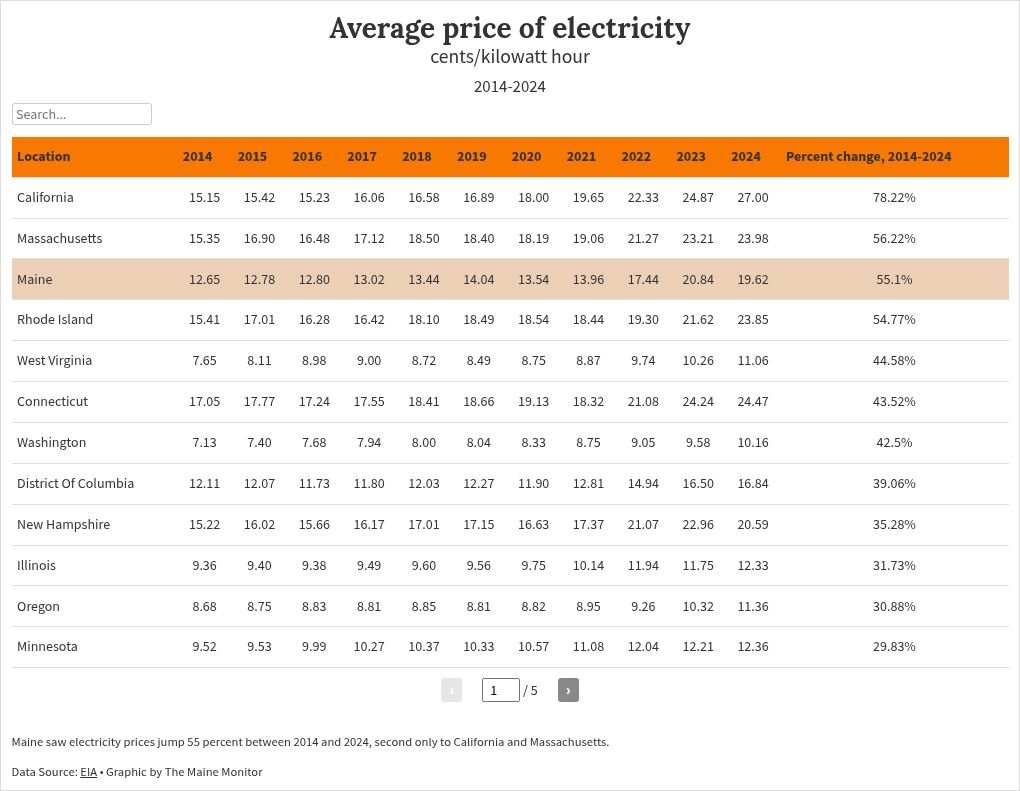
Between 2014 and 2024, the average retail price for electricity in Maine increased by the third highest rate in the country, according to an analysis by The Maine Monitor, surpassed only by California and Massachusetts.
The average retail price of electricity in Maine during the 10-year period rose from 12.65 cents/kWh to 19.62 cents, according to data collected by the federal Energy Information Administration. That’s an increase of 55 percent.
At the same time, the average retail price of electricity in the United States rose from 10.44 cents/kWh to 12.99, or 24 percent.
Maine’s rate of increase, then, was more than twice the national average. But it was considerably less than California, which saw its average price grow from 15.15 cents/kWh to 27 cents, a 78 percent jump.
In New England, Maine was followed by Massachusetts, which climbed from 15.35 cents to 23.98 cents, or 56 percent. Rhode Island grew at more than 54 percent, going from 15.41 cents in 2014, to 23.85 cents last year.
As electricity demand grows, affordable power is critical to a viable energy policy. But Maine’s energy policy is under fire: in Washington, the Trump administration is moving to withdraw most federal financial support for clean electricity in favor of boosting oil, coal and natural gas. It also has begun to challenge state efforts aimed at slowing global warming.
In Augusta, Maine continues to debate the impact of solar incentives on electricity bills.
Against that backdrop, why did Maine’s electricity prices grow so fast, and what might it mean for the quest to make electricity more affordable in the future?
Promoted by Gov. Janet Mills, Maine has set a goal of getting 100 percent of its electricity from clean energy sources by 2040. This aggressive target aims to blunt the impacts of a warming climate, largely by cutting the harmful emissions from burning oil and natural gas. But this goal is juxtaposed against another primary objective of the state’s updated energy plan: “Deliver affordable energy for Maine people and businesses.”
A key way to achieve both objectives, state energy planners say, is to shift the way we fuel our cars and heat our buildings to efficient, electric-powered technologies powered by renewable energy sources. This strategy is called “beneficial electrification.” Measures include heat pumps for air and water, battery-powered vehicles, solar and wind generation and energy storage.
But a corollary to beneficial electrification is that electricity has to be affordable. Otherwise, residents and businesses have little incentive to switch.
Here’s the dilemma. At the same time Maine’s cost of electricity has been rising steeply, some of the proposed pathways to an all-electric future are facing unexpected challenges, both in terms of cost and availability. Examples include offshore wind, electric vehicles, heat pumps and new transmission lines.
“It’s fair to say we are at a crossroads,” said Bill Harwood, who retired in January as Maine’s Public Advocate. “We need to continue to subsidize renewables for the foreseeable future, because we need to reduce our dependence on fossil fuels. But we need to be careful and thoughtful. We can’t over-subsidize it, like we did with (solar).”
Despite the increases, Maine’s electricity prices remain among the lowest in New England, noted Dan Burgess, who heads the Governor’s Energy Office. The factors pushing up prices are exactly why the state is working to move away from imported fuels in favor of homegrown renewable energy, he said.
Blaming natural gas, but it’s complicated
First, why did Maine’s electricity prices rise at such a fast pace?
Harwood and other energy experts blame three main factors — natural gas availability and price, a too-generous solar incentive program and recovery costs from recent violent storms.
Natural gas is the leading cause, but the reasons are more complicated than they may appear.
More than half of New England’s generating capacity comes from gas-fired power plants. This status dates back 25 years, as the region sought to phase out expensive and polluting oil generation.
Public opposition to more nuclear plants eliminated that carbon-free option. But new gas supplies in Canada and the Marcellus shale fields in Pennsylvania during the 1990s led policy makers and investors to back generators that promised cleaner air and lower prices. They were also quick to build. Several new gas power plants went up, including ones in Westbrook, Rumford, Veazie and Bucksport that benefited from two new gas pipelines from Canada.
But because these power plants respond daily to changing electricity demand, they aren’t able to secure the lowest gas prices through long-term contracts. As more businesses and homes converted to gas, the region’s pipeline system didn’t have enough capacity on frigid winter days. In response, developers sought to build new lines, including one through western Massachusetts.
A plan for Maine electric customers to help pay for some of the new capacity was championed by Gov. Paul LePage, a Republican. But new pipelines drew stiff opposition from local residents and some Democratic politicians.
Environmental groups also said new gas capacity would lock in the region’s dependence on fossil fuels for decades. Following legal actions, the projects were largely abandoned, including the $3 billion Northeast Energy Direct in 2016 that would have added to Maine’s supply.
Maine pays more for natural gas
This left New England electric customers at a disadvantage, according to Rich Silkman, an economist and former head of the Competitive Energy consulting firm in Portland. Pipelines carrying gas into the region from Pennsylvania face a pipeline constraint beyond the Hudson River, causing wholesale prices to rise significantly on the coldest days. This, in turn, caused electricity prices to soar.
Maine suffers the greatest impact, Silkman said. Gas from the Marcellus region must head first into the Boston area, before being delivered north into Maine and Atlantic Canada. This adds to the wholesale cost of gas for generators here, meaning that they run only at costly times to meet peak demand. On top of that, Burgess pointed out, the region depends on expensive, overseas shipments of liquefied natural gas in the winter to supplement domestic supply.
Over the 10-year period, electricity supply has been the single biggest share of a home’s monthly power bill. It has ranged from roughly 6 cents/kWh for Central Maine Power and Versant Power/Bangor Hydro customers in 2015, to more than 16 cents in 2023, following the spike in global energy markets tied to Russia’s invasion of Ukraine. These supply costs made up between 45 percent and 59 percent of a total bill.
It’s easy to blame natural gas price volatility for higher electricity costs. But Silkman said natural gas opponents also should acknowledge that Maine’s higher than average electric rates are partly self-imposed, through public opposition and public policy.
“Maine tried to get a gas pipeline built,” he said, “but it had to go through Massachusetts. We could have easily expanded the gas pipeline and that would have solved our winter pricing problems.”
Today, President Trump’s declaration of an “energy emergency” has revived talk of pipeline expansion in the Northeast. Whether Trump can overcome continued opposition, and if companies that lost millions of dollars on earlier efforts will take another gamble, remain open questions.
Also pushing Maine bills up is the cost of recovering from more-intense storms linked to climate change. Trees falling on power lines, in the country’s most-forested state, is the prime culprit.
For example: Central Maine Power serves nearly eight in ten electric customers. The cost of restoring power and fixing storm damage hovered around $32 million a decade ago. It increased to nearly $72 million in 2020, to $119 million in 2022 and $168 million in 2023, according to the Portland Press Herald. To blunt the impact on customers, the Public Utilities Commission has approved a strategy to spread out cost recovery over multiple years. Even so, storm recovery will add $20 to the average monthly CMP bill this summer, according to the energy office.
Solar benefits depend on “perspective”
Beyond gas and storms, few recent energy policies have received as much scrutiny as net energy billing, a practice in which renewable energy generators are compensated for excess power they provide. The program was initially aimed at small, rooftop solar panels. But in 2019, lawmakers advocating for cleaner energy greatly expanded the size of projects that could qualify for net energy billing, as well as the level of compensation. Today, more than 15,000 projects qualify.
By that measure, net energy billing is a huge success. When there’s enough sunlight, those projects can together generate 70 percent of the output of the Seabrook nuclear plant. This exceeds a state energy plan goal of building 750 megawatts of so-called distributed generation.
But electric customers pay for the generous subsidies, recently estimated by the Maine Office of the Public Advocate at $220 million a year. The rate impact today on a typical CMP home customer is roughly $7 a month; it runs more than $20,000 a month for a large business, according to Central Maine Power.
“Maine made some mistakes,” said Barbara Alexander, a consumer energy consultant who advises AARP Maine. “We could have built all this solar with competitive bids for half the price. We missed out on how to do this in the most cost-effective way.”
Alexander lamented that Maine has invested so heavily in solar, but isn’t seeing much benefit in rates.
“The bogeyman here in New England is that, except for a couple of volatile years, natural gas is the fuel of choice for generation,” she said. “So either make gas cheaper or replace it. Neither of those things has happened.”
As costs mount, lawmakers have been working to dial back the solar subsidy program. They’re still at it this legislative session, considering measures — largely promoted by Republicans — that range from trimming the subsidies to killing the program altogether. Harwood, the former Public Advocate, said the solution is to put experts at the PUC in charge of a competitive bidding program, rather than leave complex pricing and market details to a part-time Legislature.
But one element that colors the debate over how solar policy contributes to high electric bills is, literally, perspective.
By law, the PUC must annually study the costs and benefits of net energy billing. The latest analysis featured three “perspectives,” on the value of the program — for society in general, for Maine specifically and for electric ratepayers. The study’s primary focus is on the general society perspective.
By that measure, the 2024 program costs were $202 million and the societal benefits were $194 million. This calculation included $53 million of benefits for cuts in greenhouse gas emissions. By comparison, the ratepayer benefits were only $80 million. A bottom-line perspective: Reducing climate change emissions is good for the planet, but so far, has done little to lower your electric bill.
This story was originally published by The Maine Monitor, a nonprofit civic news organization. To get regular coverage from The Monitor, sign up for a free Monitor newsletter here.



“Do we accept the idea that innocent, loving partners and loving and devoted fathers of 3-year-olds can be collateral damage to this government’s policies? Do we agree that this is just an acceptable cost of doing business?” Gideon said. “We truly believe that people need to understand what the real costs are.”
“I want to be clear about something. Johan Sebastián, before he was shot to death, had been accused of committing no crime. He was in this country lawfully, and he was following a lawful process that’s prescribed by our federal government,” the attorney said, adding that Durán had been issued a work permit and a Social Security number under the Trump administration.
ICE has said it was conducting “targeted surveillance on the last known address of an illegal alien with a final order of removal” around 7 a.m. Monday, an agency spokesperson said.
“The vehicle attempted to flee the scene and fearing for public safety an officer discharged his weapon,” the ICE spokesperson said.
Durán, who was born and raised in Bucaramanga, Colombia, had come to the U.S. in 2023 to seek better opportunities for him and his family, relatives said.
A spokesperson with the Department of Homeland Security told NBC News in an email that Durán “illegally entered the United States” through the southern border nearly three years ago “and was released into the country under the Biden Administration.”
Entering the U.S. without proper authorization is a misdemeanor, but living in the country without legal permission is a civil violation and not a criminal offense.
At work, and everywhere he went, Durán carried an infectious joy, Rojas said.
As a father, he was devoted. Aside from working cleaning and delivery jobs to provide for his family, he took their daughter, Dulce — or “gordita” (chubby) as he lovingly called her — to the park every afternoon, Rojas said.
Durán always indulged his little girl whenever she had a craving for nuggets and fries, Rojas said, adding he would often marvel in tears every time he realized his daughter “was getting bigger.”
Rojas recalled a conversation she had with Durán a few months ago, wondering who their little girl would grow up to be. Durán said he would have a hard time sending off his daughter to school for the first time, she said.
Dulce now asks for her father every night, Rojas said, breaking down in tears. “And I don’t have the strength to tell her that dad isn’t coming, that she can’t give him a hug and tell him ‘I love you.’”
Gideon said that “there will come a time when those responsible for Johan Sebastián’s needless death will have to answer for what they did. But today is not that day. … Today is about Johan Sebastián and who he was as a person.”

Ralph Benko served as a deputy general counsel in the Reagan White House and worked closely with the George W. Bush administration as a contractor in its domestic policy initiative to find and rescue human trafficking victims. He lives in Maryland.
“As Maine goes, so goes the nation” was, for about a century, a political maxim. Recently, the political junkies in the capital were obsessing about the Platner vs. Collins race.
Wrong race!
Understandable, for those card-carrying members of the Columnist Party. The U.S. Senate majority, a very big deal, may hinge on that race. And that race was spiced up by the salacious and unseemly stories about the winner of the Democratic primary.
With that said, hey, junkies? Platner vs. Collins always was the wrong race to put on the marquee of your political theater. The real bellwether race is the governor’s contest between Bobby Charles and Hannah Pingree.
The political dynamics that have emerged or are emerging is less Republican vs. Democrat and more establishment insiders (Hannah Pingree, former speaker of the Maine House, whose family name has been a prominent fixture in Maine politics for over 30 years) vs. popular insurgents (Bobby Charles, on his first electoral foray).
Charles is fashioning his affordability program via a classic center-right Republican free market platform. Pingree is fashioning her affordability solution via a classic center-left Democratic public works and pro-regulatory platform.
Full disclosure, as chairman of the 190,000-Facebook follower Capitalist League, I lean center-right. My own preferences revealed, there is more to this race than programmatic preferences.
The Charles vs. Pingree race is the perfect microcosm of the national political culture.
I was a lifelong Democrat until the sensible Democratic Party left me for left field. And there they go again. The progressive Mills-Pingree-Platner party ghosts the FDR/JFK/Bill Clinton Democrats.
Bobby Charles — who worked in the Reagan White House and later directly for Colin Powell — is a modern Reaganesque figure, aligning himself with the sensible Maine population, including independents and traditional Democrats, offering common-sense policies.
Charles is running on the Republican line. Yet he has the kind of “man of the people” values that FDR embodied and Middle America embodies.
Yes, there is a lot of crazy going on in the GOP now. Charles, however, embodies classical Republican radical pragmatism. He’s not an ideologue, and is exempt from the fanaticism that so plagues our politics today. Charles is neither a zealot nor a moderate. He’s simply … capable.
Meanwhile the Democrats now, wholesale, are nominating “democratic socialists.” Wait, what? History has repeatedly shown that socialism doesn’t work, locally or nationally.
The further left you move, the more it never works. Remember Jimmy Carter’s misery index? (That’s what forced me out of my once beloved Democratic Party.)
Insanity is doing the same thing and expecting different outcomes. Let’s do sane for a change.
Hannah Pingree presents as an honorable and capable public servant. That said, she will, if elected, be badly constrained by the romantic-but-dysfunctional emerging narrative of her party, now in thrall to its fanatical base, listing so far to portside that it is about to capsize the ship of state.
Maine is one of the states most guided by common sense. Its voters will embrace the candidate with a proven agenda for affordability and security rather than a member of the party who is admittedly charming but impractically romantic (Bernie, AOC, Zohran, etc).
While the nation scratched its head at Maine’s oddly out of sync “oyster farmer” there was, and is, a more meaningful race afoot. Many who have known Bobby Charles for decades and watched him serve his country unflinchingly think he, considered a dark horse, is the odds-on favorite to pull an upset and bring common sense and real management skills to Maine’s governance.
So, political junkies? Now that Platner vs. Collins has ended, please turn your attention to the true marquee Maine race, Charles vs. Pingree. For as Maine goes, so goes the nation.

A poster of Joan Sebastián Durán Guerrero, the man killed by US Immigration and Customs Enforcement, is displayed at a memorial in Biddeford, Maine.Robert F. Bukaty/AP
The day after hundreds of locals poured into the streets of Biddeford, Maine in protest of ICE’s killing of 26-year-old Joan Sebastián Durán Guerrero on Monday, I drove through the former mill town. It seemed eerily still, as if in shock. When the horrors of Minneapolis and Houston come to your small corner of New England, what can you do?
In Mechanics Park in Biddeford, a small but diligent group presented one answer: you keep showing up.
“When I woke up this morning, I knew that this was the place I should go right to,” said Wayne Miller, 71, a retired pilot of 35 years and resident of Beverly, Massachusetts. “This is my backyard. This is my neighborhood.”
He paused, then started to cry. “I’m ashamed of my country. I love the country. I’m ashamed.”
Miller was standing with a sign that read “Dissent while you still can” at the corner of Mechanics Park in Biddeford, where the protest and vigil for Guerrero had been held the day before. A nearby chain-link fence served as a memorial, lined with flowers, signs, and letters of grief and apology for Guerrero and his family. One read, “3-year-olds should be watching Bluey, not their fathers being executed.” Above a “No Trespassing” sign, someone had placed another: “Biddeford was built by immigrants.”
I spoke with Miller and others who had come out on Tuesday to continue expressing their grief for their neighbor, the second person killed by federal agents in less than a week.
“It’s one thing to see a news story from a distance,” said Tessa, 28, a waitress and resident of Biddeford. “But watching it happen close to home, it really recontextualizes the safety that you feel walking around in your neighborhood.”
For Linda Henry, 27, a retired firefighter and Gloucester, Massachusetts resident, it was only a matter of time. “I know that it doesn’t matter where you live. It’s going to happen, you know. ICE is going to come.”
“I’m ashamed of my country. I love the country. I’m ashamed.”
Guerrero was a Colombian citizen who lived in Biddeford, Maine with his partner and 3-year-old daughter. He is one of at least nine people killed by federal immigration agents since the start of Donald Trump’s second term. Homeland Security Secretary Markwayne Mullin claims Guerrero “weaponized” his vehicle during a traffic stop. But similar claims by DHS have quickly fallen apart after video footage of shootings has come to light.
Reports say that not only was Guerrero authorized to legally work in the US, but he wasn’t the target of ICE’s operations that day.
Katie, a 48-year-old educator from New Hampshire, shared her anger. “A gun is not a license to kill. These agents have no business drawing their guns,” she said. “They aren’t judge, jury, and executioner, and they don’t have the right to be killing people the way that they are.”
“We were taught from the time we were little, ‘liberty and justice for all.’ We were taught that the United States was a place for everyone, and the current regime has changed that,” Katie continued.

Most of the protesters were standing with signs on the sidewalk along the adjacent intersection, shouting “ICE OUT” while passing cars honked. Near the memorial, a man on a bike caught my eye. He was off to the side, alone, quietly reading the letters addressed to Guerrero.
He introduced himself as Diego, 30, a restaurant worker and Biddeford resident. “I knew the guy. He was always around,” he said. “I was working and I was about to cry, to be honest. Because it’s injustice, you know? I’m an immigrant, and this country was built for immigrants.”
“We work, we pay taxes. We also need rights, as everybody does,” he said. “It’s not about left or right. It’s not about a political party. It’s about human rights.”
He told me that while he’s never felt disrespected by his neighbors and the people of Biddeford are good, the government is not the same. He said he feels unsafe and his community of immigrants feels like it’s hiding.
“How many need to die for us to understand?” Diego said. “He’d got a kid, a little daughter. And that’s the most devastating. Because, you know, if I do something wrong, I can say ‘I’m sorry, I apologize.’ But he’s dead. There’s no apology that can bring him back, you know? He’s dead. I can’t even believe it, I can’t even believe this is happening.”

When I asked Diego why he had stopped on his bike, he said out of solidarity—for Guerrero, for his partner and daughter. And when I asked what he would say to his community, he said, “Thank you for all the solidarity of people. Thank you for all the understanding. And I hope we can stop the violence.”
-

 Los Angeles, Ca1 hour ago
Arrest made in deadly shooting at 4th of July gathering in Compton; search for 2nd suspect continues
-

 Detroit, MI1 hour ago
Detroit crime hits decades-low as Michigan governor candidates debate how to keep progress going
-

 San Francisco, CA2 hours ago
Operator of boat that capsized near Alcatraz mourns brother as search continues
-

 Dallas, TX2 hours ago
Mavericks vs Thunder Game Preview and Injury Update
-

 Miami, FL2 hours ago
Miami Dolphins Fans Vs. The Media
-

 Boston, MA2 hours ago
Man who allegedly shot at Boston Police officers arrested after foot chase in Dorchester
-

 Denver, CO2 hours ago
Swan, dragon and duck boats are back pedaling around City Park
-

 Seattle, WA2 hours ago
Ticket Alert: Thundercat, Michelle Branch, and More Seattle Events Going On Sale This Week – The Stranger

