News
NASA’s Artemis II crew readies for Monday’s lunar flyby. Here’s what you need to know

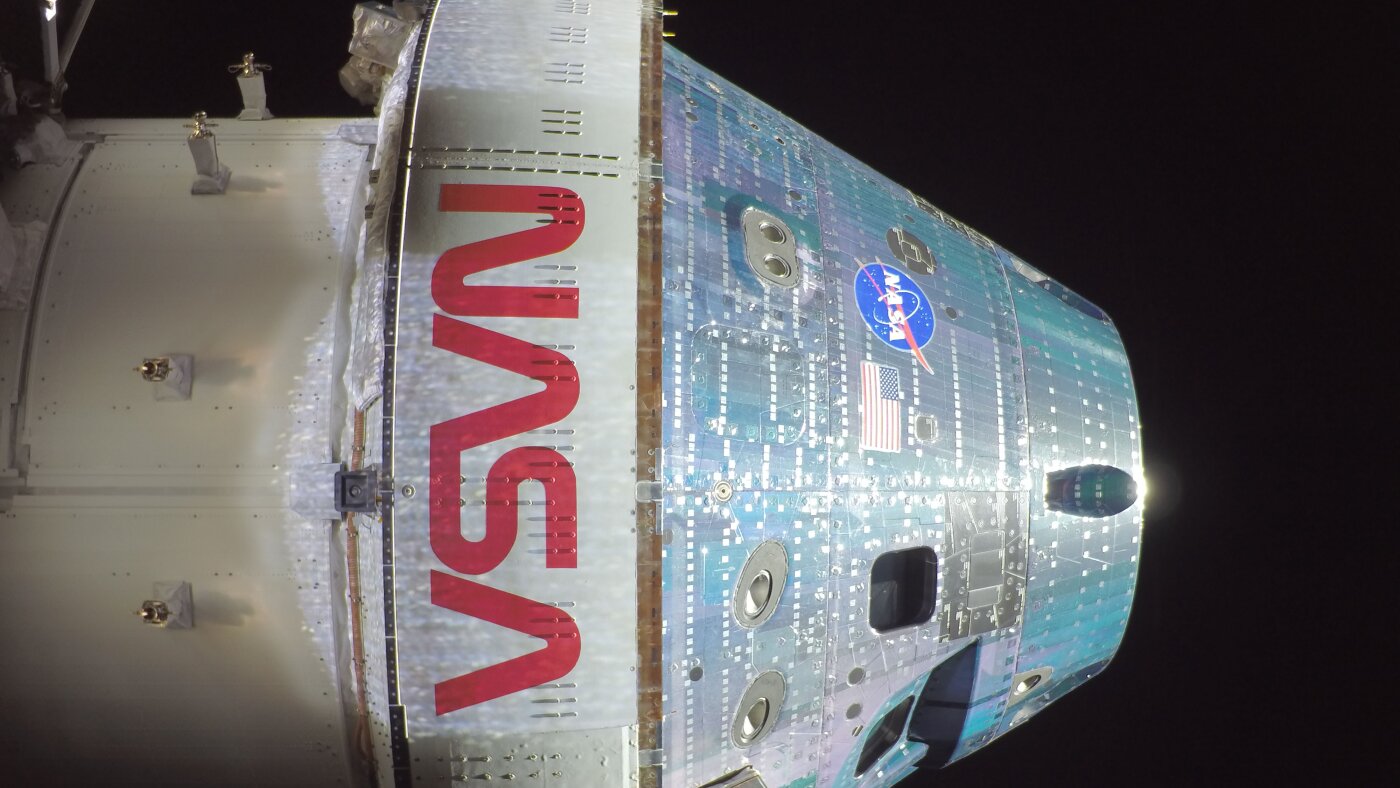
A photo of NASA’s Orion space capsule taken by a remote camera mounted on one of its solar arrays as it sped towards the moon. The four astronauts will loop around the moon on Monday and also venture farther into space than any humans before.
NASA via Getty Images
hide caption
toggle caption
NASA via Getty Images
The crew of NASA’s Artemis II will make its closest approach to the moon Monday afternoon after launching from Kennedy Space Center last week.

It marks a critical milestone of the agency’s Orion space capsule, sending humans on a mission to the moon for the first time in more than 50 years. As the capsule loops around the moon, the astronauts will reach farther into space than humans have ever ventured.
The Orion spacecraft is now in the lunar sphere of influence, meaning the moon’s gravity has more pull on the vehicle than the Earth. At 1:46 p.m. ET, the crew will surpass the record for the farthest distance traveled from Earth by humans, which was set by the Apollo 13 mission at 248,655 statute miles from Earth. At 2:45 p.m., the crew will begin making observations of the surface of the moon during the flyby.
As the vehicle circles the far side of the moon, communication back to Earth is expected to be blocked for about 40 minutes. At 7:02 p.m., the crew is expected to have reached the mission’s maximum distance from Earth at 252,760 statute miles.
The flyby is scheduled to conclude at 9:20 p.m. and then the crew will be on its way home, with a planned splashdown in the Pacific Ocean off San Diego, Calif. on Friday at 8:07 p.m.
During the Artemis II flyby, the crew will pass over two previous human lunar landing sites — Apollo 12 and 14.
Lunar science observations
During the lunar flyby, the closest Orion will come to the surface of the moon is 4,070 miles. From that distance the crew will have a unique vantage point of the moon as a full disc — and the ability to take observations never before seen by human eyes.
NASA scientists have identified about 35 geological features for the crew to observe. Working in pairs, they will take photos of the sites and describe them in real time to scientists at Mission Control at the Johnson Space Center in Houston.
“They’re going to be absolutely buzzing,” said Artemis II lunar science lead Kelsey Young on Sunday. The team will be monitoring the observations and providing guidance to the crew.
“The science team will get to work right away, kind of synthesizing those [observations], and then we’ll actually downlink the rest of the descriptions overnight, in advance of a crew conference we’ll have the following morning to continue the science discussion.”
Artemis II has ten science objectives for the flyby. One is to observe color variations on the lunar surface. Changes in color can indicate the composition of the minerals on the surface. These changes are hard to detect with satellite images.
“This is something that human eyes are just incredibly good at teasing out nuances about,” said Young.
Satellites like the Lunar Reconnaissance Orbiter, which launched in 2009, have given scientists a better understanding of the lunar surface. The Artemis II crew’s observations will build on that knowledge.
“We understand, you know, what it’s made out of. We understand the topography, but we don’t know what the crew are going to see in these specific illumination conditions from a scientific perspective,” said Young. “And that’s exciting.”

NASA astronaut and Artemis II mission specialist Christina Koch peers out of one of the Orion spacecraft’s main cabin windows, looking back at Earth on Saturday, as the crew traveled towards the Moon.
NASA via Getty Images/Getty Images North America
hide caption
toggle caption
NASA via Getty Images/Getty Images North America
The observations will help future landing missions. One target site is a potential future landing area for an uncrewed payload mission. The crew will also get a small glimpse of the lunar south pole — where humans might land as early as 2028.
The mission so far
Artemis II is more than halfway through its slingshot mission around the moon and back. This is a test flight of the Orion space capsule, carrying a human crew for the first time.
“Our mission continues to go incredibly well,” said Lori Glaze, who leads NASA’s Artemis program.
Tests include manual control of the Orion spacecraft. Mission pilot Victor Glover practiced the maneuverability of the capsule for future rendezvous with lunar landing vehicles.

The crew tested the spacecraft’s life support systems, like the carbon dioxide scrubbers, and donned their space suits midflight — which future astronauts might have to do in an emergency.
The Artemis II mission is also testing the first deep-space toilet. NASA’s Universal Waste Management System is stowed in the floor of Orion and allows the crew to use the bathroom in private. So far, the hardware has had a few hiccups (not having enough water in the bowl and, at a different point, not being able to dump the waste overboard due to a frozen line), but those seem to be resolved.
“We’re continuing to proceed with the mission and the use of the toilet nominally,” said Artemis II flight director Rick Henfling, meaning the crew is allowed to use the onboard lavatory.



new video loaded: The Sacred Catholic Site Where Trump Wants a Border Wall

By Reis Thebault, Christina Shaman, Jon Miller, June Kim and Melanie Bencosme
June 20, 2026

Kim was, in her words, “starving for that fatherly love.”
She became an intern for Baer and always looked forward to being held in his arms for extended periods of time. She eventually asked him if there was anything she could do to help ease the fear that she believed was still holding her back.
There was, Baer told her. At his direction, she took off her top and bra, Kim said, and he held her but didn’t touch her breasts or privates.
“It felt very parental, and it felt very special,” she said.
In hindsight, Kim said, she cherished the experience for another reason.
“I was getting this special attention from him,” she said. “I was pretty desperate for that in my life.”
She now sees it as classic grooming behavior.
It happened one other time, Kim said, and she eventually asked him if there was anything else she could do to experience a “bigger shift.”
Baer brought her to the pool house and instructed her to remove her clothes piece by piece, Kim said. He lay in bed with her, rubbed her back and held her breasts, according to Kim.
“There was no talking me into it — I just did it,” Kim said. “In hindsight, I realized I didn’t feel free to say no to any of it. I had the belief that if I did say no, he would write me off.”
When Kim got the call from her daughter Penelope, she said it jolted her out of what she now describes as a cult mindset.
She spoke to other women in the community and said she heard more stories involving naked holding.
One of those women was Inge Jechart. A mother of two with a doctorate in physics, Inge had been an active Real Love member since a friend recommended Baer around 2005.
“At that time, I was lost and lonely,” she said, describing struggling under the weight of a faltering marriage and a strained relationship with her sons. “I learned how to become a better person and more loving and understanding.”
The first time Baer held her in his lap, Inge was overcome with emotion.
“I just cried,” Inge recalled. “It was such a relief to feel safe and loved. What else do we want in life?”
Following that experience, Inge said, she booked every retreat at his house that she could. And it was there, in 2017, that she said she twice got naked with Baer at his direction.
“We hold our own children when they’re naked to make them feel safe,” Inge said. “For me, that’s what we were doing.”
“And here’s the thing,” she added. “It made a huge difference for me.”
But Inge said Baer fondled her breasts the second time, and that didn’t feel right at all.
“I said, ‘Hey, as a 4-year-old, I wouldn’t have breasts,’” she recalled. “And he stopped.”
Inge said Baer told her he had done it with only one other woman before, and he added in a stern voice: “I don’t talk about this with anyone else.”
“I got the message,” Inge said. “Our community was important to me, and I didn’t want it to blow up, so I kept silent.”
But she said she never considered that he might be engaging in naked holding with younger, more impressionable women like Veena and Penelope.
Kim, Penelope’s mother, said the same.
“It had never crossed my mind that he would ever do this with my daughter,” Kim said. “I was completely blind to that possibility.”
The backlash
In February 2019, Kim sat down at her computer and began to type an email to Baer.
“Greg what you have done with my daughter…is wrong, hurtful, traumatic and goes against so many gospel principles,” read the email, which was reviewed by NBC News.
“Holding people without clothes on needs to stop, what you are doing is wrong,” it added. “Touching my daughter between her legs when she was naked was wrong — there is no justification for it.”
“I know of 4 women personally who have undressed completely with you, and I don’t know hardly anyone that you spend time with so I conjecture that there are many more,” Kim wrote near the end. “I beg of you…put a stop to this horribly damaging behavior.”
Baer was defiant in his response.
Kim’s daughter was “claiming events that never happened,” he wrote. “And she is supplying lots of details that never happened. And now she is sharing these details with as many people as she can find.”
Kim’s email wasn’t the only scathing message Baer received during this period.
“I am writing to perhaps appeal to your consciences and any integrity you may still have left,” wrote a woman from the U.K. in an email viewed by NBC News. “Shut Real Love down now before it’s too late.”
“Greg you have had sexual dealings with way more women than we initially thought,” the woman added. “That’s not including the naked holding.”
Baer replied with another strong denial.
“Nothing, absolutely nothing, like this is occurring, and people are healing all over the place,” he wrote to the British woman.
After receiving an email from NBC News, the woman declined to be interviewed, citing the lasting emotional toll.
“It’s honestly an incredibly traumatic part of my life, and one I don’t want to revisit,” she wrote. “It’s been 8 years and I haven’t moved on.”
The aftermath
Veena, Penelope and her mother said they all reached out to the police in Baer’s hometown of Rome but were told there was not enough evidence to pursue a sexual abuse case.
The Rome Police Department confirmed to NBC News that it conducted an investigation but said no charges were brought due to “insufficient probable cause.”
The women said they had also reported Baer to their local Mormon churches.

A spokesman for the Church of Jesus Christ of Latter-day Saints, widely known as the Mormon church, said it “initiated ecclesiastical proceedings involving this individual beginning in February 2020.”
The process could lead to a member’s excommunication, but the spokesman said he was not authorized to comment on the outcome of the proceedings.
Veena and Penelope filed lawsuits against Baer in Georgia’s Floyd County Superior Court in April 2019. They were settled five months later for $12,000 each. (The attorney who represented Baer, Robert Smalley, declined to comment.)
By then, Veena was adapting to life outside of Real Love. She had already separated from her husband and left the church. While raising her three children, she went back to college. A career in physics no longer interested her. She earned a degree in psychology from Columbia University.
“To help me understand what on earth just happened,” Veena said.
A few years ago, she decided to write what became a very different book than the one originally conceived about her experience in Real Love. She used pseudonyms for the group and for Baer himself, but the account, she said, was drawn from her recollections, emails and journal entries.
“The True Happiness Company” was published last year with the subtitle, “How a Girl Like Me Falls for a Cult Like That.”
Veena hoped that it would help her process what happened and serve as a cautionary tale for others.
“The physical violation is not what unravels me,” she says in the book. “It’s the loss of life experience, the mental and emotional violation of having my young adulthood orchestrated by someone with undue influence over me. It’s the friendships that disintegrated. The career paths unexplored. The opinions he replaced with his own.”
“The changes feel almost imperceptible as they happen,” she added later in the book, “and then suddenly appear extreme in retrospect.”
If you or someone you know is in crisis, call or text 988 or go to 988lifeline.org to reach the 988 Suicide & Crisis Lifeline, or visit SpeakingOfSuicide.com/resources.

U.S. President Donald Trump pumps his fist after touring the inside of the newest aircraft in the presidential fleet at Andrews Air Force Base on June 19, 2026 at Joint Base Andrews, Maryland.
Alex Wong
/Getty Images
hide caption
toggle caption
Alex Wong
/Getty Images
The newest Air Force One jet, gifted to President Trump from the Qatari government, arrived ahead of schedule on Friday to Joint Base Andrews in Maryland.
On Friday afternoon, Trump toured the luxury Boeing 747 plane that initially stirred controversy. The plane was one of the biggest foreign gifts ever received by the U.S. government and raised legal and ethical questions after Qatar offered to replace the presidential jet last year. Trump said last May he’d be “stupid” not to accept the offer. Industry groups originally said the plane could be worth approximately $400 million.
Trump also spoke standing in front of the plane, thanking the Emir of Qatar.

The president praised the workmanship of the plane, describing it as the “world’s most luxurious plane.” He also called it the “largest Air Force One ever built,” adding “it flies further and faster than any Air Force One.”
“This plane was transformed into a flying White House at a level of luxury that nobody’s ever seen before, probably even almost outside of an airplane,” Trump said. “Nobody’s ever seen anything like this, and in only 10 months, a timeframe no one thought possible.”

The exterior of the jet is no longer light blue, silver, and white – a fixture since the Kennedy administration. Trump unveiled the new red, white and blue color scheme.
“It was time for a change. … Everything was designed good. It was my taste,” Trump said saying that he approved the new color scheme, which reflects the American flag.
The VC-25B Bridge aircraft will now undertake its commissioning flights, what the Air Force calls a “final exam” for the plane. The plane was modified after serving the Qatari Head of State.
“Once these flights are successfully completed, the aircraft is officially ‘commissioned’ into the active executive airlift fleet and becomes available for presidential missions,” an Air Force press release said.

The aircraft from Qatar will “serve as a bridge until the [long-term] VC-25B is delivered,” according to earlier communications from the Air Force. The plane was delivered well before expectations. The Air Force originally estimated the plane would be delivered in 2028 but said by modifying requirements it could deliver the first aircraft in 2027. The modifications “were carefully crafted to prioritize mission over aesthetics, leaving much of the previous head of state interior layout minimally changed,” the Air Force said.
Air Force Chief of Staff Gen. Ken Wilsbach praised the delivery.
“Many thought it could not be done, but the United States Air Force was able to execute and provide a secure, reliable airborne command post on an accelerated timeline,” he said.
-

 Pittsburg, PA3 minutes ago
Court orders Ohio restrictions on kids’ use of social media restored
-

 Augusta, GA10 minutes ago
Multiple teens arrested in deadly shooting on Warren Road
-
Washington, D.C18 minutes ago
Fourth of July 2026: Washington DC prepares for historic America250 milestone | The Jerusalem Post
-

 Cleveland, OH25 minutes ago
Cleveland Cavaliers Have Three Clear Options With No. 29 Pick in NBA Draft
-

 Austin, TX28 minutes ago
The Biggest Mistake National Media Is Making About The Texas Longhorns
-

 Alabama33 minutes ago
Alabama’s SEC opponents revealed for 2026-27 season
-

 Alaska34 minutes ago
Anchorage celebrates Juneteenth with 3-day community event downtown
-

 Arizona40 minutes ago
Troopers arrest ‘LARPer’ who was running late for competition in northern Arizona

