Northeast
Maine town official refuses to apologize after calling opponents of trans athlete policy ‘pedophilic’

NEWYou can now listen to Fox News articles!
A Kennebunk, Maine, town official has stepped down from her liaison role with the local school board after facing backlash for suggesting that critics of a transgender athlete policy have “pedophilic tendencies.”
Vice Chair Leslie Trentalange, who serves on the Kennebunk Select Board, made the comments during an Oct. 20 Regional School Unit (RSU) 21 meeting that focused on the district’s transgender-student athlete policy. The policy, consistent with state law, allows students to join sports teams and use facilities matching their gender identity.
Parents and community members across Maine have protested similar policies, arguing they violate Title IX protections.
Trentalange, who said she was speaking as a “concerned community member,” told the board that “the majority in this district knows that all students are welcome.” She went on to say that opponents of the transgender policy have “creepy obsessions” and have “made hate their only hobby.”
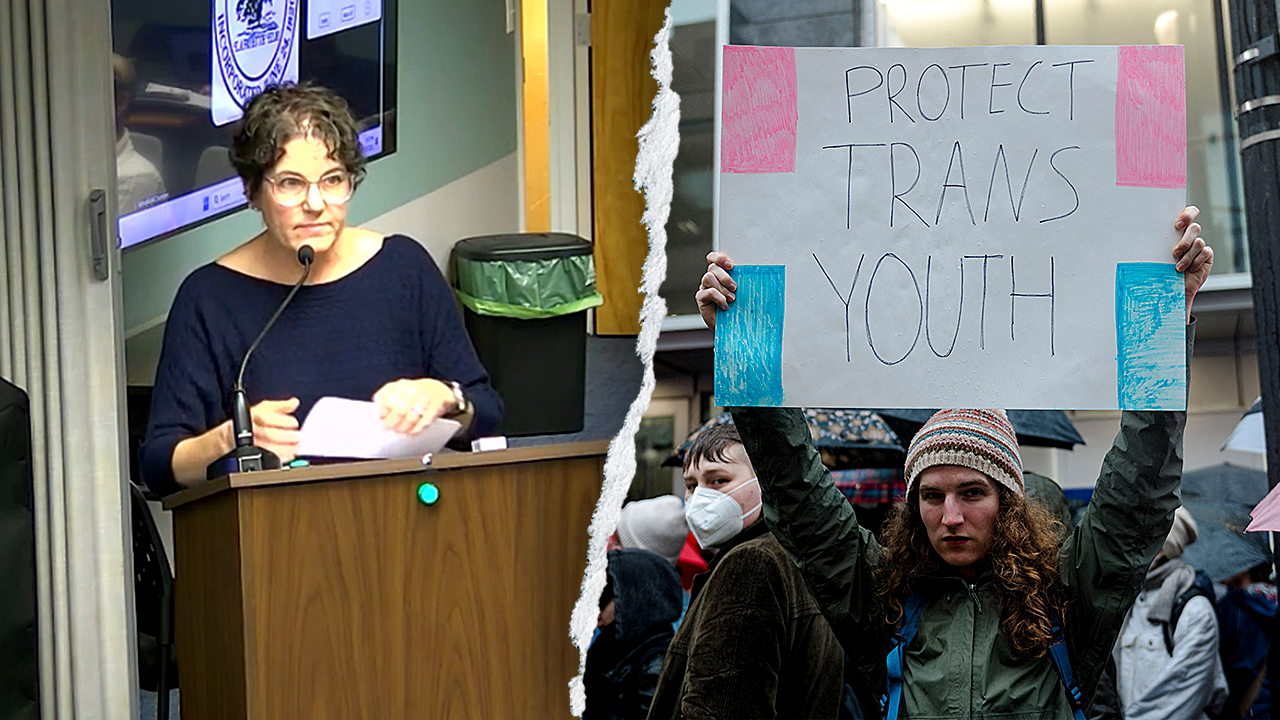
A Maine town Select Board member and school board liaison scolded critics of the district’s transgender policy. (Alejandra Villa Loarca/Newsday RM via Getty Images)
MAINE SCHOOL BOARD MEETING SEES WOMEN UNDRESS IN PROTEST OF TRANS ATHLETES IN GIRLS SPORTS, A GROWING TREND
She added that “their obsession with what is sitting in between the private parts of our students is nothing less than creepy and should absolutely be raising eyebrows in and around our school district.”
“Their obsession with genitalia points not to caring for the students in this district, but perhaps toward an underlying guilt for their own pedophilic tendencies,” she continued. “There is a registry for that.”
Her remarks drew gasps from those in attendance and a quick response from RSU 21 School Board Chair Matthew Stratford, who called her comments “inappropriate.”
“I don’t think that was inappropriate, and I stand by my comments,” Trentalange responded.
Transgender athlete supporters hold up signs as an overflow crowd converges outside the Riverside Unified School District meeting, Dec. 19, 2024. (Allen J. Schaben / Los Angeles Times via Getty Images)
FORMER NCAA SWIM CAPTAIN WARNS VIRGINIA ELECTIONS COULD DECIDE FUTURE OF WOMEN’S SPORTS
Her remarks sparked backlash from some in the community, prompting letters to the Kennebunk Select Board and calls for accountability on social media.
At an Oct. 28 Select Board meeting, John Salamone, a Republican candidate for Maine Senate District 31, accused Trentalange of violating the town’s code of conduct and urged her censure.
“When an elected official uses her platform to publicly slander citizens, she undermines the integrity of this board and erodes public trust in local government,” Salamone said. He called for her removal as liaison to RSU 21 and for a public apology.
Some residents echoed his criticism, while others argued that Trentalange’s comments were protected under state law and the First Amendment. Former RSU 21 Board member Lesley Stoeffler said, “Ms. Trentalange does not owe anyone an apology.”
Other residents and board members, speaking as private citizens, defended her right to free speech.
Leslie Trentalange refused to apologize for remarks at the school board meeting about transgender athlete policy critics. (Town of Kennebunk Select Board Meeting Screenshot/ANDREJ IVANOV/AFP via Getty Images)
“Vote them out, that is how democracy works,” Karen Plattes said in response to calls for punitive action. “Stifling free speech is not the way. And that doesn’t matter what side you are on.”
PARENTS: VIRGINIA BOYS SUSPENDED AFTER QUESTIONING TRANSGENDER LOCKER ROOM POLICY WERE IGNORED BY SCHOOL
“I personally feel that Leslie had 100% the right and the freedom of speech to say what she feels about any topic, just like any of us do, and I will always support my fellow board members,” Kortney Nedeau said. “I just know that as an elected official, for me, it is an ethical decision to never cross that line.”
During the same meeting, Trentalange acknowledged that her remarks may have “pushed some boundaries” but stood by them. She declined to apologize to those she criticized and instead expressed regret toward the “queer community.”
“If there are folks in the marginalized, queer community who feel my message did not serve them or hurt them in any way, it is that which I regret,” she said. “I do also regret any undue or undeserved backlash other members of the Select Board or town staff have felt over my comments as an individual.”
Trentalange said she would step down as liaison to the school board to avoid any “confusion” over her role with the school district when attending meetings. She remains vice chair of the Kennebunk Select Board.
President Donald Trump signs an executive order barring transgender female athletes from competing in women’s or girls’ sporting events, in the East Room of the White House, Wednesday, Feb. 5, 2025, in Washington. (AP Photo/Alex Brandon)
RSU 21, Trentalange and the Select Board did not return Fox News Digital’s request for comment.
CLICK HERE FOR MORE COVERAGE OF MEDIA AND CULTURE
In an Oct. 27 statement posted to Facebook, Stratford said the district’s transgender policy complies with the Maine Human Rights Act and will not be revisited this school year. He urged civility at future meetings and reminded residents that there is “no place for harassment, discriminatory language, or disrespectful words” during public comment.
CLICK HERE TO DOWNLOAD THE FOX NEWS APP
Read the full article from Here



Pennsylvania
Pennsylvania’s Lush Pittsburgh Suburb Has Green Spaces, Local Restaurants, And Quaint Charm – Islands

Western Pennsylvania is brimming with charming boroughs, and Plum is among the largest. Located about 20 miles east of downtown Pittsburgh, Plum was one of the original townships established in Allegheny County in 1788, and with a total area of 29 square miles, it’s the second-largest borough in Pennsylvania (and the largest in the county). That means plenty of room for parks filled with green spaces and riverfront land where residents and travelers can enjoy the outdoors.
With a population of around 27,000 people, Plum is a vibrant suburb known for its friendly and welcoming community. While it’s mostly residential, don’t take that to mean it’s boring. During the summer, you can get active on Plum’s hiking trails, sports courts, and climbing wall, or get immersed in the community at the annual Summerfest, which brings carnival rides, games, and food trucks to Larry Mills Park every June. Autumn is time for the yearly FallFest at Plum Creek Park, where adults can enjoy food trucks and craft beer, while the kids take a pony ride or explore the pumpkin patch. Come winter, you’ll find games, crafts, and other entertainment at the Plum Municipal Center’s WinterFest, or you can hit the ski slopes at Boyce Park. Whatever time of year you visit, Plum’s local restaurants and rich history give visitors a lot to explore.
Enjoy Plum Borough’s landmarks and tasty eats
Like many towns in Allegheny County, Plum Borough was a coal town for much of the 20th century. While the region’s last mine closed in 1987, that history is celebrated with the Coal Miner’s Memorial, which was created starting around 2008 and has a permanent home outside the Municipal Building. There are older landmarks to explore here, too, like the 1822 Carpenter Log House. Located inside Boyce Park, the house is maintained by the Allegheny Foothills Historical Society, which has furnished it with historic artifacts, including some owned by the original residents.
Visitors interested in colonial military history can take a stroll down Forbes Trail, the path taken by British General John Forbes on his way to Fort Duquesne in 1758, which follows Old Frankstown Road through Plum Borough. The trail also extends around 15 miles southeast to Hanna’s Town, a recreated Revolutionary War-era town just north of the overlooked cultural hotspot of Greensburg.
Foodies visiting Plum will want to check out its local restaurants. If you’re in the mood for Italian, Palmieri’s Restaurant is a family-owned spot with a history going back to 1956, serving classic steak, seafood, and pasta dishes. For more casual Italian fare, Pugliano’s Italian Grill has wings, sandwiches, and pizza, along with live music on certain days of the week (check the restaurant’s social media for its music schedule). Another local family-run favorite is Eighty Acres Kitchen & Bar, which serves upscale farm-to-table American cuisine like crab cakes, steak, and polenta fries. When you’re ready for a night out, Shooti’s Bar & Grille serves unique seasonal cocktails like Strawberries N’ Cream Martinis or Pineapple Margaritas, along with sandwiches, burgers, and a rotating menu of bar snacks. It also hosts entertainment like live music on the weekends and a karaoke night every Wednesday.
What to know about Plum’s parks and green spaces
There are lots of spots to enjoy the outdoors in Plum. The borough maintains four parks, in addition to green spaces maintained by Allegheny County. Plum’s largest outdoor recreation area is its 1,096-acre Boyce Park, which has activities for every season. When the weather’s warm, you can hike its eight trails, go rock climbing in the Bouldering Park, or take a dip in the wave pool when it’s open in the summer. In the winter, Boyce Park has the only snow tubing and downhill skiing hills in Allegheny County’s park system and hosts events like car shows and live music during the summer.
The northern border of Plum is along the Allegheny River, and this opens up more outdoor fun. Nature lovers can explore the Barking Slopes Conservation Area, where the wooded valley’s steep slopes provide challenging hikes leading to river views. It’s especially beautiful in the spring when the wildflowers are in bloom, and it houses lots of wildlife, including about 150 species of birds. Bird species consist of songbirds like Orchard Orioles, Yellow-breasted Chats, and Indigo Buntings, all of which are common in the spring and summer. Kayakers can also take a quick paddle to nearby Allegheny Islands State Park, a wildlife haven that can only be reached by boat.
This area of Western Pennsylvania is a great spot for golfers. The famous Oakmont Country Club, home to the hardest golf course in America, is just east of Plum. While that course is members-only, visitors can play at Rolling Fields Golf Club, a public par 70 course with a golf simulator and on-site restaurant. If you’re more into miniature golf, head to Willow Golf Range, which also has a driving range and batting cages.

PROVIDENCE, R.I. (WPRI) – A new tax on high-end Rhode Island homes that sit empty for most of the year took effect Wednesday, affecting thousands of property owners across the state.
Rhode Island’s Non-Owner Occupied Property Tax — also known as the “Taylor Swift tax,” a nickname inspired by the pop star’s estate in Westerly’s affluent Watch Hill neighborhood — is a new state-level tax on residential properties assessed at more than $1 million that aren’t occupied by the owner or a tenant for at least 183 days a year.
The tax is charged at a rate of $2.50 for every $500 of assessed value above $1 million, on top of the property taxes owners already pay to their city or town.
For example, Swift’s mansion, known as “Holiday House” or “High Watch,” is assessed at more than $28 million, according to Westerly land records. If it’s determined that she doesn’t occupy the residence for more than half the year, Swift’s tax bill would increase by about $136,000 annually under the new law, unless she qualifies for an exemption. (The law uses the assessed value set by municipalities and not the sales value.)
Revenue from the tax is earmarked for Rhode Island’s Low-Income Housing Tax Credit Fund, which is used to build affordable housing across the state.
R.I. Division of Taxation spokesperson Paul Grimaldi said, as of May, the state had identified 22,431 residential properties statewide with an assessed value over $1 million. Of those, 8,245 properties were flagged as non-owner-occupied and could be subject to the new tax.
The state sent notices earlier this year to owners who may owe the tax, explaining how they can seek an exemption.
Who qualifies for an exemption?
There are currently two ways to get out of paying.
A home can be exempt if it is rented long-term for more than 183 days a year or if the owner is running the property as a registered short-term rental (Airbnb-style) that’s booked more than half the year and paying the state’s lodging taxes.
Michael Pereira, president of the Rhode Island Association of Realtors, said the “Taylor Swift” nickname for the tax distracts from the financial impact the levy could have on property values.
“It romanticized the actual act,” he said. “She’s going to be paying over $130,000. It’s substantial.”
Pereira said his organization was caught off guard when legislative leaders slipped the tax into last year’s state budget at the last minute without the kind of public hearings that accompanied previous versions of the proposal.
“We were sort of blindsided by that,” he said. “We didn’t have any time to put together a survey.”
His chief concern is how the state will ensure the tax is administered fairly.
“People are going to receive bill notifications from the state who actually occupy the property or perhaps have a rental,” Pereira said. “Is there a lot of red tape to prove that you’re innocent and you don’t owe the tax?”
Pereira also raised the possibility that the tax could push part-time residents to sell, flooding the high-end market. So far this year, Pereira said Rhode Island home sales under $1 million are down 3% compared to last year, while sales over $1 million are up 8%.
Pereira said it’s too early to know whether the tax is the cause.
An earlier fiscal analysis prepared by the Division of Taxation projected that the tax would generate about $24.5 million in its first year, growing to more than $27 million by 2031, once more people come into compliance.
The analysis showed more than 90% of the homes subject to the tax were valued between $1 million and $5 million, 6% up to $10 million, and 1% up to $15 million. Less than 1% of homes subject to the tax were valued above that amount.
Property owners subject to the tax can pay in quarterly installments beginning Sept. 15 or in a single lump sum by that date.
“I just feel like the way we’re going about it … we’re deterring people to want to invest in Rhode Island,” Pereira said.

Political parties are quick to declare victory when the bills they support make it into law. But for Vermont’s Republican minority in the Legislature, it was the laws they succeeded in rolling back this year that seem to have the party celebrating just as much.
In a newsletter to supporters last month, Paul Dame, chair of the Vermont Republican Party, adopted a sweeping tone as he reflected on the 2026 legislative session that had ended just days before.
“If Vermont’s Republicans are not the most effective minority in any legislature in the country, then I’d like to hear who is,” Dame wrote in the email. The GOP accomplished its goals, he went on, “in ways that seemed impossible just two years ago.”
Two years ago, Vermont’s 2023-24 legislative biennium ended with Democrats enacting six bills into law that Republican Gov. Phil Scott had vetoed and that Scott’s GOP allies in the House and Senate broadly opposed. Democrats were able to do so because they had a supermajority of seats in both chambers.
But then, voters elected a wave of additional Republicans to the House and Senate that November — many if not all of them maligning some of those new laws on the campaign trail — and the political dynamic in the Statehouse changed.
In the two years since, Republicans enjoyed more committee leadership roles, which dictate which bills get airtime, and found an easier path to get some of their party’s priorities into law. Dame pointed, for example, to a 2025 law expanding state tax breaks for military retirees, something Scott had backed for years with no success.
READ MORE

Democrats still held a majority of seats in both chambers and so could set the agenda as they liked. They had their own priorities that they pursued, at times over many Republicans’ opposition, such as a new legal avenue for Vermonters to sue federal agents whom they allege have violated their constitutional rights.
But Republican leaders said that one of, if not their biggest, win of the 2025-26 biennium, which started last January and ended this May, was slowing or reversing some of the policies passed in the prior two-year period.
“Most of what Republicans did was apply the brakes,” Dame wrote in another newsletter last month. Even if the party succeeded in some ways, though, “there is still work to do in order to turn the car around and start moving toward prosperity instead of away from it,” he added.
Senate President Pro Tempore Phil Baruth, D/P-Chittenden Central, said the results of the 2024 election made it clear to him that his GOP colleagues would try to change some of what his caucus passed before.
“And that’s part of the democratic process,” he said in an interview. “The voters are the ones who decide. And so, given the change in the chamber, I think they accomplished some of their goals.”
Baruth agreed Republicans had a stronger voice in the Statehouse the past two years, but said he didn’t think that meant the legislative process was more confrontational.
“By and large it was not, every day, a struggle with an emboldened minority,” he said. “We worked very smoothly together — on what amounted to the Democrats’ agenda.”
The policies Republicans repealed was a focus for Gov. Scott at a press conference the week after the Legislature adjourned.
“We’ve now spent an entire session undoing harmful policies passed by the previous supermajority rather than making meaningful progress,” he said in early June.
‘The highlights of the session’
The most significant reversal Republicans say they won this year was to a slate of conservation measures included in a 2024 land use law, Act 181. That was one of the laws Democrats passed over Scott’s veto and opposition from the GOP.
Parts of the law aimed to loosen state reviews for new housing in already-developed areas. But at the same time — in response to climate change and habitat loss — the law added environmental protections for building projects in sensitive areas.
As state officials rolled out draft maps of these areas, ire from rural landowners, local officials and housing proponents bubbled up. Their opposition, which was echoed by Republican Lt. Gov. John Rodgers and GOP members of the House and Senate, also drew a large protest on the Statehouse steps in March.
After the Senate passed a bill delaying the implementation of some of those provisions, Democratic House leadership went a step further, and in an unexpected about-face approved a rollback of those measures entirely. That’s what lawmakers ultimately passed in May and Scott then signed into law.
Dame also pointed, in an interview, to how the 2025-26 biennium marked the end for the Clean Heat Standard, a 2023 law that Democrats also enacted over Scott’s red pen aimed at reducing the carbon emissions that come from heating and cooling buildings.
READ MORE

Democrats came into the 2025 session understanding the policy was dead. The state’s Public Utilities Commission had recommended against moving it forward over concerns about its cost to consumers and the fact Vermont had little to model the initiative on.
Many Republicans, who cited concerns over costs of the policy on the campaign trail in 2024, pushed for a formal repeal over the past two years, which would have been largely symbolic but that they argued would show a spirit of compromise. Language repealing the policy passed the Senate, but the House did not take it up before adjournment.
“Things like the Clean Heat Standard would have made things more expensive for Vermonters,” Senate Minority Leader Scott Beck, R-Caledonia, said in an interview. “So the ability to knock back those types of increases, and actually move the other direction a little bit — and then also to get (parts of Act 181) repealed — were probably the highlights of the session for Republicans.”
Republicans also flexed their legislative numbers in at least one other key instance this year. That was over a bill that sought to largely bar federal law enforcement officers, including U.S. Immigration and Customs Enforcement agents, from wearing masks.
When House Democratic leaders tried to bring a final version of the bill up for a vote on the final day of the session in May, House Republicans used a procedural move to block its consideration, killing the legislation. The move drew ire from Democrats, though not all of them supported the bill due to concerns a judge would find it unconstitutional.
Scott’s veto pen
At the same time, because Democrats could no longer override Scott’s vetoes on their own over the past two years, the likelihood of a bill getting rejected was at times enough for lawmakers not to advance it. A veto threat, for instance, was the reason at least some legislative leaders gave for why they did not pursue any policies that would help the state get on track to meet its carbon emissions reduction goals this year.
Scott leveraged that power throughout this year’s session. He spent months threatening to veto the state budget and key property tax rate-setting legislation if lawmakers did not advance a version of this year’s marquee legislation — an education reform plan — that he liked. Democratic lawmakers for a time contemplated whether the state government might shut down as a result, but they reached an education deal with time to spare.
The veto threat loomed over lawmakers’ decision to use more state revenue this year to again reduce property tax increases — a move backed by Scott. Lawmakers put $101 million in the coming fiscal year’s budget to “buy down” the average education property tax rate increase statewide.
Beck said Republicans’ increased numbers in the House and Senate could be directly tied to lower average increases in property tax bills. He contrasted the tax-rate setting legislation that Democrats enacted over Scott’s veto in 2024, which resulted in a 13.8% average increase in bills, to the versions of the annual bill enacted in 2025 and 2026, which set out an average increase of 1.1% and 3.5%, respectively. (Actual tax rate increases — or even decreases — have and will vary widely by town.)
“I think those are huge, huge wins,” he said Thursday.
To be sure, some Democrats, particularly in the Senate, voiced support for buying down property tax rates to the greatest extent possible from the beginning of this year’s legislative session.
“I told people on election night that I heard the message — and I do believe the message was primarily around the burden of the property tax,” Baruth said, referring to 2024.
The governor ultimately vetoed fewer bills over the 2025-26 biennium than he did in 2023 and 2024. In the more recent period, he rejected 13 bills, though one was over a technical error in how the bill was drafted and not a policy disagreement. Over the two years before that, he rejected 17. In 2023, that included the state budget bill, which lawmakers overrode.
Democrats came close to succeeding on one veto override attempt this year, over a bill that proposed a new regulatory framework for large data centers. Scott said he rejected the bill, which passed both chambers with overwhelming bipartisan support, because he thought the state’s existing land use regulations would be sufficient.
The House came just seven votes short of the threshold needed to overturn Scott’s veto. Senators did not attempt an override vote. Beck — who voted for the bill — said in a post-session newsletter to his constituents that he understood the governor’s decision, and that he was OK letting the legislation fall by the wayside.
The bill could well be an issue on the campaign trail this year. The Vermont Democratic Party slammed Scott’s decision in a social media post in early June, saying that the governor “sided with big tech and corporations over Vermonters.”
Baruth, who is not running for reelection, echoed that criticism.
“I think the Legislature should go hard on that next session,” he said.
-

 Ohio5 minutes ago
Ohio State Buckeyes Present Tough Offensive Challenge for USC Trojans
-

 Oklahoma8 minutes ago
Will Oklahoma Be Able to Replicate Febechi Nwaiwu’s Leadership on Offensive Line?
-

 Oregon13 minutes ago
We’re burning daylight! Oregon will lose about 50 minute of daytime by the end of July
-

 Pennsylvania20 minutes ago
Pennsylvania’s Lush Pittsburgh Suburb Has Green Spaces, Local Restaurants, And Quaint Charm – Islands
-

 Rhode Island23 minutes ago
‘Taylor Swift tax’ goes into effect in Rhode Island
-

 South-Carolina28 minutes ago
Horry County Fire Rescue contains 3 fires during busy Fourth of July night
-

 South Dakota35 minutes ago
Rapid City to host South Dakota Little League State Tournament
-

 Tennessee38 minutes ago
Tennessee Man Reaches For Item At Lowe’s. Then He Runs Into A Surprising New Touchscreen: ‘No Need To Wait’

