News
Video: U.S. and Iran Make Competing Claims Over Strait of Hormuz


new video loaded: U.S. and Iran Make Competing Claims Over Strait of Hormuz
transcript
transcript
U.S. and Iran Make Competing Claims Over Strait of Hormuz
The U.S. and Iran both claimed to have control over the Strait of Hormuz on Tuesday after the U.S. launched a naval effort to escort vessels through the vital shipping route. Some 1,600 ships are trapped in or near the waterway, which remains effectively closed.
-
These international waters belong to all nations, not to Iran to tax, toll or control. We’re not looking for a fight. But Iran also cannot be allowed to block innocent countries and their goods from an international waterway. Two U.S. commercial ships, along with American destroyers, have already safely transited the strait, showing the lane is clear. We know the Iranians are embarrassed by this fact. They said they control the strait. They do not.
By Christina Kelso
May 5, 2026



Top Senate Democrats are pushing for answers on whether a provision in a controversial settlement agreement between President Trump and his own administration applies to companies co-founded by or affiliated with the Trump family.
As part of a deal struck in May by the Justice Department to resolve a lawsuit brought by Mr. Trump, the Internal Revenue Service is permanently barred from pursuing claims against Mr. Trump, his oldest sons Don Jr. and Eric, and the Trump Organization based on prior tax returns.
In a one-page document signed by Acting Attorney General Todd Blanche and dated May 19, the Justice Department said the defendants in the president’s lawsuit — the IRS and the Treasury Department — are “FOREVER BARRED and PRECLUDED” from “prosecuting or pursuing, any and all claims” arising from tax returns filed before the settlement took effect. Blanche also wrote that the settlement applies to “parties including trusts, parent, sister, or related companies, affiliates, and subsidiaries.”
Now, Senators Elizabeth Warren of Massachusetts, Senate Minority Leader Chuck Schumer of New York, and Ranking Member of the Senate Finance Committee Ron Wyden of Oregon are pushing 11 businesses and organizations with ties to the Trump family to get answers for the “significant questions” the settlement raises relating to the tax audit provision, and whether the companies are included in the deal.
“Under the guise of a so-called legal settlement, the Trump administration has attempted to decree that the President, his family, and their entire business empire — potentially including entities with even the vaguest ‘affiliation’ to the family — are to face zero consequences if they have committed a range of financial crimes or misdeeds — regardless of the severity of the violation,” the senators wrote in letters transmitted to the companies Monday night.
The letters were sent to mining company Kaz Resources, defense firm Powerus, cryptocurrency companies World Liberty Financial and American Bitcoin, robotics startup Foundation Future Industries, investment firm 1789 Capital, private aviation company Tag Air, and prediction markets Polymarket and Kalshi.
All of the companies either were founded by Mr. Trump and his two adult sons, or list members of the Trump family as advisers, board members, or partial owners. Donald Trump Jr. sits on Polymarket’s advisory board and 1789 Capital, where he’s a partner, has invested in Polymarket. Days before Mr. Trump took office for his second term, Kalshi also announced Trump Jr. would be a strategic adviser.
The Democrats, who are in the minority, lack subpoena power, so Mr. Trump, his children and his companies can’t be forced to answer the questions posed by the senators.
According to recent financial disclosures, the president earned more than a billion dollars from cryptocurrency ventures alone last year, including from his meme coin business and World Liberty Financial, his family’s cryptocurrency firm.
Separately, the senators also asked the Trump Organization in a separate letter if it believes it has “immunity from all audits, civil penalties or federal prosecution” for any crimes that could have occurred before the settlement.
Trump Media and Technology Group, which is majority owned by a trust that lists Mr. Trump as the sole beneficiary and operates the Truth Social platform he uses daily, also received a letter from the Democratic senators.
“The public deserves transparency about the scope of this get-out-of-jail free card for Trump-aligned businesses, and about whether you intend to rely on this settlement as a free pass for any possible violations of the law,” the senators continued in their letter, which also seeks any communications that executives at the companies have had with the Justice Department and White House leading up to or after the settlement was signed.
The settlement was announced months after Mr. Trump and two of his sons and the Trump Organization accused the IRS and Treasury Department of unlawfully allowing a government contractor to leak tax returns to media outlets in 2020.
In a statement, a Justice Department spokesperson said “the IRS routinely provides releases as part of resolving taxpayer reviews and audits. This settlement follows that same standard practice.”
The spokesperson did not provide specific information about which companies are covered by the audit provision, or whether the Trump Organization and Trump family are the only entities covered by that addendum.

Charles De Ketelaere #17 of Belgium celebrates after scoring his team’s second goal during the World Cup Round of 16 match against the United States on Monday in Seattle.
Alex Grimm/Getty Images
hide caption
toggle caption
Alex Grimm/Getty Images
SEATTLE — This time was supposed to be different.
The U.S. men’s national team came into this FIFA World Cup with a lineup full of players with key roles in Europe’s top leagues. They had the name-brand coach — Mauricio Pochettino, of Tottenham, PSG and Chelsea fame. And they had homefield advantage, with every game on U.S. soil for the first time in three decades.

For weeks, the hype seemed like it might be real: The team’s three wins over Paraguay, Australia and Bosnia-Herzegovina were the most ever by a U.S. men’s squad in a World Cup. A new generation of American fans filled stadiums by the tens of thousands and tuned in on TV by the tens of millions.
But in the end, the Americans’ exit was the same as it ever was: Eliminated yet again in the Round of 16 at the hands of a European team — this time, Belgium, by a score of 4-1.
From the moment they stepped onto the Seattle field, the U.S. was outclassed by their opponent, No. 9-ranked Belgium. Countless turnovers and defensive lapses were seized on by the Belgians, who needed only nine minutes to take a 1-0 lead.

Then, once the Americans equalized on a free kick by midfielder Malik Tillman, Belgium scored yet again in barely a minute of play. Belgian forward Charles De Ketelaere scored both his team’s first-half goals.
After halftime, came an embarrassing nail in the coffin that silenced the Seattle sellout crowd for good — a 57th minute roll-in by Hans Vanaken after a slip-up by goalkeeper Matt Freese outside of the penalty area left the goal unguarded. Belgian forward Romelu Lukaku added a stoppage-time goal to seal the final score at 4-1.

Malik Tillman #17 of the United States celebrates scoring his team’s only goal during their World Cup match against Belgium. In what was one of the few bright spots of the game, the U.S. pulled even with Belgium at 1-1. The tie lasted less than two minutes before Belgium scored again.
Luke Hales/Getty Images
hide caption
toggle caption
Luke Hales/Getty Images
“It stinks,” said U.S. midfielder Tyler Adams. “Tonight was not a good performance overall. It’s not what we look to achieve. There [were] a lot of things that we could have done better.”
The U.S. had entered Monday’s game under a cloud of controversy around their striker Folarin Balogun, who was shown a red card in last week’s Round of 32 match against Bosnia-Herzegovina. An automatic one-game suspension was set to sideline Balogun, the Americans’ leading scorer at the World Cup, for Monday’s game.
Then, the day before the game, a FIFA disciplinary panel took the highly unusual step of delaying Balogun’s suspension by a year to allow him to participate. Then, news broke that President Trump had personally called FIFA president Gianni Infantino to encourage him to review the red card.
The Royal Belgian Football Association said it would protest Balogun’s inclusion in the lineup. But even at full strength, the U.S. were never real contenders in Monday’s game.
U.S. defender and team captain Tim Ream said the controversy swirling around the team had no impact. “We were fully focused on us as a group and as a team and fully focused on the game and not really worrying about what was being said or debated in the outside world.”
Belgium will advance to the quarterfinals for the third time in the past four World Cups, where it will face Spain on Friday in Los Angeles.

Mauricio Pochettino, Head Coach of the United States, walks down the touchline during the Round of 16 World Cup match between the USA and Belgium in Seattle on Monday.
Carl Recine/Getty Images
hide caption
toggle caption
Carl Recine/Getty Images
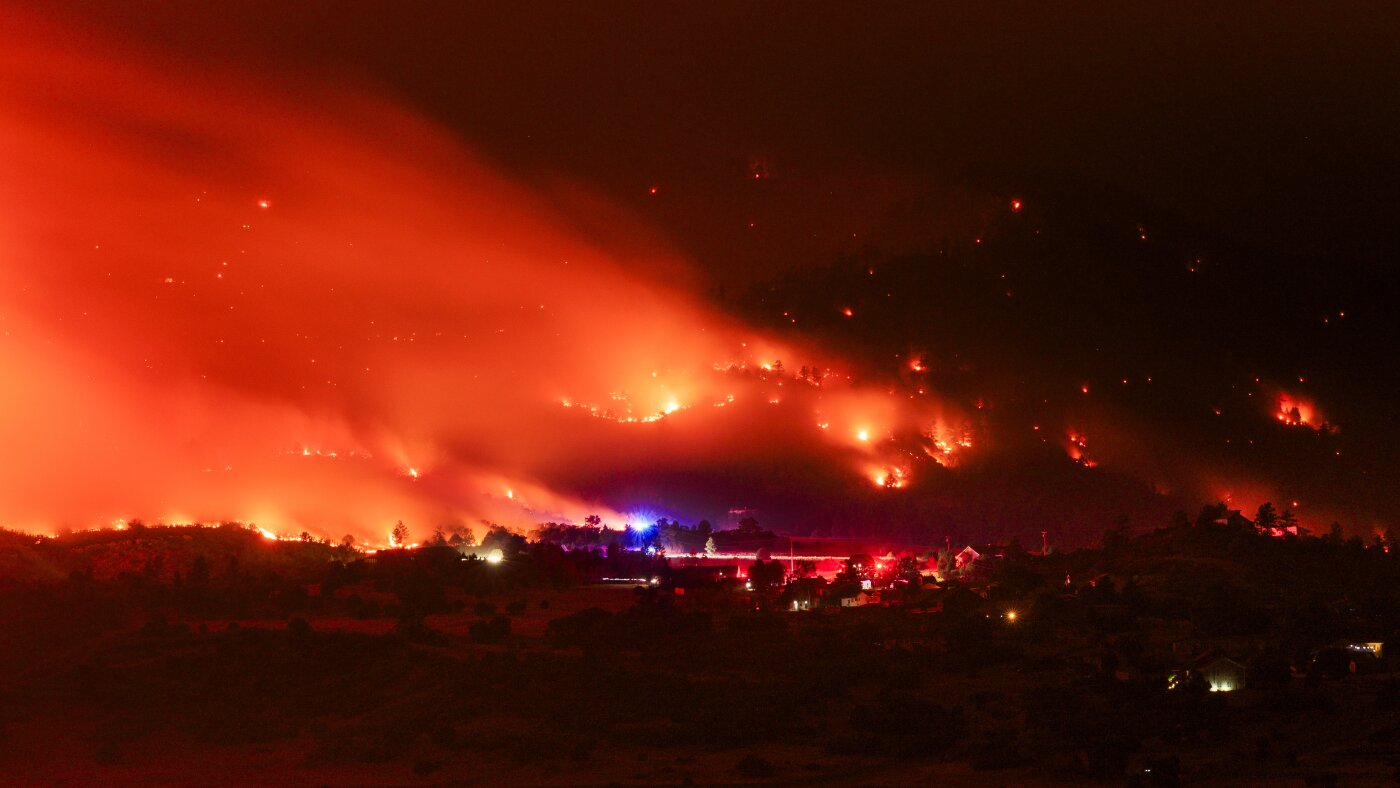
The Aspen Acres Fire burns on Friday in Rye, Colo.
Michael Ciaglo/Getty Images
hide caption
toggle caption
Michael Ciaglo/Getty Images
Thunderstorms with high winds on Sunday could hamper efforts to contain a massive wildfire that has scorched parts of southern Colorado.
The Aspen Acres Fire, which is burning south of Colorado Springs across Pueblo and Custer counties, has grown to more than 86,000 acres. It began nearly a week ago and is 13% contained, officials said on Sunday morning.

Authorities have ordered people to evacuate or to prepare to evacuate across counties including Custer, Pueblo, Huerfano and Fremont.
Scattered showers and thunderstorms could hit south central and southwest Colorado on Sunday, according to the National Weather Service.
Officials and forecasters say the rain could be beneficial for firefighting but are concerned it could lead to road damage in burned areas and cause flash flooding.
“The main threats from storms will be gusty outflow winds up to 50 mph and lightning,” the NWS office in Pueblo said.
Red flag warnings and air quality alerts have also been issued across the state, with the Colorado Department of Public Health and Environment on Sunday warning residents to limit time outdoors because of heavy smoke.
Other wildfires are burning in the state, including the Ferris Fire in southwest Colorado that has grown to more than 42,000 acres and is 7% contained as of Sunday afternoon. The Gold Mountain Fire, which is also in the southwest portion of the state, has grown to more than 25,000 acres and is 0% contained as of Sunday.
A memorial service was held on Sunday for three firefighters who were killed battling wildfires on the Colorado-Utah border on June 27: Emily Barker, Sydney Watson and Nick Hutcherson.
The firefighters, along with two others, were involved in a “burnover incident,” which happens when firefighters are overtaken and have to shelter as best they can while a fire passes directly over them, according to the Department of Interior. Two firefighters survived and were treated for burns.
Colorado Gov. Jared Polis ordered flags to fly half-staff in honor of the deceased firefighters.

“These three brave heroes ran towards the flames, put themselves in harm’s way, and gave the ultimate sacrifice to protect Coloradans, our communities and our families,” Polis said in a social media post on Sunday.
Another fire across the border in southern Utah, the Babylon Fire, has grown to more than 90,000 acres and is O% contained as of Sunday afternoon. It is expected to be hot and dry through Monday, with very little humidity, officials said, making conditions challenging for containment.
-

 Seattle, WA40 seconds ago
Disappointment on the field, but momentum on the streets
-

 San Diego, CA4 minutes ago
Community Calendar: La Jolla meetings and more, July 9-17
-

 Milwaukee, WI9 minutes ago
Opinion: Milwaukee teachers have more to give. Let’s give them the chance. | Milwaukee Neighborhood News Service
-

 Atlanta, GA16 minutes ago
Maryland kidnapping suspect taken into custody in Georgia
-

 Minneapolis, MN18 minutes ago
Man sentenced to federal prison for armed robberies of St. Paul bank, Minneapolis Walgreens
-

 Indianapolis, IN24 minutes ago
Advocates say new public camping ban criminalizes homelessness
-

 Pittsburg, PA31 minutes ago
Allegheny County park with 200-year-old trees joins network of
-

 Augusta, GA34 minutes ago
Local service members get more chances to expand their education

