Northeast
Democratic governor faces pushback from lynching research commission over reparations stance

NEWYou can now listen to Fox News articles!
Members of the Maryland Lynching Truth and Reconciliation Commission pushed back against Gov. Wes Moore’s objection to creating a reparations commission, asserting that their work ties directly to the immediate action he calls for.
“I mean, we’re doing it,” Nicholas M. Creary, a member of the commission, told Fox News Digital.
“If it goes according to plan. We’re going to be getting draft legislation introduced into session this year. So whether he thinks we need to talk about it or do more, my guess is that the reparations commission isn’t just going to necessarily study, but they’re also going to make recommendations for things to do,” Creary added.
The Maryland Lynching Truth and Reconciliation Commission released its final report last month after being established in 2019. The report is described as the first state-sponsored effort in the United States to investigate, document and “reckon with the history of racial terror lynching within its own borders.”
The Maryland Lynching Truth and Reconciliation Commission released its final report last month after being established in 2019. (Getty)
MARYLAND RECOMMENDS $100K PAYMENTS TO DESCENDANTS OF LYNCHING VICTIMS AFTER STUDY
Moore vetoed an effort to establish the Maryland Reparations Commission. His reasoning for vetoing the commission stemmed from a need for immediate action. The governor penned a letter stating that it was a “difficult decision” and also that “now is not the time for another study.”
In an interview with “The Breakfast Club’s” Charlamagne tha God, Moore explained that he is a “person of action.”
“Exactly. I mean, listen, what I said was, ‘I’m a person of action. I don’t need more studies.’ I’m like, ‘We’ve done four studies over the past 20 years on similar types of elements,’” Moore said in October. “By the way, one of which my wife worked on. And, so, when we’re now talking about doing a two-year study on something that I already know the answer to, I’m like, ‘What are we studying?’”
The governor’s veto was overridden by state lawmakers. The Maryland Reparations Commission would appoint 23 members to assess local, state and federal policies from the Reconstruction and the Jim Crow eras. The commission will recommend reparations ranging from cash compensation to a statement of apology.
While the members told Fox News Digital that the Maryland Lynching Truth and Reconciliation Commission is separate from the Maryland Reparations Commission, they defended their work, as it is similar.
Charles Chavis, who is part of the state’s Lynching Truth and Reconcilation Commission, said that their work could help address the more immediate issues the governor seeks to solve in regard to racial justice.
Among 84 recommendations, the Maryland Lynching Truth and Reconciliation Commission proposed that state leaders atone for the past through cash payments. The commission recommended that $100,000 per person be issued to descendants of lynching victims after a state-sponsored lynchings study. (OZAN KOSE/AFP via Getty Images)
“When we look at homelessness on the eastern shore – the various issues that have been plaguing Maryland’s eastern shore and other areas, there’s a direct line that can be drawn with some of these incidents of racial terror and racial violence that have yet to be addressed,” Chavis said. “The state has been aware of this. And so to take the governor more on this point, yes, let’s do something about it. And I think that is what the legislation is dealing with.”
UNIVERSITY OF ILLINOIS HOSTED STATE-FUNDED COMMITTEE MEETING WHERE PROFESSORS ADVOCATED FOR REPARATIONS
In their report, the commission concluded that state officials and institutions were complicit in 38 lynchings that followed the Civil War and that the perpetrators were never held accountable in any of the deaths. Among 84 recommendations, the group proposed that state leaders atone for the past through cash payments. The commission recommended that $100,000 per person be issued to descendants of lynching victims.
The recommendations consist of nine categories, including apology and acknowledgment of responsibility, symbolic reparations, material reparations, criminal justice, community healing, mental health, education, media and implementation.
MARYLAND GENERAL ASSEMBLY CALLED OUT FOR OVERRIDING GOVERNOR’S VETO ON ‘FOOLISH’ REPARATIONS COMMISSION
The commission members said that reparations are bigger than monetary compensation. Commission member David Fakunle said there is no cost to educating the public about the truth of Maryland history.
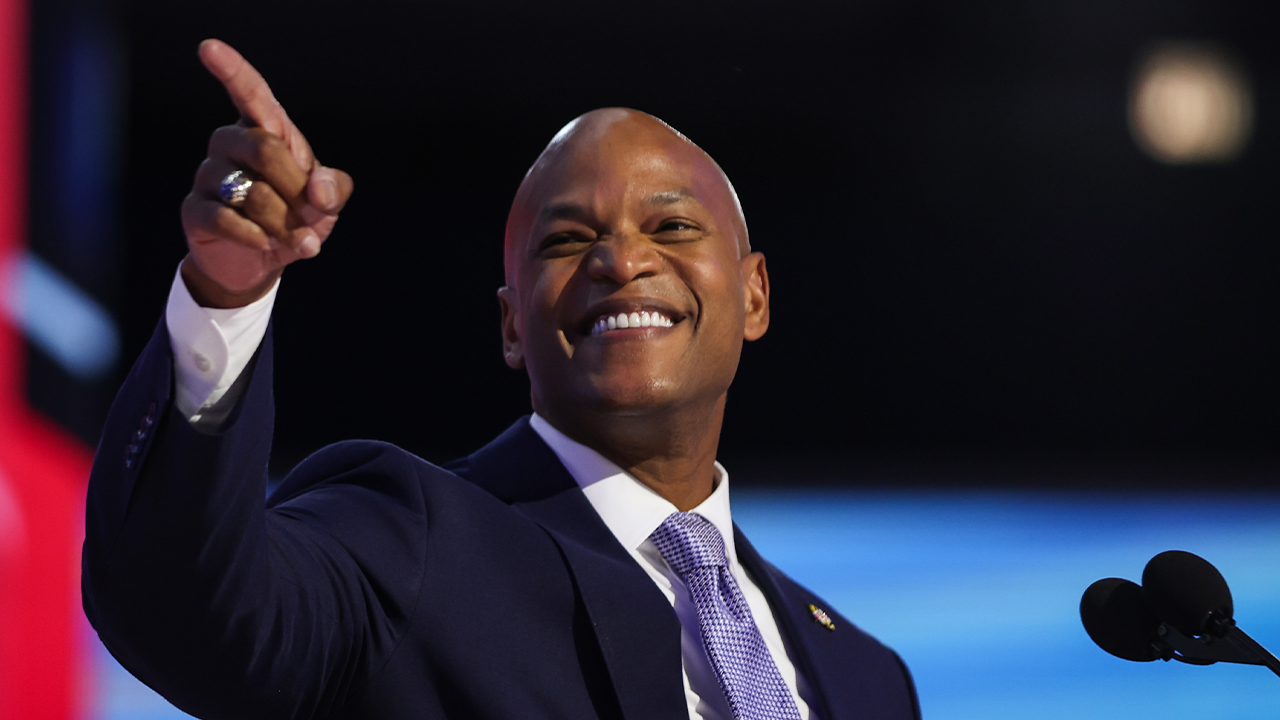
Maryland Gov. Wes Moore vetoed an effort to establish the Maryland Reparations Commission. His reasoning for vetoing the commission stemmed from a need for immediate action. The governor penned a letter stating that it was a “difficult decision” and also that “now is not the time for another study.” (Andrew Harnik/Getty Images)
“There are a lot of these things that can happen with no cost at all, and can certainly be the utilization of resources that are already being applied to certain elements of the state’s running, so to speak. And so we have to be patient. We know about patience when it comes to this work,” Fakunle told Fox News Digital. “We don’t want people to reduce the repair of this legacy to money. That is very limiting, because first and foremost, we should not put a price tag on a person’s life, although we are doing it in this case. But what we are acknowledging is that there are so many things that allow this to happen without any accountability.”
Chavis said one of the reasons he’s proud of the report is because it addresses the issues Moore has expressed.
“Our report should do nothing more than provide additional evidence as to why the present day reform is needed. But we can’t pretend like these injustices and this harm and the community issues have just happened out of nowhere. They have a history and there’s a legacy attached to the community’s suffering that needs to be alleviated,” Chavis said.
Moore’s office did not immediately respond to a request for comment.
Read the full article from Here



Florida’s tallest flag pole raises new Stars and Stripes on Independence Day
Florida’s tallest free-standing American flagpole now stands 250 feet tall at Bernice Braden Park in Cape Coral
You might have seen Connecticut’s state flag in government buildings and schools and wondered what the meaning was behind its design.
Adopted by the General Assembly in 1897, the Flag of Connecticut features a navy blue background with a white shield. Three grapevines with purple grapes are on the shield and oak leaves and acorns can be found on the shield’s edge.
Below the shield is a banner which features the phrase “Qui Transtulit Sustinet” written in Latin. According to ConnecticutHistory.org, that phrase translates to “He who transplanted still sustains,” which honors the colonists who moved to the state from England.
Per Encyclopedia Britannica, the three grapevines have two competing interpretations: they represent either the three oldest settlements in the state (Hartford, Wethersfield and Windsor) or the three colonies that merged to form Connecticut (Connecticut Colony, Saybrook Colony and New Haven Colony).
Why is the Connecticut flag blue?
According to ConnecticutHistory.org, the blue comes from Connecticut’s Civil War military flags. During the Civil War, Connecticut regiments had flags featuring blue backgrounds. ConnecticutHistory.org reports that when the legislature adopted an official flag in 1897, they kept the color that military tradition had already established.
Origins of Connecticut’s state flag
Per ConnecticutHistory.org, Connecticut did not have an official state flag until 1897. The site reports that in 1895, the Anna Warner Bailey Chapter of the Daughters of the American Revolution in Groton pushed for an official flag to display in their new meeting room.
Governor Owen Vincent Coffin introduced a bill on May 29, 1895, which ConnecticutHistory.org says caused the legislature to subsequently form a committee. After several designs were submitted, the Connecticut General Assembly adopted the flag in 1897.
Connecticut’s coat of arms, which includes the shield, grapevines and banner featured on the state flag, was not formally standardized until 1931, according to USASymbol.com. The website also says color standards for the flag came in 1956, when the Secretary of the State’s office developed uniform specifications.

Maine Senate hopeful, Democrat David Costello, speaks with a potential voter as he gathers signatures, required to be considered at the party’s convention, in downtown Brunswick, Maine on July 12.
Tamara Keith/NPR
hide caption
toggle caption
Tamara Keith/NPR
BRUNSWICK, Maine – On a sunny Sunday, Senate hopeful David Costello worked the sidewalk in downtown Brunswick asking for signatures.
“Woud you happen to be a registered Democrat?” he asked one woman before engaging in a back and forth conversation. She asks if he’s progressive.
“Very progressive,” Costello said.
Costello is one of several Maine Democrats who see the fall of Graham Platner’s senate campaign as an opportunity to represent Maine in Washington.
Platner won June’s Democratic primary election handily. But allegations of rape by a former romantic partner last week forced him to drop out of the race. It leaves Maine Democrats scrambling to find a new nominee before the July 27 deadline to put a name on the ballot. Platner denies the allegations.
The Maine Democratic Party will hold a convention on July 25 where 601 delegates will choose that nominee. That candidate will need to capitalize on the enthusiasm Platner generated to defeat Republican Sen. Susan Collins.
An unstoppable incumbent or a top pick-up opportunity?

Sen. Susan Collins, R-Maine, leans down to listen to a young paradegoer at the annual Moxie Day Parade is Lisbon, Maine on July 11.
Susan Sharon/Maine Public
hide caption
toggle caption
Susan Sharon/Maine Public
Collins remained quiet at the end of Platner’s campaign but at the annual Moxie Day parade Saturday in Lisbon, Maine, she walked with volunteers in red shirts.
“People appreciate the fact that I provide steady leadership — and the word steady does come up a lot,” Collins said at the parade, “and that I continue to work really hard for Maine.”
Collins has represented Maine in the Senate since 1997. She has managed to stay in her seat even as Maine has voted for Democrats for president statewide, including in 2020 when the state voted for Joe Biden. Collins last won reelection that year with a comfortable margin — more than 8.5%.

At the annual Moxie Day Parade in Lisbon, Maine, supporters of Sen. Susan Collins, R-Maine, march with signs and giant letters spelling S-U-S-A-N, on July 11.
Susan Sharon/Maine Public
hide caption
toggle caption
Susan Sharon/Maine Public
Democrats see Maine as pivotal to their chances to retake the Senate. Platner’s departure from the race puts pressure on the party to choose a replacement candidate who can win over Platner’s loyal voters and appeal to independents who are key to Collins’ electoral success. Maine state Senate President Mattie Daughtry, a Democrat, is encouraged to see many of the candidates running on Platner’s progressive platform of transformational change. But she’s worried about voters being turned off by the process.
“I do have that deep seated concern of how many folks are going to say ‘oh well, this man failed me. Why trust someone ever again?’” Daughtry said.
Daughtry did not endorse Platner and she quickly called on him to drop out of the race after the rape allegations surfaced. Still, she thinks his message resonated.
“I ran for office when I was 25 because I was really really angry. I was working 4 jobs. I couldn’t afford an apartment and I had no healthcare. And unfortunately that story has not changed and it is a lived reality for millions of us across this country,” Daughtry said.
“And we need to find who can pick up that mantle. Who understands what that life is like and really tap into that raw energy,” she added.
Supporters weigh what’s next
Just one month ago, Alan Crichton was playing saxophone at Graham Platner’s primary night victory party. At a brewery in Belfast, Maine this weekend, he noted his ambivalence.
“I have so many mixed feelings. I like the guy. I like his message a great deal and I think he galvanized people who are just kind of sick of what’s happening,” Crichton said.
Now, though, Crichton calls the situation “a big old mess.” As a Democrat, he hoped the charismatic populist Platner would be the one to finally knock out Collins. Though, at this point, he’ll vote for whoever the Maine Democratic party selects.
“I hope it’s somebody who can kind of carry the torch that Graham kind of lit and held out there very strongly. He was a very inspiring guy,” he said.

Joseph Berube of Northport, Maine, gave up on politics in 1972 after Democrat George McGovern lost the race for president in a landslide. This year, though, he got excited about Graham Platner’s candidacy for U.S. Senate.
Tamara Keith/NPR
hide caption
toggle caption
Tamara Keith/NPR
Joseph Berube is an independent voter who lives in Northport, Maine. After decades disengaged from politics, Graham Platner sparked something in him he could hardly believe.
“Because I am so apolitical,” Berube said, “I want nothing to do with it. [But] I was actually considering giving money to his campaign.”
Charlotte Agell is on the opposite end of the engagement spectrum. A registered Democrat, she is very politically involved and has been for decades. She met Platner early on in his campaign.
“One of our neighbors said, ‘hey would you like to come to my backyard and meet Graham Platner?’ I had sort of heard of him,” she remembered. “When I went to that back yard event, I just by happenstance walked in with him. It was me and Graham Platner walking in.”
By the time that event ended, she had signed up to volunteer for his campaign.
“I felt a kinship with everything that was coming out of his mouth basically. Very smart. Good at identifying the problem,” Agell said.
Core to Platner’s economic populist message was that the system has been failing regular people while the rich and powerful get more rich and more powerful. He had faced controversies throughout his campaign. He easily won the nomination anyway. But then came the rape allegation. Berube believes the rush to judgment was too swift.

“I agree with women’s rights and women shouldn’t be abused,” he said. “But to have one person come up and stand up and say, ‘he abused me,’ and then that’s it? It’s just not really fair to him.””I just think they didn’t want him,” Berube added.
Berube says Democrats chopped the legs out from under someone who had brought people back into politics.
“He was bringing in people like me and that’s what’s going to do this. And you know what, we’re in the middle of a war to save this country,” Berube said. “And we have the other side that’s fighting with the gloves off and we’re putting the gloves on. We’re in trouble.”
Charlotte Agell has been processing it all a little differently. Agell admits to being a chronic optimist but says this was never about one man.
“You know, we’re not a cult. We’re just a movement that wants to take back this country for the middle and the working class,” she said.
Agell wants to believe this massive disruption won’t sap the momentum for change she felt.
“It’s really been like a rocket ship. We’ve all been on it. And that’s why, when these very serious things have been alleged and rightly he has dropped out of the race, we’re kinda still flying at 90 million miles an hour and saying ‘who can take the controls’ and we’re going to figure that out,” Agell said.
State Senator Chip Curry says the state party is doing the best it can with a tight timeline.
“It’s a winnable race and we’ve got some great people. We’ve got to get there,” Curry said.
There are more than half a dozen announced candidates. And for Democrats the stakes couldn’t be higher. No clear frontrunner has emerged from the candidates who have put themselves forward to be considered. It’s also not clear if one candidate can capitalize on the momentum that Platner was building in Maine. Still, some are remaining optimistic.
“People are going to grumble. I’ve grumbled a little bit. But I think we’ll get through this,” Senate hopeful David Costello predicted. “I think whoever the nominee is will have tremendous support.”

Medford native Maria Menounos hosting ‘Heal Squad Day of Reset’ in Yarmouth
Medford native and celebrity Maria Menounos is hosting ‘Heal Squad Day of Reset’ at Red Jacket Beach Resort & Spa in Yarmouth.
Looking for a beach where fellow beachgoers have good manners?
Travel website Exoticca conducted a survey and found the beach with the best beach etiquette in each state, including Massachusetts, so you can know the place where Bay Staters treat both the beach and each other with the most respect.
“We surveyed 3,011 Americans to find out where beachgoers are seen as having the best etiquette, and the results say quite a lot about what people actually want from a beach vacation,” Exoticca said.
In Massachusetts, voters said to head to the North Shore.
Crane Beach — Ipswich, Massachusetts
The extremely popular Crane Beach in the North Shore town of Ipswich was voted the best for beach etiquette by Exoticca’s readers.
Exoticca said that the places that scored the highest in positive beach etiquette were places where people focused on the clarity of the water and the beautiful scenery rather than external distractions like seaside restaurants or shops on the boardwalk, where “everyone around seems to understand that nobody wants the place spoiled.”
Crane Beach is known for its white sand and conservation. It’s one of the nesting places for piping plovers, according to The Trustees.
“To protect threatened shorebirds during your visit, we ask that you avoid the fenced nesting areas and the wrack, the line of washed-up organic debris where the birds feed and hide,” the Trustees said.
Despite having 350,000 people visit annually, according to the Trustees, Crane Beach still achieved the top spot of beach etiquette.
How to visit Crane Beach
Barring going on Martin Luther King Jr. Day or on Veterans’ Day for families with veterans, visitors do have to buy tickets for vehicle entry and parking. Tickets are cheaper if visitors arrive via motorcycle, biking, or walking.
“Strict rules apply: no drop-offs, re-entry for nonmembers, or outside food delivery; dogs and horses are not allowed April 1–September 30,” the ticket selection webpage said.
Rin Velasco is a trending reporter. She can be reached at rvelasco@usatodayco.com.
-

 Colorado4 minutes ago
Colorado’s Front Range Passenger Rail eyes stops at future Broncos, Summit stadiums
-

 Connecticut10 minutes ago
Why Connecticut’s flag is blue and what its symbols stand for
-

 Delaware16 minutes ago
A Delaware taste of summer since 1957 is now being sold in Hockessin
-

 Florida22 minutes ago
Skunks, warthogs & monkeys, oh my! Here’s what Florida records reveal about 140+ captive animal escapes since 2022
-

 Georgia28 minutes ago
Georgia football defensive depth chart entering fall camp
-

 Hawaii34 minutes ago
Hilo woman killed in Kona traffic crash – West Hawaii Today
-

 Idaho40 minutes ago
Idaho Falls City Council delays vote on proposed alcohol ordinance – Local News 8
-

 Illinois46 minutes ago
2 teens arrested after 5 family members killed in Illinois shooting

