Northeast
Alvin Bragg's prosecutors pivot to nailing Danny Penny, cross line in court

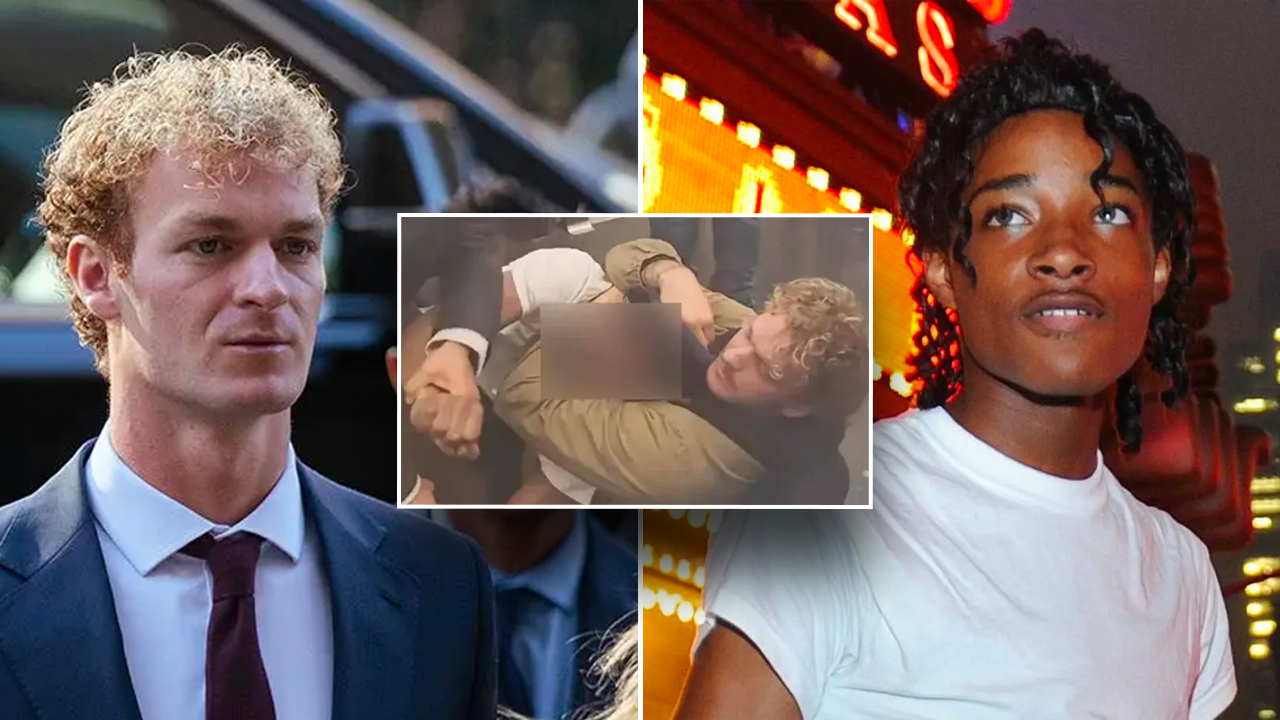
NEW YORK – Dr. Satish Chundru, a Texas forensic pathologist working for Daniel Penny’s defense as he fights charges for the subway chokehold death of Jordan Neely, returned to the witness stand Friday for a second day of grilling.
Penny, a 26-year-old Marine veteran and architecture student, grabbed the 30-year-old Neely in the middle of a schizophrenic, drug-fueled outburst on a subway car that witnesses said included death threats and had them fearing for their lives. Although Neely still had a pulse when Penny let go, he later died.
Contrary to the official autopsy report conducted by Dr. Cynthia Harris of the New York City Medical Examiner’s Office, Chundru testified that he does not believe a chokehold caused Neely’s death.
DANIEL PENNY DEFENSE CALLS FORENSIC PATHOLOGIST TO WITNESS STAND: ‘THE CHOKEHOLD DID NOT CAUSE THE DEATH’
Dr. Satish Chundru leaves the courtroom during a recess in Daniel Penny’s New York City manslaughter trial at Manhattan Supreme Court in New York City on Thursday, Nov. 21, 2024. (Rashid Umar Abbasi for Fox News Digital)
During a grueling cross-examination, Assistant Manhattan District Attorney Dafna Yoran grilled Dr. Chundru on the connection between sickle cell trait and death in other cases, prompting repeated objections from the defense.
At one point, Judge Maxwell Wiley cut her off and said “we’re not doing that.” But the questioning continued through more objections before the court went to recess.
Before jurors returned, the defense argued that Yoran improperly brought up the term “homicide,” a misstep that happened earlier in the trial as well.
Wiley said he did not want to strike the back-and-forth. When the jury returned, he told them that “homicide” means something different to a medical examiner than it does to a lawyer or a jury and asked them not to weigh the witness’ use of that word when weighing facts of the case.
Daniel Penny walks in the hallway of Manhattan Supreme Court on Tuesday, November 19, 2024. Penny, a Marine veteran, is charged with second-degree manslaughter and criminally negligent homicide in the 2023 death of Jordan Neely on a New York City subway train. (Rashid Umar Abbasi for Fox News Digital)
It was the second time that the word “homicide” came up controversially and prompted the defense to raise an objection. Earlier this week, Wiley ordered the first comment stricken, when Dr. Harris mentioned that “all homicide reports” were reviewed by another doctor in the city medical examiner’s office.
Not all homicides are criminal, and the defense argued that the prosecution’s repeated espousal of the word could confuse the jury.
The defense asked the court to note for the record that they have had several conversations, and the DA’s office agreed that bringing up testimony from forensic pathologists regarding death as a “homicide” would be misleading to the jury.
The first time, it came from Dr. Harris. The second, the defense said Yoran said the word as part of her questioning. She denied it. The judge said he would review the transcript later and issue additional jury instructions if necessary.
Jordan Neely is pictured before going to see the Michael Jackson movie, “This is It,” outside the Regal Cinemas on 8th Avenue and 42nd Street in Times Square in New York City in 2009. (Andrew Savulich/New York Daily News/Tribune News Service via Getty Images)
While Penny’s team has maintained that his actions were justified, that’s not their only line of defense, according to Louis Gelormino, a New York City defense attorney who is closely following the case.
“One of the other defenses is, ‘Well, I didn’t kill him. My actions weren’t the cause of death,’” he told Fox News Digital Friday. “So yes, it doesn’t make a difference if it was justifiable. But if his actions weren’t justifiable, the jury could also say, ‘Hey, [his] actions didn’t kill him. He died because of the other things going on in his body.’ And that’s why that’s relevant.”
Chundru, a former Miami-area medical examiner who now runs a private practice in Texas conducting autopsies in a half-dozen counties, has testified that he did not believe an air choke caused Neely’s unconsciousness and, therefore, did not cause his death.
Rather, he blamed it on “the combined effects of sickle cell crisis, the schizophrenia, the struggle and restraint, and the synthetic marijuana.”
Dr. Cynthia Harris arrives for Daniel Penny’s trial at the Manhattan Criminal Court building in New York City on Friday, Nov. 15, 2024. Penny, a Marine veteran, is charged with second-degree manslaughter and criminally negligent homicide in the 2023 death of Jordan Neely on a New York City subway train. (Adam Gray for Fox News Digital)
Dr. Michael Baden, a former New York City medical examiner and leading forensic pathologist, disagreed with Chundru’s testimony.
“Dr. Chundru’s testimony may have been very interesting, but it was wrong,” he told Fox News Digital. “He described what can happen in sickle cell disease, not what happens in sickle cell trait, which Neely had. Eight percent of Black people in this country have sickle trait, which is a benign medical condition that rarely causes any symptoms, let alone death.”
At the autopsy, Harris found significant “sickling” on Neely’s organs, she testified, and lawyers on both sides asked for an explanation. She said the condition did not contribute to Neely’s death, and she blamed it solely on asphyxiation from the chokehold.
“Sickle trait red blood cells do sickle after death, when the body’s oxygen supply disappears and can be seen at autopsy – as with Neely or with anyone with sickle trait dying from any condition,” Baden said. “It’s a post-mortem artifact like rigor mortis. Further, death from sickle disease takes days of sickling to occur; it can’t occur in seconds as happened to Neely.”
Screenshot from bystander video showing Jordan Neely being held in a chokehold on the New York City subway. (Luces de Nueva York/Juan Alberto Vazquez via Storyful)
DANIEL PENNY TRIAL: SUBWAY MADMAN CLAIMED HE HEARD TUPAC AND DEVIL BEFORE DEADLY CHOKEHOLD, SHRINK SAYS
However, he said, even if the chokehold caused Neely’s death, it is not up to the medical examiner to decide whether that was criminal.
“The individual circumstances are important as to whether the death could [or] should have been avoided, and whether the death should be prosecuted, which is entirely up to the prosecutor,” he said.
Penny faces up to 15 years in prison if convicted on the top charge of manslaughter. He also faces a charge of criminally negligent homicide.
It was not immediately clear whether he would take the stand in his own defense, although some experts have suggested it is likely that he will because it is a self-defense case.
Read the full article from Here


The preliminary injunction ordering SchoolCare to continue paying Dover educators’ health care claims may have implications for the 89 other school districts that paid SchoolCare’s special assessment, according to Anthony Carr of Shaheen and Gordon.
“This could be significant for those 89 other towns and districts,” said Carr, who is representing Superintendent Christine Boston in the lawsuit against SchoolCare.
SchoolCare threatened to stop paying claims on May 1 if Dover failed to pay a special assessment of $1.7 million above and beyond its normal monthly premium in order to cover the insurance risk pool’s losses. Dover refused to pay the special assessment, arguing that it was illegal.
Superior Court Judge John Curran, finding that school employees covered by SchoolCare could face “irreparable harm,” ordered SchoolCare to continue to pay “covered healthcare claims of Dover employees, spouses, dependents, and retirees.”
Curran also found that if the case went to trial, Dover would “likely succeed on the merits” of its case.
Whether the case will go to trial remains an open question, as the judge has not ruled on the claims of SchoolCare and the New Hampshire Secretary of State that the court is not the proper jurisdiction for Dover’s complaint.
“The court will duly consider the important jurisdictional question this case presents in ruling upon those pending motions to dismiss …,” Judge Curran wrote. “For the purposes of this motion, the court finds that the plaintiffs have a sufficient likelihood of establishing jurisdiction at this stage.”
Carr said the order for the preliminary injunction is “very helpful, very favorable.” However, the only “asterisk” is that there is a pending motion to dismiss for lack of jurisdiction.
Favorable ruling hinges on pending jurisdictional argument
Both New Hampshire Secretary of State David Scanlan, through the New Hampshire Bureau of Securities Regulation and its counsel, which intervened, and SchoolCare, have filed motions to dismiss the case with jurisdictional arguments.
“The Bureau respectfully asks this Court to dismiss the District’s Complaint in its entirety because the claims contained therein fall under the Bureau’s exclusive jurisdiction and authority and are best submitted to the Bureau’s administrative enforcement mechanism,” according to court documents.
SchoolCare has argued the plaintiffs can’t show a “likelihood of success on the merits” as the matter needs to be brought before the secretary of state, not the Superior Court.
“Basically, SchoolCare and the Secretary of State are trying to argue that none of these claims brought by Dover, none of these claims brought by Dr. Boston, should be in any court in the state, and these are all issues that should be squarely and solely resolved by the Secretary of State. So that’s really the only lingering issue in that regard,” said Carr.
The lawyer said they’re “hopeful,” based on their comprehension of the law, that a “favorable ruling” will soon come out on the jurisdiction argument.
“Once the jurisdictional issue is resolved, it will be much more clear that the 89 towns and districts likely have causes of action, similar breach of contract actions against SchoolCare to recoup the funds that they were forced to pay under duress, and SchoolCare may not have had a lawful basis to request or receive those funds,” Carr said.
89 members who paid assessment could follow Dover’s lead
Carr explained what the preliminary injunction could mean to the other districts and towns.
“If the jurisdiction were to get resolved favorably, then what those 89 towns and districts would be able to do is piggyback this order, which although it’s directly granting a preliminary injunction, what it’s inherently doing as part of that is saying that we are likely to succeed on the merits of our claim. And one of those claims is the breach of contract claims. So, if we were to be successful on jurisdiction, those other 89 towns and districts would be pretty wise to say that they very well may have viable claims as well,” said Carr.
“This order recognizes that all 89 of those towns and districts may have legal rights to recoup those funds and redeploy them for the betterment of their communities and children, including going toward educational services and staffing. I hope that other towns and school districts will follow the lead of Dover and Dr. Boston and stand up to SchoolCare and demand what’s right,” Carr said in a press release.
He called the judge’s ruling a “huge win for Dover.”
He highlighted one of the immediate results being that district teachers and staff “don’t have to worry about coverage stopping in the middle of a policy period. That’s amazing. We heard stories about a kid who was scheduled to have heart surgery. I believe a staff member needed a kidney transplant. And so, the stakes are very high. And these are people, real humans in Dover, who were worried about how this might go,” said Carr.
“On the flip side, if Dover was forced to pay the ransom, we offered testimony that $1.7 million is the equivalent of about 16 and a half full-time salaries. And we’ve seen in other towns and districts, not just the budget being thrown into crisis, but again, real humans with families being laid off. So it both preserves the status quo for the health coverage for all the fantastic teachers and staff in Dover. And it also, at least for the time being, precludes great teachers and staff within Dover from being laid off,” Carr said.
“I would not want to be the 89th or the 88th town or district that pursues recourse. I think it’s important to act urgently,” said Carr. “I guess I’m on a bit of a personal mission to kind of see all these issues through and to make sure that SchoolCare does not benefit from its own improper conduct. So, we will see what the future holds, but I may very well be representing some of these towns and districts. I would say there’s really no need for any of the towns and districts to wait (for the jurisdictional issue),” said Carr.
Portsmouth agreed to pay assessment ‘under protest’
Trevor McCourt, Portsmouth’s deputy city attorney, said “the city of Portsmouth has not made payment on the $1.57 million assessment at this time. We’ve made arrangement to make that payment by July 15th of this year, and the City Council’s vote was specifically to authorize that payment under protest.”
McCourt said “the last act of the City Council was to agree to make that payment under protest. Certainly, I don’t know what the plan will be moving forward. We plan to make the payment. We continue to make our monthly payments.”
He said they’re “certainly encouraged” by the ruling out of the Strafford Superior Court, and that he personally has already commented “pretty publicly, I agree with the position that Dover is taking.”
What’s next for the case?
Carr said right now, they have “a laser focus on an order on the jurisdictional issue, just so we can make sure that we’ve got the green light to keep these claims in court where we feel like they belong.”
Carr said if they receive a favorable ruling on jurisdiction, they’re attention will be on prosecuting their case and going to trial if needed.
“One of the elements of getting a preliminary injunction is the court has to find a likelihood of succeeding on the merits, meaning that the court is not quite, but kind of pre-adjudicating whether our claims are going to win or not,” said Carr. “So, for the court to find at this early stage that we’ve met that threshold is a great indication, but it doesn’t necessarily mean game over. What it means game over for is that Dover does not have to pay the $1.7 million now. The case will proceed on a 12-month trial track after this, and whether it’s through a jury trial or through pre-trial briefing, we will be hopeful to get a result saying that we never have to pay the $1.7 million.”
New Jersey
How a ‘Haunted’ House in New Jersey Inspired the Sinister New England Setting for Matthew Rhys-Led Hit ‘Widow’s Bay’

The acclaimed Apple TV series “Widow’s Bay” has become the latest streaming sensation to captivate viewers and critics alike—earning rave reviews across the board, thanks to its witty dialog and dark, eerie undertones.
Starring Matthew Rhys, Kate O’Flynn, and Stephen Root, the series, which premiered on April 29, is set in a fictional New England town for which the show is named, and focuses on the efforts of the local mayor, Tom Loftis, to turn the quaint locale into “the next Martha’s Vineyard.”
Yet Loftis, who is portrayed by Rhys, runs into one major hurdle in his scheme: Widow’s Bay, while both charming and picturesque on the surface, is also plagued by a series of unexplained supernatural events that have led its residents to decide that the town is “cursed.”
Though the mayor refuses to be swayed from his plans to market Widow’s Bay as the ultimate New England escape, he faces a steep uphill battle when it comes to conquering the town’s very sinister past, which includes tales of not one, but two, suspected serial killers—as well as claims that anyone born in the town will die if they dare to venture to the mainland.
Rather than lean into this sordid history and turn the town into a haunted attraction, Loftis is determined to move away from the town’s past and embrace a new future, a dream that, perhaps unsurprisingly, hits more than a few snags along the way.
Thus far, the show has received rave reviews—while also sparking a great deal of speculation about whether Widow’s Bay was inspired by a real-life location, having been shot across a number of Massachusetts towns, including Worcester, Rockport, and Gloucester.
In the show, Widow’s Bay, much like Martha’s Vineyard, is described as being a small island town off the coast of Massachusetts. However, its comparisons to the upscale New England hot spot end there.
Showrunner Katie Dippold has made clear that the mystery surrounding Widow’s Bay is part of its appeal, telling the Boston Globe: “It’s a long ferry ride, you don’t know exactly if the ferry comes from Massachusetts or Maine, but I purposely wanted to keep that a little vague.”
In fact, the only real-life source of inspiration that Dippold has credited for helping her to craft Widow’s Bay is located nearly 300 miles away from Massachusetts, in New Jersey, where the show’s creator was raised.
Speaking to Gizmodo, Dippold revealed that she wanted Widow’s Bay to conjure up the same kind of fear that she experienced as a child, when she would visit a local “haunted” house with her family.
“I would say the inspiration was trying to capture a certain feeling that I’ve always wanted,” she said.
“As a kid in New Jersey in the ‘80s, there was a haunted house that I would always go to with my family. It’s terrifying. I was way too young for it. But I loved that I would go, and it was terrifying, and I would scream, but we would also laugh, and it’s very communal.
“And so I’ve wanted to capture that feeling. And I’ve always wanted a place like this to actually exist.”
Dippold explained that she had always wanted to one day visit a town like the one that she has now created: an idyllic coastal community where every turn brings a new mystery and a sense of sinister energy lingers in the air.
“Like, I want to go to this island,” she shared. “I want to go to the weird inn, and I want to go to the Salty Whale. Just to feel like there’s these nooks and crannies you can discover is very exciting to me.”
A “haunted” house was not the only place where Dippold found inspiration, however—particularly when it came to creating that authentic New England “vibe,” as she described it.
The showrunner points to author Stephen King‘s storied works as being one of the many places she found ideas for the sinister underbelly of Widow’s Bay, while a restaurant in Marblehead, MA, helped to fan the flames of what would one day form the quintessential New England town.
“I really wanted to tap into that Stephen King atmosphere,” Dippold told the Globe. “And then also, a couple years ago, I went to this diner in Marblehead, MA. It’s called the Driftwood, and it was just everything you could possibly want.
“It was off the sea. There’s just big coffee mugs with old stains and locals in flannel shirts talking about the day. It was very cozy and very lived in, and I just never wanted to leave. It was out of a Stephen King book.”
Dippold also turned to another major Massachusetts-based thriller when it came to creating that prevalent feeling of terror: Stephen Spielberg‘s acclaimed 1975 hit “Jaws,” which was shot on Martha’s Vineyard.
However, she noted that the intent was never to create a “spoof” of the movie, but rather draw from the feeling of panic it creates among audiences.
“It was important for us to feel like [we weren’t doing] a parody of it or doing it exactly—but just the spirit of it,” she explained to Gizmodo.
Get real estate news in your inbox


Watch: Khano Smith speaks with media after the loss to Birmingham
Watch as Khano Smith speaks with media after the loss to Birmingham Legion FC on May 2.
PAWTUCKET — Rhode Island FC was under pressure at the start of both opening whistles.
Goals in the fourth and 48th minute doomed the home side against Birmingham Legion FC. The visitors halted Rhode Island’s recent success in USL Championship and tournament play.
The 3-1 loss saw Birmingham score twice over the final 45 minutes in front of 7,596 at Centreville Bank Stadium on Saturday, May 2. Rhode Island (2-3-2) attempted to change its tempo with a triple substitution in the 66th minute. But it was too late against the two-goal deficit.
Rhode Island returns to Pawtucket on May 9 against the Tampa Bay Rowdies. Start time is slated for 7:30 p.m.
“I thought we started the game poorly,” RIFC coach Khano Smith said. “We worked our way back into the game and I thought we were the team with the intensity to close out the first half. And then the second half, just for me, it’s a couple of moments of ill-discipline. If you do that at this level, you get punished. If we want to be an elite team in this league, we cannot concede three goals at home.”
Rhode Island’s backline was leaky from the start as Dawson McCartney’s cross from the left side curled its way through the defense and Sebastian Tregarthen buried it to the far post for Birmingham. And in the 12th minute, before Rhode Island answered, Hamady Diop was stripped on the back line and Ronaldo Damus hit the post to nearly double the advantage on the sequence.
Birmingham’s second goal came off a set piece from the top of the box. It was punched away initially by Koke Vegas, but fell to Phanuel Kavita for an easy rebound score that proved to be the eventual winner.
“I’m sure we’ve made mistakes in games in the past,” Smith said. “And tonight we were just punished. We made mistakes on the second goal and the third goal. We talked about how we want to press on goal kicks, and that was not a goal-kick pressing structure.”
Damus’ goal in the 57th minute forced Vegas to rally the group at midfield. It’s an uncharacteristic loss for Rhode Island, which entered with just nine goals conceded on the year.
“There’s one thing we always talk about, it’s the intensity between the defense, midfield and forwards,” RIFC forward Leo Afonso said. “Everyone has to match the same intensity, and I think tonight it wasn’t matched between the three groups.”
The Ocean State club scored seven goals across its last two USL Championship games, with a penalty-shootout win over Hartford Athletic in the Prinx Tires USL Cup. The offensive side showed that confidence as Leo Afonso equalized Birmingham in the 17th minute. Clay Holstad carried possession up the middle before dropping off to Afonso for a right-footed shot to the near post.
JJ Williams had scoring chances in the second half and Rhode Island held a 19-11 shots margin and finished with 61% of the game’s possession. The three substitutions added Zach Herivaux and Dwayne Atkinson to the midfield and Nick Scardina to the defense as Smith tried to spark the back line.
“It felt like we came off on the back foot a little bit,” Afonso said. “The rotation last week, most of the starting 11 didn’t start. So, I think maybe a little flat-footed from the beginning of the game and letting in easy goals that we were blocking in games before.”
“Just everybody has to be better,” Smith said. “Coaches need to be better. Players need to be better. We’re gonna have off nights. It’s normal. We had a fantastic night last time we were here … but just gotta get back to work.”
-

 Montana9 minutes ago
Montana’s Underrated Beach State Park Has Sandy Shorelines, Swimming, And Birding – Islands
-

 Nebraska15 minutes ago
Full-length Replay: Nebraska at Penn State
-

 Nevada21 minutes ago
Fire Safe Council executive director, former partner indicted on 29 felony counts
-

 New Hampshire27 minutes ago
Dover SchoolCare ruling could let 89 other NH districts recoup funds
-

 New Jersey33 minutes ago
How a ‘Haunted’ House in New Jersey Inspired the Sinister New England Setting for Matthew Rhys-Led Hit ‘Widow’s Bay’
-

 New Mexico39 minutes ago
10 Historic Restaurants In New Mexico Every Foodie Should Visit – Chowhound
-

 North Carolina45 minutes ago
No. 8 Virginia vs. No. 5 North Carolina Live Updates | NCAA Men’s Lacrosse
-

 North Dakota51 minutes ago
State’s new junior duck stamp overall winner is 9-year veteran of contest