Minnesota
Readers and writers: Plenty of thrills and danger in these Minnesota author’s mysteries


Two exciting novels today from Minnesota writers who are also poets. One is a coming-of-age story set during prohibition. The other shows the strength of Ojibwe women.
“The Last Tale of Norah Bow”: by J.P. White (Regal House Publishing, $19.95)
One of the men conked Uncle Bill with the butt of his gun. Bill slumped and fell out of his chair, blood gushing from his forehead. A moan trickled out of my uncle’s chest. The man in the middle whipped out a black sack and cinched it over Daddy’s head. I looked at the head in the black sack. I didn’t hear a sound from Daddy. –from “The Last Tale of Norah Bow.”

From the first pages of J.P. White’s second novel (after “Every Boat Turns South”), we cheer for plain-spoken, almost fearless Norah Bow, a 14-year-old who sets out, somewhat foolishly, to find her dad. It’s 1926, Prohibition is making a lot of people rich, and Norah finds herself in the middle of rumrunners, shady men, assorted odd characters and, most of all, on Lake Erie in the sailboat she and her dad made from the finest wood they could afford.
White, who has published six poetry collections, shows his lyrical way with words in this story that is also thrilling when Norah fights a storm that almost swamps her boat. His account is drawn from his experiences growing up in a sailing family on the lake. ” My poetry and fiction nearly always circle back to elemental forces I was first exposed to as a child,” he writes on his website.
Norah lives in Rye Beach, close to Sandusky, Ohio. One night she is surprised to see her dad helping load a boat with booze. This is not the Daddy she knew. A few days later, in the middle of dinner, three men burst into the family’s home and abduct him. Nora’s dad always told her they shared a “demon switch” that pushed them to action and Norah’s switch is turned on when she takes her boat onto Lake Erie at night, aiming for an island where she thinks her dad might be held. In the middle of the lake Norah finds Ruby, wet and shivering, who says she had been on a boat with some men.
Enigmatic Ruby is fascinating to Norah: “There was more rough than tender with this woman, a hard shine to her skin and a shrouded depth, her hair red as sundown, a beauty spilling out of a dress that would turn a priest into an eyeball sinner. Red hair, green eyes, something of the martyr turned gypsy. Her fingers rolled over her lips like she was looking to snag the right words to win me over to her cause.”
Norah, who is telling her story as an old woman, spends time traveling with Ruby, but the beautiful woman leaves with a man and Norah is on her own for a while. She leans that her dad is most likely in Detroit, where the “whiskey river” begins and ends as illegal booze is shipped from Canada to Detroit under the guise of being sent to foreign countries
As Norah looks for information about her father she gets into some situations she doesn’t know how to handle. She talks tough but she’s still a teenager. That’s when Ruby, who has experience on the seamy side of life, helps Norah make sense of what’s going on. But Ruby has secrets of her own that will tangle Norah’s search for her dad even more.
In the middle of the story Norah meets a boy who lives on the river. They only kiss and aren’t together very long, but White manages to tell an entire love story in just a few pages with the skill of a poet who knows how to convey emotion with a minimum of words.
Besides sailing as a youngster, White worked in the early 1980s delivering sailboats up and down the Eastern seaboard, to the Bahamas and the Caribbean. He sails a Cape Dory 25D out of St. Louis Bay on Lake Minnetonka. He is an award-winning writer who in the last 30 years has published essays, articles, fiction, reviews, interviews and poetry in more than 100 national publications.
White will launch his novel at 7 p.m. Tuesday, Aug. 27, at Magers & Quinn, 3038 Hennepin Ave. S., Mpls., in conversation with Steve Berg, journalist and fiction writer who lives in Asheville, N.C., and Minneapolis. Registration required: magersandquinn.com/events.

“Where They Last Saw Her”: by Marcie R. Rendon (Bantam, $18).
She felt anger on the verge of rage that pipeline workers were invading her rez. Making her woods and roads unsafe places for her to be, to live her life. Building a pipeline that would surely break and contaminate the water around them for generations. Abducting women, which left the community always on the edge of fear. There were generations of women raped and children stolen. — from “Where They Last Saw Her”

After writing three popular mysteries featuring Cash Blackbear, Marcie Rendon returns with a stand-alone novel that highlights her continuing concern about abducted/killed/sex-trafficked Native women and children and the strength of Ojibwe women. (Rendon is a citizen of the White Earth Anishinaabe Nation.)
Quill has lived on the Red Pine reservation her entire life. She’s happily married to Crow, a mechanic who keeps the community’s old vehicles running. Both adore their children, 10-year-old Niswi Anang, named for one of the three sisters of the sky, and Jackson “Baby Boy,” who’s 3.
When Quill was 9, she saw one of her friends die by suicide by jumping off a railroad bridge. She started running as fast as she could for help, but it came too late. Since then she has lived with acute anxiety only relieved by running. As the story begins she is training for the Duluth and Boston marathons. Running through the woods surrounding the reservation she hears a woman screaming. Later, she returns to the place where she heard the cry and finds tire tracks and a beautifully beaded earring.
A sense of dread runs through the reservation when it’s discovered a woman is missing. Then two women are abducted from the casino under mysterious circumstances. What is happening in their once-safe little community? Quill and her best friends and running partners, Gaylyn and Punk, are ready to help. Gaylyn is “a woman of few words” whose temper is boiling below the surface. Punk has a green mohawk haircut that matches the green of her contact lenses, facial piercings and tattoos.
Quill sometimes makes unwise but brave decisions, much to the consternation of her husband, who keeps reminding her that she is a wife and mother and should leave the investigations to the tribal police and state law enforcement. As Quill puzzles over the missing women, she’s concerned about Punk, who she knows is in a new relationship with a just-hired member of the police department. But when Punk doesn’t return phone calls, and her house is dark and empty, Quill begins to unravel the mysteries and puts herself at such risk that Crow leaves her and takes the children with him.
Why is a big, black vehicle following her? Why is she threatened by a bearded man in the casino parking lot? Will Quill pay the price of losing her family to find out what happened to her friend and the missing women?
When Quill becomes a target herself, she needs all her brains to save herself and another woman.
There is so much to like about this story, from well-drawn secondary characters to how Quill is torn between family and her perceived obligation to her community. There is a lot of love for Ojibwe women, too, especially when Quill and the women elders show solidarity by arranging a run from the reservation to a small town, all wearing red ribbon skirts (except for Quill who doesn’t have one) because red is the only color the spirits can see. Quill’s anger at what the pipeline workers have done to her reservation is palpable. The men bring in a lot of money for local restaurants and motels known as “man camps,” but they have no wives or girlfriends with them. So some loiter at the casino, fight a lot and harass the Indian women.
After writing three mysteries about Cash Blackbear, Rendon has imagined a very different character in Quill. Cash is a single, 19-year-old pool hustler who “sees things” in visions and dreams. Her stories are set in the 1970s. Quill is a wife and mother who has created a loving home with her husband. “Where They Last Saw Her” could be the beginning of a new series. We’ll have to see where multi-talented Rendon goes from here.
Rendon will launch her book Tuesday, Sept. 3, at Once Upon a Crime, 604 W. 26th St., Mpls., and visit bookstores in Duluth, Northfield and Bemidji in September.
Originally Published:



Minnesota
Where to watch Cleveland Guardians vs Minnesota Twins: TV channel, start time, streaming for July 9


What to know about MLB’s ABS robot umpire strike zone system
MLB launches ABS challenge system as players test robot umpire calls in a groundbreaking season.
The 2026 MLB season has surpassed the quarter mark, and after each team’s first 40 games, there’s plenty of reasons to tune in all summer long.
Chicago White Sox slugger Munetaka Murakami has already proven doubters wrong by launching 17 home runs, Pittsburgh’s Paul Skenes consistently looks like the best version of himself on the mound and Milwaukee ace Jacob Misiorowski is throwing harder than any starter in the majors.
The MLB action continues on Thursday as the Cleveland Guardians visit the Minnesota Twins.
Here’s everything you need to know to tune in for the first pitch.
See USA TODAY’s sortable MLB schedule to filter by team or division.
What time is Cleveland Guardians vs Minnesota Twins?
First pitch between the Minnesota Twins and Cleveland Guardians is scheduled for 1:40 p.m. (ET) on Thursday, July 9.
How to watch Cleveland Guardians vs Minnesota Twins on Thursday
All times Eastern and accurate as of Thursday, July 9, 2026, at 6:33 a.m.
- Matchup: CLE at MIN
- Date: Thursday, July 9
- Time: 1:40 p.m. (ET)
- Venue: Target Field
- Location: Minneapolis, Minnesota
- TV: Guardians.TV and Twins.TV
- Streaming: MLB.TV on Fubo
Watch MLB all season long with Fubo
MLB regional blackout restrictions apply
MLB scores, results
MLB scores for July 9 games are available on usatoday.com . Here’s how to access today’s results:
See scores, results for all of today’s games.

Minneapolis police are investigating a shooting that seriously injured a man on the city’s north side Wednesday afternoon.
The shooting happened just before 2 p.m. on the 1200 block of 36th Avenue North, according to the Minneapolis Police Department.
Upon arrival, officers found a man inside the living room of a residence suffering from a life-threatening gunshot wound. Police provided medical aid to the victim before he was transported by ambulance to an area hospital.
Officers are working to determine what led up the shooting, including if it was accidental, according to officials.
No arrest have been made so far.

The National Weather Service (NWS) has confirmed that the tornado that struck the Detroit Lakes area of northwestern Minnesota on July 6 was rated EF2, with estimated peak winds of 185 km/h (115 mph).
The tornado touched down at 19:47 local time (LT), approximately 3 km (2 miles) south-southwest of Westbury, according to the NWS.
It remained on the ground for about 10 minutes. The tornado had a path length of 10.93 km (6.79 miles) and reached a maximum width of more than 730 m (2 400 feet). It dissipated approximately 6 km (4 miles) northeast of Detroit Lakes at 19:57 LT.
The Becker County Sheriff’s Office (BCSO) said deputies and other emergency responders began monitoring the severe weather around 19:30 LT after receiving reports of a possible funnel cloud north of Lake Park.
At approximately 20:14 LT, the Sheriff’s Office received a report of a tornado near the Oakland Beach area, where it caused extensive damage to homes, buildings, and trees.
The NWS confirmed two injuries associated with the event, one of which was directly caused by the tornado.
“1 injury can be directly attributed to the tornado, as a homeowner was injured in their home when their roof was removed by the tornado. The second injury was after the tornado during the cleanup stage and could be due to shock or trauma, according to the county emergency manager,” the NWS reported.
“Responders went from home to home looking for residents and checking for the injured. Two individuals were transported to Essentia St. Mary’s Hospital with non-life-threatening injuries. One other patient went to the hospital by private vehicle,” the BCSO said.
-

Tornado damage in Detroit Lakes, Minnesota on July 6, 2026. Credit: Becker County Sheriff’s Office
-
Tornado damage in Detroit Lakes, Minnesota on July 6, 2026. Credit: Becker County Sheriff’s Office
-
Tornado damage in Detroit Lakes, Minnesota on July 6, 2026. Credit: Becker County Sheriff’s Office
-
Tornado damage in Detroit Lakes, Minnesota on July 6, 2026. Credit: Becker County Sheriff’s Office
-
Tornado damage in Detroit Lakes, Minnesota on July 6, 2026. Credit: Becker County Sheriff’s Office
-
Tornado damage in Detroit Lakes, Minnesota on July 6, 2026. Credit: Becker County Sheriff’s Office
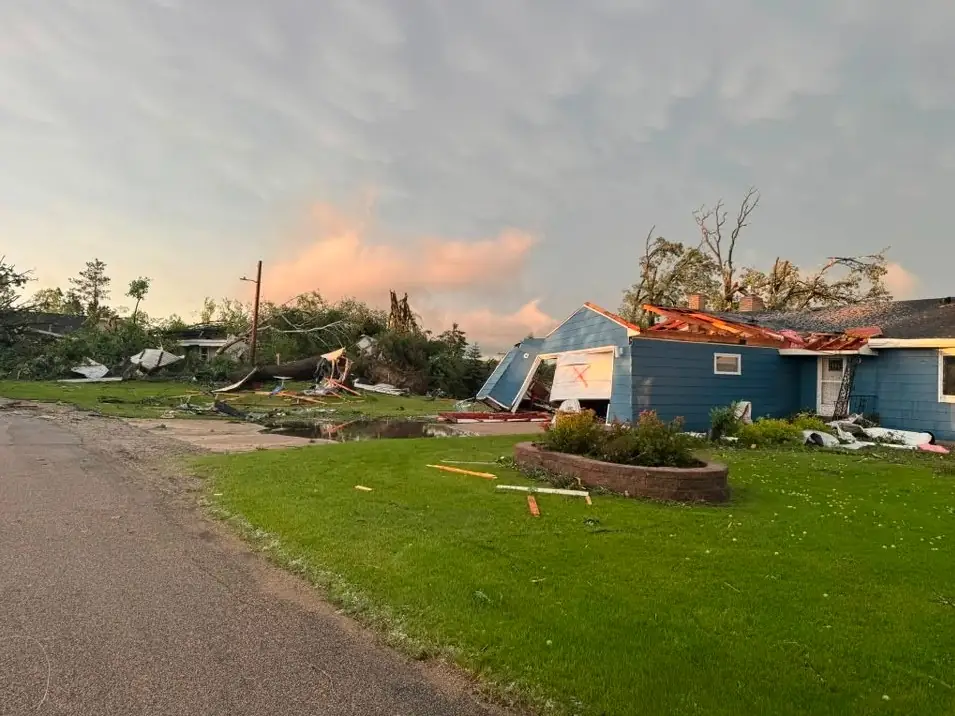
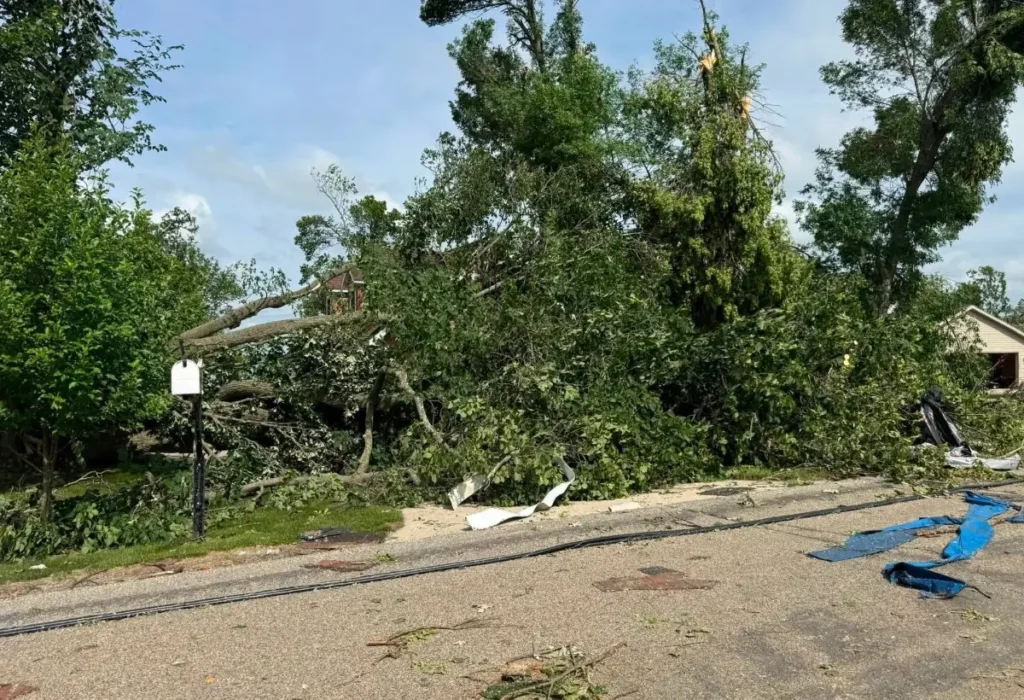
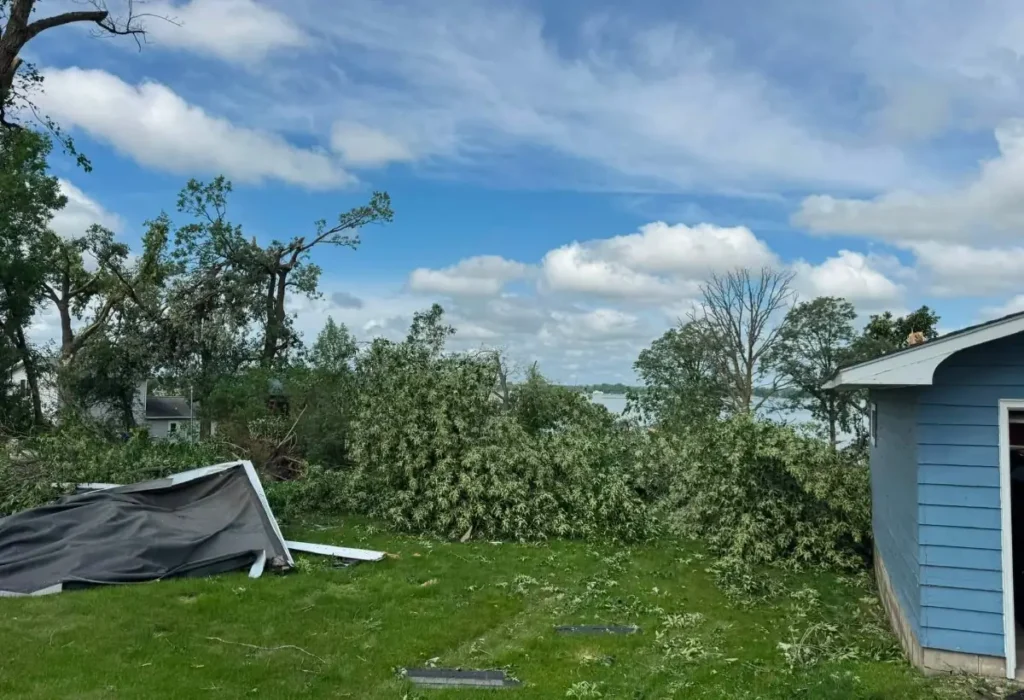
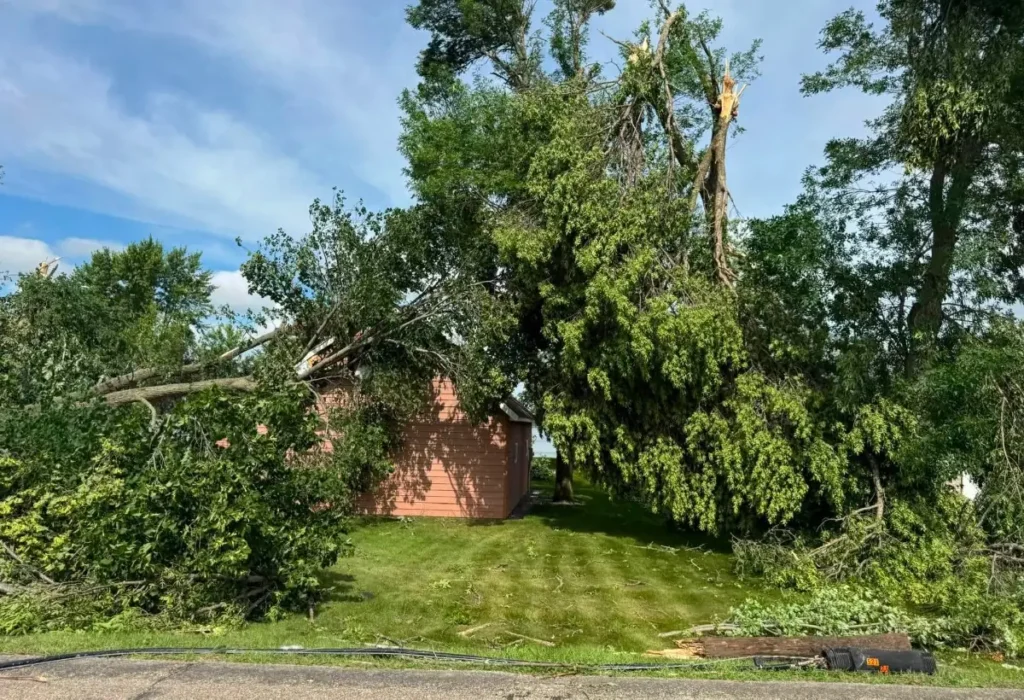
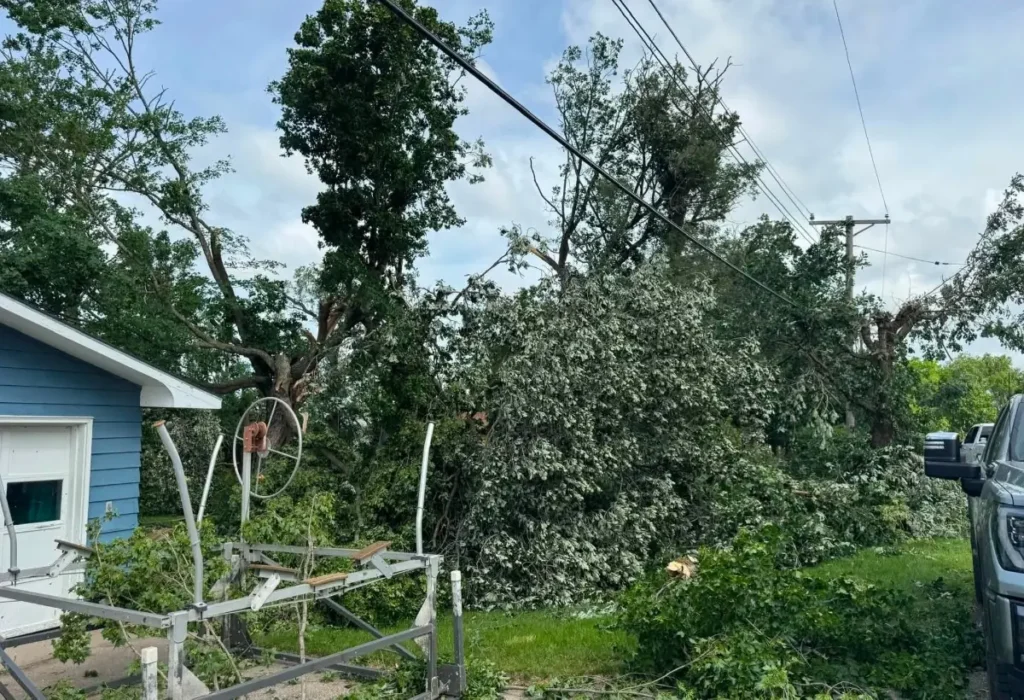
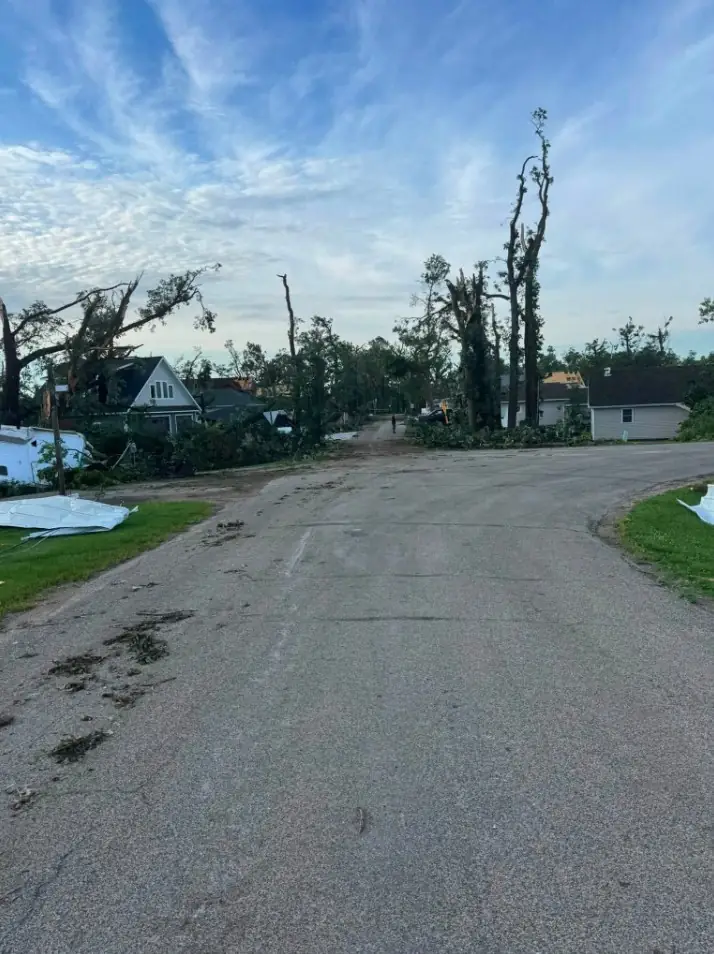
The tornado began about 2 km (1 mile) northwest of Wheeler Lake before crossing the lake, where it damaged the roofs of several homes and snapped the trunks of large oak and poplar trees.
It reached its maximum width near the western shore of Big Floyd Lake, with the Oakland Beach neighborhood sustaining the most severe damage.
Multiple garages and lighter outbuildings were swept away, while widespread roof and tree damage was reported. A 2 x 4 m (6 x 12-foot) horse trailer was lofted and carried about 200 m (656 feet) before the tornado crossed Big Floyd Lake and continued east. The last visible damage was identified near the intersection of County Highway 25 and Anchor Road.
More than 500 customers lost power as a result of the storms, according to Detroit Lakes Public Utility.
As the storm tracked east-southeast, strong winds, hail, and heavy rain affected areas north of Audubon before a tornado warning was issued for the Callaway and Rochert areas. Reports of downed trees, power lines, and debris soon followed from Detroit Township between U.S. Highway 59 and County Highway 21.
References:
1 Public Information Statement – NWS – July 7, 2026
-

 Idaho1 minute ago
Idaho Power crews respond to outage affecting 2,163 customers in Canyon County
-
 Illinois13 minutes ago
As Illinois enters 10th year under Evidence-Based Funding model, equity remains an elusive goal
-

 Indiana16 minutes ago
FAIRFIELD NATIVE AND HIS WIFE FOUND DEAD IN THEIR NEWBURGH, INDIANA HOME
-

 Iowa21 minutes ago
From caviar nuggets to bison, 10 new Iowa State Fair food trends
-

 Kentucky31 minutes ago
Kentucky lawmakers hold town hall on AI data centers in Louisville
-

 Louisiana36 minutes ago
Norman C. Francis library naming honors Lafayette education legacy
-

 Maine43 minutes ago
Live updates: U.S. and Iran escalate attacks; jockeying starts in Maine after Graham Platner drops Senate bid
-

 Maryland46 minutes ago
How the Baltimore-style hot dog tells a uniquely Maryland story

