News
In Indiana Primary Elections, Most Trump-Backed Challengers Beat Incumbents


President Trump promised political payback last year when Indiana state senators from his own party voted down his plan to redraw the state’s congressional map to help Republicans.
On Tuesday, he got much of what he wanted, as at least five of the seven anti-redistricting Republicans facing Trump-backed challengers lost their primaries, according to The Associated Press. The results reflected Mr. Trump’s continuing sway over Republican voters and his ability to enforce political consequences for Republican officeholders who defy him.
In the other races, at least one incumbent won his primary and another race remained too close to call.
State legislative primaries are often low-drama affairs, but Mr. Trump’s involvement brought unusual levels of attention and outside spending. The president issued social media endorsements to the seven challengers and hosted some of them at the White House, while outside groups aligned with Mr. Trump poured money into the races.
As the challengers emphasized their ties to Mr. Trump, many of the incumbents focused on their own conservative credentials, as well as endorsements from groups supporting farmers, gun rights or abortion restrictions.
Rather than a contest between moderates and conservatives, the primaries became a test of how much deference Republicans owe Mr. Trump and how much control the president holds over rank-and-file voters.
“It’s not that anyone is less or more pro-life,” said Lt. Gov. Micah Beckwith, a Republican redistricting supporter who backed most of the Trump-endorsed challengers. “It’s really that, do you understand the battle we are in, and do you understand the role Indiana plays in that battle on a national stage?”
State Senator Spencer Deery, one of the anti-redistricting incumbents, described the election as a test of how much sway Washington policymakers and their allies have over state policymaking.
“What’s at stake,” he said, “is the question of whether state legislators are going to be free to listen to their constituents and to govern their state without the outside meddling of enormous financial sums of dark money.”
On Tuesday, voters had diverging views of the political landscape and of the president’s endorsement.
In Granger, Ind., along the Michigan border, Tony Xouris said redistricting was his top issue and that he turned out to vote for the Trump-backed challenger to Senator Linda Rogers, who voted against the redrawn map.
“She lost my vote,” said Mr. Xouris, a semiretired insurance agent. “She’s a RINO. She’s a bad Republican.”
But outside the polls in Schererville, Ind., near Chicago, Matt Bartz said he was voting for Senator Dan Dernulc even though Mr. Trump had endorsed a challenger.
“I’m a Trump supporter,” said Mr. Bartz, a retired steelworker. “I was under the understanding that he wanted states to regulate themselves, take care of themselves, but now he’s coming back with this revenge type of thing and I’m not happy with that.”
The races also split political leaders in Indiana, where Republicans have amassed power over the last 20 years, but where there are longstanding fissures between the party establishment and an ascendant movement that hews closely to Mr. Trump.
Gov. Mike Braun and Mr. Beckwith, along with some members of the congressional delegation, came out in support of many of the challengers.
On the other side, former Gov. Mitch Daniels, who helped usher in Indiana’s era of Republican dominance, became a leading voice against redistricting. His successor as governor, former Vice President Mike Pence, endorsed one of the incumbents seeking re-election.
The rupture began last year when Mr. Trump was pushing redistricting nationwide in a bid to gain seats in Congress in the midterm elections. Several Republican-led states quickly fell in line, and some Democratic-led ones moved to counter with their own maps. But a critical mass of Indiana lawmakers remained opposed to the plan to draw a map that would position Republicans to flip the state’s two U.S. House seats held by Democrats.
When lawmakers returned to Indianapolis in December, the Republican-led House approved a new map. But the Republican-controlled Senate said no, with a slim majority of Republicans joining Democrats to vote the bill down even as Mr. Trump threatened political consequences.
“Any Republican that votes against this important redistricting, potentially having an impact on America itself, should be PRIMARIED,” Mr. Trump wrote in a November social media post that referred to two senators as Republicans in name only.
He soon followed through on that promise, endorsing challengers to seven of the eight anti-redistricting Republicans who ran for re-election this year. Other Republicans who voted against the bill have two years remaining in their terms or did not run for re-election.
Kim Bellware, Robert Chiarito and Nick Corasaniti contributed reporting.




Charles De Ketelaere #17 of Belgium celebrates after scoring his team’s second goal during the World Cup Round of 16 match against the United States on Monday in Seattle.
Alex Grimm/Getty Images
hide caption
toggle caption
Alex Grimm/Getty Images
SEATTLE — This time was supposed to be different.
The U.S. men’s national team came into this FIFA World Cup with a lineup full of players with key roles in Europe’s top leagues. They had the name-brand coach — Mauricio Pochettino, of Tottenham, PSG and Chelsea fame. And they had homefield advantage, with every game on U.S. soil for the first time in three decades.

For weeks, the hype seemed like it might be real: The team’s three wins over Paraguay, Australia and Bosnia-Herzegovina were the most ever by a U.S. men’s squad in a World Cup. A new generation of American fans filled stadiums by the tens of thousands and tuned in on TV by the tens of millions.
But in the end, the Americans’ exit was the same as it ever was: Eliminated yet again in the Round of 16 at the hands of a European team — this time, Belgium, by a score of 4-1.
From the moment they stepped onto the Seattle field, the U.S. was outclassed by their opponent, No. 9-ranked Belgium. Countless turnovers and defensive lapses were seized on by the Belgians, who needed only nine minutes to take a 1-0 lead.

Then, once the Americans equalized on a free kick by midfielder Malik Tillman, Belgium scored yet again in barely a minute of play. Belgian forward Charles De Ketelaere scored both his team’s first-half goals.
After halftime, came an embarrassing nail in the coffin that silenced the Seattle sellout crowd for good — a 57th minute roll-in by Hans Vanaken after a slip-up by goalkeeper Matt Freese outside of the penalty area left the goal unguarded. Belgian forward Romelu Lukaku added a stoppage-time goal to seal the final score at 4-1.

Malik Tillman #17 of the United States celebrates scoring his team’s only goal during their World Cup match against Belgium. In what was one of the few bright spots of the game, the U.S. pulled even with Belgium at 1-1. The tie lasted less than two minutes before Belgium scored again.
Luke Hales/Getty Images
hide caption
toggle caption
Luke Hales/Getty Images
“It stinks,” said U.S. midfielder Tyler Adams. “Tonight was not a good performance overall. It’s not what we look to achieve. There [were] a lot of things that we could have done better.”
The U.S. had entered Monday’s game under a cloud of controversy around their striker Folarin Balogun, who was shown a red card in last week’s Round of 32 match against Bosnia-Herzegovina. An automatic one-game suspension was set to sideline Balogun, the Americans’ leading scorer at the World Cup, for Monday’s game.
Then, the day before the game, a FIFA disciplinary panel took the highly unusual step of delaying Balogun’s suspension by a year to allow him to participate. Then, news broke that President Trump had personally called FIFA president Gianni Infantino to encourage him to review the red card.
The Royal Belgian Football Association said it would protest Balogun’s inclusion in the lineup. But even at full strength, the U.S. were never real contenders in Monday’s game.
U.S. defender and team captain Tim Ream said the controversy swirling around the team had no impact. “We were fully focused on us as a group and as a team and fully focused on the game and not really worrying about what was being said or debated in the outside world.”
Belgium will advance to the quarterfinals for the third time in the past four World Cups, where it will face Spain on Friday in Los Angeles.

Mauricio Pochettino, Head Coach of the United States, walks down the touchline during the Round of 16 World Cup match between the USA and Belgium in Seattle on Monday.
Carl Recine/Getty Images
hide caption
toggle caption
Carl Recine/Getty Images
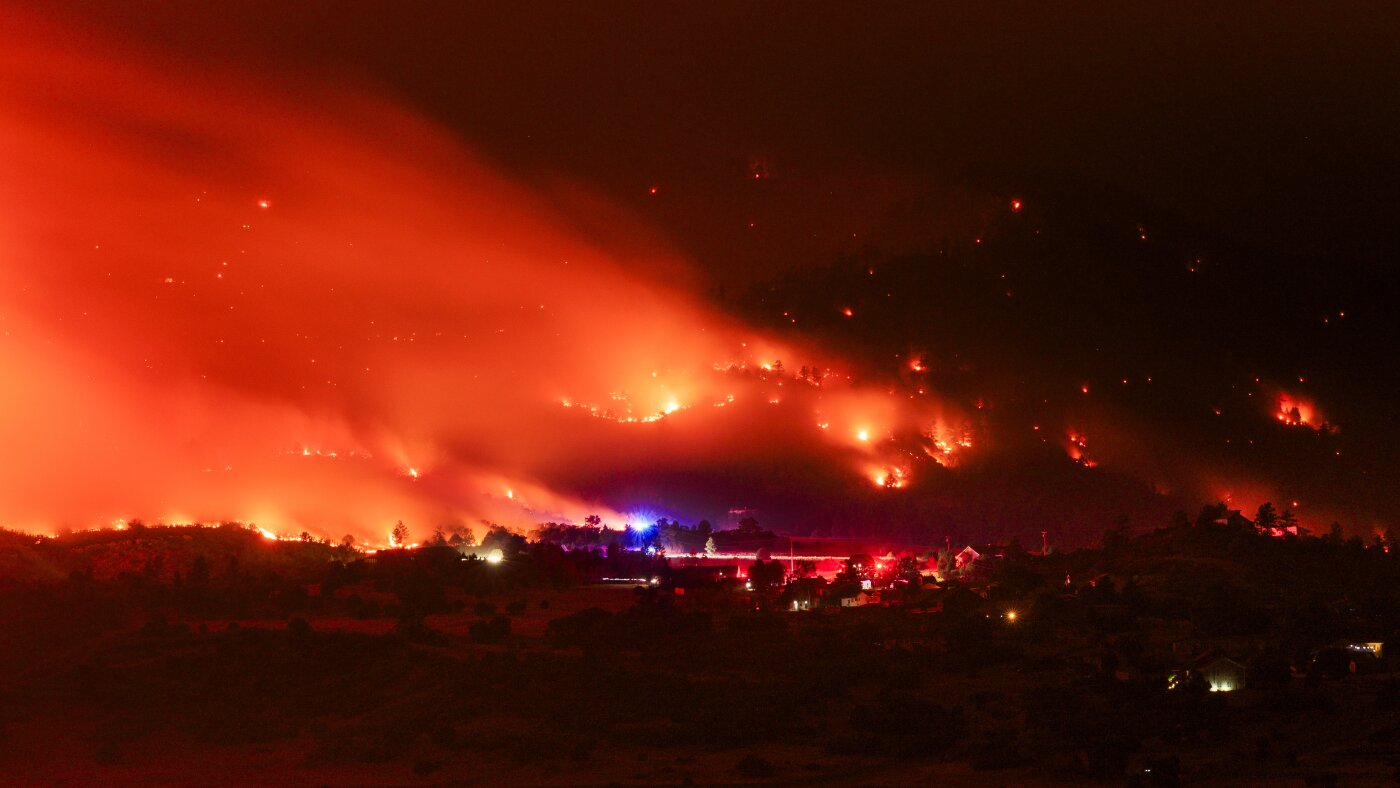
The Aspen Acres Fire burns on Friday in Rye, Colo.
Michael Ciaglo/Getty Images
hide caption
toggle caption
Michael Ciaglo/Getty Images
Thunderstorms with high winds on Sunday could hamper efforts to contain a massive wildfire that has scorched parts of southern Colorado.
The Aspen Acres Fire, which is burning south of Colorado Springs across Pueblo and Custer counties, has grown to more than 86,000 acres. It began nearly a week ago and is 13% contained, officials said on Sunday morning.

Authorities have ordered people to evacuate or to prepare to evacuate across counties including Custer, Pueblo, Huerfano and Fremont.
Scattered showers and thunderstorms could hit south central and southwest Colorado on Sunday, according to the National Weather Service.
Officials and forecasters say the rain could be beneficial for firefighting but are concerned it could lead to road damage in burned areas and cause flash flooding.
“The main threats from storms will be gusty outflow winds up to 50 mph and lightning,” the NWS office in Pueblo said.
Red flag warnings and air quality alerts have also been issued across the state, with the Colorado Department of Public Health and Environment on Sunday warning residents to limit time outdoors because of heavy smoke.
Other wildfires are burning in the state, including the Ferris Fire in southwest Colorado that has grown to more than 42,000 acres and is 7% contained as of Sunday afternoon. The Gold Mountain Fire, which is also in the southwest portion of the state, has grown to more than 25,000 acres and is 0% contained as of Sunday.
A memorial service was held on Sunday for three firefighters who were killed battling wildfires on the Colorado-Utah border on June 27: Emily Barker, Sydney Watson and Nick Hutcherson.
The firefighters, along with two others, were involved in a “burnover incident,” which happens when firefighters are overtaken and have to shelter as best they can while a fire passes directly over them, according to the Department of Interior. Two firefighters survived and were treated for burns.
Colorado Gov. Jared Polis ordered flags to fly half-staff in honor of the deceased firefighters.

“These three brave heroes ran towards the flames, put themselves in harm’s way, and gave the ultimate sacrifice to protect Coloradans, our communities and our families,” Polis said in a social media post on Sunday.
Another fire across the border in southern Utah, the Babylon Fire, has grown to more than 90,000 acres and is O% contained as of Sunday afternoon. It is expected to be hot and dry through Monday, with very little humidity, officials said, making conditions challenging for containment.

At least about two dozen people have died amid the perilous climate crisis-driven heatwave that has scorched swaths of the US with record temperatures.
As a huge heat dome sits over the county’s eastern half, extreme heat gripped millions of people in the days leading up to the US’s semiquincentennial on Saturday – and beyond it. More than 20 states experienced have reported stifling temperatures more than 100F (38C), marring celebrations. And more than 140 million people remained under active heat alerts across the US on Sunday.
Officials in New Jersey believe the extreme heat was a factor in the deaths of 22 people across 10 counties there, mostly in central and northern parts of the state. Many of the individuals were found in homes with no air conditioning, outside their residences, on the street and in parked cars, according to officials.
The first of those deaths occurred on Thursday, and the ages of the deceased in question mostly range from their mid-30s to their 80s. Preliminary findings cause investigators to believe the deaths are heat-related, though the chief state medical examiner for New Jersey would later determine the exact cause of death for each.
“This is not a typical summer heatwave,” the New Jersey department of public health said in a statement. “This type of heat can quickly become life-threatening to humans and to animals of all ages.”
The National Weather Service (NWS) has said cool air from the north in the coming days is going to lower some of the most extreme temperatures in the region, including New Jersey. The Fifa World Cup final is scheduled to be held in the New Jersey city of East Rutherford on 19 July.
Elsewhere, a heat-related death was reported in Cook county, Illinois, Natalia Derevyanny, a government spokesperson, told NBC News. The cause of that death was recorded as organic cardiovascular disease – with heat stress as a contributing factor.
Hinds county in Mississippi reported the death of 74-year-old Mitchell Ray Cooley due to heat exposure on Thursday, state officials said. Cooley had been reported missing, and his body was found the next day behind a gas station, the county coroner said in a statement.
“Mr Cooley suffered from a medical condition that impaired his judgment,” the coroner’s office said. “Based on the investigative findings, scene examination, and subsequent evaluation, the cause of death has been determined to be weather-related heat exposure. At this time, there is no indication of foul play.”
Meanwhile, on 27 June, Martha Irene Van Egmond, 83, died in Bolton, Mississippi, after falling in her garden. When her husband, Rick, tried to help her up, he fell too. The couple were unable to get up and spent hours in the heat.
Rick Van Egmond said he and his wife called out for help, and eventually two men from a nearby apartment complex came – but it was too late for Martha. She died surrounded by flowers, doing what she loved, he said to local news outlet WAPT.
Jeramiah Howard, Hinds county’s chief death investigator, attributed her death to the heat combined with her age, WAPT reported.
after newsletter promotion
As Donald Trump spoke during rain-dampened celebrations in Washington DC on Saturday, emergency services there had treated 51 people with heat-related issues as of 8pm ET, with 12 taken to nearby hospitals, according to local emergency response officials.
Other events scheduled for Saturday – including the Independence Day parade in DC – were cancelled amid the blistering heat. Among other weather-related disruptions, Trump’s so-called Great American State Fair on the National Mall also temporarily closed down on Friday after reports that 44 visitors had been treated for heat-related illnesses.
The worst of the heat started moving out of the US’s north-east and midwest regions by Sunday, shifting farther south into the mid-Atlantic and south-eastern parts of the country.
But scientists warn that heatwaves with extreme temperatures are indications that the world must lower the greenhouse gas pollution driving the global climate crisis.
The NWS is urging the public to avoid heat sickness by drinking plenty of fluids as well as staying out of the sun and in air-conditioned environments. Officials have also asked people to check on relatives and neighbors.
-

 Alaska23 seconds ago
Kei to stay, new Alaska law makes import vehicles roadworthy
-

 Arizona7 minutes ago
Padres host Arizona Diamondbacks, look to stop home slide
-

 California10 minutes ago
Man arrested after woman dies in California fireworks explosion
-
Arkansas10 minutes ago
Arkansas Lottery Powerball, Cash 3 winning numbers for July 6, 2026
-

 Colorado22 minutes ago
3 firefighters killed in Colorado remembered for their bravery
-

 Connecticut25 minutes ago
Connecticut Forests Are Healthier, And The Porcupines Have Noticed
-

 Delaware30 minutes ago
Delaware lawmakers pass same-sex marriage bill after initial failure in the House
-

 Florida37 minutes ago
Miami ranks among top U.S. cities for debt collection calls as Florida places near top, study finds

