Washington
Explore Washington, D.C.’s Science Scene – Eos


From 9 to 13 December, more than 25,000 Earth and space scientists will flock to Washington, D.C., for AGU’s Annual Meeting 2024. After jam-packed days attending talks, presenting posters, exploring the exhibit hall, loading up on swag, networking over endless coffee, and playing with puppies (for, er, science?), attendees might be wondering how to extend their science binge outside the conference center.
Luckily for them, the D.C. metro area has events to keep the science times rolling. Here are just a few places to visit in and around D.C. during AGU24.
Around the City
On 10 December, author Anna Farro Henderson will speak at Busboys and Poets on K Street about Core Samples: A Climate Scientist’s Experiments in Politics and Motherhood. On 12 December, Astronomy on Tap DC is presenting “Geology on the Rocks,” with accessible planetary geophysics talks, drinks, and prizes at the DC9 Nightclub.
The National Mall is a museum hot spot, and the Smithsonian National Museum of Natural History (NMNH) is the destination for Earth sciences. A collaboration with NASA led to the new Earth Information Center at NMNH, which connects sky-high views from satellite observations with on-the-ground research. The museum’s Lights Out: Recovering Our Night Sky exhibit one floor down demonstrates the impact of light pollution on our fading night skies.
For the more space-minded person, the National Air and Space Museum showcases innovations and pioneers in flight and space exploration. The D.C.-based museum regularly hosts stargazing, planetarium shows (for adults and kids), and solar observing. A long train ride or car trip can bring you to the museum’s Steven F. Udvar-Hazy Center in Chantilly, Va., to roam among historic planes and space vehicles and be immersed in stories about sustainable cities, butterflies, and space exploration in its IMAX theater.

The visitor’s center at the NASA Goddard Space Flight Center in Greenbelt, Md., gives tours of the facility and hosts permanent exhibits on the Sun, solar system, and beyond, as well as a rocket garden and astrobiology walk.
And, of course, you can stop by AGU’s headquarters at 2000 Florida Avenue to tour the net zero building and explore its Earth and space science museum.
The Great Outdoors

Take some time to escape the conference center and see some of the outdoor geologic sights the city has to offer. A curated archaeology tour of D.C. buildings reveals the capital’s secret geologic history, with fossils and minerals embedded in the stones used to build some of the city’s iconic buildings. Theodore Roosevelt Island, nestled between D.C. and Arlington, Va., boasts 18 miles (29 kilometers) of accessible forest trails, interesting geologic and cultural histories, and excellent birding views. The Anacostia Riverwalk Trail winds through forest, fields, and marsh and river ecosystems, as well as historic neighborhoods and hot spots in the District and Maryland.
For those who want to travel a little farther afield, the D.C. region is nestled in the foothills of the Appalachian Mountains, the fall zone of the Potomac River, and the Atlantic Coastal Plain. The unique confluence of geologies has something for everyone. And those looking for a souvenir to take home can travel out to Maryland to hunt for fossils in Calvert Cliffs State Park or search for shark teeth in Purse State Park. Adventurers can even paddle through a tidal freshwater marsh in Jug Bay Wetlands Sanctuary.

Start planning your science-filled trip now!
—Kimberly M. S. Cartier (@AstroKimCartier), Staff Writer
Citation: Cartier, K. M. S. (2024), Explore Washington, D.C.’s science scene, Eos, 105, https://doi.org/10.1029/2024EO240540. Published on 2 December 2024.
Text © 2024. AGU. CC BY-NC-ND 3.0
Except where otherwise noted, images are subject to copyright. Any reuse without express permission from the copyright owner is prohibited.
Related



The Catholic archbishop of Washington DC on Wednesday removed a well-known priest as an exorcist of the archdiocese after he made public comments suggesting that UFO sightings were the work of demons.
Cardinal Robert McElroy said the archdiocese also was cutting ties with the St Michael Center for Spiritual Renewal, a Washington-based non-profit headed by the priest, Monsignor Stephen Rossetti.
The archbishop said Rossetti’s statements “linking UFOs to demonic presence and the Center’s recent use of social media gravely undermine the Church’s very precise teaching on the devil, demons and exorcism”.
“There’s a danger here,” Rossetti said in a 29 May video posted on his Facebook page addressing UFO sightings and the existence of aliens. “As an exorcist I wanted to raise that danger. And that is that demons like to hide … They don’t want us to know what they’re doing because they’re more effective when we don’t realize it.
“They can kind of get into your head, you know, and manipulate things in the world to influence us to do evil.
“It’s my personal belief that probably many if not most of these UFO sightings are in fact demons,” Rossetti added.
Rossetti also said that people can be good Catholics and believe there’s life on other planets, though he does not personally believe life exists elsewhere.
In a statement posted on the St Michael Center website, Rossetti said he was saddened by the action of the archdiocese.
“I ask forgiveness for any ways that I have not been faithful to the teachings of the Church’s Magisterium, particularly in the cited video on ‘aliens and the demonic’,” he said. “I believe it is of the utmost importance to be obedient to the Church and I will continue to endeavor to subject all that I do and the Center to be thus obedient.”
Rossetti, who has more than 148,000 followers on Instagram, is a prominent psychologist as well as an exorcist. His center has specialized in offering spiritual healing for priests troubled by various difficulties.
In 2023, he told the Associated Press there was increasing and renewed appetite for information about demonic possession and exorcism.

PITTSBURGH — The Pittsburgh Steelers are keeping Darnell Washington around for another four years, signing the former third-round tight end to a contract extension, according to NFL insider Jordan Schultz.
Washington is the team’s third contract extension this spring, joining kicker Chris Boswell and edge rusher Nick Herbig. He’s the second member of the 2023 draft class after he and Herbig signed in back-to-back days.
Washington’s deal is worth $42 million and includes $21 million in guaranteed money.
Sources: The #Steelers and TE Darnell Washington have agreed to a 4-year, $42m extension.
The massive tight end has developed into a key piece of Pittsburgh’s offense and has been everything the Steelers hoped for when they drafted him. pic.twitter.com/PVLVF5Qh8S
— Jordan Schultz (@Schultz_Report) June 4, 2026
The 6-foot-7 tight end out of Georgia found a nice groove for himself on the offensive side of the ball last season and became a reliable target for Aaron Rodgers while being used as a key piece to the running game. Under new head coach Mike McCarthy, Washington’s role is expected to grow even more.
“Love Darnell, he’s been here every day, in the classroom, good student, he’s a pro’s pro,” McCarthy said about Washington during minicamp. “I’ve been veryimpressed with him. He’s done everything we’ve asked. I know I keep saying this, it’s year one that you get to know your players, go to certain schemes, you may tilt one way or the other variations of schemes, and definitely we’ve been doing that with our tight ends, and he’s a big part of that reason.”
With Washington under contract for the next five years and Pat Freiermuth having three more years on his deal, the Steelers solidify their tight end room for the future. Both players will be heavily involved, as Freiermuth remains the top pass-catching option and Washington grows into an all-around weapon.
Steelers Moves Aren’t Done Yet
The Steelers aren’t done with their offseason extensions, either. Outside of Washington, Herbig and Boswell, Joey Porter Jr., Keeanu Benton and Spencer Anderson could all ink deals before the season.
Porter Jr. was the talk of the town heading into the offseason, but with a contract that is likely top five in the NFL at his position, it may take longer than hoped for the two sides to sign a deal. Both sides remain optimistic, but also realistic that it may take time.
As for Benton, the team is currently negotiating with him and he could be the next domino to fall in the signings. Don’t rule out Anderson getting a deal done as well.
Make sure to bookmark Steelers On SI, and find our podcast All Steelers Talk on YouTube or anywhere you listen!
Follow

WASHINGTON COUNTY, Ore. (KPTV) – The Washington County Sheriff’s Office released video of deputies using a drone to track down a man wanted for damaging a car.
On Saturday, May 30, a 911 caller reported a man damaging a car outside their home on Southwest 179th Avenue in Aloha. The sheriff’s office said it was reported the suspect, 21-year-old Santos Paulino Castro-Ramirez, was punching the car.
Deputies used a drone to follow the suspect as he ran toward Southwest Barcelona Lane. The sheriff’s office said Castro-Ramirez then entered a white SUV that did not belong to him on SW Barcelona.
Deputies arrested Castro-Ramirez. He was booked into the Washington County Jail for first-degree burglary and attempt to commit a crime – second-degree theft.
Copyright 2026 KPTV-KPDX. All rights reserved.
-

 Los Angeles, Ca17 minutes ago
Overnight military training brings loud flash bangs, simulated gunfire to quiet Pasadena neighborhood
-

 Detroit, MI39 minutes ago
Detroit Lions add UDFA rookie WR during OTAs
-

 San Francisco, CA47 minutes ago
How to watch San Francisco Giants vs. Milwaukee Brewers
-

 Dallas, TX54 minutes ago
3 different Cowboys 53-man roster projections pinpoint contested roster spots
-

 Miami, FL57 minutes ago
Jeff Hafley suggests Miami Dolphins entertain Malik Willis Tush Push
-

 Boston, MA1 hour ago
Karen Read sues the police agencies that investigated her Boston police boyfriend’s death
-
 Denver, CO1 hour ago
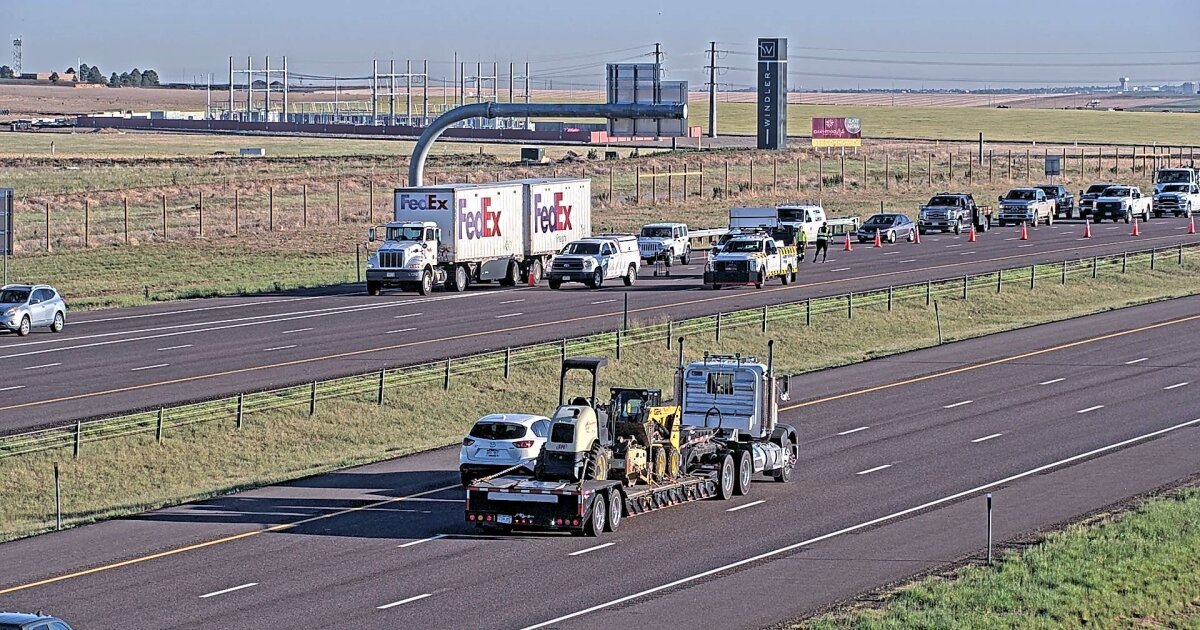
Pedestrian dies after hit by car on southbound E-470, Aurora police say
-

 Seattle, WA1 hour ago
Seattle paying $2.6M to settle sexual harassment lawsuit filed by four female SPD officers – MyNorthwest.com

