Arizona
This prominent attorney collects art to celebrate his Mexican heritage


ASU professor talks about writing Day of the Dead book
ASU professor Mathew Sandoval talks about why he wrote “Día de los Muertos: A Chicano Arts Legacy” at the Mesa Arts Center on Oct. 25, 2025.
Prominent Arizona attorney Jose Cardenas loves to show off his vast collection of Mexican and Mexican American art.
But he once made a fool of himself arguing with the legendary Mexican journalist Elena Poniatowska over a piece of artwork on display in his spacious 4,000-square-foot Chandler home.
Cardenas was giving Poniatowska a tour of his art collection during a reception he hosted for the writer. She was in town giving a lecture at Arizona State University.
“This is a self-portrait of Siqueiros,” Cardenas remembers telling Poniatwoska, referring to David Alfaro Siqueiros, one of Mexico’s three most famous muralists.
Poniatowska took a look at the sketch and shook her head, “No it’s not.”
The two got into a back and forth, with Cardenas continuing to insist the man depicted in the painting was Siqueiros.
“That’s what they told me when I bought it at the gallery in San Francisco,” Cardenas remembers telling the Mexican author.
Finally Cardenas backed down, thinking, “She’s getting up in years. I’m not going to embarrass her and argue with her.”
A few days later, Cardenas was flipping through TV channels. He came across a PBS documentary about the 1970 Chicano riots in East Los Angeles. The documentary highlighted a portrait Siqueiros had painted in homage to Ruben Salazar, the Los Angeles Times journalist killed by a tear gas canister fired by a Los Angeles County sheriff’s deputy during the protests.
Poniatowska was right. The figure in the painting was not Siqueiros, the Mexican muralist. It was indeed Ruben Salazar, the Los Angeles Times journalist, as painted by Siqueiros.
Cardenas tells this story when he gives tours of his art collection to visitors. They break out in laughter.
“You were mansplaining” one visitor told him. “No, I was being an idiot,” Cardenas said, “because why would you argue with her, of all people. She knew (Siqueiros). She wrote about him. She interviewed him. Not the person to say, ‘No, you are wrong.’”
Cardenas built prestigious career from humble roots
The personal art tours Cardenas hosts weekly at his home are peppered with similar stories that showcase his self-deprecating humor and highlight his enormous pride in his humble upbringing and Mexican heritage.
Cardenas comes from modest working-class Mexican immigrant roots. But he rose to become one of the most prominent and successful attorneys in Arizona. He has used his considerable wealth to amass what artists say is the largest collection of Mexican and Mexican-American artwork in the state, which he shares often with visitors during various events at his home, from personal tours to his annual post-Christmas bash.
Born in 1952, Cardenas is the son of an immigrant dad from the Mexican state of Sinaloa, and a Mexican-American mom. Cardenas grew up in Vegas Heights, a working-class Hispanic neighborhood west of Las Vegas that was still segregated. His father, Fortunato Cárdenas Sánchez, had a sixth-grade education. He worked as a foreman for construction company that laid pipelines. He was killed in a work accident when Cardenas was 15.
His mother, Gloria Frances Gómez Vigil, was born in a small town in northern Nevada to Mexican immigrant parents who eventually moved to Las Vegas. She only attended school through eighth grade.
After his father died, Cardenas, the second-oldest of four children, wanted to quit school and work to help his family with finances. But Cardenas was a good student, and his mother insisted he stay in school and encouraged him to attend college.
Cardenas became the first person in his family to graduate from high school and then college. He earned a bachelor’s degree in political science from the University of Nevada, Las Vegas and then a law degree from Stanford.
After law school, Cardenas clerked for a federal judge in San Francisco and then moved to Arizona in 1978 to work for the powerhouse law firm Lewis and Roca. Cardenas mostly handled commercial litigation but also did pro bono work on death penalty cases. In 1999, he was named managing partner, becoming one of the few Hispanic managing partners of a major law firm in the nation.
In 2009, Cardenas left Lewis and Roca to serve as chief legal adviser and senior vice president at Arizona State University, a position he held until 2022.
For nearly 20 years, Cardenas also hosted Horizonte, a public affairs show focusing on Arizona issues through a Hispanic perspective on Arizona PBS (KAET-TV Channel 8). He stepped down in 2023. Now semi-retired, the 73-year-old Cardenas continues to serve as special senior university adviser at ASU.
Cardenas and his Mexican-born wife, Virginia, were childhood sweethearts. When Virginia turned 15, Cardenas was one of the escorts in her quinceañera coming-of-age celebration. The two then began dating in ninth grade. They married when Cardenas was 19 and Virginia was 20 by one month. She worked as a counselor at Chandler High School. She died in July 2012 of kidney cancer.
Cardenas and Virginia bought their first artwork when he was still a financially struggling law student at Stanford. The two prints Cardenas purchased from a fellow student are now among the thousands of pieces of artwork that adorn his home.
Couple made frequent trips to purchase art
Cardenas said he and Virginia were introduced to the world of Mexican and Mexican American art when they moved to Arizona and met artists Zarco and Carmen Guerrero at a party. They are the founders of Xicanindio, the original name of Xico, a nonprofit organization that promotes Latino and Indigenous art and culture.
The couple became deeply involved in the organization. Virginia became the program director for several years and Cardenas served on the board of directors, including a stint as president.
Over the years, Cardenas and Virginia traveled frequently to Mexico City, Sante Fe and San Francisco to purchase paintings, crosses, ceramics, prints and pottery that cover practically every inch of Cardenas’ ranch home in Chandler.
Cardenas said he considers the collection an embrace of the Mexican heritage he and Virginia shared.
“It’s pride,” Cardenas said during an interview at his home.
“Virginia was born in Mexico. She came here when she was eight,” Cardenas said. “And I never considered myself Mexican American because when I was growing up, those terms weren’t used. So we were Mexicans.”
After Virginia died in 2012, Cardenas commissioned East L.A.-born artist George Yepes to paint a portrait of her. Yepes is best known as the artist who painted the cover of the 1988 Grammy Award-winning album by Los Lobos, “La Pistola y El Corazón.”
At first, Yepes turned down the commission after Cardenas showed her photo of Virginia, who was known for her dazzling smile.
“I can’t do it,” Cardenas recalled Yepes saying. “She’s always smiling. I don’t do smiles.”
A few weeks later, Yepes emailed Cardenas. “I think I can do it.”
The 7-foot-tall portrait Yepes painted of Virginia now hangs in Cardenas’ living room, where it dominates one of the walls. Cardenas considers it his most treasured piece, along with a portrait by a different artist of his three grown sons when they were young.
“The funny thing about this is she was pretty short, she was barely five foot tall. This painting is seven feet. And she’s sitting down. So talk about bigger-than-life-size,” Cardenas told a group of visitors during one of his tours.
Home is an art gallery, with frequent visitors
Cardenas frequently opens his home to visitors, serving as docent as he escorts visitors from room to room, telling stories along the way about various pieces of artwork.
In addition to the personal tours, Cardenas hosts an annual open house to showcase the ofrendas he creates in honor of Dia de los Muertos. At his Day of the Dead open house in November 2025, during the Trump administration’s ongoing mass deportation effort, one of the ofrendas focused on immigration. The ofrenda included photos of Cardenas’ relatives from Mexico, along with numerous quotes by Pope Francis that Cardenas printed out and framed.
“Migrants and refugees are not pawns on the chessboard of humanity,” read one quote.
“It is necessary to respond to the globalization of migration with the globalization of charity and cooperation, in such a way as to make the conditions for migrants more humane,” read another.
Cardenas also hosts an annual Los Tres Reyes Magos party every January in honor of Three Kings Day, a Christian holiday that is popular in Mexico and Latino America and marks the biblical visit of the three kings to the baby Jesus. This year’s party, attended by some of the most influential people in Arizona, will be Jan. 10.
One of the most powerful pieces on display in his home is a painting Cardenas commissioned as a tribute to the victims of the 2022 mass school shooting in Uvalde, Texas. The shooting killed 19 students and two teachers, and injured 21 others. The artwork, which Cardenas displays in his dining room, also was painted by Yepes, the artist who painted the portrait of Virginia.
The painting depicts a woman draped in an American flag, her arms and hands outstretched in the shape of a crucifix, with swords piercing her exposed heart, while doves flutter around her head, wrapped in a crown of thorns.
‘Everything they have in the collection was for them’
One of the most striking pieces is a massive Talavera ceramic jar created by artist and restauranteur Gennaro Garcia, a native of San Luis Rio Colorado, Sonora, who now lives in Phoenix. Garcia created the piece in Puebla, Mexico, where he studied the hand-painted Mexican ceramic artform that blends Spanish and Indigenous influences.
Cardenas had the piece shipped to his home, where he had to remove the table from his kitchen to make room for the artwork, which towers over six feet in height.
Garcia said he strived for years to have his artwork included in the Cardenas’ collection.
“As an artist, you want you want to be in in collection that you admire,” Garcia said. “His collection was already so good, and I wanted to have my name associated with those other artists” and with Virginia and Jose Cardenas as collectors.
Garcia describes the collection as a love story between the couple.
“Everything they have in the collection was for them,” Garcia said. “I always remember them standing in front of the art, talking about it, and then deciding to buy it” as a couple.
Garcia said he was not aware of a larger personal collection of Mexican and Mexican American artwork in Arizona.
“It’s the biggest one. Easy,” Garcia said.
Cristina Cardenas, a Mexican-born artist based in Tucson, agreed.
“In Arizona, to tell you the truth, I haven’t met anybody else with a bigger or more rich collection” especially of Mexican-American and Arizona artists, said Cardenas, who is not related to Jose.
She has sold numerous paintings to Cardenas. The collector also has commissioned her to paint several murals at his home, including a mural of a smiling Virginia that adorns an outdoor wall in the home’s sizable patio, and a mural of Mexican artist Frida Kahlo that greets visitors to his home.
The artist said Cardenas and Virginia have supported many artists through their collecting. They have played a role in opening the door for Latino artists to sell their work to other collectors, Cardenas said, noting that she once sold a print to former Arizona governor and U.S. Homeland Security Secretary Janet Napolitano through an introduction by Cardenas.
“It’s a commitment to represent our people, our communities, and to represent Mexico and the really highest rich cultural history that it has,” the artist said.
She noted that visitors will notice that Cardenas and Virginia have had a strong interest in collecting female figurative art. They were influential in shifting Xico artists away from depictions of low-riders and other traditional Chicano symbols toward prints and paintings that celebrate female figurative art.
Cardenas the artist, and others, often wonder what will happen to the massive collection after Cardenas is gone.
“It has to be preserved and it has to stay together. That’s my recommendation,” Cardenas the artist said.
Collection is a priceless legacy
Jose Cardenas said he isn’t sure what will become of his collection. He knows that some of the pieces will be passed down to his children and family, including the portrait of Virginia. The rest may go the Hispanic Research Center at Arizona State University, he said.
In the meantime, his collection continues to expand. He recently mounted two new pieces by renowned contemporary American artist Ayana Jackson, who reconstructs the portraiture of the 19th and early 20th centuries to, according to her bio, “assess the impact of the colonial gaze on the history of photography.”
The two pieces Cardenas acquired depict the artist suspended in midair in a battle stance while in character as Adelita, the Mexican female revolutionary soldier.



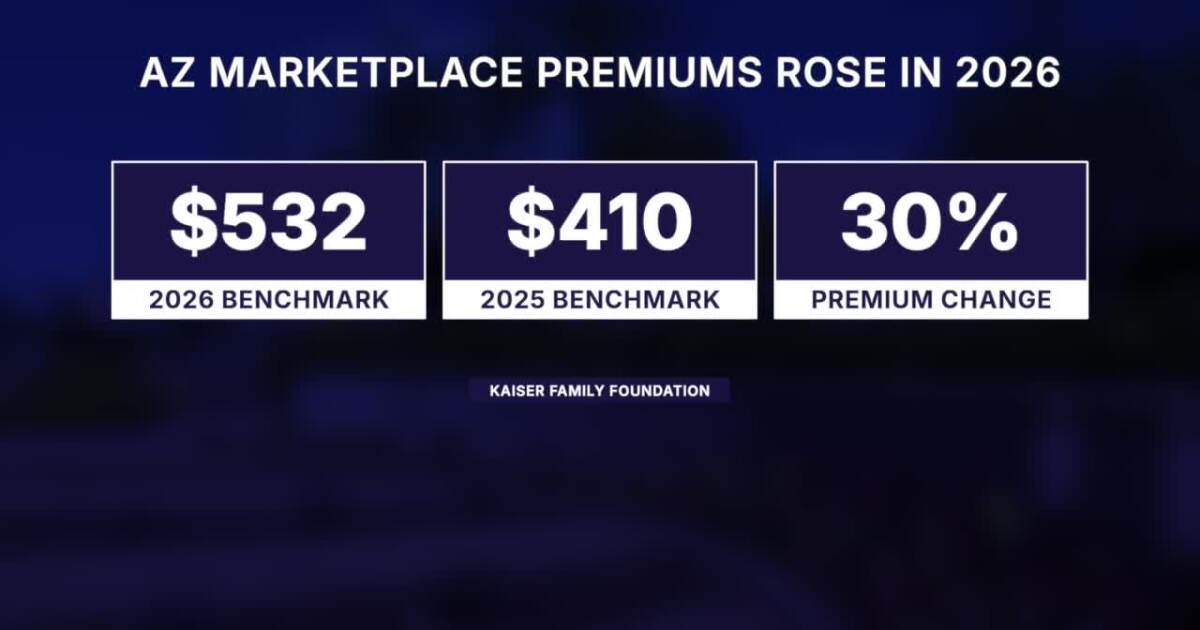
PHOENIX — Arizona’s ACA marketplace enrollment fell from 363,000 to just over 255,000 in a single year — a nearly 30% decline and the third-largest annual drop in the country.
Rising premiums and expired tax credits are driving the trend, with the average benchmark plan premium in Arizona now at $532 — up 30% from 2025.
In the player above, ABC15 Data Analyst Garrett Archer takes a look inside the numbers on how healthcare premiums are impacting health insurance enrollment.
This story was reported on-air by a journalist and has been converted to this platform with the assistance of AI. Our editorial team verifies all reporting on all platforms for fairness and accuracy.
Want more news in your community? Add ABC15 as a preferred source on Google below:

Arizona
Arizona man pleads guilty after illegally living in forest for years among ‘1,000lbs of trash’

A man in Arizona has pleaded guilty to violating federal fire restrictions and unlawfully residing in a national forest, after authorities said he spent years living at a makeshift campsite surrounded by what officials described as “approximately 1,000 pounds of trash”.
Mark Aaron Gatz was arrested on 25 June at his illegal campsite in Arizona’s Tonto national forest, according to court records. A United States Forest Service (USFS) officer wrote in documents submitted to court that Gatz had been operating an “illegal campsite” with a “hot wood burning campfire” despite fire restrictions and that he had told investigators that he had been living in the forest for about eight years.
The officer wrote that a records check found that Gatz had previously received multiple citations and was the subject of six outstanding federal arrest warrants for earlier violations, including for building fires during fire restrictions, constructing on national forest service lands, unsanitary conditions and occupying national forest as a residence.
Gatz “said that he knew about current fire restrictions but had to have fire to eat”, authorities said. The documents show that USFS officers made contact with Gatz multiple times over the last year or so, and issued him warnings as well as a violation notice for having campfires during fire restrictions.
Notes from officers’ previous encounters with Gatz earlier this year, submitted into the court docket, state that authorities observed “trash such as clothing, pans, tools, and plastic cups scattered throughout the campsite along with a structure that was four feet in height build using wood panels”.
During an encounter with Gatz in May, officers reported observing “approximately 1,000 pounds of trash” at the site, which they said included tires, plastic bags, trash bags, aluminum cans and other items. They also wrote that they found that the campfire site had been left unattended by Gatz the previous day while still hot.
In a separate report filed by law enforcement from an encounter in February, one officer wrote that “upon arrival at the camp, I was flabbergasted by the amount of debris in the area”.
Investigators said that during that encounter, the debris consisted of three ladders, six to eight totes “overfilled with debris”, five 55-gallon drums, eight tires, multiple bicycle frames, 5 gallons of motor oil, plywood and other “miscellaneous lumber”, and they wrote that trash was scattered over approximately half an acre of Forest Service land and creating what officers described as public safety concerns.
In a separate report from July 2025, officers said they observed what they described as a “large messy campsite” while patrolling the area due to complaints “from the district office abut one large messy camp”.
“There was roughly half an acre of resources ruined due to so much trash and goods on the ground for an extended period of time,” the officer wrote.
This week, after Gatz pleaded guilty, he was sentenced to time served and three years of probation, according to court records.
A representative for Gatz did not immediately respond to a request for comment.

Odds of winning the Powerball and Mega Millions are NOT in your favor
Odds of hitting the jackpot in Mega Millions or Powerball are around 1-in-292 million. Here are things that you’re more likely to land than big bucks.
The Arizona Lottery offers multiple draw games for those aiming to win big.
Here’s a look at Tuesday, July 7, 2026 results for each game:
Winning Mega Millions numbers
02-31-35-36-63, Mega Ball: 12
Check Mega Millions payouts and previous drawings here.
Winning Pick 3 Evening numbers
Evening: 4-7-2
Winning Fantasy 5 numbers
03-05-10-14-37
Check Fantasy 5 payouts and previous drawings here.
Winning Triple Twist numbers
03-06-18-23-27-32
Check Triple Twist payouts and previous drawings here.
Feeling lucky? Explore the latest lottery news and results
What time is the Powerball drawing?
Powerball drawings are at 7:59 p.m. Arizona time on Mondays, Wednesdays and Saturdays.
How much is a Powerball lottery ticket today?
In Arizona, Powerball tickets cost $2 per game, according to the Arizona Lottery.
How to play the Powerball
To play, select five numbers from 1 to 69 for the white balls, then select one number from 1 to 26 for the red Powerball.
You can choose your lucky numbers on a play slip or let the lottery terminal randomly pick your numbers.
To win, match one of the 9 Ways to Win:
- 5 white balls + 1 red Powerball = Grand prize.
- 5 white balls = $1 million.
- 4 white balls + 1 red Powerball = $50,000.
- 4 white balls = $100.
- 3 white balls + 1 red Powerball = $100.
- 3 white balls = $7.
- 2 white balls + 1 red Powerball = $7.
- 1 white ball + 1 red Powerball = $4.
- 1 red Powerball = $4.
There’s a chance to have your winnings increased two, three, four, five and 10 times through the Power Play for an additional $1 per play. Players can multiply non-jackpot wins up to 10 times when the jackpot is $150 million or less.
Are you a winner? Here’s how to claim your lottery prize
All Arizona Lottery retailers will redeem prizes up to $100 and may redeem winnings up to $599. For prizes over $599, winners can submit winning tickets through the mail or in person at Arizona Lottery offices. By mail, send a winner claim form, winning lottery ticket and a copy of a government-issued ID to P.O. Box 2913, Phoenix, AZ 85062.
To submit in person, sign the back of your ticket, fill out a winner claim form and deliver the form, along with the ticket and government-issued ID to any of these locations:
Phoenix Arizona Lottery Office: 4740 E. University Drive, Phoenix, AZ 85034, 480-921-4400. Hours: 7:30 a.m. to 5 p.m. Monday through Friday, closed holidays. This office can cash prizes of any amount.
Tucson Arizona Lottery Office: 2955 E. Grant Road, Tucson, AZ 85716, 520-628-5107. Hours: 7:30 a.m. to 5 p.m. Monday through Friday, closed holidays. This office can cash prizes of any amount.
Phoenix Sky Harbor Lottery Office: Terminal 4 Baggage Claim, 3400 E. Sky Harbor Blvd., Phoenix, AZ 85034, 480-921-4424. Hours: 8:30 a.m. to 5 p.m. Monday through Sunday, closed holidays. This office can cash prizes up to $49,999.
Kingman Arizona Lottery Office: Inside Walmart, 3396 Stockton Hill Road, Kingman, AZ 86409, 928-753-8808. Hours: 8 a.m. to 8 p.m. Monday through Friday, 8:30 a.m. to 5 p.m. Saturday and Sunday, closed holidays. This office can cash prizes up to $49,999.
Check previous winning numbers and payouts at https://www.arizonalottery.com/.
This results page was generated automatically using information from TinBu and a template written and reviewed by an Arizona Republic editor. You can send feedback using this form.
-

 Maine5 minutes ago
Live updates: U.S. and Iran escalate attacks; jockeying starts in Maine after Graham Platner drops Senate bid
-

 Maryland8 minutes ago
How the Baltimore-style hot dog tells a uniquely Maryland story
-

 Michigan13 minutes ago
Michigan immigration advocates react after Supreme Court ruling on Temporary Protected Status
-

 Massachusetts20 minutes ago
Is new construction right for you? There are benefits to buying a brand-new home in Massachusetts.
-

 Minnesota23 minutes ago
Where to watch Cleveland Guardians vs Minnesota Twins: TV channel, start time, streaming for July 9
-

 Mississippi28 minutes ago
Where Ace Reese, Mississippi State signees appear in latest MLB mock drafts
-

 Missouri35 minutes ago
Missouri Farm Bureau to host agritourism conference in Hermann | Fulton Sun
-
Montana38 minutes ago
Montana Lottery Powerball, Lotto America results for July 8, 2026

