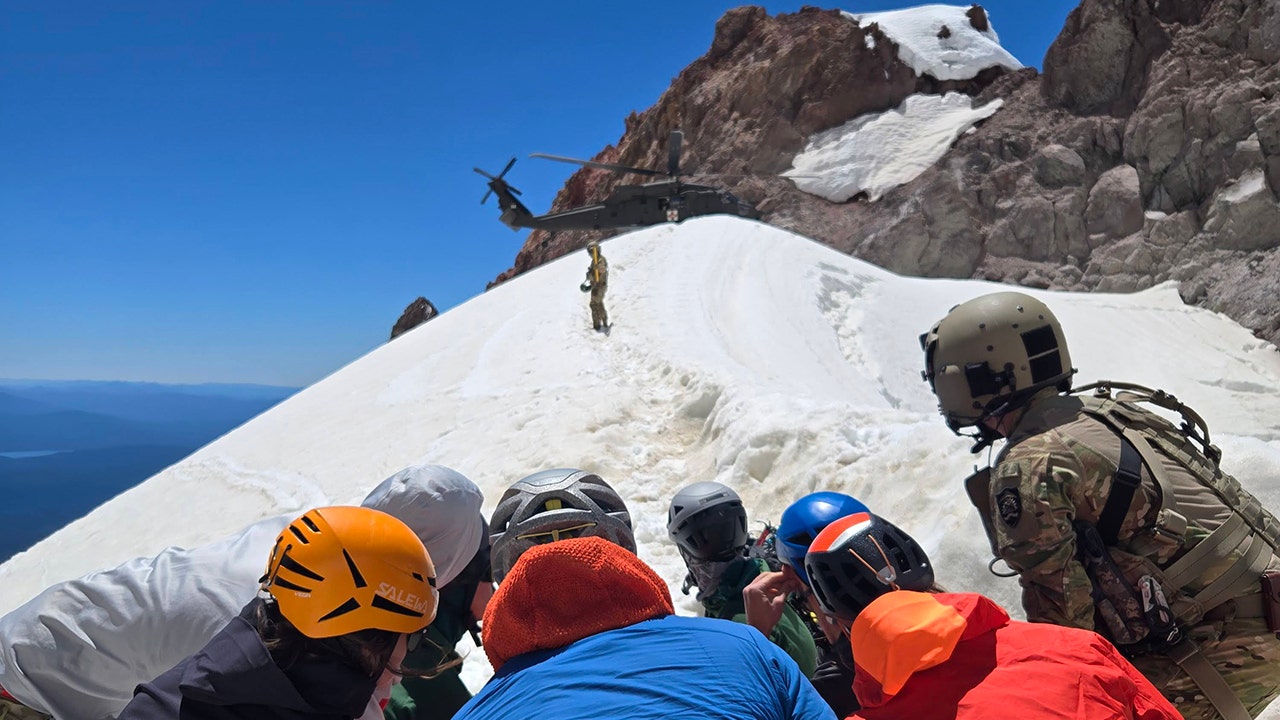
A climber on Oregon’s Mt. Hood was rescued on Saturday after surviving a 700-foot fall on a steep, icy route near the mountain’s peak, officials said.
Chris Zwierzynski, 55, of Arizona, had ascended to around 11,200 feet on the Old Chute route, a “very steep climbing route” on the mountain’s south side, when he slipped at 7:45 a.m. and suffered critical injuries, the Clackamas County Sheriff’s Office said.
“The snow surface was frozen, and the climber was unable to arrest his fall — tumbling about 700 feet down to the Hot Rocks area and sustaining multiple injuries,” the sheriff’s office added.
Two off-duty military medics witnessed his fall and immediately descended to help, officials said. Two Mt. Hood National Forest climbing rangers were also nearby and quickly provided first aid to the injured climber.
COAST GUARD RESCUES 5 MEN HUDDLED ATOP CAPSIZED BOAT 11 MILES OFF FLORIDA COAST
Advertisement
Ideal weather conditions on the mountain allowed a National Guard helicopter to make a “hot landing.”(Clackamas County Sheriff / Portland Mountain Rescue)
Rescuers reached the climber’s location just after 1 p.m. and stabilized him for transport off the mountainside.
A National Guard helicopter made a dramatic “hot landing” on a section of the mountain called the Hogsback due to excellent flight conditions around the mountain. Officials said the ideal mountain conditions allowed rescuers to get the injured climber off the mountain within just six hours after his fall.
The climber was airlifted off the mountain about six hours after his fall, officials said.(Clackamas County Sheriff / Portland Mountain Rescue)
No update on the climber’s condition was immediately provided.
Advertisement
The climber had slipped while climbing the Old Chute route around 11,200 feet on Mt. Hood.(Clackamas County Sheriff / Portland Mountain Rescue)
Officials warned climbers that while climbing conditions have remained good for longer than usual this year, the routes up the mountain are still dangerous for those unprepared.
MOTORCYCLIST DIES AT DEATH VALLEY NATIONAL PARK, ANOTHER HOSPITALIZED AMID TRIPLE-DIGIT HEAT
“Nevertheless, all routes up the mountain are technical, requiring specialized training and equipment,” Mark Morford of Portland Mountain Rescue said in a statement. “All routes become progressively more difficult approaching the summit, which can lure inexperienced climbers into situations beyond their skill.”
Morford said that all potential climbers are urged to get proper training from an organization like the Mazamas, or to climb with a qualified guide.
Advertisement
CLICK TO GET THE FOX NEWS APP
Mt. Hood is located about 50 miles southeast of Portland, and rises to an elevation of 11,249 feet.
The owner and operator of the boat that capsized earlier this week near Alcatraz Island said Thursday that his brother was killed and his sister, sister-in-law and a family friend remained missing after what began as a family trip to spread a relative’s ashes.
“It’s been horrible,” John Boisa said in a brief interview.
His comments came as San Francisco police used sonar to search for the 49-foot Volare and recovered a body floating west of Treasure Island. Authorities had not identified the person as of early Thursday evening.
Police were alerted to the body shortly after 1 p.m. by a passing vessel. The agency said it was using “multiple boat-mounted sonar platforms” to search for the Volare, which sank in water roughly 130 feet deep between Alcatraz Island and San Francisco.
Advertisement
The search has been complicated by “strong tidal currents along with wind and weather challenges,” police said in a statement.
Twenty people were aboard the boat when a wave struck it shortly after 3:30 p.m. Tuesday, causing the vessel to list before rolling over and sending everyone into the water.
Clifford Boisa, the operator’s brother, was pulled from the water and later declared dead despite receiving CPR. Sixteen others were rescued by a flotilla of first responders and nearby boaters.
Still missing Thursday were Clifford Boisa’s wife, Jackie Boisa; John Boisa’s sister, Carol Boisa; and a family friend whom he identified only as “Tonda.”
In a text message to this news organization, John Boisa recalled Jackie Boisa as possessing “a rare combination of easy acceptance of others with a kind of elegant sophistication.”
Advertisement
“She was simply a Lady and conducted herself in accordance with the highest meaning of that term,” he wrote.
He remembered his sister as bringing “her own special flavor to family gatherings and the earthy, natural joy she brought was ineffable.”
“I was especially pleased to see her enjoy our boating in recent years, and her smiles in photographs were genuine and without affectation,” he added. “I wanted for her and her children happiness and ease, and now, peace.”
Boisa, a Stockton-based consultant, said he had known Tonda only a short time but recalled her as “a generous, welcoming and gracious person.”
“I wish I knew her better, and I pray for peace and healing for her family,” he wrote.
Advertisement
Boisa described himself as the “vessel operator” and said Tuesday’s outing was “a family gathering” that included spreading the ashes of a relative who had died “a long time ago.”
Two days after the disaster, more details emerged about the boat, its weeklong stay in San Francisco and its final hours on the water.
The Volare, a 1981 Marine Trader Pilot built in Taiwan with a fiberglass hull, was based at Village West Marina & Resort, according to Tamara Barak Aparton of the San Francisco Recreation and Parks Department.
A police boat passes Alcatraz Island as search and rescue operations continue for victims of a Tuesday boat sinking on Wednesday, July 15, 2026, in San Francisco. (AP Photo/Noah Berger)
John Boisa received a guest permit to berth the boat at the city’s Marina Yacht Harbor from July 11 through Thursday, Aparton said. He had previously stayed at the harbor, though details about those visits were not available Thursday.
The vessel left the harbor around 10:15 a.m. Tuesday and traveled beneath the Golden Gate Bridge into the Pacific Ocean, according to the tracking website VesselFinder. It turned around about an hour later off Lands End and the Sutro Baths before returning to the bay at a slower speed.
Advertisement
The boat appeared to stop at Ayala Cove on the northwest side of Angel Island, leaving shortly after 3 p.m. and heading back toward the harbor, tracking data showed.
The Coast Guard’s search for survivors covered 950 square nautical miles before ending Wednesday evening. As police continued the recovery effort Thursday, maritime experts said they expected a lengthy investigation into how a vessel such as the Volare could capsize.
A US Coast Guard vessel navigates the San Francisco Bay while assisting a boat that got stuck on Alcatraz Island’s underwater rocks on Wednesday, July 15, 2026, in San Francisco. (AP Photo/Noah Berger)
The Volare — a monohull recreation craft complete with two walled-off cabin levels and a deck top — was intended to handle waters such as San Francisco Bay, said Eric C. Jones, a retired Coast Guard rear admiral and superintendent of the Cal Poly Maritime Academy in Vallejo. Still, he said it was “unusual” for such a vessel to flip over in the bay.
Investigators are likely to examine whether the boat was properly maintained and operating correctly, and whether it could safely carry 20 people, Jones said. They also are expected to scrutinize the weather and water conditions that day and how the boat was operated in that environment.
The area where the Volare sank can be among the most challenging to navigate in the bay because of its distinctive winds and currents, said John Arndt, who has sailed the bay for more than 40 years and spent the past decade as publisher of the Northern California sailing magazine Latitude 38.
Arndt called the area “the playground of sailing” and compared portions of the bay to a ski hill, with some areas better suited to beginner and intermediate boaters. The area where the Volare sank could be compared to a black diamond ski run, he said: a more “challenging” section but one that is navigable for people experienced with those waters and conditions.
Advertisement
July and August are generally the windiest months on the bay, a result of hot air rising over the Central Valley and pulling cooler air from the Pacific Ocean through the bay’s narrow entrance. While winds can remain manageable in some areas, the central channel between Angel Island and San Francisco can experience strong sustained winds and gusts.
The water can become particularly choppy when westerly winds collide with an outgoing tide. Water flowing from the Sacramento and San Joaquin river valleys toward the Pacific further complicates the currents in that area.
Arndt called a disaster of this magnitude involving this type of boat “exceptionally rare.” He said Tuesday’s conditions were not outside the normal range for summer boating on the bay.
“When people analyze accidents and disasters, it’s not one thing — it’s sort of these things that tend to be a spiral of events,” Arndt said.
A California Highway Patrol helicopter flies along the Sausalito, Calif. shoreline as search and rescue operations continue for victims of a Tuesday boat sinking on Wednesday, July 15, 2026. (AP Photo/Noah Berger)
Jakob Rodgers is a senior breaking news reporter. Call, text or send him an encrypted message via Signal at 510-390-2351, or email him at jrodgers@bayareanewsgroup.com.
Pedal boats are back at City Park in Denver this week and they come in more shapes than just swans.
On Wednesday, the city of Denver opened its newest so-called Adventure Hub where visitors can rent gear to enjoy on Ferril Lake. That includes pedal boats shaped like swans, dragons, ducks and flamingos, as well as kayaks, canoes and stand-up paddleboards. If you’d rather pedal on land instead of the water, the hub also has beach cruiser bikes and surrey bikes, which hold up to six people, available for rent.
Surrey “stretch limousines” that fit up to six rider are now available for rent at City Park and Washington Park in Denver. (Provided by Denver Parks & Recreation)
City Park’s Adventure Hub is the second to open this year, following another at Washington Park in early June. Stephanie Figueroa, spokesperson for Denver Parks and Recreation, said rentals were supposed to start sooner at City Park, but that the electricity powering the point-of-sale system needed to be replaced after a fire at the historic bandshell there.
Water sport rentals cost range from $15 per hour for a SUP or single-person kayak to $35 per hour for swan, dragon and duck pedal boats, which fit up to four people. Bikes are similarly priced at $15 per hour for a single-person beach cruiser up to $45 per hour for a surrey “stretch limousine” for six riders. Figueroa noted that it is a flat fee and not a per-person charge.
Advertisement
“For families, as long as you fit, you can go,” she said, adding that gear is available for rent during the City Park Jazz series this summer.
This year marks the first time in at least two decades that Denver officials have managed gear rentals in City Park. The city ended its longtime contract with vendor Wheel Fun Rentals, which previously supplied things like swan pedal boats, in early 2026 after more than 20 years, Figueroa said.
Denver’s decision to take over operations was both more cost-effective and enabled the city to have more control over the experience, she added. Part of the impetus was a recent initiative called the Outdoor Adventure and Alternative Sports Strategic Plan, which sought to identify how Denver could offer more recreation opportunities to residents.
“That gave us the tools and knowledge to bring this in-house,” Figueroa said. “We have historically been amazing at indoor recreation and now we want to bring more of those opportunities outside.”
The Adventure Hub at City Park is open every day from 10 a.m. to 9 p.m., while the one at Washington Park is open every day from 7 a.m. to 9 p.m. They are both closed on city-observed holidays.
Advertisement
Another Adventure Hub, currently under construction at Ruby Hill, is expected to open late this year or early next, Figueroa said.
Subscribe to our weekly newsletter, The Adventurist, to get outdoors news sent straight to your inbox.
Get ready to rumble with tickets to these newly announced shows. Groovy genre-bending bassist Thundercat will come through Seattle to support his recent release, Distracted. Pop-rock singer-songwriter Michelle Branch has announced a new album and cross-country tour for the fall. Plus, Daily Show correspondent and former pro tennis player Michael Kosta brings his Big Dad Energy stand-up special to Seattle next spring. Read on for details!
ON SALE FRIDAY, JULY 17
MUSIC
The Amity Affliction: House of Cards 2026 Showbox SoDo (Fri Nov 27)
Bravo the Bagchaser & Peysoh The Crocodile (Wed Sept 23)
Advertisement
Candlebox – Can’t Quit You Tour Paramount Theatre (Fri Sept 25)
See more on EverOut!
Related
Advertisement
EverOut is The Stranger’s new website devoted to things to do in Seattle and across the Pacific Northwest. It has all the same things you’re used to seeing from Stranger EverOut Staff, just in a new spot!…
More by EverOut Staff