West
New federal rule moves to protect military bases from nearby land sales to foreign actors

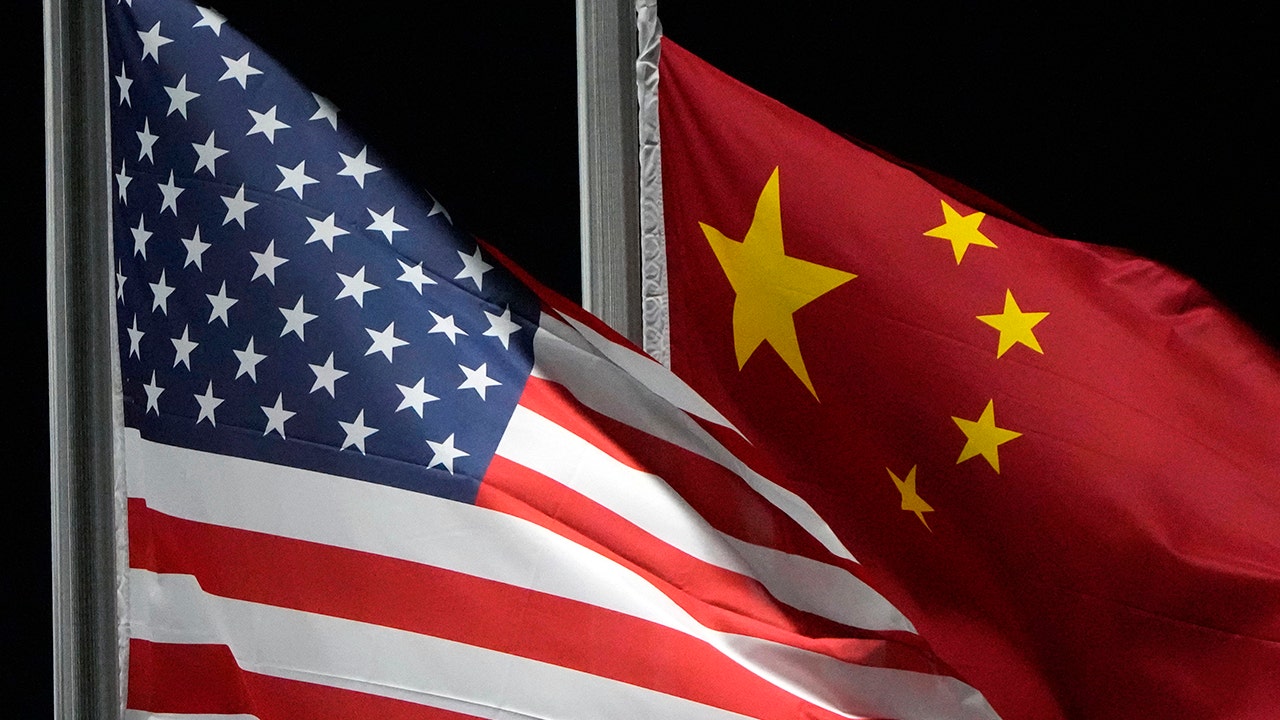
In the wake of several controversies involving foreign actors attempting land purchases near sensitive U.S. bases, a new federal rule will expand a Treasury committee’s ability to control the transactions.
Lawmakers in Florida, North Dakota and elsewhere have long sounded the alarm over Chinese companies in particular, and now the Biden administration is taking steps to potentially make it more difficult for such purchases to go through.
The rule utilizes a 2018 law that gives the Treasury’s Committee on Foreign Investment in the United States (CFIUS) broader authority to study the implications of foreign investment in real estate transactions and asset transfers.
Nearly 60 military installations or related properties will be provided further protections under the new rule.
IN THE ONLY STATE BORDERING RUSSIA, GOVERNOR SAYS DEFENSES ARE STRONG
Aerial view of Barter Island, Kaktovik, AK, where one base is located (Getty)
Some of the major installations cited include Joint Base Myer-Henderson Hall (formerly Fort Myer) in Arlington, Va., Letterkenny Army Depot in Chambersburg, Pa., Cold Bay Regional Radar Site and Naval Support Facility Ketchikan in Alaska, Pueblo Chemical Depot in Colorado, Camp Blaz in Dededo, Guam and the Naval Logistics Support Annex in Okahumpka, Fla.
The latter was likely a concern of Florida Gov. Ron DeSantis, R-Fla., prior to the passage of three landmark state laws aimed at curbing Chinese influence in the state.
One of those laws prohibits Chinese citizens “domiciled” in that country from purchasing Florida land. As of April, however, that law has been embroiled in a court challenge.
ALASKA SUES FEDS OVER ‘KNOWINGLY’ POLLUTED NATIVE LANDS
Treasury Secretary Janet Yellen, testifies during the House Financial Services Committee hearing. (Tom Williams/CQ-Roll Call, Inc via Getty Images)
DeSantis’ office did not respond to a request for comment, but said at the time the laws “make it very clear we don’t want CCP influence in the Sunshine State.”
In another case out of North Dakota, a land purchase for a Chinese company’s corn mill near Grand Forks Air Force Base was halted amid outcry from the state’s two Republican senators.
Sens. John Hoeven and Kevin Cramer had warned the transaction could be a “significant threat to national security.”
The Treasury previously stipulated in a May 2023 rule that foreign purchasers need federal approval to buy land near eight military sites, in the wake of the Grand Forks controversy.
China leader Xi Jinping (Xinhua/Shen Hong via Getty Images)
Fox News Digital also reached out to Alaska officials, as nearly a dozen of the newly-qualified installations are in the Last Frontier.
While the Treasury and CFIUS did not respond to requests for comment, Treasury Secretary Janet Yellen heralded the new rule in comments to the Associated Press.
The Biden administration is “committed to using our strong investment screening tool to defend America’s national security, including actions that protect military installations from external threats,” Yellen said.
The Treasury’s move comes one week after the White House released an order that halted a Chinese cryptocurrency firm’s planned purchase near Francis E. Warren Air Force Base in Cheyenne, Wyoming.
Read the full article from Here


Candidate handouts are displayed at an event for candidates running to represent Utah’s new Democratic-leaning congressional district in Taylorsville, Utah on March 21. While some candidates have since dropped out, four remain including former Rep. Ben McAdams and state Sen. Nate Blouin.
Hannah Schoenbaum/AP
hide caption
toggle caption
Hannah Schoenbaum/AP
In the past, a Democrat running for Congress in Utah would typically face an uphill battle. But, for the first time in modern history, Utah has a safe Democratic congressional seat that could help determine the makeup of the House majority come November.
The outcome is a result of a mid-decade redistricting process that had nothing to do with President Trump and everything to do with a years-long legal battle to prevent partisan gerrymandering. The legal battle ended with Utah’s four congressional districts redrawn.
Cook Political Report labels the newly redrawn 1st Congressional District as +12 points for Democrats, though some argue it’s even bluer, based on the percentage of its population that voted for former Vice President Kamala Harris. The new map concentrated the capital and largest city Salt Lake City, the bluest dot in a red sea, into one seat and included many of the more Democratic-leaning suburbs. The opportunity to elect a Democrat has generated enthusiasm among the Utah Democratic Party in an era when sentiment for the national party is floundering.
It’s also created one of the most competitive Democratic primary election races Utah has ever seen. In a crowded field, voters will pick between four candidates who are all different flavors of Democrat, ranging from moderate to much more progressive and aligned with the Democratic Socialists of America.
“Democrats are the odds on favorites to win this district. The question has shifted from can a Democrat win to the question of which Democrat will win,” said Damon Cann, professor of political science at Utah State University.
The top three candidates, Democratic state Sen. Nate Blouin, former Democratic Rep. Ben McAdams and the political newcomer and Utah Democratic convention winner Liban Mohamed, are all presenting different messages to voters.
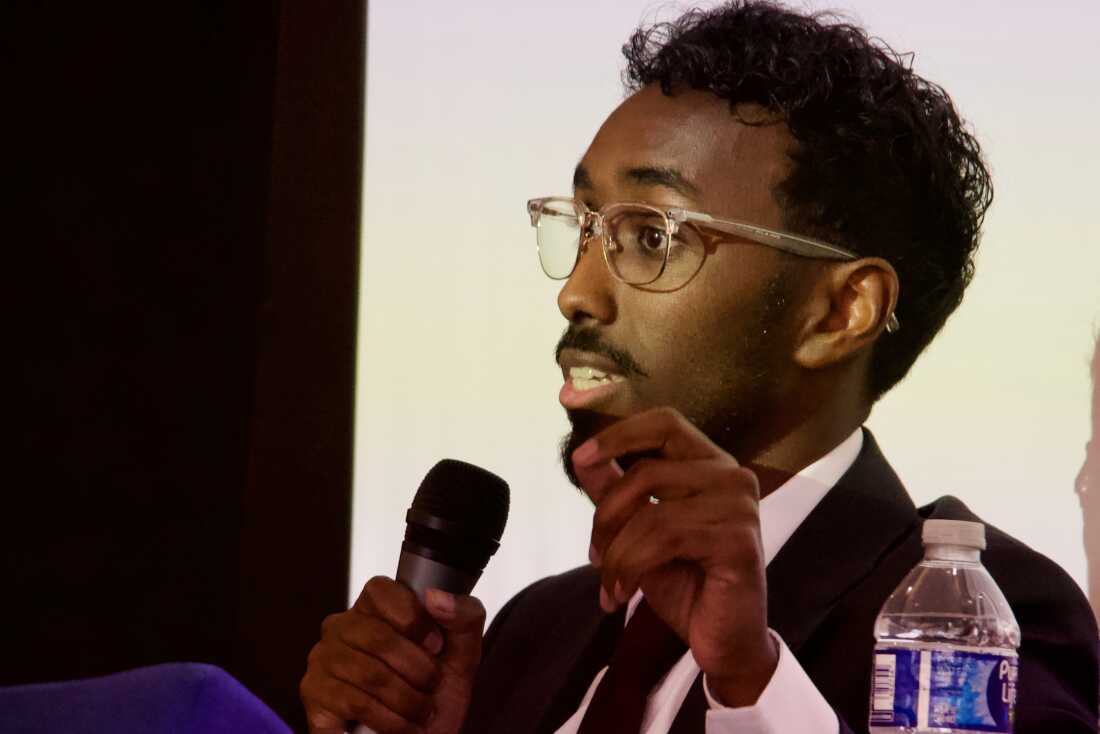
Liban Mohamed won more than 51% of the delegates at the Utah Democratic Party’s nominating convention in April, though the primary will decide the final nominee. In this file photo, Mohamed speaks on a panel of candidates running to represent Utah’s new Democratic-leaning congressional district in Taylorsville, Utah on March 21.
Hannah Schoenbaum/AP Photo/Hannah Schoenbaum/AP
hide caption
toggle caption
Hannah Schoenbaum/AP Photo/Hannah Schoenbaum/AP
Why Utah’s race matters nationally
The new district is the biggest opportunity Utah Democrats have ever had for Congressional representation, especially when the majority margin in Congress is miniscule.
“We have the ability to add to the body and the Democrats in the House of Representatives in a way that may swing that chamber back to Democratic control,” said Brian King, the chair of the Utah Democratic Party.
It’s also a pocket of blue energy during a time when excitement for the national Democratic party is low. The moment the district was solidified, King said candidates were immediately jumping in the race and participation at the Utah Democratic Convention hit a record turnout.
He said Utah is a successful example of why the national party should be investing in flipping red states and not just focusing on purple districts and areas they know they can win.
“Democrats, if they’re going to be successful across this country, they have to figure out how to speak, to reach and change the hearts and minds of voters in red areas,” he said.
Democratic factions on display

Former Rep. Ben McAdams, seen here in a campaign photo, argues the new district isn’t as blue as its rating might suggest and that a more moderate, pragmatic lawmaker makes sense.
Ben McAdams for Congress
hide caption
toggle caption
Ben McAdams for Congress
The candidate with the most name recognition is former Rep. Ben McAdams. In 2018, McAdams flipped a purple district when he beat a Republican incumbent.
While he’s widely considered a moderate, he calls himself a “pragmatic” Democrat that is keen on working across the aisle to get stuff done.
“I’m a candidate who can bring people from across the spectrum and rally them together and win tough elections. I’ve won tough elections before,” McAdams told NPR. “I’m somebody who has built coalitions to tackle some of our most difficult issues.”
He’s also presented by his opponents as the safe establishment choice. There have been questions about whether McAdams is too moderate for such a safely blue district. During his time in Congress, one analysis tagged him the most conservative Democrat in the caucus.
But McAdams believes the district isn’t as blue as people think it is. There is a significant percentage of Republicans and independents in the district. He is targeting those voters as well.
“Democrats aren’t going to win this district by appealing only to Democrats. We’re going to have to build a bigger coalition. We’re going to have to bring in the independents and unaffiliated. We’ll even have to bring in some Republicans,” McAdams said. “That’s the nature of the way things are in Utah.”
What voters want
Knocking on doors in a neighborhood right outside of Salt Lake City, state Sen. Nate Blouin made his case to voters as to why he should represent the new solidly blue congressional district in deep red Utah.
“I’m a progressive Democrat really focused on addressing people’s real material concerns,” Blouin told a prospective constituent who disclosed their loved one was battling cancer. “We’ve got to take on the big money in politics and actually find ways to reinvest in our communities. You know, affordable housing [and] Medicare for all are big proposals that I’m going to fight for in D.C.”

Utah state Sen. Nate Blouin is endorsed by Sen. Bernie Sanders and says his progressive message will win over Democratic voters. Before April’s nominating convention, Blouin, here in a campaign photo, was seen as the main challenger to McAdams.
Nate Blouin for Congress
hide caption
toggle caption
Nate Blouin for Congress
Blouin gained a reputation for being a rabble rouser during his time in the Utah state legislature as a vocal critic of controversial conservative legislation. But being outspoken can also backfire on him. More than a decade ago, he made lewd, disparaging remarks online about Latter-day Saints, the predominant religion in Utah, and sexual assault victims. Blouin has since apologized for his comments.
Meanwhile, 27-year-old political newcomer Liban Mohamed has gained an enormous amount of momentum after he won 51% of the delegate vote at the Utah Democratic convention. He’s the son of Somali immigrants. While the delegate win is important, the party will decide its candidate in Tuesday’s primary election.
Mohamed quit a job at TikTok where he lobbied against the U.S. ban of the social media platform and made the decision to run for office. Mohamed considers himself a progressive but has been called a Democratic Socialist over his political priorities.
“I’m focused on a platform to educate and advocate for the things that are going to help people have a roof over their head after working long hours, to be able to afford their health care, to be able to not have to choose between their paycheck or the well-being of their child,” Mohamed told NPR. “Most people might call this democratic socialism, progressive politics. I call it a working class, focused politics, people-centric politics.”
The fourth candidate on Tuesday’s ballot is another progressive, tax attorney Michael Farrell.
What the primary election outcome can message to the party
With both Blouin and Mohamed on the ballot, plus Farrell, there is a good chance the progressive vote will split, handing the victory to McAdams. But if both candidates combined win 50% or more of the vote, Damon Cann, the Utah State University political science professor said that is a persuasive argument about the direction Democratic candidates should be heading in the area.

“It would be wise for future candidates to read this as a matter of a majority of the district looking for a more progressive option,” Cann said. “It’s really just the field of candidates and the way votes broke down among them that led to this particular election outcome.”
Since the candidates are articulating different goals and ambitions, Cann said it signals the broad spectrum of what it means to be a Democratic in the U.S.. It can also inform the direction, the tone and policy priorities of the national Democratic Party.
In Utah, Cann believes the race in the 1st Congressional District lays out the choice facing Democrats across the country: whether voters want a party that will stand its ground on policy priorities, even if that means the needle doesn’t move quickly, or a party that aims for collaboration — even if that means compromise.

President Trump did not provide evidence that vandals damaged the Reflecting Pool. The $14 million renovation marked the latest in his efforts to beautify Washington, D.C.
(Courtesy CNN)
Courtesy CNN

(Courtesy CNN)
Courtesy CNN
(Courtesy CNN)
Courtesy CNN
(Courtesy CNN)
Courtesy CNN
(CNN) — President Donald Trump claimed Saturday, without providing evidence, that vandals damaged the algae-plagued Reflecting Pool on the National Mall and that the water will need to be drained for repairs.
Trump said police arrested “many additional people” for the vandalism, though one told CNN he was merely touching a piece of partially detached blue material from the recent renovation.
A senior administration official said police arrested five people for vandalism and issued federal citations to five others. The official said there were 14 police reports over vanadlism including for an alleged incident where a more than 250-foot section was cut with a blade.
“The Reflecting Pool was never so beautiful as it was just one week ago,” Trump said, adding that it will repaired quickly. Trump’s recent renovation, totaling $14 million, marked the latest in the president’s efforts to beautify Washington, DC, with architectural changes that have included building a White House ballroom and refurbishing run-down fountains.
Now, what was meant to be a straightforward task to return the century-old pool to its intended glory ahead of America’s 250th anniversary has become a spectacle, drawing tourists and locals to the pool for the wrong reason.
Three-time US Olympian David Hearn told CNN that police arrested him Friday after he said he touched a flap of blue material partially detached from the bottom of the pool. Hearn, who says he has a background in material science, told CNN he checked it out following a bike ride after reading reports of algae in the water and paint or sealant peeling off the bottom.
Hearn said he was curious about a partially attached blue flap he saw at the bottom of the Reflecting Pool. Upon reaching into the water, Hearn said he “sort of felt the end” and “bent it around a little bit.”
Hearn said a US National Park Service staffer instructed him not to reach into the water. After Hearn returned to his bike, he said was soon encountered by National Guard members and eventually arrested by the US Park Police. He said he was charged with destruction and defacing government property and disobeying a government employee.
The Olympic canoeist denied vandalizing the Reflecting Pool and said his actions were that of a “curious citizen.”
“There’s nothing about the Reflecting Pool that was in any different condition after I left there than it had before I went by there yesterday. I didn’t remove anything. I didn’t break, tear, peel, or rip, or destroy anything,” Hearn said Saturday.
He is set to appear in court on July 9. CNN has reached out to the US Park Police and the National Park Service to ask about Hearn’s account and for information on any other arrests.
Pet project for the president
Earlier this year, the president described the Lincoln Memorial Reflecting Pool as “absolutely filthy,” vowing to clean up the landmark and make it “look gorgeous, beautiful” so it reflects the federal monuments around it.
But with the Fourth of July and America’s 250th anniversary fast approaching, the pool that sits near the feet of Abraham Lincoln’s statue has instead come to reflect the deep divisions over those beautification efforts — and Trump’s presidency itself.
Trump on Friday first echoed claims that surfaced in right-wing circles that the pool’s broader problems are a result of vandalism, and linked it to the etching of “8647” into the grass on the National Mall days prior, adding that law enforcement is investigating.
“We’ve had some real problems with Vandalism at the beautiful Reflecting Pool,” Trump wrote on Truth Social, without citing evidence. He said the algae was “75% gone” and the “vandalized” area will be fixed early next week.
Tourists and local residents alike have flocked to the site in recent days, shooting video of the murky green water for social media posts that feature either a condemnation of Trump’s presidency or a passionate defense of the effort to clean up DC. Some peeled off strips of the blue material to take as souvenirs. Others filmed federal workers pouring bottles of hydrogen peroxide into the water.
The Interior Department has dismissed the visible signs of algae that have only become more abundant as DC’s warm, muggy weather fosters its growth. In a post on X Wednesday, the department’s press office touted its efforts to clear out the algae and described the water as being “crystal clear.”
CNN has reached out to the Interior Department for comment and additional details on the cleanup efforts.
Trump set out in late March to accomplish the renovation that has eluded previous presidents. In a post on Truth Social, he criticized the Biden administration for not taking on the project after a $34 million reconstruction effort under President Barack Obama proved unsuccessful.
In the weeks that followed, Trump expanded the scope of the project and ordered cosmetic changes, including painting the bottom of the pool “American flag blue.” The paint change immediately sparked a lawsuit from a nonprofit group, which argued the project violated federal laws requiring the Interior Department to complete a consultation process before beginning the work.
The president also wanted the project to be complete before July Fourth, an expedited timeline that the administration acknowledged drove up the cost — nearly seven times as much as the initial estimate of $1.8 million.
Trump made a visit to the site to survey progress, and weeks before it was complete, he began celebrating by posting an AI-generated image to Truth Social of him and some of his Cabinet members smiling while floating in the pool.
‘Residual algae’ woes
But just a day after the reservoir was filled with water, algae was already visible from the water’s edge.
The Interior Department told CNN at the time that the algae was “residual” and a normal part of the early process of restarting water flow.
However, within days, clumps of algae took over the pool, prompting the administration to send in workers to vacuum it out, install a filtration known as the “ozone nanobubbler” and dump in gallons of hydrogen peroxide.
To make matters worse for the Trump administration, earlier this week, blue material at the bottom of pool began peeling off. It is unclear whether the material is paint or sealant or what caused it to come up.
Democrats online were quick to gloat.
“You can’t make this up: after railing about waste, fraud, and abuse, the Trump Administration spent $14 million on a reflecting pool reno that’s now peeling and chock full of algae,” Democratic Sen. Jeff Merkley of Oregon said in a post on X. “I’m pressing to get answers for this embarrassing waste of resources.”
Beyond lawmakers, the pool saga has prompted an online debate, filled with false claims and conspiracy theories.
Left-leaning social media users latched onto a clip of a Fox News personality defending the renovation, incorrectly claiming that he was describing the visibly green water as blue. (He was referring to the pool’s bottom.)
Meanwhile, conservative media personality Grant Stinchfield alleged the excessive algae is a product of liberal “sabotage.”
“Is it nefarious? I tend to think so,” Stinchfield told his online viewers from outside the Reflecting Pool.
A video posted by conservative influencer Nick Sortor on Thursday night has also garnered attention. The video appeared to show “8647” traced into the algae at the bottom of the pool. CNN could not independently see that tracing on Saturday. When used as slang, the number 86 can refer to getting rid of or tossing something out. Trump is the 47th president. The phrase has recently been used to signal opposition to Trump.
Outside the pool, a collection of curiosity seekers and social media influencers have also gathered. One woman showed up with a banner painted with a green “Algae” as she chanted, “Algae’s smarter than MAGA.”
Matthew Weimer of California, who was in Washington, DC, to visit friends, applauded the renovation.
“I think it’s pretty great that somebody cared enough to do something about it,” Weimer said. When asked about criticisms over the pool, he said: “The people who are criticizing, what are they doing to make things better?”
Qayla Sykes, who visited from Connecticut for a bachelorette party, made a quick stop at the National Mall to take in the spectacle.
“It looks pretty gross. I’ve taken about like 20 pictures already, especially of the people cleaning it, because I don’t know if I’ll ever see this again in my lifetime,” she said. “Hopefully not.”
The-CNN-Wire
™ & © 2026 Cable News Network, Inc., a Warner Bros. Discovery Company. All rights reserved.

The 2026 Chugwater Chili Cookoff and Rodeo celebrated its 40th anniversary last weekend, and the number of people who attended broke all previous records by a long shot. Honestly, we have never seen lines like that.
Great bands, great food, and vendors. But also the pie and hot jalapeno eating contest.
First the kids go, then the adults. An audience gathers to watch and see who will drop out first. These people are sadistic.
Here is how it goes.
The contest begins, and the contestants start eating those jalapeños like it’s nothing. They have to eat them all the way down to the stem.
After a few minutes, you’ll see their ears start to go red. Then their cheeks. Watch their next go red next. Eyes go bloodshot. They look a little tipsy at this point. When snot starts running from their nose, they are nearly done.
One at a time, they start dropping out. The audience applauds those who failed because at least they tried.
It’s gross, I know. But it’s worth watching. Because we are all sadistic like that.
There are a few who can eat all of those jalapeños without it affecting them a bit. It’s strange to watch. They don’t feel a thing. Maybe that’s a mutant power. I’m not sure.
Started in 1986, the Chugwater Chili Cook-off was created by the Chugwater Chili Corporation to celebrate the town’s legendary chili and boost the local community. Over the past four decades, it has grown from a simple local contest into Wyoming’s largest single-day event, drawing thousands of visitors.
See the gallery below including the pie eating contest.
Chugwater Chili Cookoff 2023
What a huge year for the Chugwater Chili Cookoff and Rodeo in Chugwater Wyoming.
Perfect weather, great off, awesome music, record crowd, damn fine car show, and the rodeo was a blast.
If you missed this year’s, hope to see you at next.
Gallery Credit: Glenn Woods
Chugwater’s Hysterical Pie Eating Contest.
One of Wyoming’s smallest towns added a new event. A PIE EATING CONTEST.
The rules are simple:
Not hands allowed.
Eat as much as you can before time is up.
The results are hysterical.
Gallery Credit: Glenn Woods
-
Utah3 minutes ago
Voters weigh what kind of Democrat they want for Utah’s new, blue Congressional seat
-

 Vermont5 minutes ago
The University of Vermont is struggling. Will spending $175 million for athletics help? – The Boston Globe
-

 Virginia10 minutes ago
Virginia man arrested after reported larceny in Elizabeth City
-

 Washington13 minutes ago
Trump claims vandals will force drainage of algae-plagued Reflecting Pool – WTOP News
-

 Wisconsin18 minutes ago
‘Moving Menace’ faces death investigation, 10 criminal cases in Wisconsin
-

 West Virginia25 minutes ago
2030 athlete Noel Devine Jr. talks West Virginia camp
-

 Wyoming28 minutes ago
PAIN: Chugwater Wyoming Jalapeno Eating Contest
-

 Crypto33 minutes ago
Why Lummis Says the CLARITY Act Will End the ‘Absurdity’ Facing US Software Developers

