Montana
Blanc Wins Crans-Montana Super-G, Johnson Breaks Through


Malorie Blanc / GEPA pictures
Women’s Super-G, Crans-Montana: Blanc delivers a home win as Johnson puts the Stifel U.S. Ski Team on the podium
Crans-Montana delivered the kind of bluebird Super-G day racers dream about — grippy snow, great light, and a course the women could truly attack. And attack they did, with a stunning hometown breakthrough from Switzerland’s Malorie Blanc, and a massive moment for the Stifel U.S. Ski Team as Breezy Johnson charged onto her first World Cup Super-G podium.
Top 5
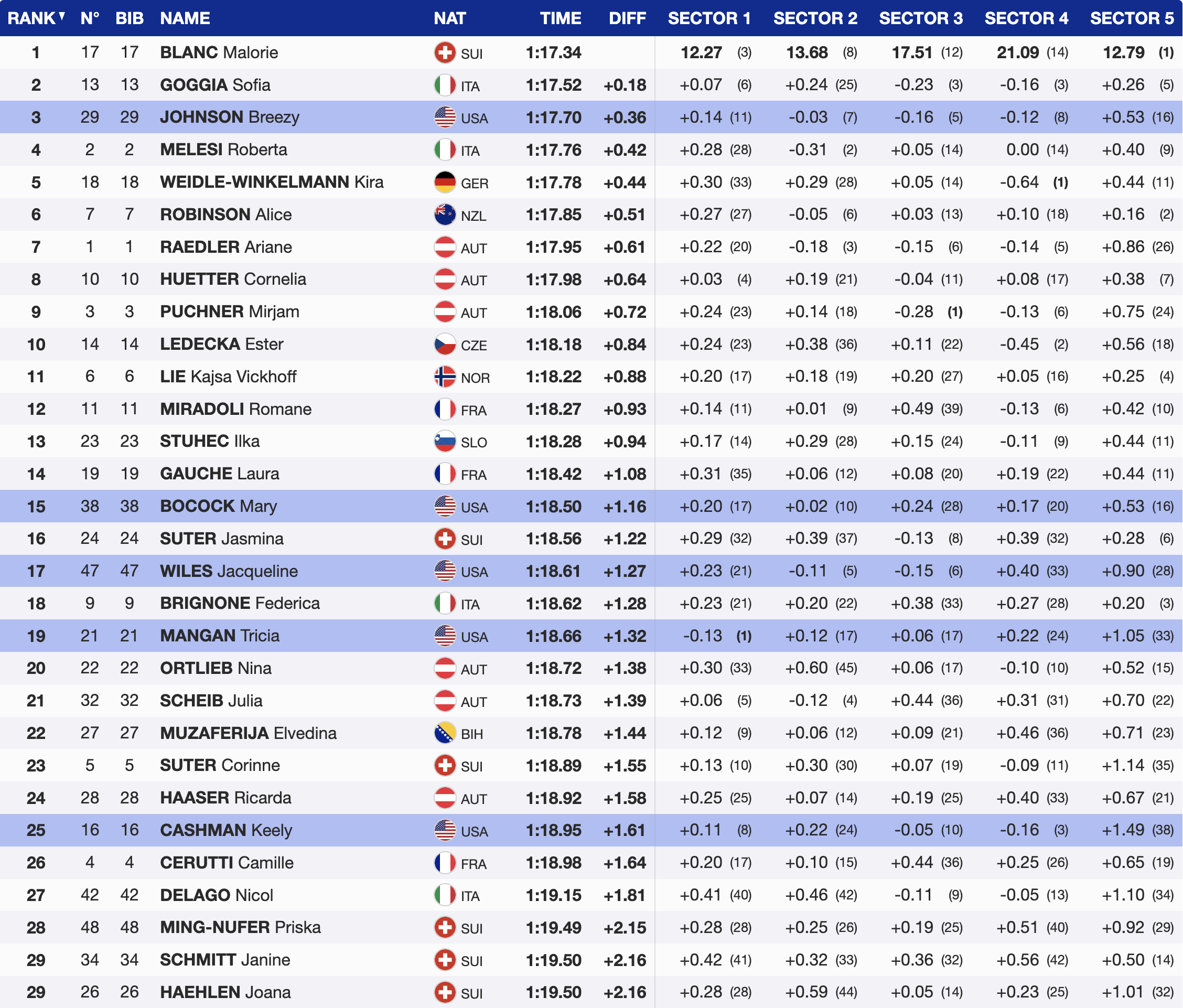
- 1st 🇨🇭 Malorie Blanc (SUI) — bib 17 — +0.00 — 2004 — Atomic
- 2nd 🇮🇹 Sofia Goggia (ITA) — bib 13 — +0.18 — 1992 — Atomic
- 3rd 🇺🇸 Breezy Johnson (USA) — bib 29 — +0.36 — 1995 — Atomic
- 4th 🇮🇹 Roberta Melesi (ITA) — bib 2 — +0.42 — 1996
- 5th 🇩🇪 Kira Weidle-Winkelmann (GER) — bib 18 — +0.44 — 1996
Top Five — Women’s Super-G Standings (entering the Olympics)
- 1st 🇮🇹 Sofia Goggia (ITA, 1992, Atomic) — 280 pts
- 2nd 🇳🇿 Alice Robinson (NZL, 2001) — −60
- 3rd 🇺🇸 Lindsey Vonn (USA, 1984, Head) — −90
- 4th 🇫🇷 Romane Miradoli (FRA, 1994) — −99
- 5th 🇨🇭 Malorie Blanc (SUI, 2004, Atomic) — −127
How the race unfolded
Austria’s Ariane Rädler opened the day by setting the first benchmark (1:17.95), but Italy quickly took control. Roberta Melesi (bib 2) tightened her line and lowered the mark to 1:17.76, immediately putting pressure on the early favorites.
The first major threats followed quickly. Kajsa Vickhoff Lie couldn’t unseat the then-leader and skied into the finish +0.46 at the time, while Alice Robinson — still searching for her best top-end speed — came close, just +0.09 back. As the race unfolded, Robinson would eventually slide to sixth (+0.51).
Then the race turned dramatic. Italy’s Elena Curtoni (bib 8) went down and did not finish, another major contender erased. Soon after, Germany’s Emma Aicher (bib 12), the Tarvisio Super-G winner, crashed in the same turn that ended Lindsey Vonn’s downhill day. Aicher was able to get up and ski to the finish.
Italy’s speed queen answered next. Sofia Goggia (bib 13) grabbed the advantage early, gave time back through the middle, then re-attacked with trademark aggression to take the lead by 0.24, lighting up the timing board with her on-the-limit style.
While Vonn appeared on the start list — a sign her team believed there was a chance — it remained a game-day decision. In the end, she did not start as she continues to recover from Friday’s downhill crash.
The emotional center of the race was also at the top. Federica Brignone racing a Super-G was a significant moment — her first speed discipline start since last spring’s injury. She skied solidly, finished safely (18th, +1.28), and took another encouraging step as she builds toward Cortina.
Blanc shocks the field in front of her home crowd
Then the stadium erupted.
Switzerland’s Malorie Blanc (bib 17) delivered the run of her life in her own backyard — fast, clean, and right on the edge of control — vaulting into the leader’s chair and eventually into her first World Cup victory. With Switzerland eager for a new speed headline after losing its top Super-G skier earlier this season, Blanc’s breakthrough could not have come at a better moment.
Blanc had never stood on a World Cup Super-G podium before — and now she was winning in front of a sold-out home crowd in Crans-Montana.
“It’s incredible, and I still have a little trouble realizing it,” Blanc said. “I’ll wait until the end just to be sure it’s real. It means so much to me — to show this to my fans and to people who love skiing. I really wanted to do something great here, and I’m very thankful I could do it.”
Blanc admitted the run itself didn’t feel perfect.
“The feeling wasn’t that good on the slope,” she said. “I thought I was making some mistakes, but I just kept going. Then I crossed the finish line and heard the crowd — it was sold out — and I thought, ‘OK, maybe it’s not that bad.’ I’m just so happy.”
With the Olympic Winter Games next on the calendar — and Crans-Montana the final race before Cortina — Blanc said she isn’t looking too far ahead yet.
“I’m just living the moment,” Blanc said. “It will be my first Olympics, so I want to enjoy it and see what happens.”
Goggia continues strong season
While Malorie Blanc thrilled the home crowd with her breakthrough victory, Sofia Goggia continued her strong Super-G campaign with a second-place finish, reinforcing her momentum heading into the Olympic Winter Games.
“I’m really happy with my performance today,” Goggia said. “My January wasn’t that good, especially in downhill, but I knew this hill suited me, so I just tried to ski my best.”
Goggia said there were still areas she felt she could improve, but she was satisfied with the way she attacked the course in the final race before the Games.
“I made a mistake in the middle and didn’t carry enough speed there,” she said. “But I’m really happy with the way I’ve been attacking the race.”
Breezy Johnson makes it a Stifel U.S. Ski Team celebration
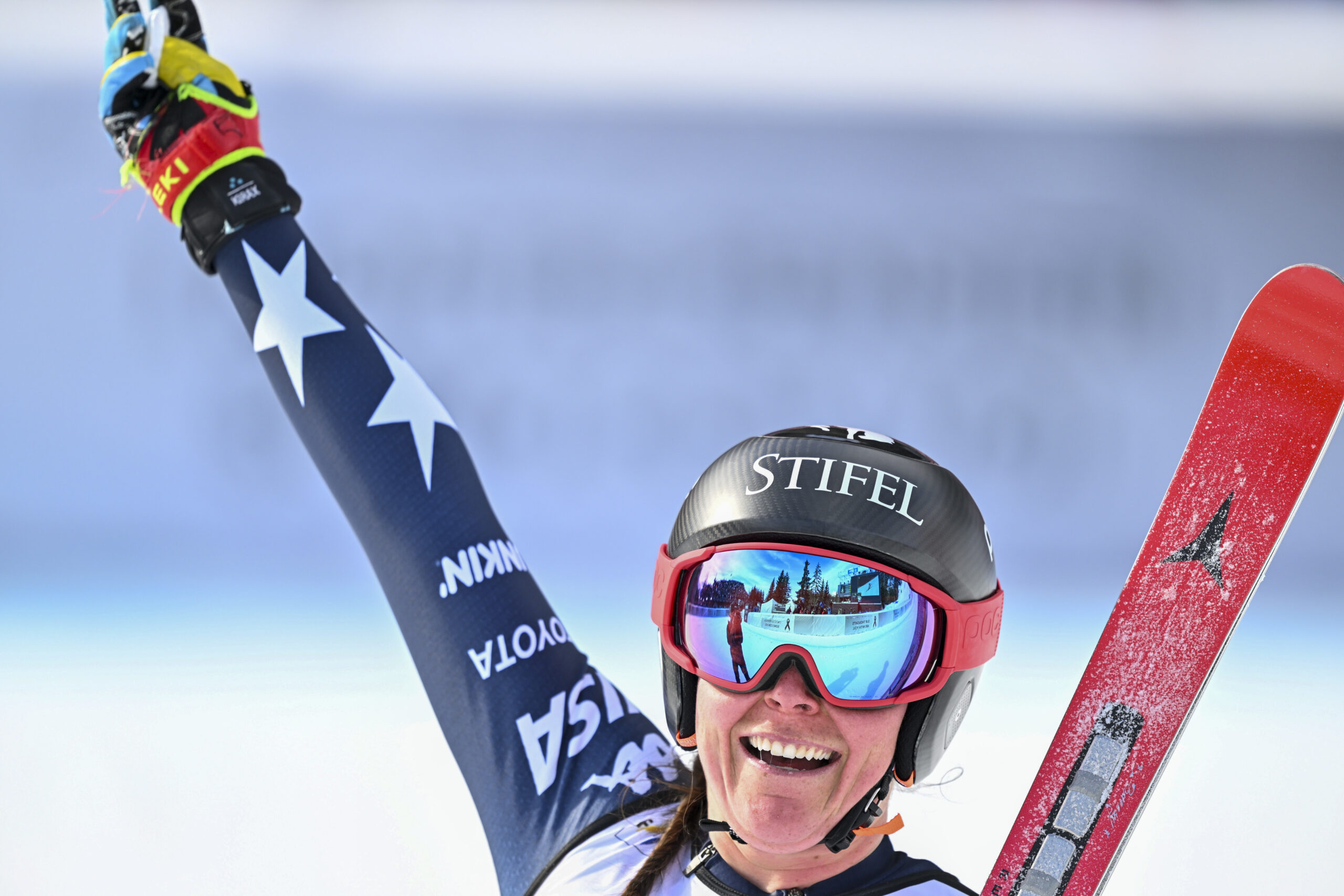
Breezy Johnson delivered one of the biggest results of her career, charging to third place (+0.36) for her first-ever World Cup Super-G podium — a huge moment for the Stifel U.S. Ski Team in the final race before the Olympics.
“I’ve been working on Super-G for a really long time,” Johnson said. “I respect Super-G — I think it’s the hardest event. I always wanted to be good at it, but I didn’t expect that run to be what got me to the podium.”
Johnson said her focus was to keep attacking even when things got messy.
“I just tried to keep it running,” she said. “Every time I made a mistake, I forgot about it and kept going.”
The run felt fast but unpredictable.
“It’s almost like downhill,” Johnson said, “but there were places where it was a little all over the place. Down at the bottom I thought I was about to straddle that gate, so that was a little crazy.”
The timing of the result mattered as much as the result itself.
“I hadn’t even qualified to race the Super-G in Cortina before today,” Johnson said. “I really wanted to race that Super-G, so I just wanted to come out and give it my best.”
Bocock builds Olympic confidence with top-15 result
For Mary Bocock, Friday’s Super-G was a meaningful step forward at exactly the right time.
“It’s very exciting, especially after yesterday was a tough day for all the girls mentally and with the conditions,” Bocock said. “I was a little nervous today, but I’m very, very happy with how it went.”
Bocock said the technical nature of the Crans-Montana course played to her strengths.
“I love this track because it’s very technical,” she said. “I’m really happy I was able to execute my plan.”
The 15th-place finish marked one of the best results of Bocock’s young World Cup career and sends her to the Olympic Winter Games with confidence.
“This is amazing because now I’m going from my best result straight into the Olympics,” Bocock said. “It gives me confidence knowing I can ski well, and Cortina can also be a pretty technical track.”
Bocock said the feedback afterward reinforced that confidence.
“They just kept saying, ‘Good job, Mary,’” she said. “They told me I looked a little loose, which I was, but also that I looked confident — and that’s always good to hear.”
More fireworks: Pirovano disqualified after leading late
Italy’s day could have been even bigger. Lara Pirovano was leading with one split to go before missing a gate just before the finish and being disqualified. Even so, the message is clear: the Italians are skiing very fast as they head toward their home Olympics.
Bibs 31+ who finished inside the top 30
- 15th ⚡ 🇺🇸 Mary Bocock (USA) — bib 38 — +1.16 — 2003
- 17th 🇺🇸 Jacqueline Wiles (USA) — bib 47 — +1.27 — 1992
- 21st 🇦🇹 Julia Scheib (AUT) — bib 32 — +1.39 — 1998
- 27th 🇮🇹 Nicol Delago (ITA) — bib 42 — +1.81 — 1996 — Atomic
- 28th 🇨🇭 Priska Ming-Nufer (SUI) — bib 48 — +2.15 — 1992 (highest bib in top 30)
- 29th 🇨🇭 Janine Schmitt (SUI) — bib 34 — +2.16 — 2000
USA skiers in the top 30
- 3rd 🇺🇸 Breezy Johnson (USA) — bib 29 — +0.36 — 1995 — Atomic
- 15th 🇺🇸 Mary Bocock (USA) — bib 38 — +1.16 — 2003
- 17th 🇺🇸 Jacqueline Wiles (USA) — bib 47 — +1.27 — 1992
- 19th 🇺🇸 Tricia Mangan (USA) — bib 21 — +1.32 — 1997 — Head
- 25th 🇺🇸 Keely Cashman (USA) — bib 16 — +1.61 — 1999 — Head
Stifel U.S. Ski Team depth: five women in the points
Beyond Johnson’s podium, it was another statement day for the Stifel U.S. Ski Team: five women scored points, a strong performance from a very strong squad. Bocock’s surge was particularly encouraging — only her second points result after the season-opening St. Moritz Super-G (the race that secured her Olympic spot), and she attacked today with unmistakable Olympic energy.

Race Results
Click on images to enlarge
Analysis of the Top Three and Other North Americans in the Top 30





The Montana Lottery offers multiple draw games for those aiming to win big.
Here’s a look at July 5, 2026, results for each game:
Winning Big Sky Bonus numbers from July 5 drawing
01-02-12-14, Bonus: 08
Check Big Sky Bonus payouts and previous drawings here.
Winning Millionaire for Life numbers from July 5 drawing
08-40-41-46-51, Bonus: 01
Check Millionaire for Life payouts and previous drawings here.
Feeling lucky? Explore the latest lottery news & results
When are the Montana Lottery drawings held?
- Powerball: 8:59 p.m. MT on Monday, Wednesday, and Saturday.
- Mega Millions: 9 p.m. MT on Tuesday and Friday.
- Lucky For Life: 8:38 p.m. MT daily.
- Lotto America: 9 p.m. MT on Monday, Wednesday and Saturday.
- Big Sky Bonus: 7:30 p.m. MT daily.
- Powerball Double Play: 8:59 p.m. MT on Monday, Wednesday, and Saturday.
- Montana Cash: 8 p.m. MT on Wednesday and Saturday.
- Millionaire for Life: 9:15 p.m. MT daily.
Missed a draw? Peek at the past week’s winning numbers.
This results page was generated automatically using information from TinBu and a template written and reviewed by a Great Falls Tribune editor. You can send feedback using this form.
Montana
10-year-old Chicago boy killed, 7 others injured in 2 separate Gary shootings minutes apart: police

GARY, Ind. (WLS) — Two separate shootings that happened minutes apart overnight left a child dead and at least seven others injured in northwest Indiana, police said.
Gary police said officers responded to reports of shots fired in the area of 19th Avenue and Hanley Street around 12:34 a.m. Sunday.
ABC7 Chicago is now streaming 24/7. Click here to watch
While officers were responding, they were told multiple victims had arrived at Methodist Northlake Hospital. Six people self-transported to the hospital, and their conditions were not immediately known.
Minutes later, around 12:49 a.m., officers started heading to the 200-block of Chase Street, about 4 miles away from the first scene, for a report of a gunshot victim. While on their way, officers learned that a 10-year-old boy and a 50-year-old man had been shot and went to Methodist Northlake Hospital.
The 10-year-old boy was pronounced dead at the hospital. The Lake County, Indiana Coroner’s Office identified him as Montana Weathers, of Chicago.
The 50-year-old man was transported to another Chicago-area hospital, where he remains in critical condition.
Police asked anyone with information on the 19th Avenue and Hanley Street shooting to contact Detective Corporal Melendez at 219-881-1209.
Police asked anyone with information on the Chase Street shooting to contact Detective Salazar with the Lake County Prosecutor’s Homicide Task Force at 219-755-3720.
Further information was not immediately available.
Copyright © 2026 WLS-TV. All Rights Reserved.

BOZEMAN, Mont. — The Bozeman Police Department received a report of a vehicle versus motorcycle collision on July 3 around 10 p.m.
The crash happened on Frontage Road and the westbound on ramp to Interstate 90.
Officials say officers and bystanders attempted lifesaving efforts on a motorcyclist who was seriously injured.
The motorcyclist was pronounced dead at the scene.
Preliminary findings indicate a Jeep was traveling eastbound on Frontage Road when the driver made a left-hand turn trying to enter the westbound I-90 on-ramp when the driver did not see the dirt bike.
Officials say there was no forward-facing headlamp or other lighting illuminated on the dirt bike, investigators examined the dirt bike for evidence of lighting equipment and found none.
According to a press release, there is no indication that the driver of the Jeep was impaired, and they are cooperating with the investigation.
The incident is currently under investigation.
-
North Dakota9 minutes ago
ND ATTORNEY GENERAL TO RELEASE 2025 CRIME STATISTICS – North Dakota Attorney General
-

 Ohio11 minutes ago
Veteran Officer Among 4 Dead in Ohio Shooting
-

 Oklahoma17 minutes ago
FFA members attend Oklahoma FFA Alumni Leadership Camp
-

 Oregon24 minutes ago
Oregon’s Class Surges in Team Recruiting Rankings to No. 3
-

 Pennsylvania27 minutes ago
Pennsylvania State Police on scene of ‘active incident’ in Marysville
-

 Rhode Island32 minutes ago
Rhode Island participates in ‘New England Drive to Save Lives’ campaign
-

 South-Carolina39 minutes ago
Georgetown County Sheriff Carter Weaver named South Carolina Sheriff of the Year: SCSA
-

 South Dakota41 minutes ago
South Dakota native lived near Iranian missile & drone attacks

