West
Crop-rich California region may fall under state monitoring to preserve groundwater flow

California might step in to regulate groundwater use in part of the crop-rich San Joaquin Valley, which would be a first-of-its-kind move that comes a decade after lawmakers tasked local communities with carefully managing the precious but often overused resource.
At issue is control over a farming-dependent area where state officials say local water agencies haven’t come up with a strong enough plan to keep the water flowing sustainably into the future. The State Water Resources Control Board will hold a hearing Tuesday to decide whether to place the region under monitoring, which would mean state, not local, officials would temporarily watch over and limit how much water could be pumped from the ground.
CALIFORNIA CONSIDERS ADDING TREATED WASTEWATER TO DRINKING SUPPLY THROUGH NEW PROPOSAL
“It’s a huge deal,” said Dusty Ference, executive director of the Kings County Farm Bureau, which represents regional farmers. “What you gain in having local control is the ability to build groundwater recharge projects and some flexibility with how water is used and moved and traded or not.”
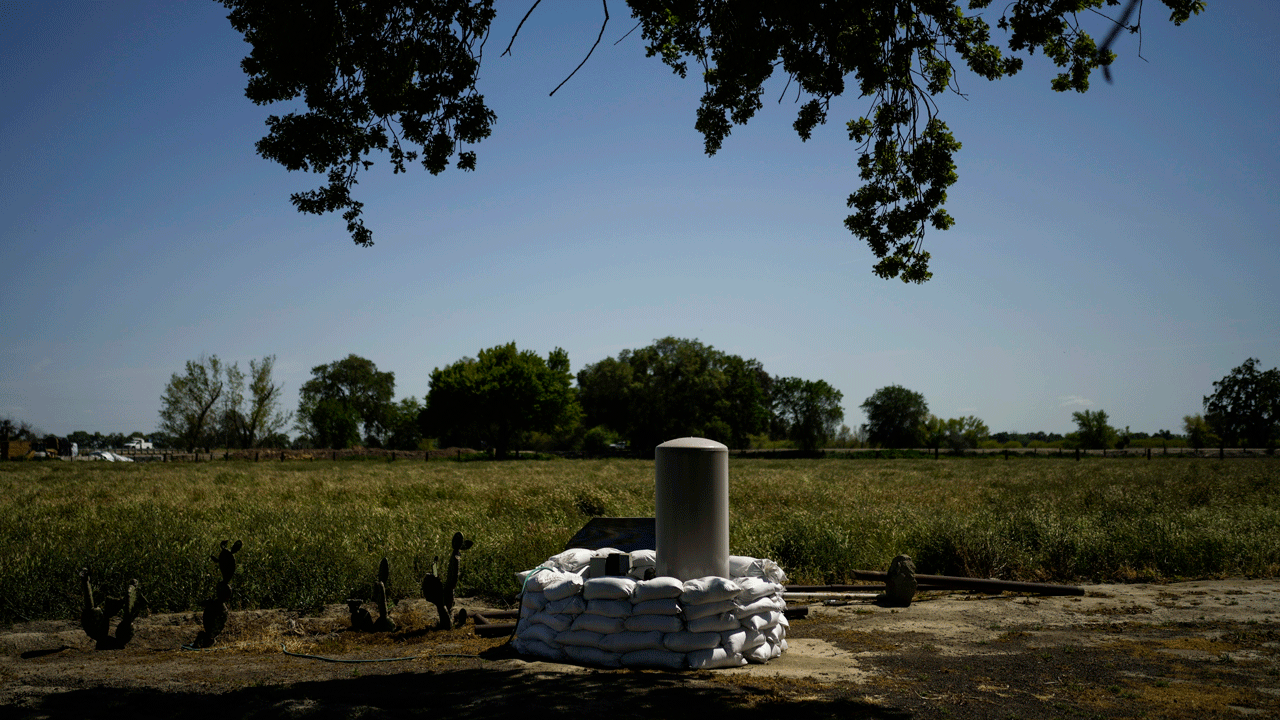
Sandbags are stacked around a well in anticipation of flooding of the Kings River in the Island District of Lemoore, Calif., April 19, 2023. California officials are considering whether to take over monitoring groundwater use in the fertile San Joaquin Valley under a landmark law aimed at protecting water flow to homes and farms. The Tuesday, April 16, 2024, hearing before the State Water Resources Control Board is the first of its kind since California passed a groundwater management law a decade ago. (AP Photo/Jae C. Hong)
Ference said the state board wouldn’t have the local expertise or staff to do this.
“It will just be, ‘Here’s the pumping amount we authorize. Do with it what you can.’”
The hearing is seen as a test of how California’s groundwater rules are working 10 years after lawmakers passed them. The limits came after years of overpumping and drought led to a host of problems ranging from residential wells running dry to sinking land. The goal was to make the most critically overdrafted groundwater basins sustainable.
Communities have since formed groundwater sustainability agencies and drafted management plans. In the Tulare Lake Subbasin, five local agencies worked on a single proposal, only to see it rejected last year by the state Department of Water Resources over concerns about lowering groundwater levels, sinking land and degrading groundwater quality.
If the state water board steps in after Tuesday’s hearing, officials could require anyone who extracts more than a minimal amount of groundwater to report how much they take and pay fees for it. The state could also require larger pumpers to install and use meters that measure water use.
The Tulare Lake Subbasin covers a stretch of Kings County, which is home to about 150,000 people halfway between Los Angeles and San Francisco. The county is a major producer of milk, pistachios, cotton and processed tomatoes, according to a county agricultural report.
It’s also home to Tulare Lake, a large, dry basin that fills with water in rainy years. The lake most recently reappeared in 2023 after intense winter downpours that flooded farms and roads.
Doug Freitas, an almond grower who owns property in areas governed by three different groundwater agencies, said each agency has been talking about what to do next. He said he knew about the state’s groundwater law, but like most small farmers, he was so busy trying to make ends meet that he couldn’t foresee the impact.
“As a farmer, my opinion is we need more time,” Freitas said. “I would like to go to that meeting and beg for mercy and ask for them to let us come back to the table.”
One of the agencies, the Mid-Kings River Groundwater Sustainability Agency, proposed an April 23 vote on charging landowners fees and limiting pumping. The move has met with some resistance, and agency director Dennis Mills recently told residents something must be done if they want to try to keep the state from stepping in.
“They will not accept more promises at this point,” Mills said. “Just a revised plan is not good enough. They need to see concrete steps as to how we’re addressing these things.”
Then there are people like Joaquin Contente, a longtime dairy farmer in Kings County, who said pumping fees and caps spell trouble for him, whether they are imposed by local or state officials. He relies on groundwater to grow the alfalfa he feeds his 800 cattle.
“I know there’s a lot of people losing sleep over it, because I am one of them,” Contente said.
Ference, the farm bureau director, said he supports local control so that farmers can have a say in what happens and communities can invest in local recharge projects.
“This is a community, countywide issue that, if it’s not managed properly, will be catastrophic,” he said.
Read the full article from Here


Whether four-star 2028 prospect King Pitts has an offer from the Washington Huskies as an offensive lineman or an athlete, he’s firmly on Jedd Fisch and the Washington Huskies coaching staff’s radar.
The 6-foot-5, 255-pound two-way lineman is back in his native Hawaii and set to play his junior season at Kapa’a High School after playing at Cardinal Newman in California, after establishing himself as a national recruit during his sophomore year as an offensive tackle and versatile defensive lineman.
The No. 241 overall recruit—according to the 247Sports Composite—Pitts holds 43 total scholarship offers with two years still left of high school football.
As a defensive lineman, Pitts can play either defensive tackle or defensive end with his ability to be a disruptive force against the run and pass. Whichever position the Islands product ends up playing at the next level, there isn’t a question of if, but how well he’ll hold up against Big Ten and SEC-caliber talent.
UW hasn’t ventured heavily into recruiting Hawaii as much recently as the football program has in previous decades. Aside from signing tight end Kekua Aumua in the 2026 class, who began and finished his prep career at Kahuku after transferring to IMG Academy in Bradenton, Florida, for his junior season, Fisch has only signed one other prospect from Hawaii, Mililani quarterback Treston Kini McMillan in 2025.
Over the years, the Huskies have featured several notable recruits from the Islands, including defensive tackle Faatui Tuitele in 2019 and a pair of edge rushers, Zion Tupuola-Fetui in 2018 and Hau’oli Kikaha in 2010.
If Fisch and Co. can get the coveted two-way lineman on campus for at least one, if not multiple, unofficial visits over the course of the next 12 months, UW should be a major factor in Pitts’ recruitment long-term.
From chart-topping bands and Broadway stars to comedians and inspirational performers, live entertainment has become a valued part of the BYU-Idaho experience. Brigham Young University-Idaho is pleased to announce the rebranding of its long-running Center Stage series as BYUI Live!—a new name that reflects the university’s vision to create memorable live entertainment experiences that bring BYU-Idaho students and the surrounding community together.
For decades, Center Stage has welcomed exceptional performers to campus, building a tradition rooted in the fine arts. As the series has evolved to include nationally recognized artists such as OneRepublic, Andy Grammer, and Brett Young, the need for a brand that better reflects the breadth of today’s programming became clear.
“BYUI Live! better represents what we’re trying to create,” said Tanner Christensen, who oversees the university’s live guest entertainment series. “Our goal is to bring people together through memorable experiences in our amazing venues at BYU-Idaho. We are excited to bring the community the best entertainment in the industry that the entire family can enjoy.”
BYUI Live! is designed to be more than just a series of concerts or performances. Each event is an opportunity for students, families, and friends, to spend an evening together on campus—enjoying food, activities, and community before gathering for an unforgettable live show.
The new brand launches alongside an exciting lineup of upcoming events. BYUI Live!’s first performance will feature two-time Grammy Award-winning artist Lauren Daigle on Friday, September 18 at the BYU-Idaho Center. Guest artists for the university’s annual Christmas production and other upcoming performances will be announced in the coming weeks.
While the name is changing, the mission remains the same: “to provide uplifting, high-quality entertainment that enriches the student experience, strengthens community, and creates lasting memories.”
For upcoming events and ticket information, visit BYUI Live!’s new website www.byui.edu/live
For media inquiries, please email Tanner Christensen at live@byui.edu

Where Khloe Kardashian Stands With Ex French Montana More Than 10 Years After Breakup
French Montana is done keeping up with reality TV.
In fact, he only agreed to appear on Keeping Up With The Kardashians and Kourtney & Khloé Take the Hamptons over a decade ago as a favor to then-girlfriend Khloe Kardashian.
“She said to get on the show,” he exclusively told E! News at the BET Awards on June 28. “And I got on the show. Shout out to Khloe.”
The “Ever Since U Left Me” rapper, who split with Kardashian in December 2014 after eight months of dating, said the experience was “fun” because her family kept it real.
“They filmed their real life,” he continued. “And we were part of something together that one time. So it felt great. It didn’t feel like work because they film what they do everyday.”
As for his future in reality TV, the 41-year-old said those days are over, shutting down any prospective offers with a simple, “Negative.”
Although the “Unforgettable” artist—whose real name is Karim Kharbouch—may not be returning to television anytime soon, he has no problem hanging out with his ex-girlfriend these days.
-
 Connecticut12 minutes ago
New CT laws taking effect July 1: Absentee ballots, zoning, AI
-

 Delaware17 minutes ago
State Police Investigating Shooting in Newark – Delaware State Police – State of Delaware
-

 Florida24 minutes ago
10 places to watch the fireworks in South Florida for 4th of July 2026
-

 Georgia27 minutes ago
Bottoms wants Georgia to meet its universal pre-K pledge | Chattanooga Times Free Press
-

 Hawaii32 minutes ago
Washington Football Pursuing Coveted 2028 Four-Star Hawaii Athlete
-
Idaho39 minutes ago
BYU-Idaho Launches BYUI Live! as New Name for Campus Entertainment
-

 Illinois42 minutes ago
‘A real farm crisis’: Illinois farm bankruptcies rise for 3rd straight year
-

 Indiana47 minutes ago
Carroll and Clinton fairs join food drive to help local food banks

